Stakeholder management is the work of finding everyone who can affect your project, or who will feel its results, and keeping the right people involved at the right level. For the PMP exam you need to know the four stakeholder processes: Identify Stakeholders, Plan Stakeholder Engagement, Manage Stakeholder Engagement and Monitor Stakeholder Engagement. The big idea is simple: telling people things is communication, but changing how they feel about the project is engagement. Most of the real work happens in conversations, not in status reports.
This page is my exam-focused view of the topic: the processes, the inputs and outputs, the engagement matrix and the models PMI likes to test. If you want the practical, day-to-day version for your job, read my stakeholder management guide instead. This page is for passing the exam.
A quick note on editions. The four processes below come from PMBOK 6. In PMBOK 8, Stakeholders is one of the seven performance domains, and the exam is now built around the 2026 Exam Content Outline. The processes are still the easiest way to learn the work step by step, and the ideas behind them show up in many exam questions.
This page covers the four processes with their inputs, tools and outputs, the stakeholder register, the engagement assessment matrix, the five engagement levels, the power/interest grid, the salience model, and how all of this works in predictive, agile and hybrid projects.
Who Is a Stakeholder?: Broader Than Most PMs Think
A stakeholder is any person, group or organisation that can affect the project, is affected by it, or thinks it is affected by it. That last part matters. Someone who only believes they will be affected can still block you.
The list is longer than most new PMs expect. Inside the organisation you have the sponsor, the team, functional managers who lend you people, the PMO and other project managers who share your resources. Outside you have customers and users, suppliers, regulators, the local community, and sometimes the media. On a building project, the people living next to the site are stakeholders too.
Stakeholder Identification: A Continuous Activity
Finding stakeholders is not a one-time job at the start. New people appear as the project moves: a regulator when scope grows, a community group when the noise starts, another department when it sees the change coming. Keep scanning, and update your register every time.
Project Stakeholder Management: The 4 PMBOK Processes
Identify Stakeholders means finding the people involved and working out their interest, influence and likely impact. It sits in Initiating, but you repeat it at the start of each phase and after any big change. Its main output is the stakeholder register.
The register holds three kinds of information: who they are (name, role, organisation, contact), what they want (requirements, expectations, influence, when they care most), and how they lean (internal or external, supporter, neutral or resistor, engagement level). Everything else in this area builds on it.
Key techniques for stakeholder identification:
- Expert judgement: Drawing on the PM's and team's experience of who typically has a stake in projects of this type, combined with subject matter expertise about the project's technical and organisational context.
- Data gathering: questionnaires and surveys: Used to systematically gather stakeholder information from identified parties and to surface additional stakeholders they may identify.
- Brainstorming: Group technique to build a full first list of potential stakeholders: covering all organisational units, external parties and interest groups.
- Stakeholder analysis models: Systematic frameworks for classifying stakeholders by their attributes: power, interest, influence, impact, urgency. The Power/Interest Grid, the Salience Model and the Stakeholder Cube are all analysis models used to organise stakeholder data and inform engagement strategy.
- Meetings: Discussions with the sponsor, key team members, and initial stakeholders to identify further stakeholders and gather initial assessment information.
- Project Charter
- Business Documents (Business case)
- Project Management Plan (Communications, Stakeholder Engagement Plans)
- Project Documents (Change log, Issue log, Requirements docs)
- Agreements
- Enterprise Environmental Factors
- Organisational Process Assets
- Expert judgement
- Data gathering (questionnaires, brainstorming)
- Data analysis (stakeholder analysis, document analysis)
- Data representation (stakeholder mapping: power/interest grid, salience model, stakeholder cube, directions of influence)
- Meetings
- Stakeholder Register
- Change Requests
- Project Management Plan Updates (Requirements, Communications, Risk, Stakeholder Engagement Plans)
- Project Documents Updates (Assumption log, Issue log, Risk register)
Plan Stakeholder Engagement means deciding how you will involve each person or group. The output is the stakeholder engagement plan, which is part of the project management plan. It says how you will move each stakeholder from where they are now to where you need them.
The key tool here is the stakeholder engagement assessment matrix (explained below). It shows each person's current level next to the level you want. Where the two differ, you need a plan to close the gap.
The plan covers: the approach for each stakeholder group, how communication will support it, the key messages, timing and frequency, how stakeholders relate to each other, and how you will handle resistance.
Check your assumptions. You will assume things about people: that the finance team is fine with the budget, or that the IT director is on board. Write these down and test them. Wrong assumptions about people are one of the most common reasons engagement fails.
- Project Charter
- Project Management Plan (Communications, Resource, Risk, Scope, Schedule Management Plans)
- Project Documents (Assumptions log, Change log, Issue log, Project schedule, Risk register, Stakeholder register)
- Agreements
- Enterprise Environmental Factors
- Organisational Process Assets
- Expert judgement
- Data gathering (benchmarking)
- Data analysis (assumptions and constraints analysis, root cause analysis)
- Decision making (prioritisation / ranking)
- Data representation (mind mapping, stakeholder engagement assessment matrix)
- Meetings
- Stakeholder Engagement Plan
Manage Stakeholder Engagement is the executing process. It is the daily work: talking to people, managing what they expect, dealing with concerns as they come up, and keeping the right people involved in decisions. This is where the plan meets real life.
You will use soft skills here more than any document: active listening (really hearing the concern), influencing (getting support without formal authority), negotiation (finding a deal when interests clash) and political awareness (knowing who really makes decisions, which is not always who the org chart says).
Handling resistance: Resistance does not go away if you ignore it. It grows. Start by finding the reason. Is the person afraid of losing their job or their way of working? Do they have a real technical concern? Is it politics? Did a similar project hurt them before? Each reason needs a different response. Fix the wrong reason and nothing changes.
Use the issue log to track concerns and disagreements that need a decision. If you cannot solve one at your level, escalate it to the sponsor or steering group using the route agreed in your plan.
- Project Management Plan (Communications, Risk, Stakeholder Engagement Plans)
- Project Documents (Change log, Issue log, Lessons learned, Stakeholder register)
- Enterprise Environmental Factors
- Organisational Process Assets
- Expert judgement
- Communication skills (feedback, presentations)
- Interpersonal and team skills (active listening, cultural awareness, leadership, networking, political awareness)
- Ground rules
- Meetings
- Change Requests
- Project Management Plan Updates (Communications, Stakeholder Engagement Plans)
- Project Documents Updates (Change log, Issue log, Lessons learned, Stakeholder register)
Monitor Stakeholder Engagement checks whether your approach is working and changes it when it is not. The question you keep asking is: is each key person where I need them, and if not, what do I change?
You compare current and desired levels in the engagement matrix again. If someone who was supportive starts drifting towards neutral, find out why and adjust. People's views change as the project moves and as its impact on them becomes clear.
Data analysis techniques:
- Alternatives analysis: Evaluating different engagement strategies when current approaches are not achieving desired engagement levels.
- Root cause analysis: Investigating why a stakeholder's engagement level is declining or why a particular engagement strategy is not working.
- Stakeholder engagement assessment matrix: Comparing current vs desired engagement levels to identify where strategies need to be intensified or revised.
Outputs include change requests (to update the engagement or communications plan), updated documents (mainly the stakeholder register and issue log) and work performance information that shows where engagement stands.
- Project Management Plan (Resource, Communications, Stakeholder Engagement Plans)
- Project Documents (Issue log, Lessons learned, Project communications, Risk register, Stakeholder register)
- Work Performance Data
- Enterprise Environmental Factors
- Organisational Process Assets
- Data analysis (alternatives analysis, root cause analysis, stakeholder engagement assessment matrix)
- Decision making (multi-criteria decision analysis)
- Data representation (stakeholder engagement assessment matrix)
- Communication skills (feedback, presentations)
- Interpersonal and team skills (active listening, cultural awareness, leadership, networking, political awareness)
- Meetings
- Work Performance Information
- Change Requests
- Project Management Plan Updates (Communications, Stakeholder Engagement Plans)
- Project Documents Updates (Issue log, Lessons learned, Risk register, Stakeholder register)
What are the five stakeholder engagement levels?
PMBOK uses five engagement levels, from opposing the project to leading it: Unaware, Resistant, Neutral, Supportive and Leading. You rate each stakeholder's current level, decide the level you need, and plan around the gap.
The Stakeholder Engagement Assessment Matrix
The matrix puts each stakeholder's current (C) level next to the desired (D) level. If C and D are different, you need a strategy to close the gap. If they match, keep doing what you are doing.
| Stakeholder | Unaware | Resistant | Neutral | Supportive | Leading |
|---|---|---|---|---|---|
| Project Sponsor (Dir. Operations) | C/D | ||||
| IT Director | C | D | |||
| Finance Manager | C | D | |||
| End User Community Lead | C | D | |||
| External Regulator | C/D | ||||
| Procurement Manager | C | D |
C = Current level · D = Desired level · C/D = Current and desired are aligned
How to read it: The IT Director is Resistant but you need them Supportive. That is a big gap, so find out what is behind the resistance before you do anything else. The Finance Manager is Neutral and needs to be Supportive, so show how the project helps their numbers. The Procurement Manager is Unaware and needs to be Supportive, which is urgent because buying starts soon. The regulator stays Neutral, and that is correct. You do not need a regulator cheering for you, only treating you fairly.
Stakeholder Analysis Models
The Power/Interest Grid
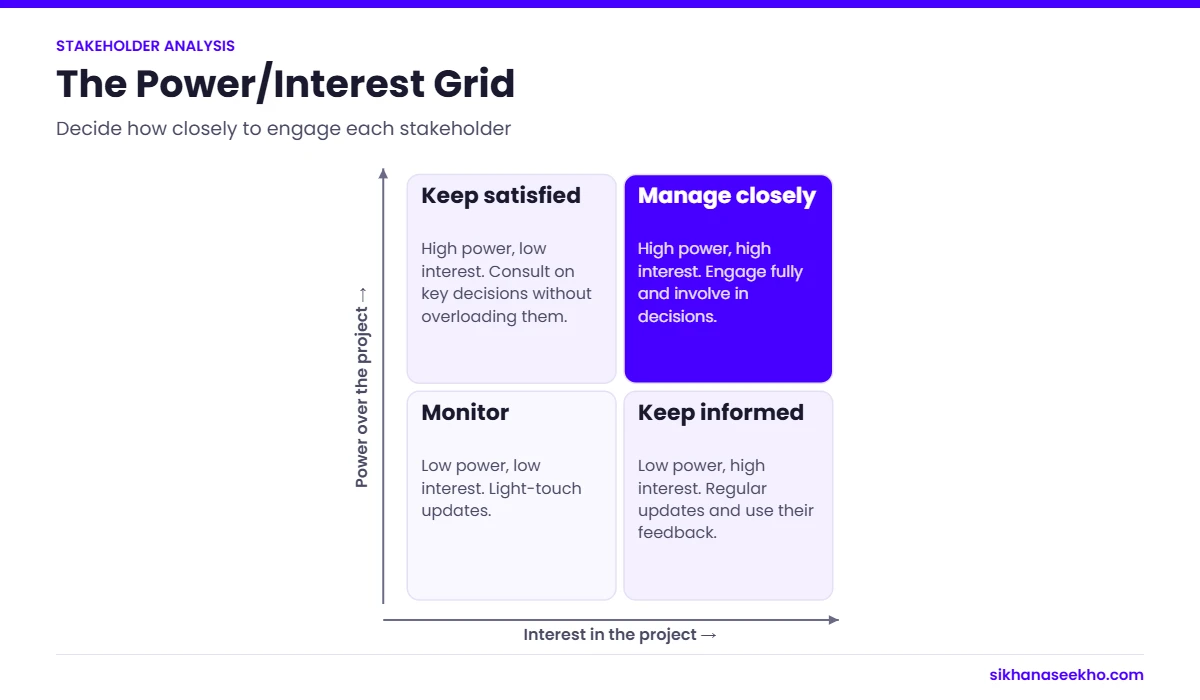
The power/interest grid is the tool you will see most. It places each stakeholder by power (can they change decisions or outcomes?) and interest (how much do they care?). The four boxes tell you how to treat them: manage closely, keep satisfied, keep informed, or monitor.
What is the salience model?
The salience model (Mitchell, Agle and Wood, 1997) uses three attributes: power, legitimacy (is their claim valid?) and urgency (do they need attention now?). People with all three need your attention first.
It gives seven types: Dormant (power only), Discretionary (legitimacy only), Demanding (urgency only), Dominant (power and legitimacy), Dangerous (power and urgency), Dependent (legitimacy and urgency) and Definitive (all three). For the exam, remember that Definitive stakeholders come first. You can also download my free stakeholder register template to practise.
The Stakeholder Register: What It Contains
The register is the main stakeholder document, and it is a living one. You start it at initiation and keep it up to date until closure. Roles change, interest changes, people leave. If your register still shows the names from month one, it is out of date.
| Stakeholder | Role | Power | Interest | Attitude | Current Engagement | Desired Engagement | Key Concerns |
|---|---|---|---|---|---|---|---|
| Sarah Chen | Project Sponsor (Dir. Operations) | High | High | Supportive | Supportive | Leading | Delivery on schedule; board visibility |
| James Abbott | IT Director | High | Medium | Resistant | Resistant | Supportive | Resource impact on BAU IT; data security |
| Finance Team | Budget Stakeholder | Medium | High | Neutral | Neutral | Supportive | Cost controls; budget reporting accuracy |
| End Users | Primary Beneficiary | Medium | High | Supportive | Supportive | Leading | Usability; training; transition support |
| Regulator | Compliance Authority | High | Medium | Neutral | Neutral | Neutral | Regulatory compliance; timely submissions |
How Stakeholder Management Connects to Every Other Knowledge Area
Stakeholder Management in Agile, Waterfall and Hybrid Environments
In a predictive (waterfall) project, stakeholder work follows the four processes with formal governance:
- Full stakeholder identification at initiation, revisited at each phase
- Formal Stakeholder Register maintained throughout lifecycle
- Stakeholder Engagement Plan developed during planning
- Structured stakeholder communication through defined channels (status reports, steering group meetings, stakeholder briefings)
- Formal stage gate reviews as primary structured stakeholder engagement points
- Issue log for tracking unresolved stakeholder concerns
- Escalation procedures defined and exercised through governance framework
- Formal change management (business change management) for stakeholders affected by project outcomes
Strength: clear accountability and planned engagement points. Weakness: if you only engage at formal reviews, small concerns can grow into big problems between meetings.
In agile, engagement is built into the delivery rhythm instead of being managed on the side:
- Product Owner: The primary stakeholder liaison: translating business stakeholder needs into backlog priorities, representing the customer in sprint planning and reviews, and managing stakeholder expectations about scope and delivery
- Sprint reviews: Structured stakeholder engagement every sprint: working software is demonstrated, feedback is collected, and the backlog is adjusted. Real working product creates genuine engagement conversations, not theoretical requirement discussions
- Daily standups: Transparency about what is being worked on: removes information asymmetry that creates stakeholder anxiety
- Collaborative planning: Stakeholders involved in backlog prioritisation: their priorities directly shape what the team works on next
- Continuous stakeholder feedback integrated into each sprint cycle
- Co-location with key stakeholders (when feasible) to enable continuous informal engagement
Strength: stakeholders see working results often, so feedback is real. Weakness: one backlog has to balance many different interests, which needs a strong product owner.
Hybrid Stakeholder Management
Hybrid projects keep formal governance at the top (steering groups, exception reports, formal change updates) and use agile practices at team level. The product owner sits in the middle, turning the sponsor's direction into sprint priorities and turning sprint progress into reports the board understands. In my experience, that middle role is the hardest seat in a hybrid project. See my hybrid project management guide for more.
Stakeholder Management: 7 Exam Tips for PMP and APM PMQ
Apply This Knowledge Area in Your PMP or APM PMQ Exam
Both the PMP and the APM PMQ test this area: the processes, the five engagement levels, the power/interest grid and the engagement matrix. In the PMP exam, most stakeholder questions are scenarios. Pick the answer where the PM talks to the person and finds the real concern before escalating or changing the plan.