Certifications PMP CertificationWorld’s top PM cert CSM — Certified ScrumMasterTop agile cert CAPMEntry-level PM cert PRINCE2UK & Europe standard View All Certifications ?
PM Guides Agile GuideComplete breakdown Scrum GuideRoles, ceremonies, artifacts EVM GuideAll formulas explained View All Guides ?
Career & Salary PM Salary 2026By country & level How to Become a PMStep-by-step roadmap 50 Interview QuestionsWith strong answers
PM Software Monday.com ReviewTop pick 2026 ClickUp ReviewBest value Best Free PM ToolsNo trials, truly free View All Software ?
Free Tools & Templates EVM CalculatorFree, no signup Gantt Chart MakerBuild & export free PMP Eligibility Checker30-second result Free PM Templates30 templates — Excel, Word, PDF
Get the Free PMP Guide ?
Career Guide · Updated March 2026

50 Project Manager Interview Questions 2026 With Strong Answers

The most common PM interview questions — behavioural, situational and technical — with full STAR-method answer frameworks for every level from junior coordinator to senior programme manager.

By Syed Mujeeb Rehman, PMP
📅Updated March 2026
16 min read
50 questions across 4 categories
Quick Answer

Use the STAR method for every behavioural question: Situation (context, 1–2 sentences) → Task (your specific responsibility) → Action (what you personally did — say "I", not "we") → Result (measurable outcome). Always end with a number. Keep answers to 90–120 seconds.

The STAR Method — Quick Reference

Structure every behavioural answer

S
Situation
Set the context. Where were you, what project, what was the challenge? Keep this to 1–2 sentences.
→ 10–15% of your answer
T
Task
What was your specific responsibility? What were you expected to do or decide?
→ 10–15% of your answer
A
Action
What did YOU do? Use "I", not "we". Walk through your specific steps and decisions. This is the longest part.
→ 60–70% of your answer
R
Result
What was the outcome? Always include a number — time saved, budget variance, satisfaction score, projects delivered.
→ 15–20% of your answer. Always quantify.
50
Questions with full answer frameworks
4
Question categories covered
90sec
Ideal answer length per question
3+
Prep rounds recommended before any interview
01 — Before You Start

How to Use the STAR Method

Every behavioural PM interview question — "Tell me about a time when…", "Describe a situation where…", "Give me an example of…" — should be answered using STAR. Candidates who use structured frameworks consistently score higher than those who ramble through unstructured stories.
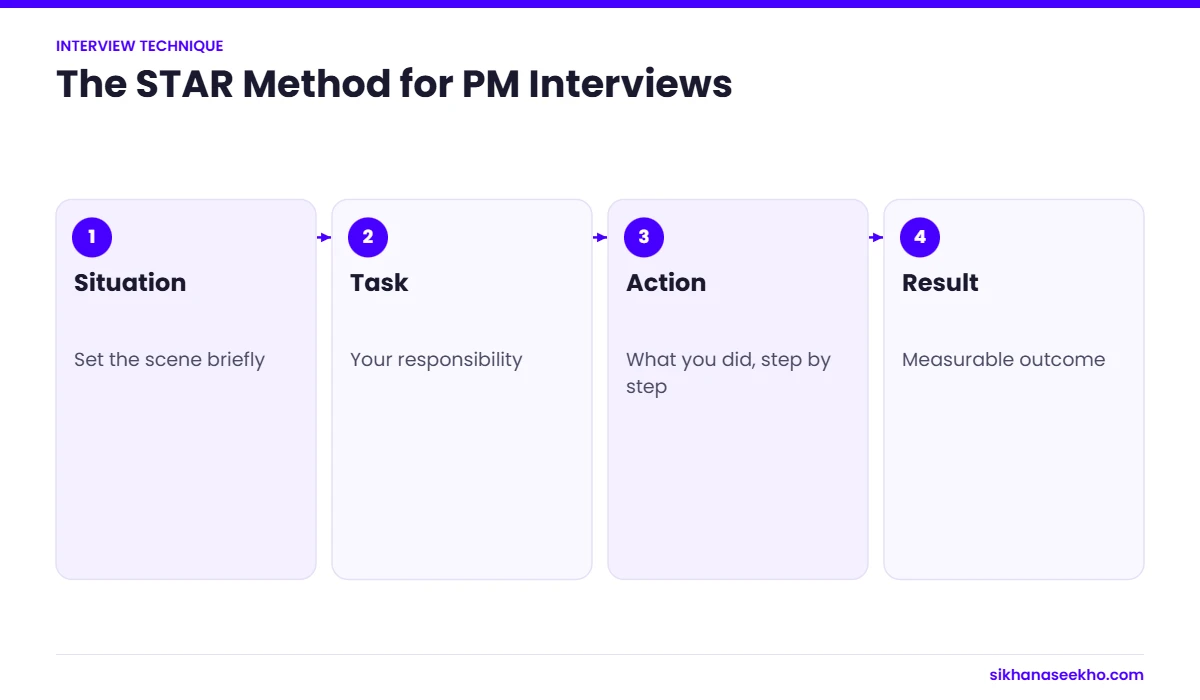
The most common mistake is spending too long on Situation and Task, and not long enough on Action and Result. Interviewers want to hear what you specifically did and what measurably happened — not a lengthy background story. Practice each answer aloud until it takes 90–120 seconds.

💡
Prepare 10 core stories before every PM interview. Cover: a project that failed or was at risk, a difficult stakeholder, a major scope change, a team conflict, a tight deadline, a budget overrun, a risk that materialised, a time you pushed back on a request, a time you made a decision with incomplete information, and your biggest project achievement. With 10 strong stories you can adapt to almost any behavioural question.
02 — All 50 Questions

Interview Questions by Category

Filter by question type below. Click any question to expand the full STAR-method answer framework.

Behavioural Questions
Why they ask this: Every interviewer wants to know how you handle failure. They are not looking for someone who has never failed — that candidate doesn't exist. They are testing your self-awareness, accountability and ability to learn. Candidates who blame others or minimise problems raise major red flags.
Strong Answer Framework
S — Situation
"I was leading a [type] project for [context]. We were [X weeks/months] into delivery when [specific thing went wrong — missed milestone, budget overrun, key resource left, scope exploded]."
T — Task
"As PM, I was accountable for [scope/budget/timeline/stakeholder relationship]. The situation required me to [decide/escalate/recover/restructure]."
A — Action
"I immediately [what you did first — called a team meeting, escalated to sponsor, convened a lessons learned session, revised the plan]. I [specific steps taken]. I also took responsibility in the next steering committee by [how you communicated the issue honestly]."
R — Result
"We [what actually happened — recovered partially, delivered late, had to descope]. The lessons I took from this were [2–3 specific changes you made to your process afterwards]. In my next project I applied [specific change], which contributed to [positive outcome]."
Key tip: Choose a real failure — not something trivially small. Show genuine reflection. The most powerful answer ends with evidence that you actually changed your behaviour as a result.
Why they ask this: Stakeholder management is the number one PM skill according to most hiring managers. They want evidence that you can navigate organisational politics, influence without authority and build relationships under pressure.
Strong Answer Framework
S — Situation
"On a [project type], one of my key stakeholders — [their role/department, no names] — was [consistently blocking decisions / publicly critical of the project / refusing to provide required inputs / undermining team morale in steering meetings]."
T — Task
"I needed to [maintain the project timeline / protect the team / secure their sign-off / get their active support] without escalating the conflict to a point that damaged the project."
A — Action
"I started by seeking a one-to-one meeting to understand their specific concerns. I listened without defending the project. I discovered their resistance was rooted in [real concern — previous failed project, fear of job impact, lack of consultation]. I addressed this by [specific action — involving them in a decision, adjusting the comms plan, giving them a formal review role, escalating their concern through the right channel]. I also [second action]."
R — Result
"Within [timeframe], their engagement shifted from [resistant] to [supportive/neutral]. They became [describe changed behaviour]. The project [delivered outcome]. I learned that resistance is almost always rooted in a legitimate concern that hasn't been heard."
Key tip: Never badmouth the stakeholder. Frame them as having a legitimate concern that you took seriously. This shows maturity and emotional intelligence — two of the most valued PM qualities.
Why they ask this: PMs always work with less than they need. This question tests your prioritisation skills, creativity under constraint and ability to deliver value even when conditions aren't ideal.
Strong Answer Framework
S
"I was asked to deliver a [project type] with a team of [X] — half what was originally planned — and a budget of [$X] after a mid-project funding reduction."
T
"I had to deliver the same core outcome with fewer resources, without compromising the quality criteria that had been agreed with the sponsor."
A
"I ran a prioritisation workshop with the sponsor to identify the must-have vs nice-to-have scope items. We agreed to descope [specific items] and phase the remaining work into a second release. I also [specific action — negotiated part-time support from another team, brought in a contractor for a critical 4-week window, automated a manual reporting process to free up capacity]."
R
"We delivered [X% of original scope] on the original deadline and within the revised budget. The sponsor rated the project [satisfaction metric]. Phase 2 was delivered [X weeks] later with the remaining scope."
Key tip: Interviewers want to see that you proactively managed the constraint — you didn't just complain about limited resources. Show the trade-offs you negotiated and the decisions you made.
Why they ask this: Team conflict is inevitable. They want to see that you address it early and directly, not ignore it or escalate immediately to HR. Servant leadership under pressure is what distinguishes good PMs.
Strong Answer Framework
S
"Two members of my project team — a [role] and a [role] — had an ongoing conflict about [technical approach / ownership of deliverables / working style / communication]. It was affecting team morale and beginning to impact sprint velocity."
T
"As Scrum Master / PM, it was my responsibility to resolve the conflict before it delayed the project or caused a key team member to disengage."
A
"I spoke with each person individually first to understand their perspective without judgement. I then brought them together in a structured conversation where I facilitated — I established ground rules, asked each to explain their position, and helped them identify common ground. I [specific resolution action — clarified ownership, agreed a decision-making protocol, restructured responsibilities, set up a regular sync]."
R
"The conflict was resolved within [timeframe]. Team velocity improved [measurably or qualitatively]. Both team members remained on the project and [one of them later / the team subsequently] delivered [positive outcome]."
Key tip: Don't pick a trivial conflict. Choose something real where tensions were genuine. Show you listened before acting and that the resolution was durable — not just a temporary patch.
Why they ask this: This is your showcase question. They want to understand the scale and complexity you've operated at and assess whether it matches what they need. Lead with numbers — budget, team size, timeline, number of workstreams.
Strong Answer Framework
S
"The most complex project I've managed was a [$X budget] [project type] involving [X] teams across [X] departments and [X] countries. It had [X] workstreams running concurrently with interdependencies across [business areas]."
T
"I was the programme manager accountable for overall delivery, reporting to [executive level], managing [X] direct stream leads and coordinating [X] external vendors."
A
"The key challenge was [specific complexity — managing cross-cultural teams, interdependency risk, regulatory compliance layer, stakeholder conflict at executive level]. I managed this by [specific governance approach — steering committee structure, dependency tracking, risk escalation protocol, weekly cross-stream sync]. I also [second specific action]."
R
"We delivered [outcome] — [on time / X weeks ahead / X% under budget]. The project [measurable business impact — saved $X, increased revenue by X%, improved NPS by X points, launched into X markets]."
Key tip: Front-load the numbers. "A $4M programme across 6 countries" lands differently than "a large global programme." Specific numbers signal credibility immediately.
Why they ask this: PMs who can't say no deliver failed projects. They want to see that you protect scope professionally, use data and process rather than personality, and maintain stakeholder relationships while holding the line.
Strong Answer Framework
S
"During execution on a [project], a [Director/VP/CXO] requested [new feature/scope addition/requirement change] that was outside the agreed project scope. We were [X weeks] from the go-live date."
T
"I needed to either formally change the scope with appropriate impact assessment, or politely decline the request while preserving the relationship."
A
"I prepared a clear impact assessment showing the cost, timeline and risk implications of the addition — [X days delay, $X cost, impact on X dependent workstreams]. I presented this to the sponsor in a one-to-one before the steering committee so they weren't surprised. I also proposed two alternatives: include it in phase 2, or defer [lower priority item] to accommodate it."
R
"The sponsor chose [option]. The original go-live date was maintained and the additional scope was [delivered in phase 2 / deferred]. The stakeholder later said they appreciated the transparency of the impact analysis."
Key tip: Frame pushback as protecting business value, not as being obstructive. You're not saying "no" — you're saying "here's what it costs and here are your options." That's professional PM practice.
Why they ask this: PMs are constantly making decisions under uncertainty. They want to see your decision-making process — how you assess risk, gather the information you can, and commit to a course of action without paralysis.
Strong Answer Framework
S
"We were at a critical decision point in the project — [specific decision needed: vendor selection, go/no-go for launch, technical architecture choice]. The information I needed [wouldn't be available for X weeks / was contradictory / was unavailable due to X]."
T
"Delaying the decision would push the delivery date by [X weeks] and cost [$X]. I needed to make the best possible decision with the information available."
A
"I listed the known facts, identified the key assumptions I was making, assessed the reversibility of the decision, and consulted [subject matter expert / senior team member]. I documented my reasoning and the risk I was accepting. I then [made the decision and communicated it clearly to the team], noting the specific trigger that would cause me to revisit it."
R
"The decision [proved correct / needed one adjustment when X became clear]. Overall it [saved X time / kept us on track / enabled us to proceed]. The documentation of my reasoning meant the team understood the rationale and remained aligned."
Key tip: Show structured thinking, not gut instinct. Interviewers want to see you can make defensible decisions — not just lucky ones.
Why they ask this: Project recovery is one of the most valued PM skills. They want to see your diagnostic process, your ability to take decisive action under pressure, and your stakeholder communication when things go wrong.
Strong Answer Framework
S
"At [project milestone], I identified that we were [X weeks] behind the critical path due to [root cause — vendor delay, resource loss, underestimated complexity, dependency failure]."
T
"I needed to recover [X weeks] in a [X-week] remaining window while maintaining quality and without burning out the team."
A
"I immediately called a recovery planning session with the team. We identified [specific recovery actions: fast-tracked parallel activities, removed non-critical dependencies, brought in additional resource for a 3-week sprint, renegotiated the vendor SLA]. I also had a transparent conversation with the project sponsor — I presented the revised plan with the timeline impact and what we were doing to recover. I set up daily check-ins for the recovery period."
R
"We recovered [X of the X weeks] slippage. The project delivered [X weeks] after the original date — rather than the [X weeks] it was tracking toward. The sponsor commended the team's response and the transparency of communication throughout."
Key tip: Transparent stakeholder communication during recovery is as important as the recovery plan itself. Highlight this explicitly — it shows PM maturity.
Why they ask this: Senior PMs frequently manage multiple projects simultaneously. They want to see your prioritisation framework and how you manage stakeholder expectations across competing demands.
Strong Answer Framework
S
"I was managing [X] concurrent projects when [two critical milestones clashed / a resource was needed on two projects simultaneously / a new high-priority project was added without removing anything from my portfolio]."
T
"I needed to make an objective prioritisation decision and communicate it clearly to all project sponsors without creating conflict between them."
A
"I created a [priority matrix / portfolio view / impact vs effort grid] showing each project's business value, deadline and resource requirement. I presented this to [PMO lead / line manager / sponsors collectively] and facilitated a decision on priority. I was transparent with the lower-priority sponsors about the impact and the timeline adjustment."
R
"The [higher priority project] delivered on time. [Lower priority project] was rescheduled by [X weeks] with sponsor agreement. Both relationships remained intact."
Key tip: Show that prioritisation involved data and stakeholder alignment — not just your personal judgment.
Why they ask this: They want to see initiative and continuous improvement mindset — two hallmarks of strong PMs. Also tests change management skills at team level.
Strong Answer Framework
S
"My team was [struggling with X — late status reports, no visibility on risks, chaotic sprint planning, manual reporting consuming 5 hours a week]. I identified [the root cause]."
T
"As PM, I took responsibility for improving the process even though it wasn't formally in my remit."
A
"I proposed [specific improvement — introducing Scrum ceremonies, a RAID log, a standard project dashboard, an automated reporting template]. I piloted it on one project first, gathered feedback, refined it, then rolled it out across the team. I ran a short training session and created a one-page reference guide."
R
"Within [X weeks], [specific measurable improvement — reporting time reduced by X hours, risk escalations increased by X%, on-time delivery improved from X% to Y%]. The approach was adopted by [other teams / the PMO / the wider department]."
Key tip: The best answers here show both the improvement idea and the change management — how you got people to adopt it, not just what the idea was.
Why they ask this: Delivering bad news quickly, clearly and with a solution is one of the hardest PM skills. They want evidence that you don't hide problems and that you communicate under pressure.
Strong Answer Framework
S
"We discovered [significant issue — vendor failure, cost overrun, data breach, missed regulatory deadline] that would directly impact [project outcome the sponsor cared about]."
T
"I needed to inform the [Director/CXO/Board] as quickly as possible, with enough context for them to make a decision — but without creating unnecessary panic."
A
"I called a meeting within [X hours] of discovering the issue. Before going in, I prepared a one-page brief: the situation clearly stated, the impact quantified, the options available and my recommendation. I led with the facts, not defensive justification. I owned the issue without deflecting blame."
R
"The sponsor appreciated the early notice and the solution-oriented approach. We agreed [option chosen]. The issue was [resolved within X / managed to X outcome]. My approach preserved the trust in the relationship for the rest of the project."
Key tip: Always come with a solution, not just the problem. "Here's what happened, here's what it means, here's what I recommend" is the formula.
Why they ask this: Increasingly relevant as organisations operate globally. Tests communication style flexibility, cultural awareness and remote delivery capability.
Strong Answer Framework
S
"I managed a project team distributed across [X countries / time zones], including team members in [regions]. The challenges included [time zone gaps, communication style differences, different approaches to hierarchy and decision-making, public holiday clashes]."
T
"I needed to build a cohesive team culture and maintain delivery momentum despite not having face-to-face interaction."
A
"I established [working agreements for the team], rotating meeting times to share the timezone burden fairly. I invested in virtual team building at the project start — [specific activity]. I adapted my communication style for different cultural norms around directness and hierarchy. I used [async tools — Confluence, Miro, recorded video updates] to ensure no team member was excluded by timezone."
R
"The project delivered [outcome]. Team engagement scores averaged [X] across all locations. [Specific positive cross-cultural outcome]."
Why they ask this: Agility is now a core PM skill. They want to see you can adapt plans in response to change without losing control of the project.
Strong Answer Framework
S
"Partway through a [project type], [significant change occurred — business strategy shifted, key sponsor left, technology choice changed, merger was announced, pandemic disrupted operations]."
T
"The original project plan was no longer valid. I needed to produce a revised plan that reflected the new reality while protecting as much of the completed work as possible."
A
"I called a replanning workshop, assessed what could be salvaged, documented the change formally through the change control process, and built a revised baseline. I communicated the impact to all stakeholders with a clear explanation of the changed scope, revised timeline and updated budget."
R
"The revised project [delivered outcome]. The change control process gave the sponsor and steering committee confidence that the replanning was disciplined and not ad hoc."
Why they ask this: Senior PM roles increasingly require you to develop others. This tests leadership maturity and how you invest in your team beyond just delivering the project.
Strong Answer Framework
S
"I had a junior PM / project coordinator on my team who showed strong potential but was [struggling with stakeholder confidence / avoiding difficult conversations / underdelivering on reporting quality]."
T
"I made a deliberate decision to invest time in their development rather than just correcting their outputs."
A
"I set up fortnightly one-to-ones specifically for their development — separate from project updates. I gave them [specific stretch assignments — leading a steering committee, owning a vendor relationship, presenting to the sponsor]. I coached them through each experience with feedback before and after."
R
"Within [X months], they had [specific growth evidence — taken on their own project, been promoted, received positive 360 feedback]. They went on to [career achievement]."
Key tip: This answer signals that you're ready for senior leadership. Always have this story prepared even for mid-level interviews.
Why they ask this: They want to see that you can disagree professionally without being insubordinate, and that you can advocate for your position with evidence.
Strong Answer Framework
S
"My [sponsor/manager/director] wanted to [rush to go-live without adequate testing / cut the QA phase to save budget / add a high-risk feature without change control / proceed with a vendor I had serious concerns about]."
T
"I believed this decision created significant risk to [project quality / team / customer / organisation]. I had a professional obligation to raise it."
A
"I requested a private meeting rather than challenging the decision publicly. I prepared [data / risk analysis / cost-benefit case] to support my position. I presented my concerns clearly and respectfully, proposing an alternative approach. I made clear I would support whatever decision was made once I had raised my concerns formally."
R
"They [changed the decision based on my input / held their position but I implemented it professionally / modified their approach partially]. The outcome was [what happened and what it showed about the relationship]."
Key tip: Never portray your manager as wrong and you as right. Show professional advocacy followed by committed execution — even if the decision didn't go your way.
Why they ask this: Vendor management is a key PM competency, especially at senior level. They want to see you can hold external parties accountable without escalating to legal or destroying the relationship.
Strong Answer Framework
S
"A key vendor was consistently [missing milestone dates / delivering below the agreed quality standard / unresponsive to issue escalations]. The impact was [X delay / $X cost / risk to go-live]."
T
"I needed to recover the relationship and performance without triggering a formal contractual dispute that would consume more time than it saved."
A
"I set up a formal performance review meeting with their account manager and project lead. I presented the documented evidence of SLA breaches clearly and without emotion. I gave them a specific recovery plan with milestones — and made clear the contractual consequences if the pattern continued. I also identified what we could do differently on our side that might be contributing to the problem."
R
"Performance improved within [X weeks]. We [recovered the delay partially / delivered on the revised timeline]. The lesson I took was [specific process change for future vendor contracts]."
Why they ask this: Team motivation is a soft skill that separates average PMs from great ones. They want to see servant leadership in action.
Strong Answer Framework
S
"My team was [exhibiting low energy, high absence, disengaged in meetings, delivering below their usual standard] after [cause: long project, failed product launch, budget cuts announced, leadership change, post-merger uncertainty]."
T
"I needed to rebuild morale without making promises I couldn't keep, and do so while the underlying cause of disengagement hadn't been fully resolved."
A
"I started with individual one-to-ones to understand each person's specific concern rather than assuming. I was honest about what I didn't know. I focused the team on [a near-term visible win — a release, a customer milestone, a demo]. I [specific recognition action, team ritual, small win celebration]. I also escalated the systemic issue to [senior stakeholder] with evidence of its impact on delivery."
R
"Team engagement [measurably improved — sprint velocity, attendance, retrospective feedback]. [Specific individual outcome]."
Why they ask this: Budget accountability is fundamental to senior PM roles. They want to see financial literacy, proactive monitoring and honest stakeholder communication.
Strong Answer Framework
S
"On a [$X] project, my cost tracking identified that we were tracking [X%] over budget at the [midpoint]. The cause was [scope additions not formally approved, underestimated technical complexity, vendor price increase, additional testing required]."
T
"I needed to either recover the overspend, formally request a budget increase, or descope to get back within budget — and communicate the situation to the sponsor before it became a surprise."
A
"I prepared a cost analysis showing the cause, the remaining spend profile and three options: [recovery actions / descope / budget increase request]. I took this to the sponsor within [X days] of identifying the issue. I also implemented [specific corrective controls — weekly cost tracking, approval threshold for spend, cost reporting in steering committee]."
R
"The sponsor approved [chosen option]. Final outturn was [X% over original budget / within revised budget]. Process improvement [specific change implemented] prevented recurrence on subsequent projects."
Why they ask this: This is your opportunity to set the ceiling on your experience. Lead with the most impressive metrics you have — budget, scale, impact. This is not the time for modesty.
Strong Answer Framework
S
"My proudest achievement was [project] — a [$X] programme involving [X] teams that [context: strategic importance to the organisation]."
T
"I was accountable for [full programme / specific high-stakes workstream]. The challenge was [what made it hard — complexity, timeline, politics, scale]."
A
"What I'm most proud of is [specific thing — not just delivery, but: how I built the team, a creative problem I solved, how I handled a major crisis, how I developed others, the stakeholder relationships I built]."
R
"The project delivered [outcome with specific numbers]. The impact on the business was [tangible result: revenue, cost saving, market launch, customer impact]. [What I personally took from it as a professional]."
Key tip: Prepare this answer as your "hero story." This is what you want the interviewer to remember. Use it to anchor your candidacy at the right level of seniority.
Why they ask this: PMs almost never have direct line authority over their teams. Influence without authority is the defining PM skill and interviewers probe for it directly at senior level.
Strong Answer Framework
S
"I needed [a technical team / a department head / a senior stakeholder] to [change their approach / prioritise our project / adopt a new process] but I had no authority over them and they reported to a different part of the organisation."
T
"Without their cooperation the project would [miss a critical dependency / lose its budget case / fail a key milestone]."
A
"I invested time first in understanding their perspective and what mattered to them. I reframed my ask in terms of their priorities — [what this meant for their team, their metrics, their agenda]. I provided [data / a pilot result / an external reference] to support my case. I built the relationship informally before I needed anything formally from them."
R
"They agreed to [what you needed]. The project [delivered outcome]. That relationship [has since become X / they became an advocate for future projects]."
Key tip: The phrase "influence without authority" should appear in your answer. Interviewers often use it verbatim in their notes when assessing this competency.
Situational Questions
Why they ask this: Tests your problem-solving process, prioritisation skills and stakeholder management under constraint. There is no single right answer — they want to see your structured thinking.
Strong Answer
"My first step would be a root cause analysis — why are we 3 weeks behind? Is it scope underestimate, resource performance, dependencies, technical complexity or changing requirements? The cause determines the recovery approach.

With no budget for additional resources, I would: (1) Fast-track — identify activities currently in sequence that could run in parallel to compress the schedule; (2) Scope review — work with the sponsor to identify any descope that recovers time without compromising the core outcome; (3) Remove non-critical meetings and administrative overhead from the team for a focused recovery sprint; (4) Be transparent with the sponsor — present the situation, the root cause, the options and a recommendation. I would not promise a recovery I couldn't deliver.

Throughout, I'd maintain daily check-ins with the team and update the risk register to reflect the schedule risk formally."
Key tip: Structure your answer: diagnose first, then options, then recommend. Avoid jumping straight to "I would work overtime" — that's not a PM answer, that's a delivery team answer.
Why they ask this: Resource risk is one of the most common project threats. They want to see a calm, structured crisis response.
Strong Answer
"Immediately, I would: (1) Have a direct conversation with the team member to understand the reason and explore whether it's resolvable — if they're leaving due to a solvable issue, that's worth knowing; (2) Assess the knowledge risk — document what only they know before they leave; (3) Conduct an impact assessment on the remaining plan — which deliverables are affected, and by how much; (4) Identify options: internal reassignment, contractor, redistribution of work, or descope.

I would escalate to the project sponsor within 24 hours — not to panic them, but to give them the information they need and the options available. I'd present: the impact, the preferred solution, the cost and the timeline implication. Then I'd execute the agreed plan with daily monitoring for the remainder of the project."
Key tip: "Escalate to the sponsor within 24 hours" is a strong signal of PM maturity. Hiding resource issues until they cause a delay is one of the most common PM mistakes.
Why they ask this: Stakeholder conflicts at senior level are common and dangerous for PMs. They want to see you can manage this without becoming a political casualty.
Strong Answer
"I would not try to resolve this directly between them — that's not my role or my level. My role is to surface the conflict clearly and provide the forum for it to be resolved.

First, I would document both requirements clearly and objectively — no editorialising. Then I would assess the impact of each option on scope, timeline, cost and risk. I would present the conflict and options at the next steering committee or request a dedicated session with both stakeholders and the project sponsor together.

My job in that meeting is facilitator — I present the trade-offs clearly, ensure both perspectives are heard, and ask for a formal decision to be made and documented. The decision is theirs to make, not mine. Once made, I implement it and update the project documentation accordingly."
Key tip: "My role is to surface the conflict, not solve it" is a mature PM answer. Junior candidates often try to resolve stakeholder conflicts personally — which usually backfires at senior level.
Why they ask this: Often the reality of PM roles — inheriting troubled projects. They want to see your structured diagnostic approach.
Strong Answer
"Week 1: Listen and diagnose — I would not make any changes or promises. I'd read all project documentation, conduct one-to-ones with every team member and key stakeholder, and map the current RAID log. I want to understand the situation from multiple perspectives before forming an opinion.

End of Week 1: Produce a health check assessment — what's actually true about the status (not just what the previous PM reported). Be honest with the sponsor about what I found.

Week 2: Baseline and stabilise — agree a revised, realistic baseline with the sponsor. Remove the commitments that were never achievable. Get the team aligned around a credible plan they believe in.

Week 3+: Deliver with daily visibility — tighter governance, more frequent check-ins, weekly sponsor updates until trust is established."
Key tip: The phrase "I would not make changes or promises in week 1" is a strong signal of seniority. Rushing to 'fix things' before diagnosing is a classic mistake.
Why they ask this: Tests understanding of Scrum principles and the PO/SM relationship. The Scrum Guide is specific on this.
Strong Answer
"Per the Scrum Guide, the Sprint Goal should not be disrupted once the sprint has started. My answer as Scrum Master would be: add the feature to the Product Backlog for consideration in Sprint Planning for the next sprint.

If the PO believes the feature is genuinely so urgent it cannot wait, the options are: (1) Cancel the sprint — a drastic measure only the PO can invoke, typically reserved for cases where the Sprint Goal has become obsolete; (2) Negotiate with the Developers to swap an equivalent-sized item out of the Sprint Backlog to accommodate the addition, if the team agrees and the Sprint Goal remains achievable.

I would facilitate this conversation between the PO and the Developers transparently, making the trade-off explicit. The team's decision-making autonomy over the Sprint Backlog should be respected."
Key tip: Referencing the Scrum Guide directly signals that your Agile knowledge is grounded in the official framework, not just general Agile buzzwords.
Why they ask this: Scope management and change control are core PM skills. They want to see a structured approach, not just acceptance of all changes.
Strong Answer
"My approach depends on whether the project is Agile or predictive. In an Agile environment, changing requirements are expected — the Product Backlog is continuously refined and prioritised, and we accommodate change between sprints through backlog ordering.

In a predictive/Waterfall environment, I would implement a formal change control process: every change request is documented, assessed for impact on scope, schedule and cost, reviewed and approved by the change authority before being incorporated into the plan. No undocumented changes.

Either way, the core discipline is: changes are transparent, impacts are communicated, and the sponsor or PO makes an informed decision. The PM's job is not to say yes or no — it is to make the cost of change visible so the right person can decide."
Why they ask this: Tests risk management maturity and your ability to move swiftly from risk to issue management mode.
Strong Answer
"An issue is a risk that has materialised, so my pre-planned risk response should now activate. First step: check the risk register — what was the agreed response plan for this risk? If a response owner and action were pre-agreed, I activate them immediately.

I update the issue log, assess the current impact on scope, schedule and cost, and notify the sponsor. Since this was a flagged risk — not a surprise — the context is already documented, which makes the communication cleaner.

Then I manage the issue: implement the response plan, track resolution, communicate status updates on a cadence appropriate to the severity, and close the issue formally when resolved with a lessons-learned note in the register."
Key tip: "Check the risk register — what was the agreed response plan" is a strong answer that shows proactive risk management, not reactive crisis management.
Why they ask this: Portfolio prioritisation is a senior PM skill. They want to see a structured, business-value-led approach rather than "whoever shouts loudest gets attention."
Strong Answer
"I would use a portfolio view that scores each project on: (1) Strategic alignment — how critical is this to the organisation's current priorities; (2) Deadline pressure — which has the hardest external or contractual deadline; (3) Risk level — which project has the highest exposure if it slips; (4) Resource dependency — which projects share resources and create bottlenecks if I don't intervene.

With those scores visible, I can have an objective conversation with the PMO or sponsor group about priority — rather than defending a subjective judgment. I'd review the priority order at least monthly as project statuses change.

For my own time, I triage daily: what needs a PM decision today that will block progress if I don't act? That determines where I focus attention, not which sponsor messages me most frequently."
Why they ask this: An disengaged sponsor is one of the most common causes of project failure. This tests your upward influence skills.
Strong Answer
"First, I'd try to understand why they're disengaged — is it competing priorities, lack of clarity on what's needed from them, or a loss of confidence in the project? The approach differs depending on the cause.

I would make it as easy as possible for them to engage: send a one-page decision brief before every interaction that clearly states 'I need a decision on X by Y date because the impact of no decision is Z.' Make their ask extremely specific and time-bounded.

If decisions are repeatedly missed and it's affecting the project, I would escalate through the project governance — formally note the outstanding decisions on the risk register with impact ratings, and raise it at the steering committee. If the sponsor is not attending the steering committee, I would escalate to their line manager through the project board.

The project shouldn't stall because of sponsor disengagement — that's a governance issue I'm accountable for surfacing."
Why they ask this: Project closure is the most skipped PM phase. Asking about it tests whether you're a practitioner who actually closes projects properly or just moves on to the next one.
Strong Answer
"For me, project closure has five elements:

(1) Formal acceptance — get written sign-off from the sponsor that deliverables meet the agreed success criteria;
(2) Financial closure — reconcile the final budget, close purchase orders, confirm no residual liabilities;
(3) Resource release — formally release team members and acknowledge their contribution, provide project references where requested;
(4) Lessons learned — run a structured session with the team covering what went well, what we'd do differently, and what specific recommendations we'd make for future projects. Document and share with the PMO;
(5) Benefits realisation hand-off — agree who owns measuring the projected benefits post-delivery and set a review date.

Lessons learned only have value if they're accessible and acted on — I always send the lessons learned document to the PMO and follow up after the next similar project to see if they were applied."
Key tip: Mentioning benefits realisation hand-off signals senior-level PM maturity — most junior candidates stop at lessons learned.
Why they ask this: Tests practical planning methodology. They want to see a logical sequence, not just "I use MS Project."
Strong Answer
"My planning sequence: (1) Define scope — agree what's in and out with the sponsor using a scope statement or WBS; (2) Identify deliverables — break the scope into discrete, measurable outputs; (3) Identify activities — what tasks are needed to produce each deliverable; (4) Sequence activities — identify dependencies (finish-to-start, start-to-start etc.); (5) Estimate durations — with the team, not for the team; (6) Assign resources; (7) Identify the critical path — the longest sequence determines the minimum project duration; (8) Review and baseline with the sponsor.

For maintenance: I update the plan weekly at minimum, track actuals vs baseline, forecast completion using earned value or velocity data, and rebaseline formally only through the change control process. The plan is a living document — not a snapshot."
Why they ask this: Stakeholder identification and analysis is a PMBOK and ECO-tested knowledge area. They want to see a structured approach.
Strong Answer
"My stakeholder mapping process: (1) Identify — who is affected by or can affect the project? Cast a wide net initially — team members, end users, leadership, finance, IT, compliance, customers, suppliers, regulators; (2) Analyse — for each stakeholder: what is their level of power (influence over the project) and their level of interest (how affected they are)? This produces the classic power-interest grid; (3) Classify — High power/high interest: manage closely. High power/low interest: keep satisfied. Low power/high interest: keep informed. Low power/low interest: monitor; (4) Plan engagement — what does each stakeholder need from me, how often, in what format?; (5) Execute and revisit — stakeholder positions shift during a project. I review the register at every major milestone."
Key tip: Name the power-interest grid explicitly — it shows theoretical grounding alongside practical application.
Why they ask this: Tests your decision-making under extreme time pressure and your willingness to make the right call, not the easy one.
Strong Answer
"Before anything else, I assess the severity: is this a showstopper that puts users, data or the business at risk — or is it a cosmetic issue? The answer determines everything.

If it's a critical defect: I escalate to the sponsor immediately with the facts — severity, impact, fix timeline and go-live risk. I do not make the go/no-go decision alone at this point — I present the options and facilitate the decision. Typical options: delay go-live, go live with a workaround and fix in patch, or go live with the defect accepted and a communication plan.

If it's a minor issue: I document it, communicate it transparently to the sponsor, and agree whether to accept it and fix post-launch or to delay. I would not hide any quality issue — even a minor one — from the sponsor two days before go-live."
Key tip: "I do not make the go/no-go decision alone" is a key phrase. This shows you understand accountability and governance, not just project mechanics.
Why they ask this: Strategic alignment is a Business Environment domain topic on the PMP exam and a growing expectation of senior PMs. They want to see you think beyond delivery mechanics.
Strong Answer
"Business objectives change — what the project was commissioned to achieve in January may look different by June. My approach: (1) Start by documenting the business case and success criteria explicitly at project kick-off, agreed with the sponsor in writing; (2) Include a 'strategic health check' at every steering committee — not just schedule/budget/risk, but 'are we still solving the right problem?'; (3) When significant scope or requirements changes are proposed, assess them against the original business case — does this change increase or decrease the business value?; (4) Build a benefits realisation plan that defines how success will be measured post-delivery, and who owns measuring it.

The project should stop if the business case no longer holds — a delivered project that nobody needed is not a success."
Why they ask this: A surprisingly revealing question. It tests whether you know the difference between a productive meeting and a performative one.
Strong Answer
"The first rule: status should be shared before the meeting, not in it. I send a written status report [RAG-rated, 1 page] 24 hours in advance. The meeting then focuses on decisions, risks and blockers — not reading out what everyone already received in writing.

Meeting structure: (1) 5 minutes — confirm status is understood and no corrections needed; (2) 15 minutes — risks and issues requiring decisions or escalation, with a clear ask from the meeting; (3) 10 minutes — dependencies and upcoming milestones needing cross-team awareness; (4) Action log review — 5 minutes on outstanding actions from last meeting only.

I time-box aggressively. If a discussion needs more than 5 minutes, it goes into a breakout. I close with confirmed actions and owners — not vague 'we'll look into it.'"
Key tip: "Status should be shared before the meeting, not in it" is a strong answer that signals meeting maturity and respect for people's time.
Technical Questions
Why they ask this: Risk management is a core PMBOK knowledge area and heavily tested in PM interviews at all levels. They want to see a structured, repeatable process — not ad hoc identification.
Strong Answer
"My risk management process follows five steps:

(1) Identify — I use risk workshops with the team, checklists from previous similar projects, and assumption analysis to identify risks from the outset. Risks are captured in a Risk Register with ID, description, category and date identified;

(2) Analyse — I assess each risk qualitatively: probability (High/Medium/Low) x Impact (High/Medium/Low) to produce a risk score. For high-priority risks on large projects, I may use quantitative analysis — Monte Carlo simulation for schedule risk, for example;

(3) Plan response — for each significant risk I assign an owner and a response strategy: Avoid, Transfer, Mitigate (for threats) or Exploit, Share, Enhance (for opportunities). Accept is used for low-priority risks;

(4) Implement responses — risk owners execute their plans and report back;

(5) Monitor — I review the risk register weekly, update probability/impact as more becomes known, and close risks that have passed or materialised into issues.

The risk register is a standing agenda item at every steering committee."
Why they ask this: EVM is heavily tested in the PMP exam and expected knowledge for experienced PMs on large projects.
Strong Answer
"Earned Value Management is a technique that integrates scope, schedule and cost to give an objective picture of project performance and forecast future outcomes.

The three base values: PV (Planned Value) — what we planned to have done by now; EV (Earned Value) — the value of work actually completed; AC (Actual Cost) — what we actually spent.

Key metrics: SV (Schedule Variance) = EV − PV — negative means behind schedule; CV (Cost Variance) = EV − AC — negative means over budget; SPI (Schedule Performance Index) = EV/PV — below 1.0 means behind; CPI (Cost Performance Index) = EV/AC — below 1.0 means over budget; EAC (Estimate at Completion) = BAC/CPI — forecasts final cost.

In practice I use EVM to provide objective, data-based status reporting to sponsors. A CPI of 0.87 is more credible than 'slightly over budget' and enables better forecasting of final project cost."
Key tip: Always include a practical example of how you have used it — not just the formula definitions. See our full EVM guide →
Why they ask this: Critical path analysis is fundamental PM knowledge. Interviewers want to see you can explain it clearly and apply it practically.
Strong Answer
"The critical path is the longest sequence of dependent activities from project start to finish — it determines the minimum project duration. Any delay to an activity on the critical path directly delays the project completion date. Activities on the critical path have zero float (total float = 0).

In practice I use critical path analysis to: (1) Identify which activities require the most protection — I assign my most experienced resources to critical path activities; (2) Focus monitoring — I track critical path activities daily, not just weekly; (3) Find schedule recovery options — fast-tracking (running sequential activities in parallel) is only possible off the critical path without risk to the end date; (4) Communicate schedule risk to stakeholders — 'this activity is on the critical path' carries more weight than 'this activity might be late.'"
Why they ask this: Senior PMs are often involved in business case development. Knowing the structure signals commercial and strategic awareness.
Strong Answer
"A business case typically contains: (1) Executive summary — the ask and the recommended option in one page; (2) Problem or opportunity statement — why does this need to exist?; (3) Options appraisal — at least 3 options including 'do nothing'; (4) Recommended option — with rationale; (5) Benefits — quantified where possible (financial and non-financial); (6) Costs — capital, revenue, total cost of ownership; (7) Risks — top 5 risks of proceeding and of not proceeding; (8) Timeline — high-level delivery phases; (9) Success criteria — how we'll know the benefits were realised; (10) Approvals required.

The business case is a living document — I update it at key stage gates as actual costs and benefits become clearer."
Why they ask this: They want to know you can hit the ground running with their toolstack — and that you can evaluate tools, not just use them.
Strong Answer
"My primary tools are [X, Y, Z] — be specific to your actual experience. For an interview, frame each tool with what you use it for:

Jira — Agile sprint management, backlog prioritisation, dependency tracking. Excellent for software teams, less suited to non-technical stakeholders.
Monday.com — visual project tracking, stakeholder-facing dashboards. Strong for non-technical teams and exec reporting.
MS Project — detailed Gantt planning, critical path analysis, resource levelling. My choice for complex Waterfall programmes.
Confluence / SharePoint — documentation, project wikis, team collaboration.
Excel — still my go-to for financial modelling, RAID logs on smaller projects and EVM calculations.

I always choose the tool that serves the team's workflow and the sponsor's reporting needs — not the one I personally prefer. The best tool is the one the team will actually use."
Key tip: "The best tool is the one the team will actually use" is a mature answer that shows tool-agnosticism — a valued PM quality.
Why they ask this: Tests whether you understand PMI's scope framework and whether you're ready for programme-level responsibility.
Strong Answer
"A project is a temporary endeavour to create a unique product, service or result. It has a defined start, end, scope and success criteria. A programme is a group of related projects managed in a coordinated way to obtain benefits and control that wouldn't be achievable by managing them individually.

The key distinction: projects deliver outputs (a new system, a building, a product). Programmes deliver outcomes and strategic benefits (a transformed operating model, a new market capability, an organisation redesigned). The Programme Manager is accountable for benefits realisation — ensuring the outputs of individual projects actually produce the intended strategic value.

A portfolio is a collection of projects and programmes grouped together to achieve strategic objectives — managed by a PMO."
Why they ask this: Dependency management is a programme-level PM skill that separates senior PMs from mid-level ones.
Strong Answer
"My approach: (1) Identify early — in the planning phase I run a dependency mapping workshop with all workstream leads. Every finish-to-start dependency is documented with the providing stream, receiving stream, delivery date and what happens if it's late; (2) Dependency register — I maintain a dedicated dependency register, separate from the project plan, visible to all stream leads; (3) Early warning system — any dependency at risk of slipping is flagged in the weekly cross-stream meeting with 2+ weeks notice — not on the due date; (4) Buffer time — for critical dependencies I build explicit float into the schedule rather than relying on all streams to deliver simultaneously on the same day; (5) Cross-stream governance — a weekly dependency meeting with all stream leads is non-negotiable on large programmes. Dependencies managed in silos are the biggest cause of programme delay."
Why they ask this: Change control is a governance topic heavily tested in PMP. It also tests whether you understand that change control protects the project, not restricts it.
Strong Answer
"Change control is the formal process for managing changes to any approved project baseline — scope, schedule, cost or quality. It matters for three reasons: (1) Integrity — without change control, the project plan ceases to reflect reality; (2) Accountability — it ensures someone with appropriate authority approves the cost of any change, not just the PM; (3) Protection — it protects the PM. A documented change request is evidence that scope was added with approval — without it, the PM is held accountable for an overrun caused by undocumented additions.

The process: request raised → impact assessed (scope/schedule/cost/risk) → reviewed by change authority → approved or rejected → baseline updated. Every change, no matter how small, should go through this process — 'it's just a small change' is how budgets double."
Why they ask this: This is a values question dressed as a technical one. They want to know if you're a delivery-focused PM (on time, on budget) or a value-focused PM (did it achieve the business objective?).
Strong Answer
"I measure project success across four dimensions:

(1) Delivery metrics — delivered to agreed scope, within baseline schedule variance, within baseline cost variance. These are the traditional 'iron triangle' metrics;
(2) Quality metrics — defect rates, user acceptance test pass rates, post-launch incident volume. Delivered on time but broken is not success;
(3) Stakeholder satisfaction — sponsor and key stakeholder satisfaction score at project close. Delivery metrics can be green while the relationship is destroyed;
(4) Benefits realisation — did the project actually achieve its business objective 6 or 12 months after delivery? This is the ultimate measure, and one most projects never track.

A project can be 'on time, on budget' and still be a failure if nobody uses the output or if it doesn't solve the original problem. That's why the business case success criteria matter as much as the delivery metrics."
Key tip: Leading with benefits realisation as the ultimate measure is a senior-level answer. Most candidates only mention the iron triangle.
Why they ask this: Methodology knowledge is tested in every PM interview. They want a nuanced, practical answer — not a textbook recitation.
Strong Answer
"Waterfall is linear and sequential — you fully define requirements, then design, build, test and release. Strong on predictability, documentation and governance. Best for projects with fixed, well-defined requirements — construction, engineering, regulated industries, government contracts with fixed-price scope.

Agile is iterative — you deliver in short cycles (sprints), adapt requirements based on feedback, and release value continuously. Best for software, digital products and innovation where requirements will evolve.

In practice, most large organisations use a hybrid — Waterfall-style governance (business case, stage gates, change control, steering committees) with Agile delivery within those phases. This is the most common answer for large enterprise projects and is explicitly tested on the PMP exam.

I choose based on: how certain are the requirements? How tolerant is the organisation of scope change? What's the regulatory environment? What's the team's maturity with each approach? The right methodology is context-driven, not a dogma." See our full Agile vs Waterfall guide →
Questions to Ask the Interviewer
💡
Always ask questions. "Do you have any questions for us?" is not a formality — it's a final assessment opportunity. Candidates who ask sharp questions signal genuine interest and strategic thinking. Candidates who say "No, I think you've covered everything" leave a weak final impression. Prepare 3–4 questions; typically you get to ask 2.
Why this is a strong question
This question does three things: it shows you're results-oriented, it gives you concrete information about the role's expectations, and it often reveals whether the organisation has clarity about what they actually need — a lack of a clear answer is itself informative. Follow up: "Is there anything about the current project status that I should know before I start?"
Why this is a strong question
This signals that you're not just interested in the job title — you want to understand the real situation you'd be walking into. It also gives you an opportunity to demonstrate relevant experience: "That's interesting — I managed a similar challenge on a programme at [company], where we approached it by..." A question that leads naturally to further evidence of your capability is the best kind.
Why this is a strong question
Senior PMs know that governance and stakeholder culture make or break project delivery regardless of the PM's individual skill. This question shows organisational savvy. The answer will tell you whether this is a well-governed PMO environment or a chaotic one where PMs are expected to fight for everything. Both are real — but you should know which you're choosing.
Why this is a strong question
This tells you whether the role is a genuine Agile environment or one where Agile is a buzzword plastered over traditional Waterfall processes — a very common situation. Follow up with: "Are teams empowered to self-organise, or is the delivery approach more prescribed?" The answer reveals actual working culture far better than the job description.
Why this is a strong question
This is the single most revealing question you can ask. The answer tells you what the organisation actually values in its PMs — which may or may not match the job description. If the answer is "people who are very stakeholder-focused" but the job description emphasises technical delivery, you're learning something important about the culture. It also ends the interview on a positive note by making the interviewer think about success rather than assessment.
03 — Meta Questions

PM Interviews — 4 Common Questions

The most common PM interview questions fall into three categories: Behavioural (tell me about a time you managed a difficult stakeholder, describe a project that failed), Situational (how would you handle a project behind schedule, what do you do when requirements change), and Technical (walk me through your risk management process, what is earned value management). Prepare STAR-method answers for at least 10 behavioural questions before any PM interview.
STAR = Situation (1–2 sentences of context), Task (your specific responsibility), Action (what you personally did — use "I" not "we"), Result (measurable outcome). The Action section should be 60–70% of your answer. Always end with a number. Keep the full answer to 90–120 seconds. Practice aloud until it feels natural — reading from notes in an interview is a red flag.
Prepare: 10 STAR stories covering the most common behavioural themes, answers to the 10 most common technical questions about your PM process, 3–4 smart questions to ask the interviewer, knowledge of the company's recent projects and industry context, and your "hero story" — your most impressive project achievement, rehearsed to 2 minutes with specific numbers.
Senior PM interviews go beyond delivery. Expect questions on: programme and portfolio management, PMO governance and standards, strategic alignment of projects to business objectives, managing other PMs, executive stakeholder management, handling large budgets ($5M+), organisational change management, and building PM capability across a team. Fewer scenario questions, more strategic discussion. Benefits realisation and business case ownership become key themes.