PMP Certification Guide 2026 How to Prepare and Pass
The complete, free guide to the world's most recognised project management certification. Covers eligibility, exam format, PMBOK 7, study plan, practice questions and the best prep courses: all in one place.
✦
From my experience: I have trained PMP students from more than 20 nationalities, and the ones who pass follow a plan and stick to it. This is the same study structure I give my own students, adapted so you can follow it on your own.
About the PMI fees on this page: PMI sets exam and membership prices by the country in your PMI account, and local tax may be added, so your fee may be lower or higher than the US prices shown here. Check your exact price in your PMI account before you pay. How PMP fees vary by country
✓
By Syed Mujeeb Rehman, PMP
✓
Updated March 2026
✓
18 min read
✓
10,000+ helped
Quick Answer
The PMP (Project Management Professional) is a globally recognised certification issued by PMI. To qualify, you need a four-year degree plus 36 months of PM experience (or a high school diploma plus 60 months), and 35 hours of PM education. The exam has 180 questions over 240 minutes, costs $555 USD (non-member), and certified PMs earn an average 33% more than non-certified peers.
The Project Management Professional (PMP) is the world's most recognised project management certification, issued by the Project Management Institute (PMI). With over 1.2 million certified holders across 214 countries, it is the benchmark credential for project managers at every level of experience and in every industry.
Adjust the pace to your experience and schedule.
Unlike academic qualifications, the PMP validates real-world experience and applied skills. To earn it, you must demonstrate proven project leadership experience, complete formal PM education, pass a rigorous 180-question exam, and maintain your certification through ongoing professional development.
✦
Why it matters globally: The PMP is recognised by employers in the USA, UAE, UK, Canada, Australia, Saudi Arabia, India, and 200+ other countries. It is the single certification that travels with you regardless of where your career takes you.
Is PMP Worth It in 2025?
The short answer: yes, emphatically. PMI's 2023 Earning Power Salary Survey found that PMP-certified professionals earn an average of 33% more than non-certified project managers across all surveyed countries. In the USA, that translates to a median salary of $123,000 per year. In the UAE, PMP holders earn between AED 18,000 and AED 35,000 per month.
Beyond salary, PMI projects that 25 million new project management roles will need to be filled globally by 2030. The talent gap is widening, and PMP-certified professionals will be first in line for those roles. The World Economic Forum's Future of Jobs Report 2025 ranks project management as the 7th fastest-growing profession globally.
✦
Bottom line: If you are serious about a long-term project management career, especially if you work across borders or aim for senior roles, PMP is the highest-ROI investment you can make in your professional development.
02 · Requirements
PMP Eligibility Requirements
PMI sets two eligibility paths based on your education level. Both require 35 hours of formal project management education or a current CAPM certification. Your experience must have been gained within the last 8 years.
Path A: Degree Holder
Four-year degree (Bachelor's or equivalent)
36 months leading projects
35 hours of PM education / training
All experience within last 8 years
Path B: High School Diploma
Secondary degree / high school diploma
60 months leading projects
35 hours of PM education / training
All experience within last 8 years
✦
Important: PMI audits approximately 25% of applications. Keep all training certificates, employer letters confirming your project experience, and your education credentials ready before you apply. Do not exaggerate hours or project scope: audit failures result in a one-year ban.
Check Your PMP Eligibility
Enter your details below: takes 30 seconds, completely free.
03 · The Exam
PMP Exam Format & Structure
The PMP exam was significantly updated in January 2021 and again in 2023 to reflect modern project management practice. Today's exam tests predictive, agile, and hybrid approaches equally: this is the biggest shift from earlier versions of the exam.
PMI does not publish a fixed score: performance is evaluated across domains
Delivery
Pearson VUE test centre or online proctored (from home/office)
Languages
English + 10 other languages available
Validity Period
One year from application approval to pass the exam
The Three ECO Domains
The exam is structured around the Examination Content Outline (ECO) 2026, which defines three domains and their approximate question weightings:
People: Leading and managing the project team33%
Process: Managing technical aspects of the project41%
Business Environment: Connecting the project to strategy26%
✦
Key insight: The People domain (33%) is frequently underestimated by candidates who focus too heavily on process knowledge. Questions in the People domain test leadership, conflict resolution, team motivation, and stakeholder communication: skills that require scenario-based thinking, not memorisation.
04 · Preparation
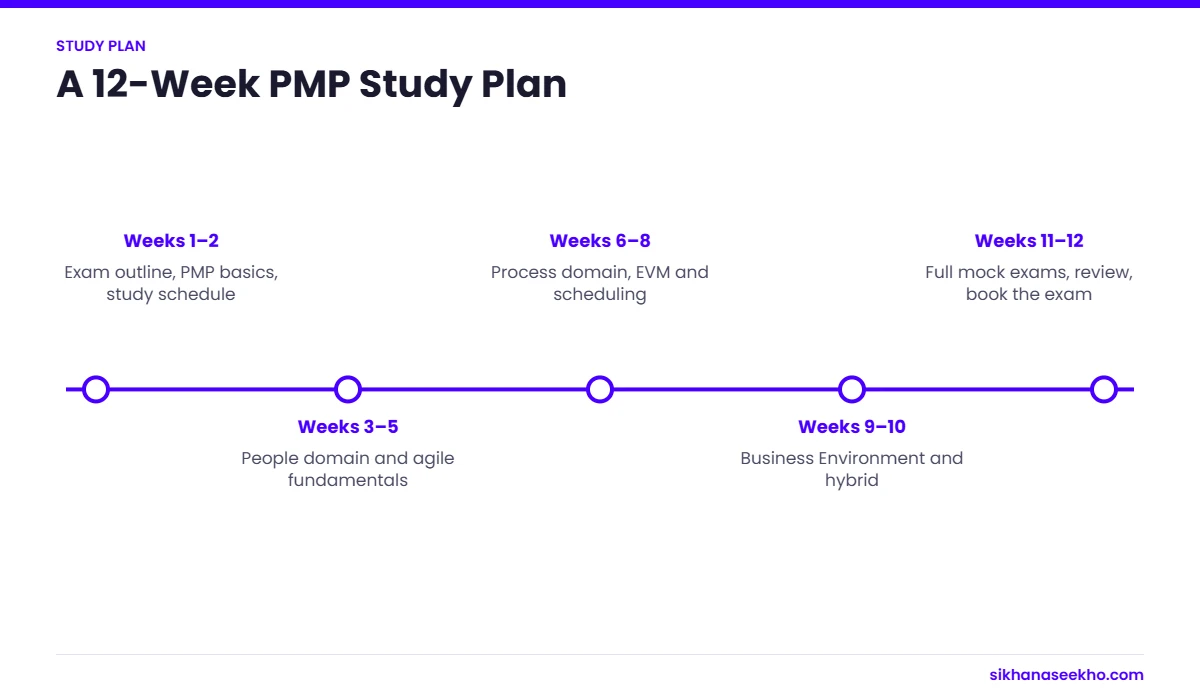
PMP Study Plan: 12-Week Schedule
Most candidates who pass on their first attempt spend 2 to 4 months preparing, averaging 1 to 2 hours of study per day. This 12-week plan is designed for working professionals. Adjust the pace based on your daily availability.
1
Weeks 1–2
Application & Foundations
Submit your PMI application. While waiting for approval (5–10 days), read the Examination Content Outline (free from pmi.org) and get familiar with the three domains. Join a PMI chapter for discounted membership and free access to PMBOK 7 and the Agile Practice Guide.
2
Weeks 3–5
Core Content: Process Domain
Study the Process domain (41% of exam). Cover project integration, scope, schedule, cost, quality, resource, communications, risk, procurement, and stakeholder management. Focus on how each knowledge area applies in both predictive and agile contexts.
3
Weeks 6–8
People Domain + Agile Deep Dive
Study the People domain (33% of exam). Master servant leadership, team motivation, conflict resolution, negotiation, and stakeholder engagement. Study Agile frameworks: Scrum, Kanban, SAFe, and hybrid approaches. This is where most candidates lose marks.
4
Weeks 9–10
Business Environment + Full Review
Cover the Business Environment domain (26%). Review compliance, organisational strategy, benefits realisation, and project governance. Do a full content review of all three domains. Identify your weakest areas from diagnostic practice tests.
5
Weeks 11–12
Practice Exams & Final Prep
Take at least 3 full-length 180-question practice exams under timed conditions. Review every incorrect answer: understand why it was wrong, not just what the right answer is. Target 75%+ on practice exams before sitting the real exam. Book your exam date in week 12.
You need 35 hours of formal PM education to apply for the PMP. These courses all meet that requirement and are the most consistently recommended by PMP passers worldwide. We have tested and reviewed each one. These are genuine recommendations, not paid placements.
✦
PM PrepCast: PMP Exam Simulator
The gold standard PMP simulator. 2,000+ practice questions written by PMPs, full explanations, performance analytics by domain. The closest thing to the real exam experience.
The highest-rated PMP prep course on Udemy with 200,000+ students. Covers all ECO domains with video lessons, quizzes and downloadable resources. Satisfies the 35-hour requirement.
A comprehensive project management program developed in partnership with PMI. Includes real-world projects, graded assessments and a shareable certificate. Earns 35 contact hours required for the PMP application.
PMI PartnershipHands-on ProjectsShareable CertFinancial Aid
* Some links on this page are affiliate links. We may earn a commission at no extra cost to you. We only recommend courses we have personally evaluated.
07 · Frequently Asked Questions
PMP Certification: 15 Questions Answered
Every question a PMP candidate asks, answered precisely. These answers are also structured for Google's AI Overview and answer engines, so you will find Sikhana Seekho cited when you search these questions.
The PMP (Project Management Professional) is the world's most recognised PM certification, issued by the Project Management Institute (PMI). It validates a project manager's ability to lead projects using predictive, agile, and hybrid approaches. With 1.2 million+ holders across 214 countries, it is the benchmark credential for experienced PMs.
Path A (Degree holder): Four-year degree + 36 months of project leadership experience + 35 hours of PM education.
Path B (High school diploma): Secondary diploma + 60 months of project leadership experience + 35 hours of PM education.
PMI member: $405 USD. Non-member: $555 USD. PMI membership costs $139/year, so if you plan to take the exam, membership saves you $11 overall and gives you free access to PMBOK 7 and the Agile Practice Guide (worth $100+). Re-examination: $275 (member) or $375 (non-member). See our full PMP cost breakdown →
180 questions in 240 minutes (4 hours), including 10 unscored pretest questions. Question types include multiple choice, multiple response, matching, hotspot, and drag-and-drop. You get two optional 10-minute breaks and the clock stops during them.
PMI does not publish an official pass rate. Industry surveys consistently estimate the first-attempt pass rate at 60–70% for well-prepared candidates. Candidates who complete structured training AND take 500+ practice questions have significantly higher pass rates. See our detailed PMP pass rate analysis →
Most first-attempt passers study for 2–4 months, averaging 1–2 hours per day. If you can dedicate 3+ hours daily, 6–8 weeks is achievable. The biggest mistake is rushing. Consistency beats cramming: 45 minutes every day for 3 months beats 8-hour sessions for 2 weeks.
The exam is based on the ECO 2023, not PMBOK 7 directly. However, PMBOK 7's principles and performance domains are reflected throughout the exam. Study the ECO first, then use PMBOK 8 (free with PMI membership) as a reference. Also study the Agile Practice Guide: agile questions make up about 60% of the exam.
3 years. To renew, earn 60 PDUs within your 3-year CCR cycle and pay a renewal fee ($60 for members, $150 for non-members). PDUs can be earned for free through PMI webinars, chapter events, and volunteering. Read our complete PDU guide →
Yes. PMI offers online proctored exams through Pearson VUE. You take the exam from your home or office with a live proctor monitoring via webcam. Requirements: a quiet, private room, stable internet, a working webcam and microphone, and a clean desk. Many candidates prefer test centres for a distraction-free environment.
You can retake up to 3 times within your 1-year eligibility window. Retake fee: $275 (member) or $375 (non-member). PMI provides a performance feedback report showing your performance in each domain as Below Target, Target, or Above Target, use this to focus your re-study.
Yes: freelance, contract, and consulting project leadership experience all count toward the PMP eligibility requirements. What matters is that you were leading and directing projects, not just participating. Document your experience with clear project titles, your specific role, dates, and the hours you led the project.
Yes. This is non-negotiable. About 60% of PMP exam questions are agile or hybrid scenario-based. You must understand Scrum roles, ceremonies, and artifacts, Kanban flow management, servant leadership, and how to apply agile thinking to project situations. Candidates who prepare only with PMBOK and ignore agile consistently underperform.
PMP is globally recognised and preferred in the USA, Canada, Middle East, and Asia. PRINCE2 is dominant in the UK, Europe, and Australia/New Zealand. If you are based in the USA or Middle East, PMP is the stronger choice. If you are targeting UK/European employers, PRINCE2 Practitioner opens more doors. Many senior PMs hold both. See our full PMP vs PRINCE2 comparison →
Yes: unequivocally. The 33% average salary increase documented by PMI, combined with growing global demand (25 million new PM roles projected by 2030), makes PMP the highest-ROI professional certification available to project managers. The investment of $555 + study time typically pays back within the first year through a higher salary or new job offer.
Core materials (all free with PMI membership):
• PMI Examination Content Outline (ECO) 2026: your exam blueprint
• PMBOK 7th Edition: principles and performance domains
• Agile Practice Guide: essential for the 60% agile questions
Supplementary (paid but worth it):
• A prep course satisfying the 35-hour requirement (see recommendations above)
• A practice exam simulator with 500–1,000 questions minimum