Everything you need to know about the Certified ScrumMaster certification: what it is, who it's for, exactly what the exam involves, how much it costs, and how it compares to PSM and PMI-ACP.
✓By Syed Mujeeb Rehman, PMP
✓Updated March 2026
✓15 min read
✓Scrum Alliance
Quick Answer
The Certified ScrumMaster (CSM) is an entry-level Scrum certification issued by Scrum Alliance. It requires attending a 16-hour instructor-led course, no prior experience needed. The exam has 50 questions (60 minutes, 74% pass mark). Total cost is $500 to $1,500 including training and two exam attempts. The certification lasts 2 years and renews at $100 plus 20 SEUs.
The Certified ScrumMaster (CSM) is an entry-level Scrum certification issued by Scrum Alliance, the organisation that founded the Scrum certification ecosystem in 2001. With over one million holders globally, it is one of the most widely recognised Agile credentials in the world and is frequently listed as "preferred" or "required" in job descriptions for Scrum Master, Agile Project Manager, Agile Coach and Product Owner roles.
CSM is one of the quickest agile credentials to earn.
Unlike the PMP or CAPM, the CSM has no formal prerequisites. No minimum education level, no years of experience and no prior Agile knowledge required. The only mandatory step is attending a 16-hour live training course taught by a Certified Scrum Trainer (CST) accredited by Scrum Alliance. After completing the course you have 90 days and two free attempts to pass the online exam.
The certification covers the Scrum framework: the roles (Scrum Master, Product Owner, Development Team), the events (Sprint Planning, Daily Scrum, Sprint Review, Sprint Retrospective) and the artifacts (Product Backlog, Sprint Backlog, Increment). The focus is on practical understanding of how Scrum works in real teams, not memorisation of theory.
✦
CSM vs Scrum Master role: The CSM certifies that you understand Scrum. It does not certify that you are currently working as a Scrum Master. Many CSM holders are project managers, business analysts, developers, product managers or team leads who want to work in Agile environments. The role of Scrum Master is available to anyone. The CSM signals you have formal training in fulfilling it well.
02: Requirements
CSM Eligibility Requirements 2026
The CSM has the most accessible entry requirements of any major PM certification. There is no education requirement, no experience requirement and no prior certification requirement. The only mandatory step is the training.
Education
None
No minimum education level required. High school, bachelor's or postgraduate, all welcome.
Experience
None
No project management or Scrum experience required. Beginners can and do start here.
Training
16 hrs
Mandatory live course with a Certified Scrum Trainer. Cannot be replaced by self-study.
The One Mandatory Requirement: CST-Led Training
You must attend a Certified ScrumMaster course delivered by a Certified Scrum Trainer (CST) accredited by Scrum Alliance. The course is 16 hours, typically spread across two full days in-person or up to four half-days online. Self-paced video courses, recorded webinars and non-CST trainers do not qualify, regardless of how many hours they cover.
CSTs are listed on the Scrum Alliance website. When booking a course, verify that the trainer holds the CST designation. This is what unlocks your access to the CSM exam portal after the course.
✦
Watch out for unofficial courses. Many online platforms sell "Scrum Master training" that does not qualify for the CSM exam because the trainer is not a Scrum Alliance-accredited CST. Before paying, verify the trainer's CST status on scrumalliance.org's trainer directory. A legitimate CSM course will explicitly state it provides access to the official exam.
03: The Process
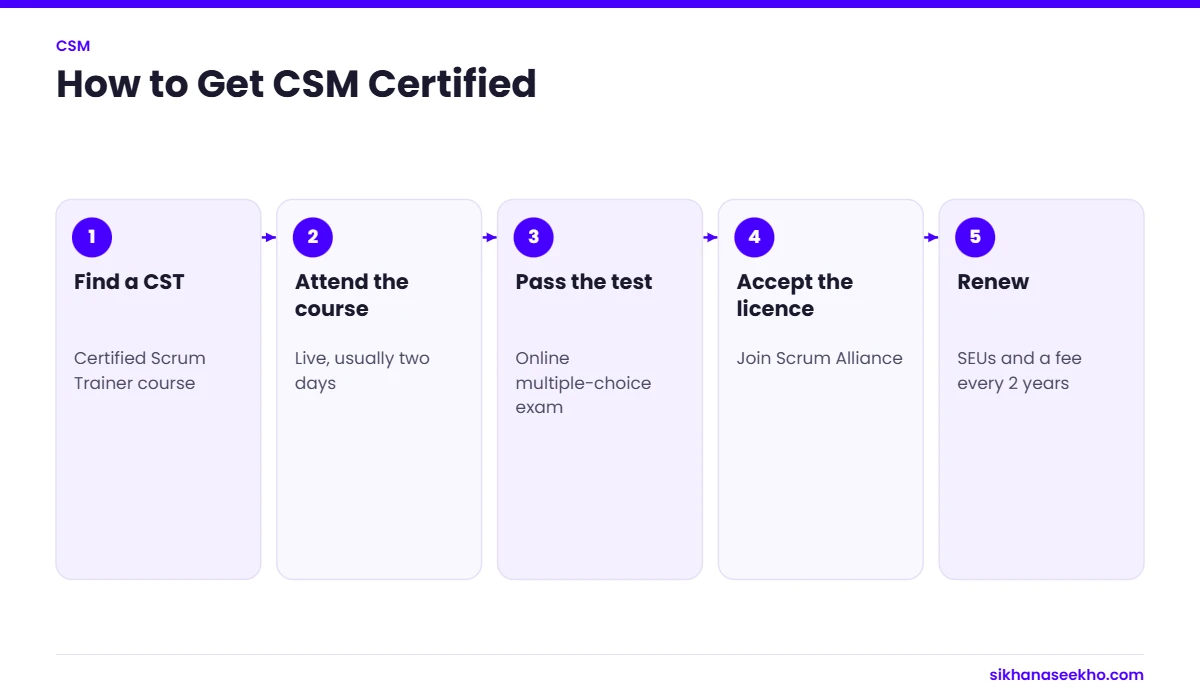
How to Get CSM Certified: Step by Step
1
Find a Certified Scrum Trainer (CST) and Book Your Course
Go to scrumalliance.org and use the course finder to search for CSM courses near you or available online. Filter by format (in-person, live online) and date. Prices vary by provider, compare a few before booking. The course is typically 2 days in-person or 4 half-days online.
2
Complete the 16-Hour Training Course
Attend the full course. Topics covered include the Agile manifesto, Scrum roles, Scrum events, Scrum artifacts, servant leadership, facilitation and how to handle real-world Scrum challenges. Participation is active: exercises, discussions and scenarios, not passive slide-watching.
3
Receive Your Exam Access Link
After completing the course, your CST will arrange for Scrum Alliance to send you a welcome email with a link to create your Scrum Alliance account and access the exam portal. You have 90 days from this email to attempt the exam.
4
Pass the CSM Exam
The exam is 50 multiple-choice questions in 60 minutes. Passing score is 74%, which is 37 correct answers. The exam is open-book in the sense that no proctoring is involved, but questions are scenario-based and test applied understanding, not fact recall. Most well-prepared candidates pass on the first attempt. You have two free attempts. Additional attempts cost $25 each.
5
Accept the Licence Agreement and Complete Your Profile
After passing, you must accept Scrum Alliance's licence agreement and complete your member profile. Your digital CSM badge is then issued. Add it to your LinkedIn profile, CV and email signature. Your two-year Scrum Alliance membership also activates at this point.
04: Exam Details
CSM Exam Format: Everything You Need to Know
Format and Pass Mark
50 multiple-choice questions, 60 minutes, 74% required to pass (37/50). The exam is taken online through the Scrum Alliance portal. No test centre required. There is no live proctoring but the exam must be completed in one sitting. You cannot pause and return.
What the Exam Covers
Questions map to the Scrum Alliance's official CSM Learning Objectives across four main areas:
Scrum Theory and Principles
Agile Manifesto values and principles, empiricism, Scrum values (commitment, courage, focus, openness, respect), transparency, inspection and adaptation.
Scrum Roles
Accountabilities and responsibilities of the Scrum Master, Product Owner and Developers. Servant leadership, coaching, facilitation and removing impediments.
Scrum Events
Sprint, Sprint Planning, Daily Scrum, Sprint Review, Sprint Retrospective. Purpose, participants, timebox and what good looks like in practice.
Scrum Artifacts
Product Backlog, Sprint Backlog and Increment. Commitments (Product Goal, Sprint Goal, Definition of Done) and how artifacts create transparency.
Difficulty Level and Pass Rate
The CSM exam is considered relatively accessible compared to PMP or PSM Level II. Most candidates who attend the full training and re-read the Scrum Guide pass on their first attempt. The questions are scenario-based. They present a real team situation and ask what a Scrum Master should do, rather than asking you to recall definitions. The key preparation is understanding the why behind Scrum rules, not just the rules themselves. I tell my own students this every time the topic comes up.
✦
Exam preparation tips: Read the 2020 Scrum Guide. It is free and only 13 pages. Focus on the Scrum Master's role as servant-leader and coach, not as a manager. Know the timeboxes: Sprint (up to 4 weeks), Sprint Planning (8 hours for a 4-week Sprint), Daily Scrum (15 minutes), Sprint Review (4 hours), Retrospective (3 hours). Practice scenario questions. If a question describes a team problem, ask "what would a servant-leader do here?"
05: Cost
CSM Certification Cost 2026: Full Breakdown
The CSM pricing model is different from PMP or CAPM. Scrum Alliance does not charge a separate exam fee. The cost of the exam is bundled into the training course fee, which varies by provider.
Cost Item
USA / Canada
UK
India (INR)
Notes
Training + Exam (bundle)
$500 to $1,500
£400 to £1,200
₹25,000 to ₹45,000
Price varies by provider, format and class size. Includes 2 exam attempts.
Scrum Alliance Membership
Included
Included
Included
2-year membership is included in all course fees at no extra charge.
Extra Exam Attempts
$25 each
~£20 each
~₹2,000 each
Only if you use both free attempts and still need to resit.
Renewal (every 2 years)
$100
~£80
~₹8,000
Plus 20 SEUs earned through qualifying CPD activities.
Study Materials
Free
Free
Free
Scrum Guide (2020) is free at scrumguides.org. Most trainers provide materials.
How to Reduce the Cost
Compare providers. Scrum Alliance does not set the course price. Individual CSTs and training companies do. Prices vary significantly for the same qualification. Online courses are generally cheaper than in-person. Check the Scrum Alliance course finder and compare at least three providers before booking.
Corporate training. If your employer is moving to Agile, many will fund CSM training as part of an organisational adoption programme. A group booking for 10 or more staff often reduces the per-person cost to $400 to $600.
Timing. New trainers building their reputation sometimes offer introductory rates. Early-bird booking discounts of 15 to 20% are common for in-person events.
06: Comparison
CSM vs PSM vs PMI-ACP: Which Should You Choose?
Three certifications dominate the Scrum/Agile space. Here is how they compare on the factors that matter most for your career decision.
Factor
CSM (Scrum Alliance)
PSM I (Scrum.org)
PMI-ACP (PMI)
Prerequisites
None
None
36 months PM exp plus 21 months Agile plus 28 hrs training
Mandatory Training
Yes, 16 hrs with CST
No, self-study allowed
No, but 28 hrs recommended
Exam Questions
50 questions, 60 min
80 questions, 60 min
120 questions, 3 hrs
Pass Mark
74% (37/50)
85% (68/80), harder
Not published, scored scale
Cost
$500 to $1,500 (training incl.)
$200 (exam only)
$495 members / $435 non-members
Validity
2 years
Lifetime, no renewal
3 years
Renewal Cost
$100 + 20 SEUs
None, lifetime
$60 members plus 30 PDUs
Difficulty
Easy to medium
Medium to hard
Hard
Best For
Beginners, US/Canada job market, networking via Scrum Alliance
Cost-conscious learners, self-studiers, European market
Choose CSM if: you are new to Scrum and want a recognised entry credential with built-in training, you are job-hunting in the US or Canada where CSM appears frequently in job descriptions, or your employer is paying for training.
Choose PSM if: you want the lowest cost option, you are a self-sufficient learner who does not need structured training, or you prefer a lifetime certification with no renewal overhead. Note that the PSM pass mark (85%) is significantly harder than CSM (74%).
Choose PMI-ACP if: you already have project management experience and want a broader Agile credential covering Scrum, Kanban, SAFe and other frameworks, not just Scrum. The ACP is strongly valued by large enterprise employers. See our PMI-ACP guide for full details.
07: Career Value
CSM Career Path: From Certified to Agile Coach
The CSM is the first rung on the Scrum Alliance certification ladder. Here is the full path from entry-level to enterprise Agile leadership.
Entry Level
CSM, Certified ScrumMaster (you are here)
Foundational Scrum knowledge. Qualifies you for Scrum Master, Agile Project Manager, Agile Business Analyst and Product Team roles.
Advanced
A-CSM, Advanced Certified ScrumMaster
Deeper coaching and facilitation skills. Requires active CSM plus 12 months Scrum Master experience. Cost: $800 to $1,200 training.
Professional
CSP-SM, Certified Scrum Professional, ScrumMaster
Senior Scrum mastery. Requires A-CSM plus 24 months as Scrum Master plus 70 SEUs. Positions you for Agile Coach and transformation lead roles.
Expert
Agile Coach to Enterprise Agile Coach
Organisation-wide Agile transformation leadership. Typically requires CSP-SM plus 5 or more years coaching experience. Salary range: $120K to $180K or more in the US.
CSM Salary Data 2026
CSM-certified Scrum Masters command a significant salary premium over non-certified practitioners. Verified data from LinkedIn Salary and Glassdoor as of Q1 2026:
USA
$95K to $130K
Average: ~$108K/yr
UK
£55K to £85K
Average: ~£65K/yr
India
₹12 to 20 LPA
Average: ~₹15 LPA
CSM holders typically earn 20 to 30% more than non-certified Scrum practitioners in equivalent roles. The premium is highest in the US financial services and technology sectors. See our full PM salary guide for country-by-country data.
08: Renewal
CSM Renewal: How It Works
The CSM is valid for two years from the date you pass the exam. Renewal requires two things submitted together to Scrum Alliance: a $100 renewal fee and 20 Scrum Education Units (SEUs).
What Are SEUs?
SEUs are earned through qualifying professional development activities. One hour of qualifying activity earns one SEU. Scrum Alliance accepts four categories:
EventsAttending Agile conferences, Scrum gatherings, local user groups or Scrum Alliance virtual events.
✦
VolunteeringVolunteering at Agile events, contributing to the Scrum community, mentoring other practitioners.
✦
OtherWriting blog posts about Scrum, coaching teams, teaching others, independent Scrum practice.
✦
Easiest renewal route: Take another Scrum Alliance certification course (CSPO, A-CSM, etc). Doing so automatically renews all of your other Scrum Alliance certifications, regardless of SEUs. If you are planning to advance your career with A-CSM anyway, timing it before your CSM expires solves both problems at once.
09: FAQ
CSM Certification: 6 Common Questions
The Certified ScrumMaster (CSM) is an entry-level Scrum certification issued by Scrum Alliance. It validates that you understand the Scrum framework and can support a Scrum team as a servant-leader. It has no prerequisites. Anyone can take the mandatory 16-hour training and sit the exam. Over one million people hold the CSM globally, making it one of the most widely recognised Agile credentials in the world.
There are no formal prerequisites. No education level, no experience and no prior certifications required. The only mandatory requirement is attending a 16-hour Certified ScrumMaster course taught by a Certified Scrum Trainer (CST) accredited by Scrum Alliance. Self-paced online courses do not qualify. After completing training you get 90 days and two free attempts to pass the online exam.
There is no separate exam fee. The exam cost is bundled into the training course price. Courses typically cost $500 to $1,500 in the US, including training, two exam attempts and a two-year Scrum Alliance membership. Renewal every two years costs $100 plus 20 SEUs earned through professional development activities.
50 multiple-choice questions, completed within 60 minutes. The passing score is 74%, meaning you need to answer at least 37 of the 50 questions correctly. The exam is taken online through the Scrum Alliance portal after completing the mandatory training. You receive two free attempts within 90 days of course completion. Additional attempts cost $25 each.
CSM (Scrum Alliance) requires mandatory 16-hour instructor-led training and costs $500 to $1,500 all-in. It must be renewed every 2 years at $100 plus 20 SEUs. PSM (Scrum.org) requires no mandatory training, costs $200 for the exam only and is a lifetime certification with no renewal fees. PSM has a harder pass mark (85% versus 74%) but is cheaper and more flexible. CSM is better known in the US job market. PSM has strong recognition in Europe and among technical practitioners.
Two years. To renew you must earn 20 Scrum Education Units (SEUs) and pay a $100 fee to Scrum Alliance. SEUs are earned through qualifying professional development: reading Agile books, attending webinars or events, volunteering or writing about Scrum. The easiest renewal route is to take another Scrum Alliance certification. Doing so automatically renews all your existing certifications.