Certifications PMP CertificationWorld’s top PM cert CSM — Certified ScrumMasterTop agile cert CAPMEntry-level PM cert PRINCE2UK & Europe standard View All Certifications ?
PM Guides Agile GuideComplete breakdown Scrum GuideRoles, ceremonies, artifacts EVM GuideAll formulas explained View All Guides ?
Career & Salary PM Salary 2026By country & level How to Become a PMStep-by-step roadmap 50 Interview QuestionsWith strong answers
PM Software Monday.com ReviewTop pick 2026 ClickUp ReviewBest value Best Free PM ToolsNo trials, truly free View All Software ?
Free Tools & Templates EVM CalculatorFree, no signup Gantt Chart MakerBuild & export free PMP Eligibility Checker30-second result Free PM Templates30 templates — Excel, Word, PDF
Get the Free PMP Guide ?
PRINCE2 Certification Guide · Updated March 2026

PRINCE2 Certification
Foundation & Practitioner

The dominant project management certification in the UK, Middle East and much of Europe. Whether you need Foundation for an entry-level PM role or Practitioner to lead government and enterprise projects — this guide covers everything: exam format, pass marks, costs, study plan and how PRINCE2 compares to PMP.

60
Foundation Qs
55%
Pass Mark
7
Principles
3 yrs
Practitioner Validity
🏛️
PRINCE2
PeopleCert / Axelos
01 — Overview

What is PRINCE2?

PRINCE2 (PRojects IN Controlled Environments) is a structured project management method originally developed for UK government IT projects in the 1980s and now used across the public and private sectors worldwide. It is owned by PeopleCert (which acquired Axelos in 2021) and is the most widely adopted project management framework in the United Kingdom, the Middle East and much of Europe and Australia.
Unlike the PMP — which certifies knowledge of project management principles across any methodology — PRINCE2 certifies proficiency in a specific, prescriptive method. The method defines seven principles, seven practices (formerly themes) and seven processes that together describe how a PRINCE2 project is initiated, planned, executed and closed.

Who uses PRINCE2? UK central and local government, NHS, defence contractors, financial services firms, infrastructure and construction companies, and large enterprises operating in the UK, Middle East, Australia and parts of Europe. If the job description says "PRINCE2 preferred" or "PRINCE2 required" — particularly in a UK public sector or government-adjacent role — this certification is effectively mandatory.

💡
PRINCE2 7th Edition (2023): The most recent version replaced the previous "themes" terminology with "practices" and introduced a greater emphasis on tailoring the method to project context. If you are studying now, ensure your materials are 7th edition aligned. PeopleCert exams from 2023 onwards test the 7th edition syllabus.
02 — Levels

Foundation vs Practitioner — Which Do You Need?

PRINCE2 has two active certification levels. Foundation is the entry-level credential — it proves you understand the method. Practitioner is the professional credential — it proves you can apply the method on real projects.

Level 1
Foundation
Questions 60 MCQ
Duration 60 minutes
Pass mark 55% (33/60)
Format Closed book
Prerequisite None
Validity Does not expire
Best for Entry-level PMs, team leads
Level 2
Practitioner
Questions 68 (objective)
Duration 150 minutes
Pass mark 55% (38/68)
Format Open book
Prerequisite PRINCE2 Foundation
Validity 3 years
Best for Project managers, senior PMs

Which Level Do You Need?

Foundation only is sufficient for project coordinator, project support, business analyst or junior PM roles in PRINCE2 environments. It demonstrates you understand the method and can work effectively within a PRINCE2 project team.

Practitioner is required or expected for project manager, programme manager and PMO manager roles where you will be responsible for tailoring and applying the PRINCE2 method. Most UK government and large enterprise PM roles at grade 6 and above expect Practitioner. If you plan to make project management your career, Practitioner is the target.

Open book means you can bring the manual: The Practitioner exam allows you to bring the official PRINCE2 manual. This does not make it easy — the exam tests application and scenario reasoning, not recall. You cannot look up answers to scenario questions fast enough under time pressure. Treat the manual as a reference for confirming specific terminology, not as a crutch.
03 — The Method

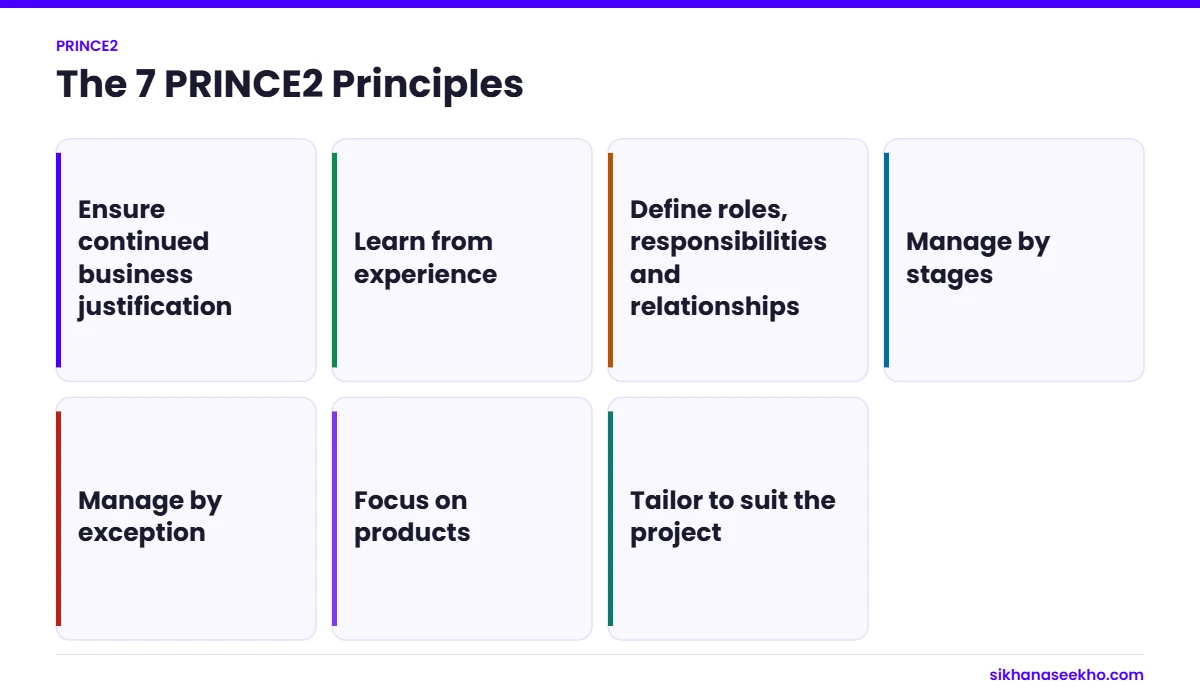
The 7 PRINCE2 Principles

The seven principles are the foundations of the PRINCE2 method — non-negotiable behaviours that must be present for a project to be considered PRINCE2. Understanding them deeply is essential for both exam levels. The Practitioner exam tests how they apply in specific project scenarios.

1
Continued Business Justification
A PRINCE2 project must have a valid business case throughout its life. If the justification disappears, the project should be stopped.
2
Learn from Experience
Lessons from previous projects must be sought, recorded and used — throughout the project, not just at closure.
3
Defined Roles and Responsibilities
Every PRINCE2 project must have defined roles covering business, user and supplier stakeholder interests.
4
Manage by Stages
Projects are planned and controlled on a stage-by-stage basis. The Project Board authorises each stage individually.
5
Manage by Exception
Each level of management sets tolerances for delegated authority. Issues are escalated only when tolerances are forecast to be exceeded.
6
Focus on Products
PRINCE2 projects focus on delivering defined products — outputs with agreed quality criteria — not just completing activities.
7
Tailor to Suit the Project
PRINCE2 must be tailored to the specific project environment, complexity, risk, scale and importance. A one-size-fits-all application of PRINCE2 is not PRINCE2 — appropriate tailoring is a principle, not an exception. This principle was strengthened in the 7th edition.
04 — Costs

PRINCE2 Exam Costs & Registration

PRINCE2 exams are administered by PeopleCert (which owns Axelos). You can take exams online via PeopleCert's proctored platform or at an accredited training centre. Costs vary by region and whether you sit through an accredited training organisation (ATO) or purchase an exam voucher directly.

Approximate Exam Costs (2026)

Foundation: £200–£260 for the exam voucher purchased directly from PeopleCert. Many training providers include the exam fee in a combined course package. Practitioner: £270–£330 for the exam voucher. A combined 5-day Foundation + Practitioner training course with both exams included typically costs £900–£1,500 in the UK depending on provider and format (classroom vs virtual). Self-study with purchased exam vouchers is the most cost-effective route if you are disciplined.

Renewal (Practitioner Only)

Practitioner certification expires after 3 years and requires renewal via PeopleCert's MyCredentials portal. Renewal options: sit the Practitioner exam again, or accumulate the required CPD points through PeopleCert's continuing education activities. Foundation does not expire and does not require renewal.

📌
Employer-funded certification: In the UK, many employers — particularly in the public sector and consultancies — fund PRINCE2 Foundation and Practitioner as standard professional development. Before self-funding, check your organisation's training and development policy. A combined 5-day course is a legitimate and commonly approved CPD request.
05 — Comparison

PRINCE2 vs PMP — Which Is Right for You?

The two most recognised project management certifications globally. Neither is universally superior — the right choice depends almost entirely on where you work and where you want to work.

DimensionPRINCE2PMP
Owned byPeopleCert / AxelosPMI (Project Management Institute)
Primary marketsUK, Middle East, Europe, AustraliaUSA, Canada, global tech and finance
MethodologyPrescriptive method (follow PRINCE2)Broad framework (methodology-agnostic)
Experience requiredNone for Foundation; none formally for Practitioner3–5 years PM experience + 35 hours training
Exam formatMCQ (Foundation), objective (Practitioner)Mixed (scenario-based, predictive + agile)
Cost (total)~£500–£700 self-study route~£400–£500 (PMI member rate)
RenewalPractitioner: 3 years / CPD3 years / 60 PDUs
Best forUK/Middle East public sector, government contracts, large enterpriseGlobal roles, tech sector, US-based organisations
💡
Many experienced PMs hold both. PRINCE2 Practitioner + PMP is a strong combination for UK-based PMs who want to work across public and private sectors, or for those targeting Middle East and international roles. If you already hold PMP, PRINCE2 Practitioner adds relatively quickly — the methodologies complement rather than conflict. See our full PMP Certification Guide for the PMP side of the comparison.
06 — Study Plan

How to Pass PRINCE2 — Foundation & Practitioner

1
Get the official manual
The official PRINCE2 manual — Managing Successful Projects with PRINCE2 (7th Edition) — is the authoritative source and can be used as an open book in the Practitioner exam. Read it cover to cover at least once before attempting either exam. The 7th edition runs to around 300 pages — plan 8–10 hours of reading time.
2
Learn the structure: principles, practices, processes
Memorise the 7 principles, 7 practices (Business Case, Organising, Quality, Plans, Risk, Issues, Progress) and 7 processes (Starting Up, Directing, Initiating, Controlling a Stage, Managing Product Delivery, Managing a Stage Boundary, Closing). The Foundation exam tests this knowledge directly. Understanding how they connect is what Practitioner tests.
3
Do Foundation mock exams until you consistently score 70%+
The pass mark is 55% but aim for 70%+ in practice to give yourself a comfortable buffer on the day. PeopleCert publishes official sample papers on their website. Third-party question banks from providers like QA, BCS and SPOCE are also worth using. Do not attempt the real exam until you are scoring above 70% consistently.
4
For Practitioner: practise scenario application
The Practitioner exam presents a project scenario and asks you to apply PRINCE2 principles and practices to specific situations. The most common mistake is trying to answer from memory rather than reasoning from the scenario. Practise reading scenarios carefully and identifying which principle, practice or process is being tested. Speed matters — 68 questions in 150 minutes is approximately 2 minutes per question.
5
Use the manual strategically in Practitioner
Mark the manual with tabs or sticky notes for: the 7 principles (page references), the purpose statement of each practice, the inputs and outputs of each process, and the management product descriptions. You will not have time to read — only to confirm specific terminology quickly. Build a reference index during your practice sessions so you know exactly where to look.
07 — FAQ

PRINCE2 Certification — Frequently Asked Questions

PRINCE2 is worth it if you work in or plan to work in the UK public sector, UK-based private sector firms, or organisations in the Middle East, Australia or Europe that use PRINCE2. It is the dominant certification for UK government contracts and is often a mandatory or preferred requirement for project roles in these markets. If you work primarily in the US or in tech, PMP or Agile certifications may be more valuable. Foundation is solid for entry-level roles; Practitioner is the target for PM career progression in PRINCE2 environments.
Foundation tests knowledge of the PRINCE2 method — its principles, practices and processes. It is a closed-book, 60-question multiple-choice exam in 60 minutes, with a 55% pass mark. Practitioner tests the ability to apply PRINCE2 in realistic project scenarios. It is an open-book, 68-question objective exam in 150 minutes, also with a 55% pass mark. Foundation is a prerequisite for Practitioner. Foundation proves you understand PRINCE2; Practitioner proves you can use it on a real project.
Most candidates spend 3–5 days of focused study for Foundation and an additional 3–5 days for Practitioner. Many providers offer a 5-day combined course. Self-study takes longer — typically 2–3 weeks of part-time study per level. The official PRINCE2 manual is the primary resource and doubles as an open-book reference in the Practitioner exam, so familiarity with its structure is as important as knowledge of its content.
PRINCE2 Practitioner is valid for 3 years and must be renewed through a recertification exam or by accumulating CPD points through PeopleCert's MyCredentials portal. PRINCE2 Foundation does not expire. PeopleCert acquired Axelos in 2021 and now manages all PRINCE2 certification, renewal and digital badge issuance.
Yes — both Foundation and Practitioner exams can be taken online via PeopleCert's proctored platform. Online proctoring requires a webcam, stable internet connection and a quiet, private environment. The examiner monitors via webcam throughout. Alternatively, exams can be sat at PeopleCert-accredited test centres. Online is the most convenient option for most candidates — exams can typically be booked within a few days.