Waterfall Project Management
A Real PM's Guide
I have managed multi-million dollar projects in the UAE. Buildings like EGA Head Office in Al Taweelah, The Constellation in Abu Dhabi, and Bateen Al Marina Hotel. Every single one of them ran on Waterfall. This guide explains what Waterfall is, when it works, and when it will hurt you: based on real experience, not theory.
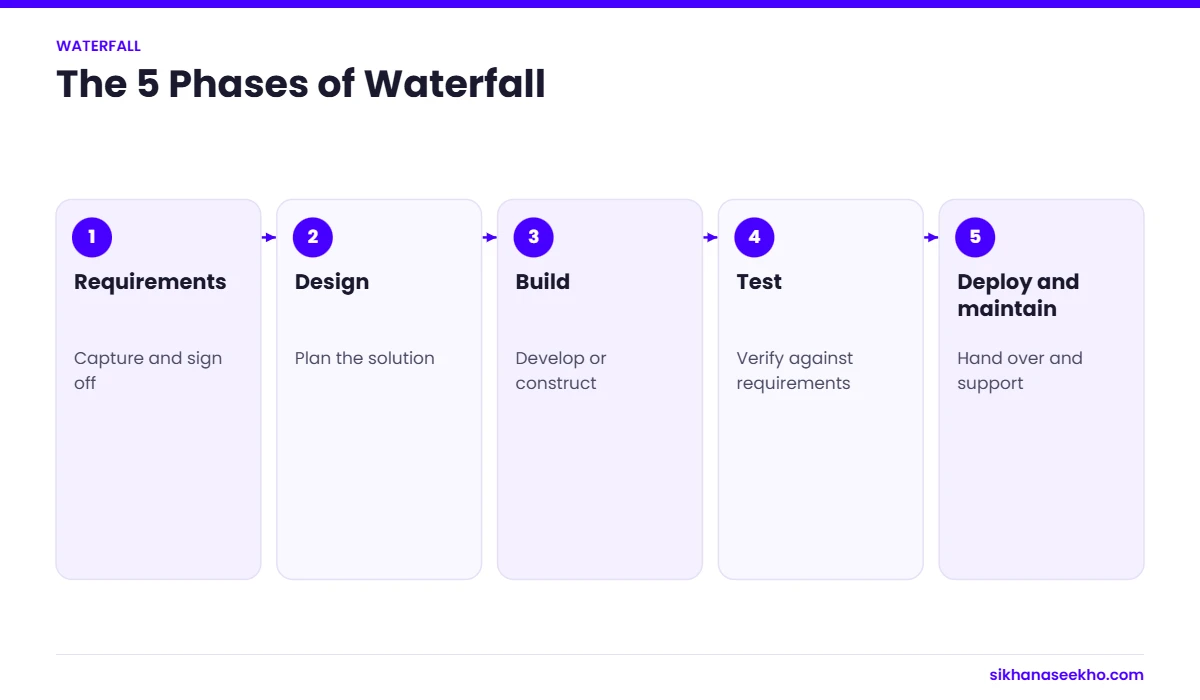
Waterfall is a linear, sequential methodology. You finish one phase fully before you start the next. The five phases are: Requirements → Design → Implementation → Testing → Deployment. Use it when your scope is fixed and agreed upfront: like a construction project or a regulated industry. Do not use it when requirements will change. I learned this the hard way on site.
Waterfall at a Glance
Key characteristics of the methodology
What Is Waterfall Project Management?
Waterfall is a predictive, plan-driven methodology. You define everything upfront. Then you execute in one direction: forward. No going back. Phase one completes. Then phase two starts. Each phase produces a formal deliverable. That deliverable gets approved. Only then does the next phase begin.
I spent years working on flagship construction projects in the UAE. Projects worth hundreds of millions of dollars. On every single one of those projects, we used Waterfall. Not because it was trendy. Because you cannot pour a foundation and then decide to change the building layout. The methodology matched the physical reality of the work.
The name makes sense when you visualise it. Water flows down. It does not flow back up. Once a phase is done, you do not return to it. This makes Waterfall predictable and structured. It also makes it rigid. A change request after the design phase on a construction project is not just a problem. It can cost millions and delay the whole programme.
Winston Royce described this model in 1970. He actually wrote it as an example of a flawed approach. But the sequential structure stuck. The construction, aerospace and defence industries adopted it. They still use it today, and in those industries, it is the right choice.
The 5 Phases of Waterfall: What Actually Happens
I will walk you through each phase. I will not just give you textbook definitions. I will tell you what actually happens, and what goes wrong when teams skip steps.
When Waterfall Is the Right Choice
I get this question a lot from my PMP students. "Sir, when do I use Waterfall and when do I use Agile?" My answer is always the same. It depends on your project. Not on what is fashionable. Not on what your company prefers. On the nature of the work itself.
Here are the situations where Waterfall gives you a clear advantage.
Waterfall Pros and Cons: My Honest View
Waterfall, Agile or Hybrid? How to Decide
When I teach PMP, students always ask me for a simple rule. There is no single rule. But there is a framework. Ask yourself these questions about your project. Then pick the methodology that fits the answers.
Waterfall in Practice: From My Projects and Beyond
I want to give you real examples. Not generic ones from a textbook. Some are from my own experience on site in the UAE. Others are from industries where Waterfall is the standard approach worldwide.
Waterfall vs Agile: The Key Differences
My PMP students always ask me to compare these two directly. Here is a clean table. For a deeper breakdown with a full decision tree, see the Agile vs Waterfall guide.
| Factor | Waterfall | Agile |
|---|---|---|
| Delivery approach | Linear, sequential phases | Iterative sprints and cycles |
| Requirements | Fully defined before work starts | Evolve throughout delivery |
| Customer involvement | At start and at the end | Continuous throughout |
| Working product | Only at the very end | After every sprint |
| Change tolerance | Low: expensive mid-project | High: built into the process |
| Documentation | Comprehensive at every phase | Just enough, just in time |
| Risk discovery | Late: usually in testing | Early: each iteration surfaces issues |
| Team structure | Specialist, phase-based teams | Cross-functional, persistent teams |
| Best for | Construction, aerospace, regulated sectors, fixed-price contracts | Software products, digital services, evolving requirements |
| Predictability | High when scope is stable | Moderate: scope can shift over time |
| Speed to first value | Slow: only delivered at the end | Fast: first sprint delivers something usable |
How to Run a Waterfall Project Without It Blowing Up
Waterfall projects fail for the same reasons every time. I have seen it on site and I have taught it in the classroom. Here is what separates projects that deliver from projects that spiral.