Project Charter Guide
What to Include and How to Get It Approved
A project charter that is too vague will be questioned. One that is too detailed will be ignored. The right charter is 3 to 5 pages, precise enough to authorise clearly, concise enough to be read and signed. I have written and signed off dozens of these on real projects in the UAE. This guide covers every section, shows good and weak examples for each, and explains how to get it approved first time.
What is a Project Charter?
A project charter is the document that formally authorises a project to begin and gives the project manager the authority to apply organisational resources to project activities. In PMBOK, it is an output of the Develop Project Charter process, the first process in the Initiating process group. Without a signed charter, the project has no formal mandate and the PM has no organisational authority to proceed.
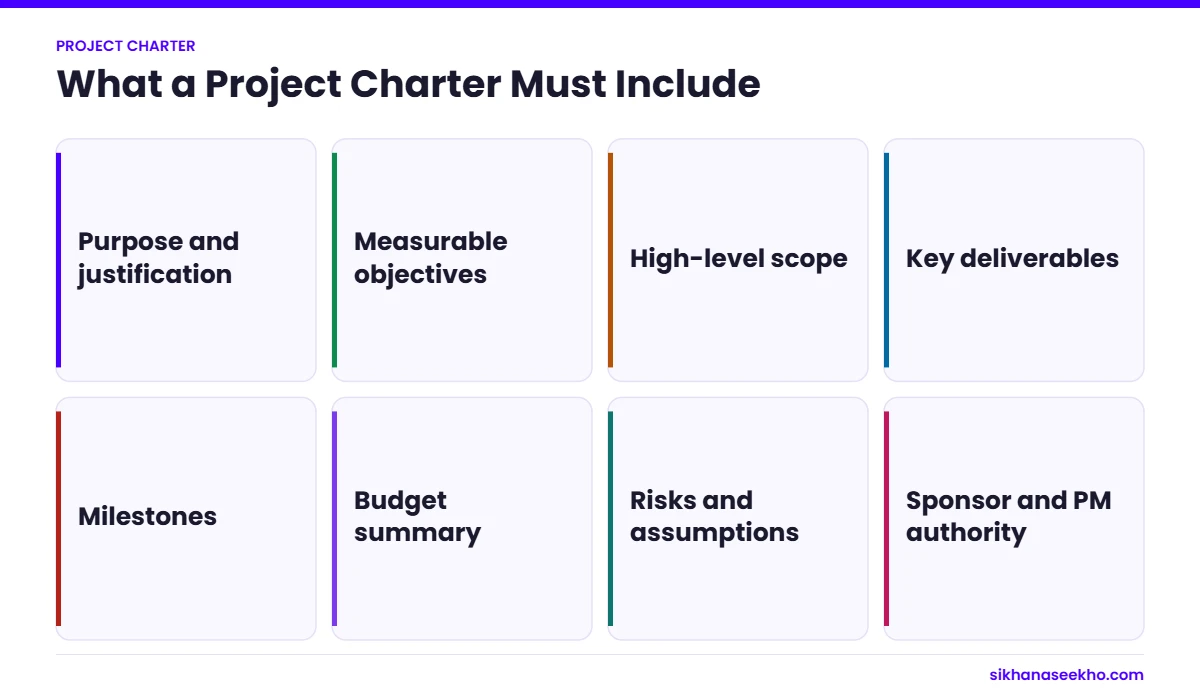
The charter does two things at the same time. It documents what the project is and why it exists clearly enough to be a reference document throughout the project, and it secures the formal signature that converts a proposal into an authorised project. These two functions explain why getting the tone right matters. A charter that reads like a business case fails as an operational reference. One that reads like a project plan fails as an authorisation document.
The 10 Charter Sections: What Each Must Contain
A complete project charter covers ten areas. The sections are sequential. Each builds on the previous one. A sponsor reading the charter should be able to understand the project's purpose, boundaries and governance structure in a single read, without needing to consult any other document.
Writing Measurable Objectives That Hold Up
Project charter objectives are the most commonly written badly of any charter section. Weak objectives are either unmeasurable ("improve customer experience"), too vague to be useful as a success criterion ("deliver the system on time and within budget"), or describe outputs rather than outcomes ("deliver a new CRM system").
A strong objective is SMART: Specific (clear about what will change), Measurable (with a metric and target value), Achievable (realistic given constraints), Relevant (linked to a business outcome), and Time-bound (with a target date for achievement). I taught this exact framework to every PMP student I have trained.
Defining Scope Boundaries: In, Out and Deferred
The scope section of the project charter is the first and most important line of defence against scope creep. Scope defined vaguely at initiation will be interpreted broadly during execution. Every ambiguous boundary will be resolved in favour of "that's obviously included."
A strong scope statement uses three lists: In Scope (what the project will deliver), Out of Scope (what the project will specifically not deliver), and Deferred (items that are acknowledged but intentionally excluded from this phase for a future phase). The Out of Scope and Deferred lists are as important as the In Scope list, and far more frequently omitted.
Project Charter Examples Across Six Industries
The structure of a project charter is consistent across industries, but the language and emphasis vary significantly. Here are worked examples of the objective and scope sections from six common project types, showing how the same charter framework applies to very different contexts.
Out of Scope: Historical records pre-2015, clinical systems integration (Phase 2), GP practice systems.
Out of Scope: Floors 1 to 3, external façade, car park, IT infrastructure (separate project).
Out of Scope: Refund workflow redesign, international currency handling, mobile app (separate sprint).
Out of Scope: Third-party vendor remediation (separate workstream), legacy systems scheduled for decommission.
Out of Scope: Fraud detection system, appeals process, integration with DWP legacy systems.
Out of Scope: Library systems integration, student records system, corporate training (separate procurement).
How to Get Your Charter Approved First Time
Most charter rejections or lengthy revision cycles are caused by one of three things: the sponsor does not feel the project is ready to be authorised, the document is not written for the right audience, or there are unresolved governance questions that the sponsor is not comfortable signing off on. All three are avoidable, and I have walked many of my students through fixing exactly this.