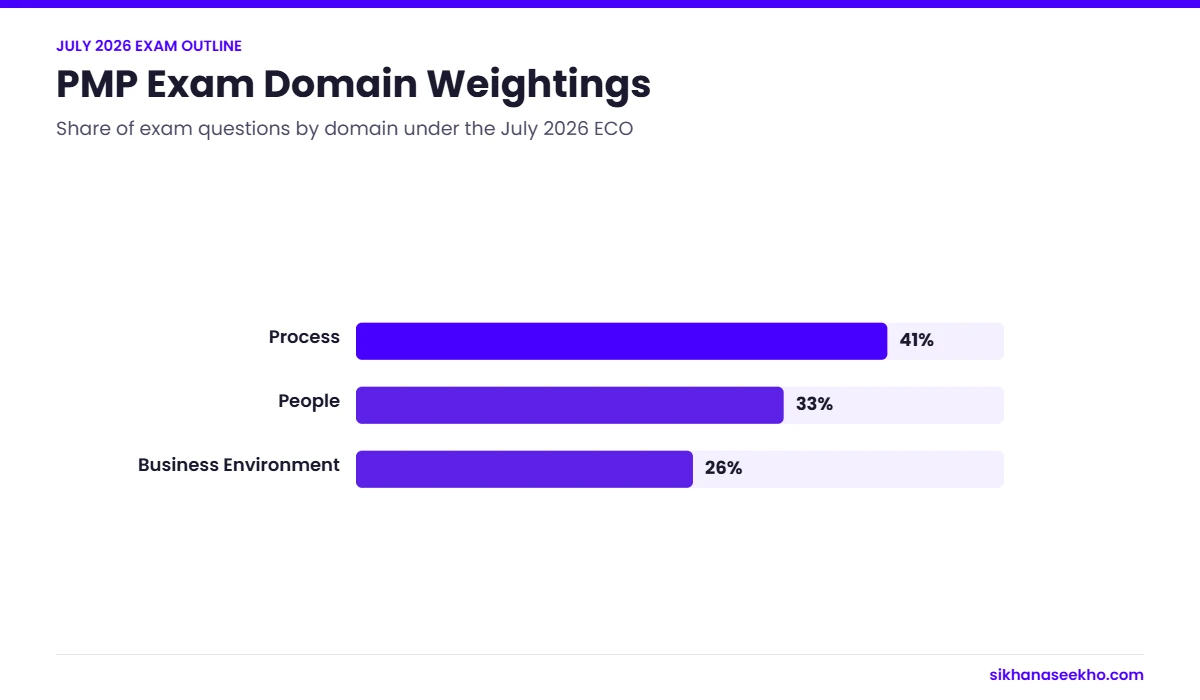
The PMP exam is built around three domains: People (leading teams and stakeholders), Process (managing delivery: scope, schedule, cost, risk, quality), and Business Environment (connecting projects to organisational strategy and value). The percentage of questions from each domain depends on when you sit the exam. Before July 9 2026: People 42%, Process 50%, Business Environment 8%. From July 9 2026 onwards: People 33%, Process 41%, Business Environment 26%. The July 2026 update is the most significant PMP exam change since 2021: Business Environment more than tripled its weighting and new topics including AI and sustainability were introduced.
Important: The PMP exam changed on 9 July 2026
PMI launched a significantly updated PMP exam on 9 July 2026, based on a new Examination Content Outline (ECO) aligned with PMBOK 8. The three domain names stay the same, but the weightings change substantially and new content areas (AI, sustainability) are introduced. Exams taken before 9 July 2026 used the old percentages. Every exam from 9 July 2026 uses the new percentages. Both versions are covered in this guide.
When you download the PMP Examination Content Outline (ECO), the first thing you see is a three-column framework: People, Process and Business Environment. Everything the exam tests, every scenario question, every calculation, every situational judgement, maps to one of these three domains.
Understanding the domains is not just useful background knowledge. It is the foundation of your study strategy. The percentages tell you exactly how many questions will come from each area, which tells you how to allocate your preparation time. Study the domains in proportion to their weightings and you are being strategically efficient. Study without knowing the weightings and you will likely over-prepare on some areas and under-prepare on others.
This guide explains all three domains in full: what they cover, what the exam tests within each, and a representative example question for each. It also covers the July 2026 domain changes so you can calibrate your study plan correctly.
✦
This is the hub post for the domain series. For a complete breakdown of each domain, including all tasks, key concepts and 10 practice questions per domain, see the dedicated domain posts: People Domain, Process Domain and Business Environment Domain.
01 · Current vs New ECO
Current ECO vs July 2026 ECO: Domain Weightings Compared
The most important thing to know before studying is which version of the exam you are preparing for. Here is the side-by-side comparison.
Business Environment rose from 8% to 26% in the July 2026 outline.
Current ECO: Valid until 8 July 2026
People42%
Process50%
Business Environment8%
Total scored questions175
New ECO: From 9 July 2026
People
33%from 42%
Process
41%from 50%
Business Environment
26%from 8%
Total scored questions170 (+ 10 pretest)
The numbers translate directly to question counts. On the old exam, with 175 scored questions, People was 73 to 74 questions, Process 87 to 88 and Business Environment 14. On the new exam with 170 scored questions, People → 56, Process → 70, Business Environment → 44.
The Business Environment shift is dramatic: from roughly 14 questions to 44 questions. Candidates who treat Business Environment as an afterthought (as many did under the old ECO) will face 44 questions they are under-prepared for.
✦
Which ECO applies to you? Every PMP exam since 9 July 2026 uses the new ECO (People 33%, Process 41%, Business Environment 26%), which includes the new topics: AI in project management, sustainability, and PMBOK 8 content.
02 · What the Three Domains Cover
What Each Domain Actually Tests
The domain names, People, Process, Business Environment, are intentionally broad. Here is what they actually mean in practice.
The People domain covers how a project manager leads, motivates, develops and supports their team and stakeholders. It is the interpersonal and leadership dimension of project management, and it is heavily influenced by Agile and servant leadership principles.
Key areas tested in the People domain:
Team leadership and empowerment: servant leadership, coaching and mentoring, psychological safety, creating self-organising teams
Conflict resolution: five conflict resolution styles (collaborating, compromising, accommodating, avoiding, forcing) and when to use each
Team development: Tuckman's model (forming, storming, norming, performing, adjourning), recognising team development stages and intervening appropriately
Communication and collaboration: virtual teams, cultural diversity, inclusive PM practice
Emotional intelligence: self-awareness, empathy, managing relationships under pressure
The core PMI principle tested here: The project manager is a servant leader who empowers the team rather than directing or controlling them. In Agile contexts especially, the correct answer almost always involves removing obstacles, coaching the team and facilitating decisions, not making decisions for the team.
Example People Domain Question
A Scrum team is in the middle of a sprint when a senior stakeholder emails the project manager directly, requesting that a significant new feature be added to the current sprint backlog. The team is already at capacity. What should the project manager do?
A. Add the feature to the sprint backlog and inform the team of the change.
B. Refuse the stakeholder's request and explain that the sprint cannot be changed.
C. Acknowledge the request, direct the stakeholder to the Product Owner, and explain that new scope can be added to the product backlog for prioritisation in a future sprint.
D. Call a sprint review meeting to assess whether the team can accommodate the additional feature.
Why C is correct: In Agile, sprint scope is protected: mid-sprint changes undermine team commitments and sprint goals. The correct channel for new requests is the Product Owner, who owns the product backlog. The PM's role is to shield the team and ensure process is followed, not to make scope decisions (A) or refuse stakeholders abruptly (B). D (sprint review) is the wrong ceremony. That is for inspecting and adapting after a sprint, not for assessing mid-sprint scope changes.
The Process domain covers the technical mechanics of managing a project: how a project manager plans, executes, monitors and controls the work across scope, schedule, cost, quality, risk, communications and procurement. It tests both Agile and predictive approaches, and increasingly hybrid scenarios.
The core PMI principle tested here: Every change goes through change control. Every issue requires root cause identification before action. Costs and schedule must be forecast, not just tracked. The PM proactively manages risks, not reactively deals with problems after they occur.
Example Process Domain Question
A project has a BAC of $180,000. At the current status date, the team has completed 55% of the planned work and has spent $105,000. The project sponsor asks whether the project is on budget. What should the project manager report?
A. The project is on budget because spending is consistent with the timeline.
B. The project is over budget, the Cost Variance is −$6,000 and the CPI is 0.94.
C. The project is under budget because only 55% of the budget has been spent.
D. It is too early to determine whether the project is on budget.
Why B is correct: EV = 55% × $180,000 = $99,000. AC = $105,000. CV = EV − AC = $99,000 − $105,000 = −$6,000 (over budget). CPI = EV ÷ AC = $99,000 ÷ $105,000 = 0.94. A negative CV and CPI below 1.0 both confirm the project is over budget. Option A ignores EVM entirely. Option C confuses budget spent with budget efficiency. Option D is evasive: EVM gives a clear answer at any point in the project.
The Business Environment domain covers the relationship between the project and the wider organisation: how projects connect to strategy, deliver business value, operate within governance frameworks, navigate compliance requirements and drive organisational change. Under the old ECO this was the smallest domain. Under the July 2026 ECO it tripled in size and became the second-largest area of study.
Key areas tested in the Business Environment domain (core areas):
Benefits realisation: ensuring the project delivers the business value it was initiated to create, measuring outcomes not just outputs
Compliance: regulatory requirements, legal constraints, organisational policies and how projects must operate within them
Organisational change management: helping stakeholders adapt to project-driven changes, managing resistance, sustainability of change
Strategic alignment: understanding how the project links to organisational strategy and ensuring delivery decisions stay aligned
Additional areas introduced in the July 2026 ECO:
AI in project management: using AI tools for scheduling, risk prediction, reporting and decision support; managing human-AI collaboration
Sustainability and ESG: incorporating environmental, social and governance considerations into project planning and execution
Data-driven decision making: using analytics, dashboards and KPIs for evidence-based PM decisions
Governance and risk: expanded coverage of project governance frameworks, enterprise risk tolerance and portfolio alignment
The core PMI principle tested here: The project manager is accountable not just for delivering outputs on time and budget, but for ensuring those outputs generate genuine business value. Projects exist to serve organisational strategy. Every major decision should be tested against whether it supports the intended business outcome.
Example Business Environment Domain Question
A project has been completed on time and within budget. All planned deliverables have been accepted by the client. However, six months after project closure, the sponsor reports that the intended business benefits have not been realised. What should the project manager have done differently?
A. Extended the project timeline to ensure benefits were realised before closure.
B. Delivered additional features beyond the agreed scope to increase the chance of benefit realisation.
C. Established a benefits realisation plan at project initiation that defined how and when benefits would be measured, and handed it off to the business owner at closure.
D. Raised a change request to transfer project ownership to the operations team before closure.
Why C is correct: Benefits realisation is a Business Environment domain concept, the PM is responsible for ensuring a mechanism exists to measure and track whether the intended business value is being delivered, even after the project closes. A benefits realisation plan established at initiation gives the business owner a framework for post-project measurement. Option A (extending the timeline) conflates project delivery with business change, which happens after closure. Option B (delivering extra features) is gold plating: prohibited by PMI. Option D (change request) does not address the root cause.
The Agile and Hybrid Content Split Across All Three Domains
Separate from the domain percentages, PMI specifies how questions are distributed across delivery approaches. This applies within every domain, not as a separate domain.
Agile / Hybrid approaches
~50%
Roughly half of all exam questions involve Agile, Scrum, Kanban or hybrid delivery contexts: across all three domains
Predictive (waterfall) approaches
~50%
The other half test traditional predictive delivery: PMBOK processes, change control, EVM, CPM, formal planning
This means that within the People domain, for example, roughly half the questions will test Agile servant leadership scenarios and half will test traditional PM stakeholder management. Within the Process domain, half will test sprint planning and backlog management and half will test EVM calculations and critical path method. You cannot pass by preparing for only one delivery approach.
04 · How to Allocate Your Study Time
Study Time Allocation by Domain: Current and New ECO
Use these allocations as a starting framework. Adjust based on your practice exam results: if your Business Environment scores are consistently low, reallocate time there.
Domain
Current ECO weighting
Suggested study %
New ECO weighting
New study %
People
42%
35–40%
33%
30–35%
Process
50%
40–45%
41%
35–40%
Business Environment
8%
15–20%
26%
25–30%
Note: Study allocation percentages are deliberately higher than exam weightings for Business Environment because it is the domain where most candidates have the largest gaps. Time spent on Process can be reduced if you have strong EVM and risk management knowledge from experience.
05 · Deep Dive Into Each Domain
Go Deeper: Complete Domain Guides With Practice Questions
This hub post gives you the overview of all three domains. For the full task list, detailed concept breakdowns and 10 scenario practice questions per domain, use the dedicated domain guides below.
The domain guides have 10 practice questions each. For a full 200-question set covering all three domains, with complete explanations, use the free question bank below.
The PMP exam is built around three domains: People, Process and Business Environment. The People domain covers how a project manager leads teams and engages stakeholders: servant leadership, conflict resolution, team development and collaboration. The Process domain covers the technical mechanics of managing delivery: scope, schedule, cost, risk, quality, communications and procurement, across both Agile and predictive approaches. The Business Environment domain covers how projects connect to organisational strategy and deliver business value: benefits realisation, compliance, governance, sustainability and (from July 2026) AI in project management.
The PMP domain percentages in 2026 depend on when you sit the exam. For exams taken before 9 July 2026, the old ECO percentages applied: People 42%, Process 50%, Business Environment 8%. For exams taken on or after 9 July 2026, the new ECO percentages apply: People 33%, Process 41%, Business Environment 26%. The Business Environment domain more than tripled its weighting in the new ECO: from approximately 14 questions to approximately 44 questions out of 170 scored questions. Candidates preparing for the post-July exam must substantially increase their Business Environment study time.
PMI launched a significantly updated PMP exam on 9 July 2026, based on a new Examination Content Outline (ECO) aligned with the PMBOK Guide 8th Edition. The key changes are: (1) Domain weightings change: Business Environment jumps from 8% to 26%, Process drops from 50% to 41%, People drops from 42% to 33%; (2) New testable topics are introduced: AI in project management, sustainability and ESG in project delivery, and data-driven decision making; (3) The scored question count changes from 175 to 170 (with 10 pretest questions added); (4) New question formats are introduced including case study sets and drag-and-drop questions. The three domain names (People, Process, Business Environment) remain unchanged.
If you are already well into your preparation using current study materials, taking the exam before 9 July 2026 avoids needing to learn new content areas (AI, sustainability, expanded Business Environment). If you are early in your preparation or your exam date naturally falls after July, the new exam is manageable: PMI designs updates to reflect real-world PM practice, not to make the exam harder. The new Business Environment content (governance, compliance, benefits realisation, sustainability) is practically relevant and logic-based rather than memorisation-heavy. The most important factor is readiness: sit when your practice scores consistently exceed 70%, regardless of which ECO version applies.
Difficulty is subjective and depends on a candidate's background. Most candidates find the People domain hardest because the correct PMI answers to stakeholder and leadership scenarios often feel counter-intuitive: PMI consistently favours collaborative, empowering, servant-leader responses over the more directive instincts that experienced managers have developed. The Process domain is large and formula-heavy (EVM, critical path) but more predictable once the patterns are learned. The Business Environment domain was historically easy due to its small size, but under the July 2026 ECO it became significantly larger and more important: candidates with limited strategic PM or governance experience will find it challenging.
The three PMP exam domains (People, Process, Business Environment) are defined by the Examination Content Outline (ECO), which is a separate document from the PMBOK Guide. The ECO defines what the exam tests; PMBOK describes PM knowledge and practice. They are aligned but not identical, the exam tests real-world PM judgement based on the ECO tasks, using PMBOK principles and the Agile Practice Guide as supporting reference material. In the old exam, PMBOK 7 underpinned much of the content. From July 2026, PMBOK 8 is the primary reference. The ECO (not PMBOK) is the most important document to read before starting exam preparation. It tells you exactly what will be tested.
Yes: Agile knowledge is essential for the PMP exam. PMI's 2026 outline puts about 60% of questions in Agile or hybrid delivery approaches, spread across all three domains. This is not a separate "Agile section": Agile scenarios appear throughout People, Process and Business Environment questions. Key Agile content to know includes Scrum roles (Product Owner, Scrum Master, Development Team), ceremonies (Sprint Planning, Daily Scrum, Sprint Review, Sprint Retrospective), artefacts (Product Backlog, Sprint Backlog, Increment, Definition of Done), servant leadership principles, the Agile Manifesto four values and twelve principles, and Kanban basics. Candidates who prepare only on predictive PMBOK content will face roughly 90 questions they are poorly prepared for.

Pingback: PMP People Domain 2026: Tasks and Practice Questions
Pingback: PMP Business Environment Domain 2026 Explained
Pingback: PMP Certification Cost in Pakistan 2026: Full PKR Breakdown
Pingback: APM PMQ vs PMP: Which Should You Choose in 2026?