
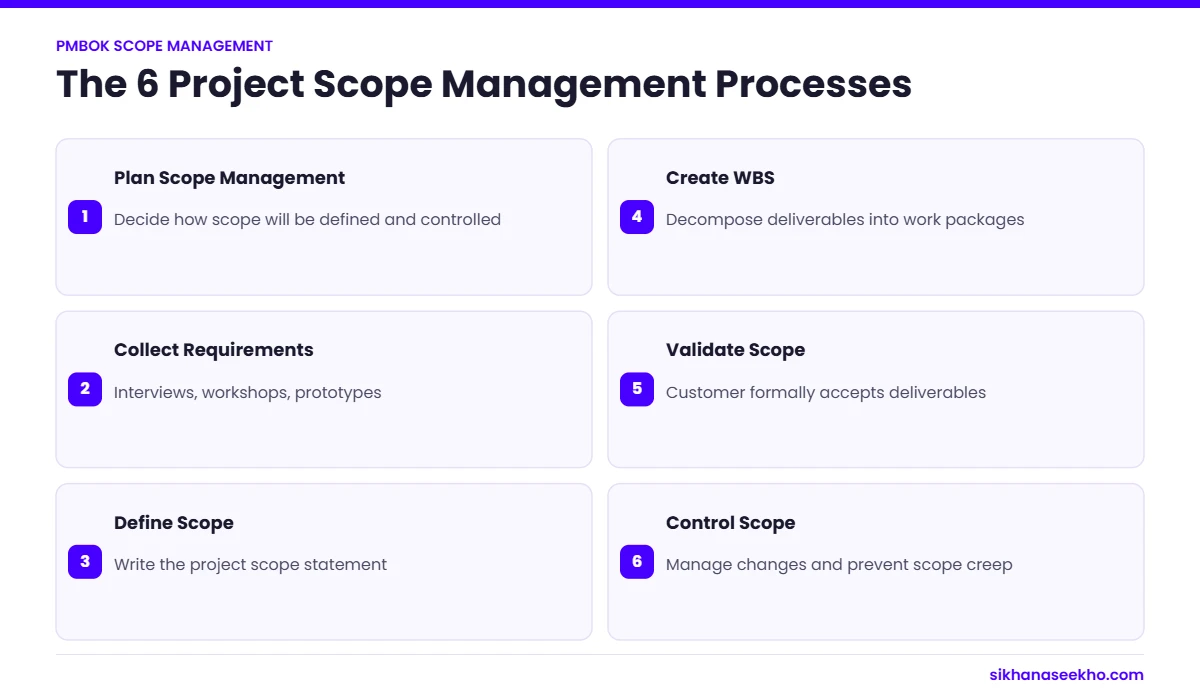
Project Scope Management (PMBOK Knowledge Area 5) is the collection of six processes that ensure the project includes all, and only, the work required to complete the project successfully. It covers Plan Scope Management (defining the approach), Collect Requirements (determining stakeholder needs), Define Scope (developing a detailed project scope statement), Create WBS (decomposing scope into manageable work packages), Validate Scope (obtaining formal acceptance of completed deliverables), and Control Scope (monitoring scope and managing changes to the scope baseline). The central challenge is not defining scope. It is controlling it. Scope creep: the uncontrolled expansion of project scope without corresponding adjustments to time, cost or resources: is one of the most common causes of project failure. The Scope Baseline (Project Scope Statement + WBS + WBS Dictionary) is the reference against which all scope performance is measured throughout the project lifecycle.
Of all the constraints a project manager must balance, time, cost, quality, risk, resources, scope is the one that defines everything else. You cannot estimate cost without knowing what needs to be built. You cannot schedule activities without knowing what work needs to be done. You cannot assess quality without knowing what the deliverables are supposed to achieve. Scope is the foundation on which the entire project management plan rests.
Yet scope management is also the discipline most frequently under-invested in. Requirements workshops are rushed or skipped. The WBS is produced at too high a level to be useful for planning. Scope changes are agreed informally without formal change control. By the time the project reaches delivery, the team is working to a scope that has drifted significantly from the original baseline, and nobody has a clear picture of exactly what has changed, what it has cost, or whether the delivery team is even aware of all the changes that have been agreed.
This guide covers all six PMBOK processes with full ITO breakdowns, the Work Breakdown Structure in depth, the Scope Baseline and its three components, requirements collection techniques, the critical distinction between product scope and project scope, scope creep and how to prevent it, how scope management operates in Agile and hybrid environments, and the interrelation of scope management with every other PMBOK knowledge area.
Product Scope vs Project Scope: A Critical Distinction
PMBOK makes an important distinction between two types of scope that are managed differently within the same knowledge area.
Product scope describes the features and functions that characterise a product, service or result. It defines what is being built: the characteristics of the deliverable.
- Defined in requirements documentation and product specifications
- Measured against the product requirements: does it do what it was specified to do?
- Completion is measured by comparing the product against its requirements
- Examples: the features of a software application, the specifications of a building, the components of a training programme
- Often described in functional and non-functional requirements
Project scope describes the work that must be performed to deliver a product, service or result with the specified features and functions. It defines how the product will be built: the work required.
- Defined in the Project Scope Statement and WBS
- Measured against the project management plan: is all the planned work being done, and only the planned work?
- Completion is measured by comparing work performed against the scope baseline
- Examples: the activities required to build the software, the construction activities needed, the development of training materials
- Includes all project management work, not just technical delivery
Project Scope Management: The 6 PMBOK Processes
Plan Scope Management is the process of creating a Scope Management Plan that documents how the project and product scope will be defined, validated and controlled. Like all management plans, it establishes the framework within which the subsequent scope processes operate: without it, scope decisions are made inconsistently and scope control becomes ad hoc.
The Scope Management Plan defines: how the project scope statement will be prepared; how the WBS will be created from the scope statement; how the WBS will be maintained and approved; how formal acceptance of completed deliverables will be obtained (Validate Scope); and how requests for scope changes will be processed.
The Requirements Management Plan is the second output. It describes how requirements will be collected, analysed, documented and managed. It defines: the requirements prioritisation process; the product metrics to be used; traceability from requirements to deliverables; and the change management process for requirements.
- Project Charter
- Project Management Plan (Quality Management Plan, Project Life Cycle, Development Approach)
- Enterprise Environmental Factors
- Organisational Process Assets
- Expert judgement
- Data analysis (alternatives analysis)
- Meetings
- Scope Management Plan
- Requirements Management Plan
Collect Requirements is the process of determining, documenting and managing stakeholder needs and requirements to meet project objectives. It is one of the most technically demanding processes in scope management: eliciting requirements from stakeholders is a skill that goes well beyond asking "what do you want?" Stakeholders often cannot fully articulate their needs, confuse wants with requirements, and frequently disagree with each other about what the project should deliver.
The key outputs are Requirements Documentation (the detailed list of functional, non-functional, business, stakeholder, solution, transition and project requirements) and the Requirements Traceability Matrix (which links requirements to their source, through design and development to testing and delivery, ensuring nothing is missed or added without authorisation).
Types of requirements collected:
- Business requirements: The higher-level needs of the organisation: why the project is being undertaken, the business problem or opportunity being addressed.
- Stakeholder requirements: The needs and expectations of specific stakeholder groups: what they need the project to deliver for them.
- Solution requirements: Functional requirements (what the solution does) and non-functional requirements (how well it does it: performance, security, usability, reliability).
- Transition and readiness requirements: Temporary requirements for training, data migration, parallel running, cutover and handover to operations.
- Project requirements: Actions, processes and conditions the project itself must meet: governance, reporting, quality standards, compliance.
- Quality requirements: The conditions or criteria needed to validate the successful completion of a project deliverable or the quality standards that must be met.
- Scope Management Plan
- Requirements Management Plan
- Stakeholder Engagement Plan
- Project Charter
- Project Documents (Assumption log, Lessons learned, Stakeholder register)
- Business Documents (Business case)
- Agreements
- Enterprise Environmental Factors
- Organisational Process Assets
- Expert judgement
- Data gathering (brainstorming, interviews, focus groups, questionnaires, benchmarking)
- Data analysis (document analysis)
- Decision making (voting, autocratic decision making, multi-criteria)
- Data representation (affinity diagrams, mind maps)
- Interpersonal and team skills (nominal group technique, observation/conversation, facilitation)
- Context diagrams
- Prototypes
- Requirements Documentation
- Requirements Traceability Matrix
Define Scope is the process of developing a detailed description of the project and product. It selects from the requirements collected in 5.2 those that will be included in the project scope, and documents the project scope in the Project Scope Statement: the definitive, authoritative description of what the project will deliver and what it will not.
Not all requirements collected in 5.2 necessarily become project scope. Collect Requirements gathers the full universe of stakeholder needs; Define Scope selects the subset that will be delivered within the project's constraints of time, cost and resources. Requirements deferred to future phases or excluded entirely must be documented, the scope statement records both what is included and what is explicitly excluded.
The Project Scope Statement contains:
- Product scope description: The characteristics of the product, service or result: what will be built, progressively elaborated from the project charter.
- Project deliverables: The tangible outputs the project will produce, the products, results and services that constitute project success.
- Acceptance criteria: The conditions that must be met before deliverables are formally accepted by the customer or sponsor. Clear acceptance criteria prevent disputes during Validate Scope.
- Project exclusions: An explicit statement of what is out of scope: preventing stakeholders from assuming that anything not explicitly excluded is implicitly included.
- Constraints: Factors that limit the project's options: budget ceilings, mandated end dates, technology standards, regulatory requirements.
- Assumptions: Factors assumed to be true for planning purposes. Each assumption represents a potential risk if it proves false.
- Scope Management Plan
- Project Charter
- Project Documents (Assumption log, Requirements documentation, Risk register)
- Enterprise Environmental Factors
- Organisational Process Assets
- Expert judgement
- Data analysis (alternatives analysis)
- Decision making (multi-criteria decision analysis)
- Interpersonal and team skills (facilitation)
- Product analysis (product breakdown, requirements analysis, systems analysis, systems engineering, value engineering, value analysis)
- Project Scope Statement
- Project Documents Updates (Assumption log, Requirements documentation, Requirements traceability matrix, Stakeholder register)
Create WBS is the process of subdividing project deliverables and project work into smaller, more manageable components. The Work Breakdown Structure (WBS) is a hierarchical decomposition of the total scope of work. Every level of the hierarchy represents a progressively more detailed definition of the project deliverables and work. The lowest level of the WBS, the work package, is the unit at which work can be reliably estimated, scheduled, assigned, tracked and controlled.
The WBS is deliverable-oriented, not activity-oriented. Each element of the WBS represents a tangible deliverable or outcome, not an action. Work packages at the bottom of the WBS are then decomposed into activities in the Schedule Management process (Define Activities, Process 6.2). This two-level structure: WBS work packages → scheduled activities: is a fundamental PMBOK architecture that many practitioners collapse into a single level, losing the clarity that the separation provides.
WBS Dictionary: The WBS Dictionary is an essential companion document to the WBS structure. For each WBS element it provides: a unique identifier (WBS code), a description of the work included, associated deliverables, assigned organisational unit, schedule milestones, associated schedule activities, cost estimates, quality requirements, acceptance criteria, technical references and contract information. Without the WBS Dictionary, the WBS structure is a list of labels whose content is ambiguous, the Dictionary is what makes the WBS an actionable management tool.
Together the Project Scope Statement, the WBS and the WBS Dictionary form the Scope Baseline: the approved version of scope against which all scope performance is measured and all scope changes are assessed.
- Scope Management Plan
- Project Scope Statement
- Requirements Documentation
- Enterprise Environmental Factors
- Organisational Process Assets
- Expert judgement
- Decomposition
- Scope Baseline (Project Scope Statement + WBS + WBS Dictionary)
- Project Documents Updates (Assumption log, Requirements documentation)
Validate Scope is the process of formalising acceptance of the completed project deliverables. It involves working with the customer or sponsor to review deliverables and obtain formal written acceptance. Validate Scope is distinct from Control Quality: Quality control verifies that a deliverable meets its quality requirements (an internal process); Validate Scope obtains the customer's formal acceptance that the deliverable meets their requirements (an external process). Verified deliverables from Control Quality are the input to Validate Scope. You verify quality internally first, then seek customer acceptance.
The sequence is critical: Control Quality → Validated Deliverables → Validate Scope → Accepted Deliverables. This sequence ensures that deliverables are quality-verified before being presented to the customer for acceptance: avoiding the embarrassment and rework cost of presenting a defective deliverable for formal sign-off.
When a deliverable is rejected in Validate Scope, a change request is generated to address the deficiencies. The change request goes through integrated change control, and the corrected deliverable must go back through Control Quality before being presented again for Validate Scope. This loop, quality verify, acceptance review, corrective action if needed, is how PMBOK ensures deliverable quality and acceptance are managed rigorously rather than informally.
Validate Scope also explicitly acknowledges that projects may be terminated before all deliverables are complete. In this case, Validate Scope documents the level and extent of completion, which deliverables were accepted, which were partially complete, and which were not started: providing a formal record of project output at termination.
- Project Management Plan (Scope Baseline, Requirements Management Plan, Scope Management Plan)
- Project Documents (Lessons learned, Quality reports, Requirements documentation, Requirements traceability matrix)
- Verified Deliverables
- Work Performance Data
- Inspection
- Decision making (voting)
- Accepted Deliverables
- Work Performance Information
- Change Requests
- Project Documents Updates (Lessons learned, Requirements documentation, Requirements traceability matrix)
Control Scope is the process of monitoring the status of the project and product scope and managing changes to the scope baseline. It is the process that prevents and manages scope creep: ensuring that any change to the scope baseline goes through integrated change control rather than being absorbed informally. Control Scope runs continuously throughout execution.
Effective scope control requires monitoring two things simultaneously: whether the team is delivering the work in the scope baseline (scope performance), and whether any unauthorised scope additions have crept into the project without going through change control (scope creep prevention). Both require the PM to have a clear, detailed understanding of what is and is not in the current approved scope baseline at all times.
Variance analysis is the primary analytical technique: comparing actual scope performance against the scope baseline to identify deviations. This includes: work that was planned but not completed (scope shortfall), work completed that was not in the plan (gold plating or scope creep), and deliverables that do not match the quality or characteristics defined in the scope statement (scope non-conformance).
Gold plating: adding features or functionality beyond what was specified, without a formal change request: is a scope control problem even when the additions are beneficial. Gold plating consumes time and resources that were budgeted for other work, introduces untested functionality, and sets a precedent that scope can be expanded without formal approval. The PM must actively discourage gold plating as much as they discourage scope creep.
- Project Management Plan (Scope Baseline, Scope Management Plan, Requirements Management Plan, Change Management Plan, Configuration Management Plan, Performance Measurement Baseline)
- Project Documents (Lessons learned, Requirements documentation, Requirements traceability matrix)
- Work Performance Data
- Organisational Process Assets
- Data analysis (variance analysis, trend analysis)
- Work Performance Information
- Change Requests
- Project Management Plan Updates (Scope Baseline, Schedule Baseline, Cost Baseline)
- Project Documents Updates (Lessons learned, Requirements documentation, Requirements traceability matrix)
The Work Breakdown Structure: The Engine of Scope Management
The WBS is the most important deliverable produced in scope management, and arguably the most important planning artefact in the entire project management plan. Everything else in the project plan is built on top of the WBS: cost estimates are derived from work packages, the schedule is built from activities that come from work packages, resource assignments are made to work packages, and risks are identified at the work package level. A poorly constructed WBS undermines every downstream planning process.
CRM System Implementation
Level 1: Major Deliverable
Level 1: Major Deliverable
Level 1: Major Deliverable
Level 1: Major Deliverable
Level 1: Major Deliverable
Architecture
Data Model
UI Design
Integrations
The Scope Baseline: Three Components
The Scope Baseline is the approved version of the project scope, the reference against which all scope performance is measured and all scope changes are assessed. It consists of three documents that together provide a complete, unambiguous description of what the project will deliver.
Scope Creep: The Most Common Cause of Project Overrun
Scope creep is the uncontrolled expansion of project scope: adding features, functionality or deliverables to a project without a formal change request, without corresponding adjustments to the schedule and budget, and often without the PM's knowledge or approval. It is the single most commonly cited cause of project cost overruns and schedule delays. Scope creep is insidious precisely because individual additions seem small and reasonable, a single "quick addition" seems harmless; a hundred quick additions over a six-month project turns a £500K project into a £750K project that delivers six months late.
Common Sources of Scope Creep
Scope creep typically enters a project through one of four channels. The first is stakeholder requests made informally: directly to team members rather than through the PM, bypassing change control entirely. A developer who receives a request from a business user and adds it to their sprint without raising a change request has introduced scope creep. The second is poorly defined requirements: ambiguous scope that team members interpret generously, adding work they believe is "obviously" implied even if it was never specified. The third is gold plating: well-intentioned team members adding features they believe will delight the customer without being asked. The fourth is insufficient change control: a change management process so burdensome that stakeholders route around it, or a PM who informally agrees scope additions to avoid conflict.
Preventing Scope Creep
The most effective scope creep prevention strategy is a combination of clear scope documentation, robust change control, and active stakeholder engagement. The project scope statement and WBS must be detailed enough that every stakeholder knows exactly what is and is not in scope. The change control process must be easy enough to use that requesting a formal change is less effort than routing around it. And the PM must actively enforce scope boundaries: responding to informal scope requests by requiring a formal change request, regardless of how small the request appears.
Requirements Collection Techniques
How Scope Management Connects to Every Other Knowledge Area
Scope Management in Agile, Waterfall and Hybrid Environments
Traditional waterfall scope management follows the full six-process PMBOK model with formal change control:
- Complete requirements collected and documented before design begins
- Formal requirements sign-off by key stakeholders before moving to design
- Detailed WBS produced from fully-defined scope before scheduling begins
- Scope Baseline established and change-controlled throughout execution
- All scope changes processed through integrated change control
- Validate Scope conducted at each phase boundary and project close
- Requirements traceability matrix maintained from requirements through testing
- Gold plating actively discouraged and controlled
Strength: Maximum scope predictability and formal governance. Challenge: Assumes scope can be fully defined upfront: in practice, requirements evolve as stakeholders see the product being built.
Agile inverts the traditional relationship between scope and constraints:
- Fixed cost and time, variable scope: Agile fixes the team cost and sprint cadence; the product backlog (scope) is the variable that adjusts to deliver maximum value within the fixed constraints
- Product backlog: The living, prioritised list of all features and stories that replaces the traditional requirements documentation: continuously refined and re-prioritised
- User stories: Small, customer-value-oriented scope descriptions ("As a [user], I want [feature], so that [benefit]") that replace large requirements documents
- Incremental delivery: Working product delivered every sprint: scope is validated continuously through working software rather than at defined acceptance gates
- No formal WBS: Agile does not use a WBS, the product backlog and sprint backlog serve as the scope decomposition structure
- Scope changes welcomed as backlog items: re-prioritised rather than processed through formal change control
- Definition of Done provides sprint-level acceptance criteria replacing formal Validate Scope
Strength: Inherently adaptive: scope adjusts to evolving understanding. Challenge: Less predictability for stakeholders who need to know total scope and cost upfront.
Hybrid Scope Management
Hybrid environments typically maintain a formal high-level scope definition (Project Scope Statement and Level 1–2 WBS) for governance and planning purposes, while using Agile techniques for detailed requirements and delivery within stages. The Stage plan identifies the expected deliverables (high-level WBS elements); the sprint backlog provides the detailed decomposition within each stage. Scope changes at the stage level go through formal change control; backlog re-prioritisation within a stage is managed by the Product Owner without formal change requests. This combination preserves governance while enabling the flexibility that complex requirements demand.
Scope Management: 7 Exam Tips for PMP and APM PMQ
Apply This Knowledge Area in Your PMP or APM PMQ Exam
Scope management, including the six processes, WBS construction, scope creep prevention, Validate Scope and the distinction between product and project scope: is one of the most heavily tested areas in both the PMP and APM PMQ examinations.
Pingback: CAPM Certification: An Entry-Level Project Management Credential
Pingback: Project Management Scope in Different States of USA
Pingback: Context Diagram - The Key to Effective Project Management