Most real-world projects do not fit neatly into Waterfall or Agile. I learned this on large UAE construction projects where the structural work had to follow a strict sequence but the fit-out and systems work needed to flex constantly. That is hybrid project management: using predictive structure where you need control and adaptive iteration where you need flexibility. This guide explains exactly how it works, when to use it, the four main hybrid models, a six-step implementation framework and the mistakes I see teams make when they rush into it without a plan.
Hybrid project management is an approach that combines predictive (Waterfall) and adaptive (Agile) methods in a single project or programme. It uses structured, sequential planning where scope is fixed and certain, and iterative delivery cycles where requirements need to emerge through collaboration and testing.
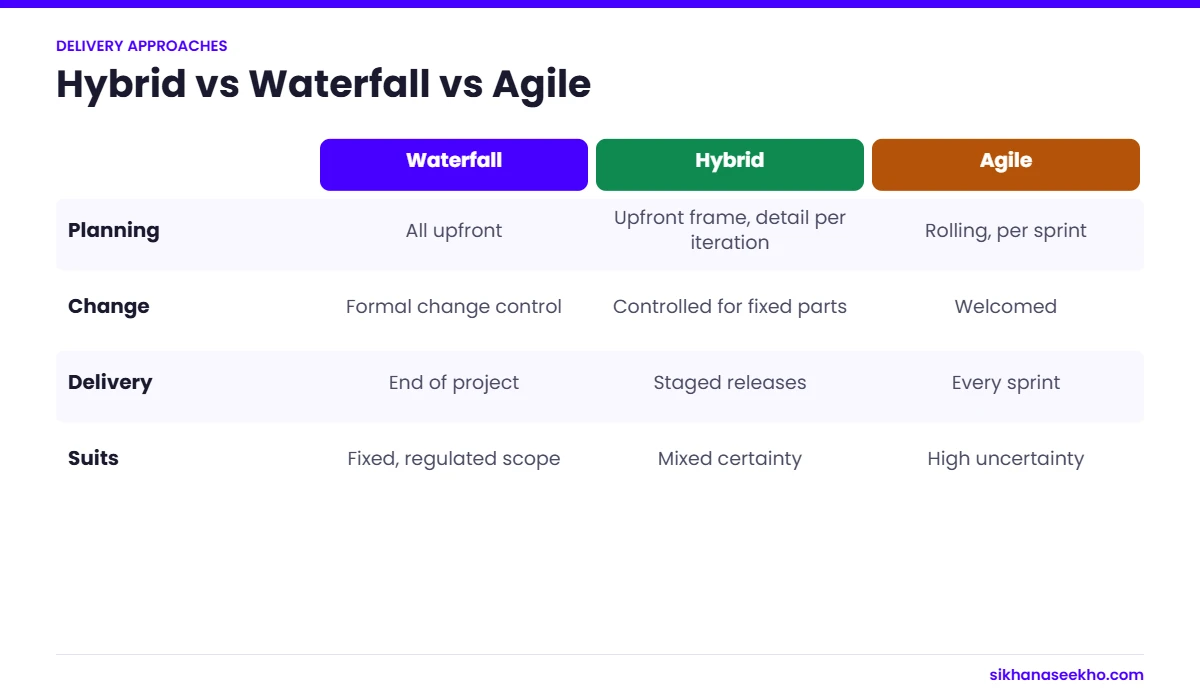
Hybrid combines predictive control with agile delivery.
It is not a compromise. It is not Waterfall with some post-its on the wall, and it is not Agile with a Gantt chart attached. A genuine hybrid approach deliberately assigns different methods to different components of the same project based on the nature of the work. The regulatory compliance workstream might follow strict phase gates. The customer-facing digital product being built alongside it might run in two-week sprints. Both are managed as one integrated project.
PMI's 2021 Pulse of the Profession report found that 71% of organisations use hybrid approaches, up from 60% in the previous survey. By 2026 that number has continued to rise. Pure Waterfall and pure Agile are now the minority positions. Hybrid is how most real projects are delivered.
💡
The key insight behind hybrid: not all work on a project is the same type of work. Infrastructure work, compliance deliverables and safety-critical components have fixed requirements and sequential dependencies. Customer-facing features, UX design and product decisions benefit from iteration and feedback. Hybrid lets you apply the right method to each type of work rather than forcing everything through a single framework that only fits part of the problem.
Predictive vs Adaptive: The Core Distinction
Understanding hybrid starts with understanding what the two parent approaches are actually good at, and where each one struggles.
Predictive (Waterfall)
Works best when
Scope is fully defined upfront
Changes are expensive or dangerous
Regulatory approval is required at each stage
Sequential dependencies must be respected
The technology is well understood
Adaptive (Agile)
Works best when
Requirements will evolve through customer feedback
Speed to market matters more than comprehensive planning
The team is small, co-located and experienced
Stakeholders can engage continuously
Failure is safe and cheap to recover from
Hybrid
Works best when
Some parts of the project are fixed, others are not
Governance requires stage gates AND the team needs to iterate
Multiple workstreams run in parallel with different natures
The organisation is transitioning from Waterfall to Agile
External constraints (contracts, regulation) restrict part of scope
02: When to Use It
When Should You Use Hybrid Project Management?
The decision to use hybrid should be driven by project characteristics, not by personal preference or organisational fashion. I have seen teams adopt hybrid because it sounded modern and end up with all the overhead of both methods and the benefits of neither. The trigger should always be a genuine mismatch between the nature of the work and what a single methodology can accommodate.
Pharmaceutical trials, financial compliance systems, government contracts and construction projects often have legal requirements that mandate sequential approval gates. The deliverables that carry those requirements use Waterfall. Everything customer-facing or configurable uses Agile sprints.
Hardware-software integration projects
Manufacturing a physical product requires fixed design, prototyping and production sequences. The embedded software or digital interface running on that hardware can be developed iteratively. The hardware and software workstreams run in parallel using different methods and converge at integration milestones.
Large enterprise transformation programmes
ERP implementations, infrastructure migrations and digital transformation programmes typically have a core infrastructure layer (predictive) and a change management and training layer (adaptive). Organisations transitioning from Waterfall to Agile culture also use hybrid as a managed stepping stone during the transition period.
Fixed external constraints on part of scope
Fixed-price contracts with a client often make pure Agile impossible for the whole project because the contract defines scope and cost upfront. The contractual deliverables run on Waterfall. Internal process improvements, testing approaches and delivery optimisations within the engagement use Agile practices.
Multiple teams with different working styles
A vendor delivering infrastructure may insist on a Waterfall contract. Your internal development team insists on Agile. The integration point between them requires a hybrid interface: predictive milestones that the Agile team delivers through iterative sprints, reported at fixed governance intervals.
PMO governance requires phase gates
Many PMOs mandate phase-gate reviews regardless of delivery method. The Agile delivery team works in sprints between gates. At each gate the PM presents a predictive summary of progress, forecasts and risks. The delivery is Agile. The governance is Waterfall. That is a valid and very common hybrid pattern.
⚠️
When not to use hybrid. If the project scope is fully knowable upfront and sequential delivery is genuinely the lowest-risk approach, Waterfall is the right choice. If the scope is almost entirely exploratory and the stakeholders can engage continuously in sprint reviews, pure Agile is cleaner. Hybrid adds coordination overhead between workstreams. That overhead is worth it when the project genuinely needs both approaches. It is not worth it when you just want to use both methods because they both sound useful.
03: Comparison
Hybrid vs Waterfall vs Agile: Side by Side
I teach all three of these approaches in my PMP training sessions. Students from the UK, UAE, USA and Australia all ask the same question: which one is right? The honest answer is that the question itself is slightly wrong. Here is how the three actually compare across the dimensions that matter.
Dimension
Waterfall (Predictive)
Agile (Adaptive)
Hybrid
Scope definition
Fixed upfront, fully documented
Evolves through iterations and feedback
Fixed for some components, evolving for others
Change management
Formal change control, slow and expensive
Changes welcomed at any sprint boundary
Formal control for predictive workstream, flexible for adaptive workstream
Planning horizon
Full project planned upfront
Sprint-by-sprint with rolling backlog refinement
Full predictive plan for fixed scope, rolling wave for adaptive scope
Team structure
Functional specialists in sequence
Cross-functional self-organising team
Mixed: specialist teams for predictive work, cross-functional squads for adaptive work
Stakeholder engagement
Heavy at start and end, lighter in middle
Continuous throughout all sprints
Governance reporting at phase gates plus sprint reviews for adaptive workstream
Risk management
Identified and mitigated upfront
Managed continuously through frequent delivery
Formal risk register for predictive component, continuous risk management for adaptive
Success measurement
Delivered to scope, on time, on budget
Value delivered per sprint, customer satisfaction, velocity
Phase-gate metrics for predictive workstream, velocity and value metrics for adaptive
Best for
Construction, infrastructure, compliance
Software products, digital services, innovation
Digital transformation, enterprise tech, mixed-nature programmes
04: The Four Hybrid Models
The Four Main Hybrid Models
Hybrid is not a single methodology. It is a category of approaches. Within that category there are four main patterns, each suited to different project types. Knowing which model fits your project is more important than knowing which tools to use. The tools follow the model. The model follows the work.
Model 01
Sequential Hybrid
Waterfall first, then Agile
The project uses Waterfall for the early foundational phases (requirements, architecture, procurement, regulatory approvals) and then switches to Agile sprints for the delivery and testing phases once the foundation is stable. The two methods run in sequence, not in parallel.
Best for:
Digital product projects where the platform architecture must be specified and approved before the product team can iterate on features. Also common in cloud migration projects where the migration plan is Waterfall but the optimisation and configuration phase runs in sprints.
Model 02
Parallel Hybrid
Both methods running simultaneously
Two separate workstreams run at the same time. The predictive workstream manages the fixed infrastructure, compliance or hardware components. The adaptive workstream manages the iterative digital, software or customer-facing components. They converge at defined integration milestones.
Best for:
A bank building a new mobile banking platform: the core banking infrastructure integration is Waterfall (fixed APIs, security, regulatory compliance). The app features run in Agile sprints with frequent user testing. Both workstreams run simultaneously and converge at UAT.
Model 03
Iterative Hybrid
Agile delivery within Waterfall phases
The overall project follows a Waterfall structure with formal phase gates. Within each phase the team delivers through Agile sprints. The PMO sees Waterfall reporting at governance level. The delivery team works iteratively day to day. This is the most common corporate hybrid pattern.
Best for:
Large organisations with mandatory PMO stage gates that want Agile delivery cadence. The Execution phase has a fixed start and end date (Waterfall) but delivery happens through 10 two-week sprints (Agile). Progress is reported at the Waterfall phase gate using Agile velocity data.
Model 04
Rolling Wave Hybrid
Progressive elaboration of plan
Near-term work is fully planned in Waterfall-style detail. Work further out is planned at a high level and elaborated progressively as it approaches. This recognises that detailed planning far in advance is often wasted effort because scope will change. The level of planning adapts to the planning horizon.
Best for:
Long-duration programmes (12 to 36 months) where early phases can be planned in detail but later phases depend on the outcomes of earlier work. Common in research-heavy projects, product development programmes and large infrastructure projects with multiple unknowns.
📌
Most projects use a combination of these models. A large digital transformation programme might use Sequential Hybrid for the data migration (Waterfall foundation, then Agile delivery), Parallel Hybrid for the legacy system decommission running alongside the new platform build, and Rolling Wave Hybrid for the overall programme planning horizon. The models are not mutually exclusive. Apply the one that fits each component.
05: Implementation
How to Implement Hybrid Project Management
This is where most teams struggle. They decide to go hybrid and then start mixing methods without a clear framework for how the two approaches connect, how decisions cross the boundary between workstreams and how governance works across both. Here is the six-step implementation process I walk teams through.
1
Audit the project scope: fixed vs flexible
Go through every major deliverable and ask one question: is the requirement fixed and knowable now, or will it need to emerge through feedback and iteration? Fixed requirements go to the predictive workstream. Emergent requirements go to the adaptive workstream. If a deliverable has both fixed and flexible elements, split it at the component level. This classification is the foundation of your hybrid design. Get it wrong and the rest of the framework will not help you.
2
Choose the right hybrid model
Based on your audit, select the model that fits. If the fixed work must be complete before the adaptive work can begin, Sequential Hybrid. If they can run simultaneously, Parallel Hybrid. If your PMO requires phase gates but the team needs to iterate, Iterative Hybrid. If the project is long and complex with evolving scope in later phases, Rolling Wave. Document your choice and the reasoning. You will need to explain it to sponsors, PMO leaders and team members who have not encountered hybrid before.
3
Design the governance bridge
This is the most critical design decision in a hybrid project. The governance bridge is the set of rules that determines how the Waterfall workstream and the Agile workstream communicate, how progress is reported across both, what happens when a decision in one workstream affects the other, and what the escalation path is when conflicts arise. Specifically you need: a defined integration milestone schedule, a reporting template that translates Agile sprint metrics into Waterfall phase-gate language, a clear owner for each workstream and a defined decision authority matrix for cross-workstream decisions.
4
Set up the hybrid toolkit
Your tools need to support both methods. A single tool that does both reasonably well is better than two separate tools that do not talk to each other. Options vary by scale and budget. At minimum you need a Gantt chart or project schedule for the predictive workstream milestones, a sprint board (Kanban or Scrum board) for the adaptive workstream, and a shared risk and issue register that captures risks from both workstreams. The section below covers specific tool recommendations for hybrid projects.
5
Train both teams in the shared framework
The Waterfall team needs enough Agile literacy to understand sprint reviews, backlog management and iterative delivery so they can work alongside the Agile workstream without treating every sprint change as a scope creep event. The Agile team needs enough governance literacy to understand phase gates, change control and predictive reporting so they do not assume every constraint is bureaucracy to be resisted. Both teams need to understand the governance bridge before the project starts, not after the first conflict arises.
6
Run a detailed retrospective at the first integration point
The first time the two workstreams formally connect is where hybrid projects most often fail. The Agile team has been iterating. The Waterfall team has been following a plan. At the integration milestone those two realities have to mesh. Run a structured retrospective at that first integration point before proceeding. What worked? What caused friction? What needs to change in the governance bridge? The adjustments you make after the first integration point will save far more time than any amount of upfront planning.
06: Hybrid Frameworks
Established Hybrid Frameworks
You do not have to design your hybrid approach from scratch. Several established frameworks provide ready-made structures for combining predictive and adaptive methods. Here are the four most widely recognised ones.
PRINCE2 Agile
PRINCE2 Agile is the most formal and structured hybrid framework available. It takes PRINCE2's governance structure: roles (Project Board, Project Manager, Team Manager), principles (continued business justification, defined roles, manage by exception) and stage-gate process, and integrates Agile delivery techniques from Scrum and Kanban within each stage. The Project Manager uses PRINCE2 for governance and reporting. The delivery team uses Agile sprints to produce the stage products. This is the framework I recommend most for UK and European organisations that already operate in a PRINCE2 environment and want to add Agile delivery capability without dismantling their governance structure. See our PRINCE2 certification guide for more detail.
SAFe (Scaled Agile Framework)
SAFe is a hybrid framework designed for large organisations running multiple Agile teams that still need portfolio-level governance and budget control. It operates at three levels: Team (Agile sprints), Programme (Agile Release Train, PI Planning) and Portfolio (Lean portfolio management with investment themes and budget guardrails). The portfolio level provides the predictive governance. The team level delivers iteratively. SAFe is the most widely adopted hybrid framework for enterprise technology delivery. It is also the most complex and requires significant investment to implement well.
PMI's Hybrid Approach
PMI's PMBOK 7th edition takes a principles-based approach that explicitly accommodates hybrid delivery. It replaces the previous process-group structure with eight performance domains and twelve project management principles that apply regardless of whether the project is predictive, adaptive or hybrid. The Agile Practice Guide (jointly published by PMI and the Agile Alliance) provides detailed guidance on hybrid tailoring. The PMP exam since 2021 tests hybrid scenarios directly: approximately 50% of PMP exam questions now relate to Agile or hybrid approaches.
Spotify Model
The Spotify Model is not a formal methodology but it has influenced how many organisations structure hybrid delivery. It uses Squads (small cross-functional Agile teams), Tribes (clusters of squads working on related areas), Chapters (functional communities of practice) and Guilds (interest groups). The model combines Agile delivery at team level with loose coordination governance at tribe level. It works well for technology product organisations but requires a genuinely mature Agile culture and does not map directly to traditional project governance.
💡
Choose the framework that fits your governance context. PRINCE2 Agile for UK and European regulated environments. SAFe for large enterprises with multiple Agile teams needing portfolio governance. PMI hybrid for PMP-trained PMs working in international environments. Do not choose a framework because it sounds impressive. Choose it because your organisation's governance requirements and team maturity align with what the framework actually demands. I have seen SAFe implementations collapse in organisations that had not yet mastered basic Scrum.
07: Tools
Tools for Hybrid Project Management
Choosing tools for a hybrid project is harder than for a pure Waterfall or pure Agile project because you need to support two genuinely different working styles simultaneously. The goal is the minimum number of tools that cover both workstreams without creating a data reconciliation problem between them.
Tool
Hybrid Capability
Best For
Limitation
Microsoft Project
Strong Waterfall Gantt, basic sprint boards via Tasks
Organisations already in Microsoft 365 ecosystem; PMO-led hybrid governance
Sprint board experience is weak compared to dedicated Agile tools
Jira
Strong Agile sprint boards plus roadmap view for predictive planning
Software development-led hybrid projects; teams comfortable with Atlassian
Gantt and resource management weaker than MS Project; can be complex to configure
Monday.com
Flexible: both Gantt and Kanban board views on same data
Teams needing a visually simple tool that spans both methods without heavy configuration
Less powerful at the edges: not as strong as MS Project for complex scheduling or Jira for Agile sprint management
ClickUp
Multiple views: Gantt, Kanban, List, Calendar all available on same tasks
Teams wanting one tool to replace multiple tools; strong for parallel hybrid workstreams
Feature density can overwhelm teams new to hybrid; requires discipline to keep structured
Azure DevOps
Full Agile sprint management plus work item tracking linkable to milestones
Enterprise software delivery in Microsoft technology stack; integrates with MS Project
Strong for tech teams; less accessible for non-technical workstream managers
Wrike
Gantt, Kanban and custom workflow views; strong reporting for mixed teams
Marketing, agency and creative hybrid projects; mixed technical and non-technical teams
Less specialised than Jira for software Agile; pricing scales quickly with features
📌
The shared risk register is more important than the sprint board. In hybrid projects the biggest tool gap I see is not in planning or task management. It is in risk management. The Waterfall workstream maintains a risk register. The Agile workstream discusses risks in retrospectives. Neither feeds the other. Use one shared risk and issue register for the entire project, owned by the PM, updated by both workstreams. Download our free Risk Register template as your starting point.
08: Common Mistakes
Five Hybrid PM Mistakes I See Teams Make
I have trained PMs from 20-plus nationalities and the same five mistakes appear across every geography and sector when teams first attempt hybrid delivery. Here they are, with the fix for each one.
❌
Using hybrid because it sounds better than admitting you are doing Waterfall
Many organisations label their projects hybrid because it sounds more modern than saying they are doing traditional project management. In reality they are running a sequential Waterfall project with one Agile sprint at the end for testing. That is not hybrid. That is Waterfall with better branding. Calling it hybrid creates confusion for the team and false expectations for stakeholders.
Fix: Be honest about what each part of the project actually is. If 90% of the work is predictive and 10% is a sprint-based testing cycle, call it a predictive project with iterative testing. Reserve the hybrid label for projects that genuinely have substantial components of both methods.
❌
No governance bridge between the two workstreams
The two workstreams run in isolation. The Waterfall team does not understand why the Agile sprint results are changing scope. The Agile team does not understand why the Waterfall phase gate is creating blockers. Nobody owns the integration point. At the first milestone where the two workstreams connect, everything stops while people argue about whose fault the mismatch is.
Fix: Design the governance bridge before work starts. Define integration milestones, cross-workstream decision authority, escalation paths and a shared reporting format. The PM owns the bridge. Both workstream leads report into it.
❌
Applying Agile change tolerance to the Waterfall workstream
The Agile team's culture of welcoming change bleeds into the Waterfall workstream. Requirements that were fixed and approved start being revisited because the Agile team found a better way. The Waterfall workstream has already built downstream dependencies on those requirements. Changes cascade. Cost and schedule impact spreads. The PM loses control of the predictive components.
Fix: Be explicit from day one about which components are frozen and why. The predictive workstream uses formal change control. The adaptive workstream uses backlog management. The boundary between them is firm and documented in the project management plan.
❌
Trying to run hybrid with Waterfall-only tooling
The project uses MS Project for the full plan. Sprint backlogs are managed in Excel or on a physical whiteboard. The Agile team's progress is invisible to the Waterfall schedule. The PM cannot see whether the sprint team is on track to deliver for the integration milestone. By the time the problem is visible it is too late to recover the schedule.
Fix: Use one tool that supports both workstreams, or use two connected tools with a defined synchronisation point at integration milestones. The PM must have visibility of both workstreams in near-real-time, not just at reporting dates.
❌
Not training both teams in the other method
The Waterfall team thinks Agile means no planning and no accountability. The Agile team thinks Waterfall means bureaucracy and slow decision-making. Neither team respects the other's approach. Cross-workstream collaboration breaks down. The integration points become political events rather than technical milestones.
Fix: Run a half-day joint session before the project starts. The Waterfall team gets a practical introduction to sprint ceremonies and what the Agile team's output looks like. The Agile team gets a walkthrough of the phase-gate reporting structure and why it exists. Mutual understanding does not mean agreement. It means both teams know how to work alongside each other.
09: PMP Exam Angle
Hybrid Project Management on the PMP Exam
This is important for anyone preparing for the PMP. Since PMI updated the exam in January 2021, hybrid approaches have been tested directly and extensively. The current PMP Exam Content Outline states that approximately 50% of exam questions relate to Agile or hybrid approaches. That is not a minor topic you can skip. It is half the exam.
The PMP tests hybrid in specific ways. You need to know how to select the right approach (predictive, Agile or hybrid) for a given project scenario. You need to know how to manage change in a hybrid environment: what gets formal change control and what goes through backlog management. You need to understand how to report progress across both workstreams to a steering committee. And you need to know when to escalate from the adaptive workstream into the predictive governance structure.
🏅
PMP exam tip on hybrid questions. When the exam presents a scenario where a project has both fixed requirements and customer-facing iterative delivery, the correct answer almost always involves using the right method for each component rather than forcing everything into one approach. PMI rewards tailoring: assessing the situation and applying the appropriate tools and techniques. In hybrid scenarios, look for answers that protect the predictive components with formal change control while allowing the adaptive components to flex. Answers that apply a single rigid methodology to a mixed-nature project are almost always wrong on the 2026 PMP exam. See our 200 PMP practice questions for hybrid and Agile scenario practice.
Key Hybrid Concepts Tested on the PMP
Know these cold
Hybrid PMP Topics
Tailoring: selecting the right approach for each project component
Rolling wave planning: elaborating predictive components progressively
Iterative delivery within predictive phase-gate governance
Change management in hybrid: formal vs backlog-based
Risk management across both workstreams
Stakeholder engagement in sprint reviews vs phase-gate presentations
Common exam traps
What PMP Candidates Get Wrong
Applying Agile change tolerance to fixed-scope components
Assuming Waterfall governance is always wrong in hybrid scenarios
Ignoring the stakeholder type when choosing the method (sponsor vs end user)
Treating hybrid as Waterfall with sprint ceremonies added
Not recognising when a question is testing tailoring vs a specific methodology
10: FAQ
Hybrid Project Management: FAQ
Hybrid project management combines predictive (Waterfall) and adaptive (Agile) methods in a single project or programme. It uses structured, sequential phases and formal change control where scope is fixed and certain, and iterative sprints where requirements need to emerge through collaboration and testing. Most real-world projects in 2026 use some form of hybrid rather than pure Waterfall or pure Agile. PMI's research shows 71% of organisations use hybrid approaches.
Use hybrid when a project has both fixed and flexible components. Common triggers are: regulatory constraints on some deliverables but customer-facing features that need iteration; hardware or infrastructure work that must be sequentially planned alongside software development that benefits from sprints; large organisations where governance requires phase-gate reporting but delivery teams work in sprints; fixed-price contracts covering part of the work while internal development runs adaptively; and projects with multiple vendor workstreams using different methods that must integrate at defined milestones.
Waterfall is predictive: all scope is defined upfront, work flows sequentially through phases and changes are formally controlled. It works best when requirements are fully known, sequential dependencies are real and changes are expensive. Agile is adaptive: scope evolves through iterative delivery cycles, requirements are refined continuously and teams self-organise. It works best when requirements will emerge through customer feedback and the team can deliver frequently. Hybrid combines both: predictive control for fixed scope components and adaptive iteration for exploratory or customer-facing components. The right blend depends on the nature of the work, not on personal preference.
A bank building a new mobile banking app is a classic example. The core banking infrastructure integration (APIs, security frameworks, regulatory compliance documentation) is managed with Waterfall because the requirements are fixed, the regulatory approvals are sequential and the risk of change is high. The customer-facing mobile app features are developed in two-week Agile sprints with frequent user testing because customer preferences evolve and the cost of changing a screen design is low. Both workstreams run in parallel with defined integration milestones where the Agile feature team connects to the Waterfall infrastructure team for end-to-end testing.
Yes. PRINCE2 Agile is an officially recognised hybrid framework from PeopleCert that combines PRINCE2's governance structure (roles, principles, stage-gate process) with Agile delivery techniques from Scrum and Kanban. The Project Manager uses PRINCE2 for governance, reporting and exception management. The delivery team uses Agile sprints to produce the products within each stage. It is well suited to UK and European regulated environments where formal project governance is required but iterative delivery is needed. See our PRINCE2 guide for certification details.
Yes, extensively. Since PMI updated the PMP exam in January 2021, approximately 50% of questions relate to Agile or hybrid approaches. The exam tests your ability to select the right approach for a given scenario, manage change across hybrid workstreams, report progress from both predictive and adaptive components to governance bodies, and apply the principle of tailoring: using the right method for the right type of work. Hybrid scenarios are among the most frequently mishandled question types. The key mindset PMI tests is that no single method is always right and that a good PM selects and blends approaches based on the project context.
Advantages: applies the right method to each component rather than forcing all work through a single approach; satisfies both governance and delivery team requirements; allows iterative discovery where scope is uncertain while maintaining control where it is not; supports organisations transitioning from Waterfall to Agile by using both in the same project. Disadvantages: requires more coordination overhead between workstreams; demands PM competence in both predictive and adaptive methods; can create confusion if the boundary between the two workstreams is not clearly defined; team members need cross-method literacy which takes time to develop; and poorly designed hybrid can produce all the bureaucracy of Waterfall and all the unpredictability of Agile with the benefits of neither.