Certifications PMP CertificationWorld’s top PM cert CSM — Certified ScrumMasterTop agile cert CAPMEntry-level PM cert PRINCE2UK & Europe standard View All Certifications ?
PM Guides Agile GuideComplete breakdown Scrum GuideRoles, ceremonies, artifacts EVM GuideAll formulas explained View All Guides ?
Career & Salary PM Salary 2026By country & level How to Become a PMStep-by-step roadmap 50 Interview QuestionsWith strong answers
PM Software Monday.com ReviewTop pick 2026 ClickUp ReviewBest value Best Free PM ToolsNo trials, truly free View All Software ?
Free Tools & Templates EVM CalculatorFree, no signup Gantt Chart MakerBuild & export free PMP Eligibility Checker30-second result Free PM Templates30 templates — Excel, Word, PDF
Get the Free PMP Guide ?
PMI Certification · Updated March 2026

PMI-ACP Certification Guide 2026
Agile Certified Practitioner

The PMI-ACP is the strongest cross-framework Agile certification available — covering Scrum, Kanban, XP, Lean and SAFe rather than a single framework. For experienced PMs working in hybrid environments, it is the most valuable Agile credential you can hold.

By Syed Mujeeb Rehman, PMP
📅Updated March 2026
15 min read
🏆Complete guide
Quick Answer

The PMI-ACP requires 8 months of Agile project experience, 12 months of general PM experience and 21 hours of Agile education. The exam is 120 questions in 3 hours and costs $435 (PMI member) or $495 (non-member). It covers Scrum, Kanban, XP, Lean and hybrid Agile — making it the most broadly recognised Agile credential for PMs working across multiple frameworks.

PMI-ACP at a Glance — 2026

PMI official requirements

$435
Exam fee (member)
$495
Exam fee (non-member)
8mo
Agile experience
21hrs
Agile education
120
Exam questions
30PDU
PDUs to renew (3yr)
7
Agile domains tested across multiple frameworks
8mo
Agile experience required — lower bar than PMP
30PDU
PDUs to renew — half the PMP's renewal requirement
$60
Net saving by joining PMI before applying
01 — Overview

What Is the PMI-ACP Certification?

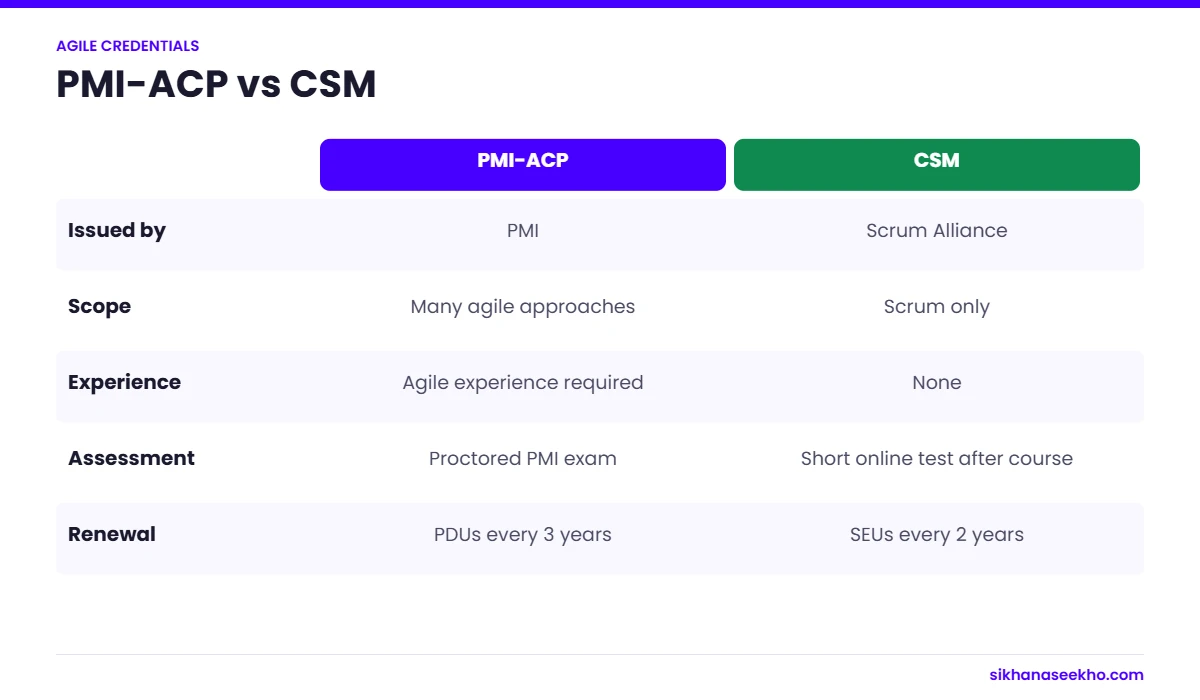
The PMI Agile Certified Practitioner (PMI-ACP) is PMI's primary Agile certification. Unlike CSM — which focuses exclusively on Scrum — or SAFe certifications that focus on a single proprietary framework, the PMI-ACP tests knowledge across multiple Agile frameworks and methodologies, including Scrum, Kanban, Lean, XP (Extreme Programming), and hybrid approaches.
This breadth is its defining strength. The PMI-ACP is particularly valuable for project managers working in hybrid Agile/traditional environments, programme managers coordinating teams using different frameworks, PMs transitioning from traditional PM into Agile roles, and anyone who needs a single Agile credential recognised by non-Agile employers and clients — not just those already inside the Agile community.

It is also the Agile credential that appears most frequently in enterprise job descriptions alongside the PMP — because hiring managers familiar with PMI naturally trust PMI's Agile credential more than they might a Scrum Alliance or Scaled Agile certification they are less familiar with.

💡
PMI-ACP vs CSM — which should you get? CSM is faster and cheaper (2-day course, easy exam). PMI-ACP requires more experience but tests deeper, broader Agile knowledge. For Scrum developers and team members, CSM is the faster route. For PMs working across multiple Agile approaches or in hybrid environments, PMI-ACP carries more weight. Many experienced practitioners hold both. See the full CSM guide →
02 — Eligibility Requirements

PMI-ACP Eligibility — What You Need to Apply

The PMI-ACP has three requirements. All must be met before submitting your application.

1
Secondary education or higher
High school diploma, GCSEs, A-levels or any equivalent. No degree required — unlike the PMP, there is no degree/experience trade-off for the PMI-ACP.
2
12 months of general project experience (within last 5 years)
General PM or project team experience — not necessarily Agile. This can overlap with your Agile experience below; it is not additional to it.
3
8 months of Agile project experience (within last 3 years)
Must be working on an Agile team — not simply being Agile-aware or attending Agile training. Scrum sprints, Kanban flow work and XP practices all count.
4
21 contact hours of Agile education
Formal Agile training from a structured course. A PMI-ACP prep course satisfies this requirement and prepares you for the exam simultaneously.
General PM Experience
12 months
Within last 5 years. Can overlap with Agile experience — not in addition to it.
Agile Project Experience
8 months
Within last 3 years. Must be actively working on an Agile team, not just Agile-aware.
Agile Education
21 contact hours
From a structured course. A PMI-ACP prep course satisfies this and prepares you simultaneously.
Application Process
Online via PMI
Submit at PMI.org. Applications may be audited — document your experience before applying.
Already hold the PMP? If you have your PMP, you almost certainly meet the general PM experience requirement already. You only need to confirm 8 months of Agile team experience and 21 hours of Agile education — making the PMI-ACP a natural companion credential for PMP holders.
03 — Exam Format

PMI-ACP Exam Format and Structure

The PMI-ACP exam is delivered via Pearson VUE — at a test centre or via online proctoring. Like the PMP, questions are primarily scenario-based: you are asked what the best Agile response would be in a given situation, not just what the definition of a term is.

DetailSpecification
Number of questions120 questions (some unscored pretest items)
Time allowed3 hours (180 minutes)
Question formatMultiple choice, multiple response, matching, drag-and-drop — scenario-based
Passing scoreNot disclosed — determined by psychometric analysis
DeliveryPearson VUE test centre or online proctored
Retakes3 attempts within 1-year eligibility window
LanguageEnglish

The 7 PMI-ACP Exam Domains

The PMI-ACP ECO (Exam Content Outline) defines seven domains. Questions are distributed across these domains — you must be competent in all of them, not just Scrum-specific content.

Agile Principles and Mindset~16%
Agile Manifesto values and principles, servant leadership, team empowerment and Agile mindset vs Agile process.
Value-Driven Delivery~20%
Prioritisation techniques (MoSCoW, Kano), MVP, incremental delivery, managing the backlog for value.
Stakeholder Engagement~17%
Managing stakeholders in Agile contexts, product owner collaboration, active stakeholder participation in reviews.
Team Performance~16%
High-performing Agile teams, team velocity, conflict resolution, building psychological safety and self-organisation.
Adaptive Planning~12%
Rolling wave planning, story point estimation, release planning, iteration planning vs upfront planning.
Problem Detection and Resolution~10%
Risk management in Agile, impediment removal, burn-down charts, using retrospectives to surface problems.
Continuous Improvement~9%
Retrospectives, process improvement, knowledge sharing, kaizen, reducing waste (Lean principles).
04 — Exam Cost

PMI-ACP Exam Cost 2026

The PMI-ACP is priced between the CAPM and PMP. Joining PMI before applying saves $60 on the exam — and membership gives you free access to the Agile Practice Guide (the primary PMI-ACP study reference).

Cost ItemPMI MemberNon-MemberNotes
PMI Membership$139/yr$0Saves $60 on exam + free Agile Practice Guide download ($29 value)
PMI-ACP Exam Fee$435$495Paid after application approval
21-Hour Agile Course$49 – $500Required for application. PMI-ACP Udemy courses from $49. Satisfies the 21-hr requirement.
Study Books$0 (free with membership)$29 – $80Agile Practice Guide free with PMI membership. Mike Griffiths' PMI-ACP Exam Prep ~$60.
Practice Simulator$0 – $99Free questions at Sikhana Seekho. PM PrepCast ACP edition from $79.
Retake Fee$345$395Per attempt. Up to 3 attempts within 1-year window.
💰
Minimum realistic total: PMI membership ($139) + member exam fee ($435) + Udemy course ($49) = approximately $623. Add the free Agile Practice Guide (with membership) and free practice questions from Sikhana Seekho and you have a complete study package for under $650.
05 — How to Prepare

PMI-ACP Study Guide — How to Prepare and Pass

Most candidates prepare in 6–10 weeks of part-time study. The PMI-ACP is scenario-based like the PMP — rote memorisation is not enough. You need to understand how Agile principles apply in complex real-world situations.

Step 1 — Download the Agile Practice Guide

Download the PMI Agile Practice Guide from PMI.org (free with membership). This is PMI's official Agile reference and the closest thing to the PMI-ACP's "PMBOK" — read it thoroughly. Sections on Agile frameworks, hybrid approaches and tailoring are particularly important for the exam.

Step 2 — Complete Your 21-Hour Agile Course

Choose a PMI-ACP-specific prep course, not a general Agile course. Mike Griffiths' PMI-ACP course on Udemy is the most widely recommended. It covers all seven exam domains with scenario-based examples, satisfies the 21-hour requirement and provides an excellent framework for self-study.

Step 3 — Study Across All Frameworks

The PMI-ACP tests Scrum, Kanban, XP, Lean and hybrid approaches — not just Scrum. Many candidates who know Scrum well underestimate the XP and Lean content. Ensure you are comfortable with: Kanban's WIP limits, flow metrics and cadences; XP practices (pair programming, TDD, continuous integration, refactoring); and Lean's waste reduction and value stream concepts.

Step 4 — Practise Scenario Questions

Complete at least 400 scenario-based practice questions before your exam. PMI-ACP scenarios test Agile mindset — the "Agile purist" answer is almost always favoured over the pragmatic or process-heavy answer. When in doubt, ask: "What would a servant leader do? What prioritises team autonomy and customer collaboration?"

Recommended study timeline: Week 1–2: read Agile Practice Guide and complete the 21-hour course. Week 3–4: domain deep-dive — Scrum, Kanban, XP, Lean. Week 5–6: scenario questions and weak-domain review. Week 7–8: full mock exams. Book when scoring 72%+ consistently on full timed mocks.
06 — PMI-ACP vs CSM

PMI-ACP vs CSM — Which Should You Get?

FactorPMI-ACPCSM
IssuerPMIScrum Alliance
Frameworks coveredScrum, Kanban, XP, Lean, SAFe, hybridScrum only
Experience required8 months Agile + 12 months PMNone required
Exam120 questions, 3 hours, rigorous50 questions, easy, usually passes at course end
Exam fee (member)$435~$195 (included in 2-day course ~$995)
Validity3 years (30 PDUs)2 years (20 SEUs)
Employer recognitionStrong — recognised by non-Agile employersGood — most recognised Scrum cert
Best forExperienced PMs, hybrid environmentsDevelopers, team members, Scrum teams
DifficultyHard — scenario-basedEasy — attendance + quiz
📌
Decision rule: If you are a developer or team member new to Scrum — get the CSM first, it is faster and cheaper. If you are an experienced PM who works across multiple Agile frameworks or needs a credential employers outside the Agile bubble will recognise — PMI-ACP. Many senior practitioners hold both.
07 — Alternatives

PMI-ACP vs Other Agile Certifications 2026

CertificationIssuerScopeDifficultyBest For
PMI-ACPPMIMulti-frameworkHardExperienced PMs, hybrid environments
CSMScrum AllianceScrum onlyEasyTeam members, Scrum practitioners
PSM IScrum.orgScrum onlyHard (85% pass mark)Serious Scrum practitioners wanting rigour
SAFe Agilist (SA)Scaled AgileSAFe frameworkModerateEnterprise PMs in SAFe organisations
PRINCE2 AgileAxelos/PeopleCertPRINCE2 + Agile hybridRigorous two-levelUK/European PMs needing governance + Agile
ICP-ACCICAgileAgile coachingModerateAgile coaches and change agents
🏆
Our recommendation: For most PM-track professionals — PMI-ACP is the best Agile credential alongside the PMP. For Scrum-only environments — PSM I (Scrum.org) is more rigorous than CSM. For UK public sector — PRINCE2 Agile. For enterprise at scale — SAFe Agilist. See the full certifications ranked guide →
08 — Renewal & Maintenance

PMI-ACP Renewal — PDUs and Maintenance

The PMI-ACP is valid for 3 years. To renew, you must earn 30 PDUs and pay the renewal fee. This is half the PMP's 60 PDU requirement, making the PMI-ACP significantly easier to maintain.

PDUs Required
30 PDUs
Every 3 years. At least 18 must be in Agile topics (Education category).
Renewal Fee
$60 (member)
$150 for non-members. PMI membership makes renewal significantly cheaper.
Free PDU Sources
Many available
PMI webinars, chapter events, reading PM books, attending Agile events, writing articles.
If Credential Lapses
Must retake exam
No reinstatement option — set PDU reminders well before the 3-year deadline.
💡
Combine with PMP renewal: If you hold both PMI-ACP and PMP, you can use the same PDUs toward both renewal requirements — up to 30 PDUs can count for both. This makes dual-credential maintenance very efficient.
09 — Study Resources

Best PMI-ACP Study Resources 2026

ResourceTypeCostWhy Use It
PMI Agile Practice GuideReference textFree (PMI member)Primary exam reference — download free with $139 PMI membership. Read cover to cover.
Mike Griffiths PMI-ACP Exam Prep (Udemy)Video course — 21+ hrs$19–$49Best-in-class PMI-ACP course. Satisfies 21-hr requirement and covers all 7 domains.
Mike Griffiths PMI-ACP Exam Prep (book)Study book~$60The definitive PMI-ACP prep book — written by a PMI-ACP co-author. Highly recommended.
Sikhana Seekho Practice QuestionsFree question bankFreeScenario-based Agile practice questions with detailed explanations and domain mapping.
PM PrepCast (PMI-ACP edition)Practice simulator$79–$99Most realistic PMI-ACP simulation — 800+ scenario questions across all 7 domains.
PMBOK Guide (Agile sections)Reference textFree (PMI member)Supplement to Agile Practice Guide — useful for hybrid Agile/predictive content on the exam.
10 — FAQ

PMI-ACP — 8 Questions Answered

Yes — particularly for experienced PMs working in hybrid environments. The PMI-ACP is recognised by employers familiar with PMI credentials (which is most large organisations and enterprises) and demonstrates cross-framework Agile competence rather than single-framework proficiency. If you work primarily in pure Scrum software teams, CSM or PSM I may be more directly relevant. If you are a programme manager or PM working across multiple teams and approaches, PMI-ACP is the stronger credential.
Yes — the PMI-ACP has no prerequisite relationship with the PMP. They are fully independent credentials. Many practitioners hold both, and the order does not matter. If you are earlier in your PM career, the PMI-ACP's lower experience requirement (8 months Agile, 12 months general PM) may make it more accessible before you have the 36 months of project leadership required for the PMP.
Harder than the CSM, but not as hard as the PMP. Most candidates rate it a 6–7 out of 10 in difficulty. The main challenges are: the scenario-based format requires Agile mindset application rather than recall; the breadth of frameworks tested (Scrum is not enough); and the "Agile purist" bias in correct answers — answers that reflect command-and-control, heavy documentation or manager-driven decision-making are almost never correct. Candidates who study thoroughly for 6–8 weeks pass comfortably.
PMI-ACP is broader and more rigorous — it tests across multiple Agile frameworks rather than a single proprietary framework. SAFe certifications (SA, SPC, RTE) are deep and framework-specific, most valuable in organisations that have adopted SAFe at scale. If you work in a SAFe organisation, a SAFe certification is directly useful for your daily work. If you work across multiple approaches or want a credential recognised outside the Agile community, PMI-ACP carries more weight with traditional PM employers and hiring managers.
PMI does not publish official pass rate data. Based on candidate reports, the estimated first-attempt pass rate for well-prepared candidates is around 65–75%. The most common reason for failure is underestimating the breadth of frameworks tested (especially XP and Lean content) and relying on Scrum knowledge alone. Candidates who complete a structured 21-hour course and practise 400+ scenario questions before sitting consistently perform well.
30 PDUs every 3 years — half the PMP's 60 PDU requirement. At least 18 of the 30 must be in Agile topics (Education category). Free PDU sources include PMI webinars, PMI chapter events, reading PM/Agile books, writing articles and presenting at events. The renewal fee is $60 for PMI members and $150 for non-members. If you hold both PMP and PMI-ACP, PDUs earned can count toward both renewal requirements.
Mike Griffiths' "PMI-ACP Exam Prep" is widely considered the definitive study book for the PMI-ACP — Griffiths was one of the PMI-ACP's co-creators and the book reflects exactly what the exam tests. The PMI Agile Practice Guide (free with PMI membership) is the official reference and should be read alongside it. For video content, Mike Griffiths' Udemy course is the most highly rated option.
Yes — the PMI-ACP is available via Pearson VUE online proctoring. You can sit the exam from home with a webcam, stable internet connection, a quiet private room and a clean desk. No notes, books or second monitors are permitted. The online proctored experience is identical to the test centre version. Many candidates prefer it for convenience, though some prefer the test centre environment to eliminate home distractions.