
The APM PMQ (Project Management Qualification) is the intermediate-level certification from the Association for Project Management, the UK's only chartered professional body for project management. It is designed for project managers with around 2–3 years of experience and assesses applied competence across 24 learning objectives and 73 learning outcomes aligned to the APM Competence Framework. The exam is 2.5 hours, 40 questions, 90 marks, in a mixed format: multiple response, select-from-list, short response and long response. The PMQ sits at RQF Level 4 / SCQF Level 7, is recognised internationally as equivalent to IPMA Level D, and forms the core step on the pathway to Chartered Project Professional (ChPP) status, the highest professional recognition in UK project management.
If you are a project manager in the UK, the APM PMQ is likely to appear in almost every job description for roles above entry level. The Association for Project Management has been the professional home of UK project managers since 1972, and its PMQ is widely considered the definitive mid-career qualification, the point at which a practising PM formalises and validates their knowledge across the full breadth of project management competencies.
The PMQ went through a significant transformation in 2024. The old three-hour, ten-essay exam format, which many candidates found more a test of typing speed and stamina than project management knowledge: was replaced with a modernised mixed-format assessment. The new format is more accessible while remaining genuinely challenging, and it tests application rather than recall.
This guide covers everything you need to know about the APM PMQ in 2026: what it is, who it is for, eligibility requirements, the full exam format breakdown, the 24 learning objectives, what it costs, how it compares to PMP and PRINCE2, and a practical study strategy for passing first time.
What Is the APM and Why Does Its Qualification Matter?
The Association for Project Management (APM) is the only chartered professional body for project management in the UK, granted its Royal Charter in 2017. This chartered status sets it apart from other certification bodies, the APM is not a commercial training organisation but a professional institution, equivalent in status to the Chartered Institute of Accountants or the British Medical Association in their respective fields.
For UK project managers, this matters enormously. The APM's Chartered Project Professional (ChPP) designation is the highest level of professional recognition available in UK project management. The PMQ is the critical mid-point on the pathway to ChPP. It is the qualification that demonstrates you have the breadth of PM knowledge required to work effectively on complex projects across any industry.
The APM is also the UK affiliate of IPMA (International Project Management Association), a global network of 70+ national project management associations. APM qualifications therefore carry international recognition through the IPMA framework, the PMQ is equivalent to IPMA Level D (Certified Project Management Associate).
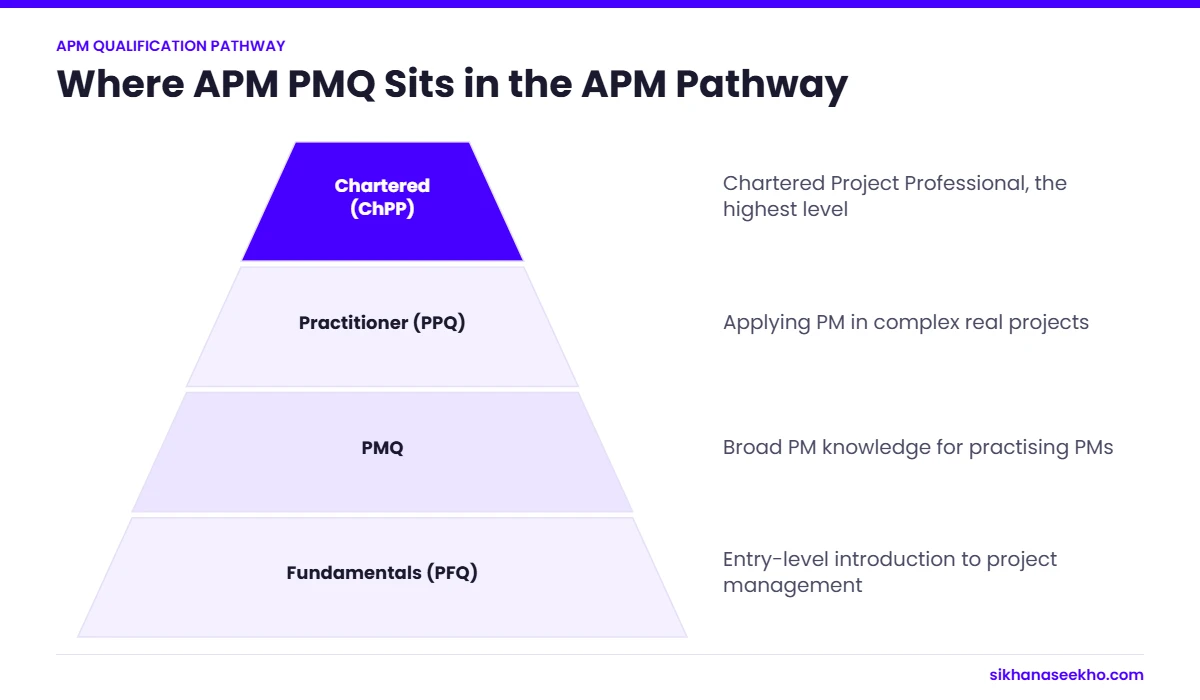
The APM Qualification Pathway: Where PMQ Sits
The PMQ sits in the middle of a structured career pathway. Each step has a different level of experience requirement and depth of assessment.
APM PFQ (Project Fundamentals Qualification) is the entry-level qualification: 60 multiple choice questions in 60 minutes, requiring 36 correct to pass. No prior experience required. Suitable for people new to project management or project team members wanting foundational knowledge.
APM PMQ (Project Management Qualification), this guide's focus, is the intermediate qualification for practising project managers with 2–3 years of experience. It is the main professional qualification in the APM pathway and the gateway to chartered status.
APM PPQ (Project Professional Qualification) is a higher-level qualification for experienced senior PMs. It involves both an examination and a substantial work-based assessment: candidates must demonstrate professional-level competence across complex, real projects.
APM ChPP (Chartered Project Professional) is the highest professional recognition the APM offers. It requires substantial experience, a rigorous assessment interview and ongoing CPD commitment. Only a minority of project managers pursue ChPP, but it is the pinnacle of the profession in the UK.
APM PMQ Eligibility: Who Should Take This Qualification?
The APM does not mandate strict prerequisite qualifications for the PMQ. There is no formal requirement to hold the PFQ first. However, the PMQ is explicitly not an entry-level qualification. The exam and syllabus assume you have practical project management experience that you are building knowledge around.
| Eligibility Factor | Requirement | Notes |
|---|---|---|
| Experience required | Typically 2–3 years of project management experience | Not formally checked at registration but expected for success, the exam tests applied knowledge, not theory |
| Prior qualification | None formally required | APM PFQ is recommended but not mandatory. PRINCE2 Practitioners qualify for a shorter study pathway |
| Training requirement | No mandatory training hours (unlike PMP) | You can self-study and sit the open online exam without attending a training course |
| PRINCE2 Practitioners | Eligible for shortened study pathway | APM recognises prior PRINCE2 Practitioner learning: shorter course and exam option may be available through some providers |
| Apprentices and students | Eligible if pursuing a project management apprenticeship or degree | APM explicitly includes apprenticeship and degree candidates as suitable PMQ candidates |
| Industry sector | Any sector | The PMQ is methodology-agnostic, it is relevant to construction, IT, defence, healthcare, finance, public sector, rail, any industry that runs projects |
| Nationality / location | No restriction: online exam available worldwide | Particularly relevant for UK-based PMs. Recognised internationally through IPMA Level D equivalence |
The APM's honest guidance: If you have fewer than 2 years of project management experience, consider the APM PFQ first. If you have significant general business experience but limited PM-specific experience, the PMQ may still be appropriate, but expect the scenario-based questions to challenge you more than they would an experienced PM.
APM PMQ Exam Format 2026: The Complete Breakdown
The current exam format was introduced in August 2024: replacing the old three-hour, ten-essay format that many candidates found punishing. The new format is genuinely mixed: it tests both knowledge (through multiple choice and select-from-list questions) and application (through short and long written responses). Understanding the format in detail is essential preparation.
The Pass Mark: Variable (Modified Angoff Method)
There is no fixed pass mark. APM uses the modified Angoff method: the pass mark is set based on the difficulty of each specific paper. This means the pass mark varies slightly from sitting to sitting. In practice, candidates are typically told to aim for approximately 55% as a working target, though the actual pass mark may be slightly higher or lower for a given paper.
The variable pass mark reflects APM's commitment to fairness, a harder paper has a lower pass mark, an easier paper a higher one. It prevents luck determining results and rewards genuine competence.
The Two-Part Structure
The exam is split into two parts. Candidates may take an optional break of up to 30 minutes between Part 1 and Part 2:this break time is in addition to the 2.5-hour exam time. Once Part 1 is submitted, candidates cannot return to it. The break is optional, use it only if you find the mental break beneficial; do not use it to review Part 1 answers as they are locked.
Delivery: Online Remote Proctored
The exam is taken online under remote proctoring. Candidates need a computer with a webcam and stable internet connection. The exam can be taken at home or in the office. It is closed book: no study materials are permitted during the exam. The online format means candidates can sit the exam within 12 months of completing their training course, at a time of their choosing.
The APM PMQ Syllabus: 24 Learning Objectives Across 4 Domains
The PMQ syllabus is built around the APM Competence Framework: not the APM Body of Knowledge (BoK) directly, though the two are closely aligned. The syllabus has 24 learning objectives organised into four domains, each with multiple learning outcomes (73 in total). Every question in the exam maps to one of these learning objectives.
- Project context: types, characteristics, lifecycle models
- Project governance: structures, roles and responsibilities
- Organisational roles: sponsor, PM, team, stakeholders
- Business case: purpose, development and approval
- Project management plan: structure and content
- Scope management: definition, WBS, change control
- Stakeholder management: identification, analysis, engagement
- Communications management: planning and delivery
- Benefits management: identification, measurement, realisation
- Organisational change management: readiness and transition
- Procurement: contract types, vendor management
- Information management: documentation, knowledge capture
- Planning: scheduling, critical path, resource planning
- Schedule management: Gantt, network diagrams, compression
- Resource management: human and physical resources
- Cost management and earned value management
- Risk management: identification, assessment, response
- Issue management: tracking and resolution
- Quality management: planning, assurance, control
- Leadership and team management
- Conflict management and negotiation
- Ethics and professional standards
- Diversity and inclusion in project teams
- Agile and hybrid delivery approaches
- Continuous professional development (CPD)
APM PMQ Cost Breakdown 2026
| Item | APM Member | Non-Member | Notes |
|---|---|---|---|
| Open online exam only (self-study) | £471.60 | £591.60 | Exam fee only: no training included |
| Exam resit | £415.32 | Same rate for members and non-members | |
| APM annual membership | ~£150–£175/year | Provides exam discount plus resources, CPD tracking, ChPP pathway | |
| Online self-study course (typical) | £250–£500 + VAT | Includes 6–12 months course access; exam fee sometimes included | |
| Virtual classroom training (5-day) | £800–£1,400 + VAT | Live instructor-led; may include exam fee | |
| Classroom training + exam (residential) | £1,800–£2,400 + VAT | Full package with accommodation; premium providers ~£2,395 | |
| Study workbook (APM official) | ~£30–£50 | APM's official PMQ preparation workbook | |
Is APM membership worth it for the PMQ? At approximately £150–£175 per year, APM membership saves £120 on the exam fee alone (£591.60 non-member vs £471.60 member). Add access to the APM Body of Knowledge (free to members), the APM Learning platform, CPD tracking and the career benefits of member status, and membership represents good value for any serious PM pursuing the PMQ.
How to Pass the APM PMQ: Study Strategy and Exam Technique
Study Approach
The APM recommends approximately 72 hours of total study time for the PMQ: 40 hours of self-directed study and 32 hours of guided learning (through a training course). In practice, candidates with strong PM experience often need less; those new to structured PM frameworks may need more.
Mastering the Long-Response Questions
Long-response questions (5 marks each, 10 questions = 50 marks total) are the most critical skill to develop for the PMQ. They cannot be answered with bullet points alone. They require structured written responses that apply knowledge to the scenario presented. The APM marker can only award marks for what is explicitly written. They will not infer meaning or reward implied knowledge.
APM PMQ vs PMP vs PRINCE2: Which Should You Choose?
| Factor | APM PMQ | PMP (PMI) | PRINCE2 Practitioner |
|---|---|---|---|
| Issuing body | APM (chartered UK body) | PMI (US-based global body) | PeopleCert / AXELOS |
| Type | Knowledge and competence-based qualification | Experience + knowledge certification | Methodology-based certification |
| Experience required | 2–3 years (recommended) | 3–5 years (mandatory: documented) | None required |
| Exam format | 2.5 hrs, 40 questions (mixed format including written responses) | 4 hrs, 180 scenario-based multiple choice | 2.5 hrs, objective testing (open book) |
| Exam style | Closed book: includes written application questions | Closed book: scenario-based MCQ | Open book: methodology application MCQ |
| Renewal required? | No fixed expiry: CPD expected for ongoing membership | Yes: 60 PDUs every 3 years ($150 fee) | Yes: every 3 years |
| Primary market | UK and IPMA countries: strong in infrastructure, defence, public sector | Global: US-origin, strong in multinationals and tech | UK, Europe, Commonwealth: strong in IT and government |
| Methodology coverage | Methodology-agnostic: broad PM knowledge and competencies | PMBOK-aligned: blend of predictive, Agile, hybrid | PRINCE2 methodology specifically |
| Career pathway | PFQ − PMQ − PPQ → ChPP (Chartered status) | CAPM → PMP → PgMP → PfMP | Foundation → Practitioner → no formal higher level |
| Approximate total cost (UK) | £600–£2,500 depending on study route | £500–£2,000 (course + PMI exam fee) | £500–£1,800 (Foundation + Practitioner) |
| IPMA recognition | Yes: equivalent to IPMA Level D | No direct IPMA equivalence | No IPMA equivalence |
How to Choose
The right qualification depends heavily on your sector, career goals and geographical context. There is no universally correct answer, but here is the honest guidance:
- Choose APM PMQ if: You work in UK infrastructure, defence, rail, nuclear, construction, or the public sector. You want a methodology-agnostic qualification that travels across industries. You are building toward Chartered Project Professional status. Your organisation uses APM or values broad PM competencies over a specific methodology.
- Choose PMP if: You work for a US-headquartered multinational or in a sector where PMP is the de facto global standard (technology, consulting, finance). You want the most widely recognised international PM credential. You have 3–5 years of documented PM experience and can meet PMI's eligibility requirements.
- Choose PRINCE2 if: You work in UK government, IT delivery, or an organisation where PRINCE2 is already the mandated delivery methodology. You are early in your PM career and want a structured methodology to follow. You want a quick qualification win before pursuing PMQ or PMP.
- Consider both PMQ and PRINCE2: The two qualifications genuinely complement each other. PRINCE2 tells you what to do (the structure and processes); the PMQ tells you how to do it (the techniques and tools). Many experienced UK PMs hold both. They are not in competition.
Best Study Resources for APM PMQ 2026
Official APM Resources
- APM Body of Knowledge 8th Edition (BoK8): The definitive reference, though dense. Aligned with the 2026 syllabus. Free digital access for APM members; available in print.
- APM PMQ Qualification Handbook: Free download from apm.org.uk. Contains the full syllabus, learning objectives, exam format details and sample questions. Download this first.
- APM PMQ Study Workbook (official): Published by APM, aligned to the syllabus. Useful as a structured study companion. Available via APM's online shop.
- APM PMQ Sample Papers: Available free on the APM website. Practice with these under timed conditions. They are the closest representation of real exam questions.
Training Providers
- Wellingtone: Well-regarded UK training provider with strong PMQ materials and excellent exam technique guidance. Their PMQ webinar insights are widely shared in the PM community.
- Parallel Project Training: One of the longest-established APM accredited providers. Strong online and classroom offerings including podcasts and study guides specifically for PMQ.
- Training ByteSize: Competitively priced online self-study course aligned to BoK8 and the new exam format. Exam included in the package.
- QA / Capita / BCS Learning: Enterprise training providers often used for volume corporate PMQ programmes. Higher cost but integrated booking and employer invoicing.
Self-Study
The APM PMQ is available as an open online exam for self-study candidates. If you are an experienced PM with strong PM knowledge and prefer structured self-study to a training course, this route is viable. You will need the official study workbook, access to sample papers, and a systematic approach to working through all 73 learning outcomes. Without the discipline of a course structure, many self-study candidates find it takes longer than expected to reach exam readiness.
The APM updated the PMQ syllabus for 2026 with expanded content aligned to BoK8. Anyone preparing with materials from 2023 or earlier should verify that their course content reflects the 2026 syllabus. The exam question types and format changed in August 2024, and the 2026 syllabus expanded some content areas further. Old essay-format practice questions are no longer representative of what you will face.
Ready to Compare Your Options?
Whether you are deciding between APM PMQ, PMP and PRINCE2, or planning your full APM pathway to Chartered status, the PMP guide and PRINCE2 comparison articles below will give you the full picture.
Pingback: Project Stakeholder Management: PMBOK Processes
Pingback: Project Procurement Management and Contract Types
Pingback: PMP Certification Cost in Pakistan 2026: Full PKR Breakdown
Pingback: Project Risk Management: 7 PMBOK Processes and EMV
Pingback: Project Schedule Management: PMBOK Processes and CPM
Pingback: Project Quality Management: PMBOK Processes and Tools
Pingback: APM PMQ vs PMP: Which Should You Choose in 2026?
Pingback: Top 10 APM PMQ Exam Tips to Pass First Time in 2026
Pingback: Project Scope Management: 6 PMBOK Processes and WBS
Pingback: PRINCE2 Foundation vs Practitioner (2026)
Pingback: Project Resource Management: PMBOK Processes Explained