Certifications PMP CertificationWorld’s top PM cert CSM — Certified ScrumMasterTop agile cert CAPMEntry-level PM cert PRINCE2UK & Europe standard View All Certifications ?
PM Guides Agile GuideComplete breakdown Scrum GuideRoles, ceremonies, artifacts EVM GuideAll formulas explained View All Guides ?
Career & Salary PM Salary 2026By country & level How to Become a PMStep-by-step roadmap 50 Interview QuestionsWith strong answers
PM Software Monday.com ReviewTop pick 2026 ClickUp ReviewBest value Best Free PM ToolsNo trials, truly free View All Software ?
Free Tools & Templates EVM CalculatorFree, no signup Gantt Chart MakerBuild & export free PMP Eligibility Checker30-second result Free PM Templates30 templates — Excel, Word, PDF
Get the Free PMP Guide ?
Agile Framework · Updated March 2026

Scrum Guide 2026
Roles, Ceremonies & Artifacts

Everything you need to understand Scrum: the three roles, five ceremonies, three artifacts, the sprint cycle, Definition of Done and how to run your first Scrum team. Based on the official Scrum Guide 2020.

By Syed Mujeeb Rehman, PMP
📅Updated March 2026
12 min read
📘Based on Scrum Guide 2020
Quick Answer

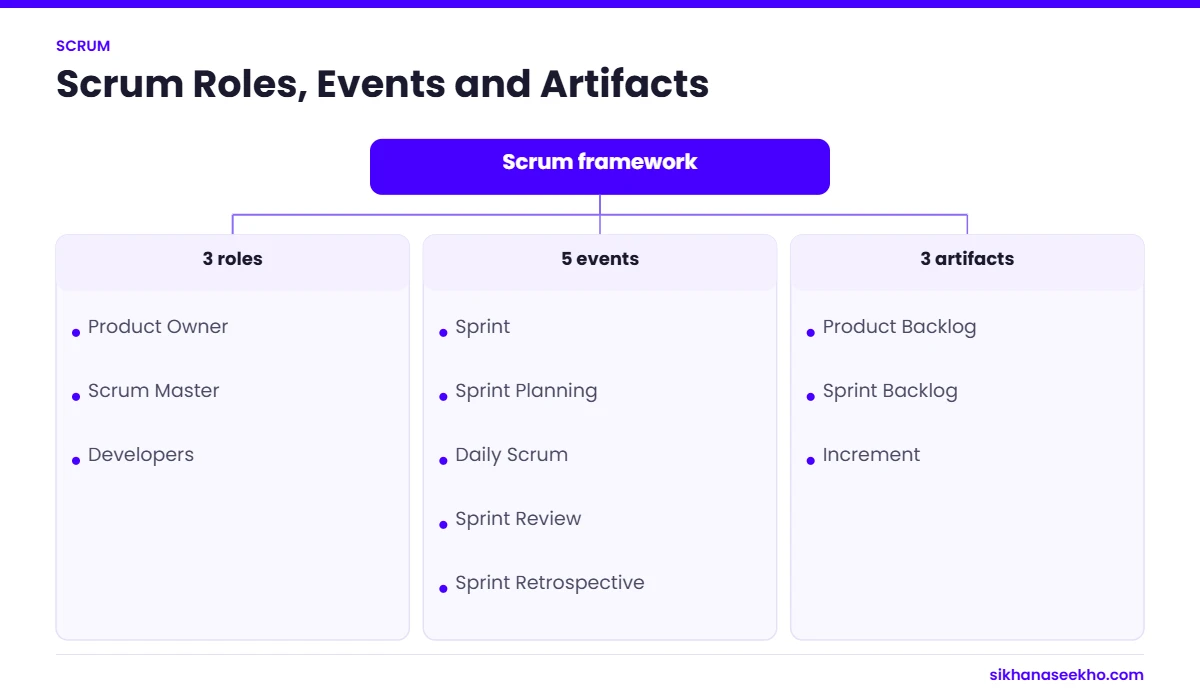
Scrum is a lightweight Agile framework for complex work. It uses fixed-length sprints (usually 2 weeks), 3 roles (Product Owner, Scrum Master, Developers), 5 ceremonies (Sprint Planning, Daily Scrum, Sprint Review, Sprint Retrospective, Backlog Refinement) and 3 artifacts (Product Backlog, Sprint Backlog, Increment).

Scrum at a Glance

Key facts — Scrum Guide 2020

Roles 3 (PO, SM, Developers)
Ceremonies 5 events
Artifacts 3 (+ 3 commitments)
Sprint length ≤ 4 weeks (2 weeks typical)
Daily Scrum time-box 15 minutes
Team size 10 or fewer people
Governed by Scrum Guide 2020 (Schwaber & Sutherland)
PMP exam relevance ~50% of questions
Certification CSM · PSM
3
Roles in a Scrum Team
5
Scrum ceremonies (events)
2wk
Most common sprint length
58%
Of Agile teams use Scrum (State of Agile 2024)
01 — Foundation

What Is Scrum?

Scrum is a lightweight framework that helps teams, organisations and individuals generate value through adaptive solutions for complex problems. It was created by Ken Schwaber and Jeff Sutherland and is formally defined in the Scrum Guide, last updated in November 2020.
Scrum is intentionally incomplete — it defines only the parts required to implement Scrum theory. It is built on empiricism (knowledge comes from experience) and lean thinking (reduce waste and focus on essentials). The three pillars of Scrum are transparency, inspection and adaptation.

Scrum is not a process or technique for building products. It is a framework within which you can employ various processes and techniques. Scrum wraps around your existing practices and reveals the relative efficacy of your current management, environment and work techniques so that you can improve.

📌
Scrum vs Agile: Agile is the mindset; Scrum is one way to implement it. Think of Agile as the philosophy and Scrum as the specific framework. Other Agile frameworks include Kanban, SAFe, XP and LeSS. Scrum is the most widely used — 58% of Agile teams use Scrum according to the State of Agile 2024 report. See our full Agile guide →

The Five Scrum Values

Successful use of Scrum depends on people becoming more proficient in living these five values: Commitment — team members personally commit to achieving the goals; Focus — everyone focuses on the work of the Sprint; Openness — the team and stakeholders agree to be open about all work and challenges; Respect — team members respect each other; Courage — team members have courage to do the right thing and work on tough problems.

02 — The Scrum Team

The 3 Scrum Roles

In Scrum 2020, the fundamental unit is the Scrum Team — a small group of 10 or fewer people consisting of one Product Owner, one Scrum Master and Developers. There are no sub-teams or hierarchies. The Scrum Team is cross-functional, self-managing and accountable for creating a valuable Increment every Sprint.

🎯
Product Owner
Accountable for product value
The Product Owner is responsible for maximising the value of the product resulting from the work of the Scrum Team. One person — not a committee.
  • Develops and explicitly communicates the Product Goal
  • Creates and orders Product Backlog items
  • Ensures the Product Backlog is transparent and understood
  • Decides what gets built and in what order
  • The organisation must respect PO decisions
🛡️
Scrum Master
Accountable for Scrum effectiveness
The Scrum Master is accountable for establishing Scrum as defined in the Scrum Guide. A servant-leader — not a project manager or team lead.
  • Coaches team on Scrum theory and practice
  • Removes impediments to the team's progress
  • Facilitates Scrum events as needed
  • Helps organisation understand and adopt Scrum
  • Protects team from outside interference
⚙️
Developers
Accountable for the Increment
Developers are the people in the Scrum Team who are committed to creating any aspect of a usable Increment each Sprint. Not just software engineers — anyone who does the work.
  • Creates a Sprint plan (the Sprint Backlog)
  • Instils quality by adhering to the Definition of Done
  • Adapts plan each day toward the Sprint Goal
  • Hold each other accountable as professionals
  • Cross-functional — all skills needed to create value
⚠️
Common mistake: The Scrum Master is not the team manager, not the project manager and not the person who assigns work. The Scrum Master is a coach and servant-leader. Treating the SM as a traditional manager is one of the most frequent Scrum anti-patterns and undermines team self-management.
03 — Scrum Events

The 5 Scrum Ceremonies

Scrum prescribes five formal events for inspection and adaptation. Each event is an opportunity to inspect and adapt Scrum artifacts. These events are specifically designed to enable the transparency required. Failure to operate any event as prescribed results in lost opportunities to inspect and adapt.

The Scrum Sprint Cycle
Sprint Planning
Day 1
Sprint
(1–4 weeks)
Daily Scrum each day
Sprint Review
End of Sprint
Sprint Retro
After Review
Next Sprint
Immediately
01
The Sprint
≤ 4 weeks
The Sprint
The Sprint is the container event — a fixed time-box of one month or less during which all other Scrum events occur. A new Sprint begins immediately after the previous one ends. Sprints are never cancelled except by the Product Owner if the Sprint Goal becomes obsolete.
All Scrum Team members
02
Sprint Planning
≤ 8 hrs/month
Sprint Planning
Sprint Planning initiates the Sprint by laying out the work to be performed. The team defines the Sprint Goal, selects items from the Product Backlog and creates the Sprint Backlog. The entire Scrum Team collaborates. Time-boxed to 8 hours for a one-month Sprint.
Entire Scrum Team
03
Daily Scrum
15 minutes
Daily Scrum
A 15-minute event held every day of the Sprint for the Developers to inspect progress toward the Sprint Goal and adapt the Sprint Backlog. The Daily Scrum is not a status report — it is a planning event for the next 24 hours. The Scrum Master ensures it stays within the time-box.
Developers (SM and PO may attend)
04
Sprint Review
≤ 4 hrs/month
Sprint Review
The Sprint Review is held at the end of the Sprint to inspect the Increment and adapt the Product Backlog. The Scrum Team presents their work to stakeholders and progress toward the Product Goal is discussed. This is a working session — not a demo or presentation.
Scrum Team + Key Stakeholders
05
Sprint Retro
≤ 3 hrs/month
Sprint Retrospective
The Sprint Retrospective concludes the Sprint. The team inspects how the last Sprint went regarding individuals, interactions, processes, tools and their Definition of Done. They identify the most helpful changes and add them to the next Sprint Backlog. Focused on improving the team, not the product.
Scrum Team (typically without external stakeholders)
💡
Backlog Refinement is not an official Scrum ceremony but is widely practised. It is the act of breaking down and further defining Product Backlog items — adding detail, estimates and order. Typically takes up to 10% of the team's capacity per Sprint. Many teams hold a dedicated refinement session mid-sprint.
04 — Scrum Artifacts

The 3 Scrum Artifacts

Scrum's artifacts represent work or value. They are designed to maximise transparency of key information. Each artifact contains a commitment to ensure it provides information that enhances transparency and focus against which progress can be measured.

Artifact 01
Product Backlog
Commitment: Product Goal
An ordered list of everything needed to improve the product. It is the single source of work for the Scrum Team. The Product Owner is accountable for the Product Backlog — its content, availability and ordering. Items are called Product Backlog Items (PBIs) or User Stories.
Artifact 02
Sprint Backlog
Commitment: Sprint Goal
The Sprint Goal (the why), the set of Product Backlog items selected for the Sprint (the what), and an actionable plan for delivering the Increment (the how). Created by the Developers during Sprint Planning. Updated throughout the Sprint as more is learned.
Artifact 03
Increment
Commitment: Definition of Done
A concrete stepping stone toward the Product Goal. Each Increment is additive to all prior Increments and verified, ensuring they all work together. An Increment must meet the Definition of Done before it can be delivered to stakeholders or released.
05 — Quality Standard

The Definition of Done

The Definition of Done (DoD) is a formal description of the state of the Increment when it meets the quality standards required for the product. It creates transparency and a shared understanding of what "done" means across the Scrum Team. If a Product Backlog item does not meet the DoD, it cannot be released or even presented at the Sprint Review.

ItemExample DoD CriteriaType
Code completeAll acceptance criteria met and code committed to main branchTechnical
Code reviewedReviewed by at least one other Developer and all comments resolvedTechnical
Tests passingUnit tests written and all existing tests pass in CI/CD pipelineQuality
DocumentationUser-facing documentation updated where applicableDocumentation
No critical bugsZero P1 or P2 defects outstanding on the itemQuality
Deployed to stagingSuccessfully deployed and tested in staging environmentTechnical
Product Owner acceptedPO has reviewed and accepted the item against acceptance criteriaProcess
📌
Key rule: If the organisation's Definition of Done for a product is not yet a standard, the Scrum Team must create a DoD appropriate for the product. All Scrum Teams must follow the organisation's DoD as a minimum standard. Teams may agree on a stricter DoD but never a weaker one.
06 — Getting Started

How to Run Your First Sprint

Starting Scrum for the first time feels overwhelming — but the structure is simple once you follow it in sequence. Here is a practical step-by-step guide for teams new to Scrum.

1
Before Sprint 1 — Build the Product Backlog
The Product Owner creates an initial Product Backlog with user stories ordered by business value. Work with stakeholders to define the Product Goal. The backlog does not need to be complete — just enough to fill the first 2–3 sprints.
2
Sprint Planning — Set Your Sprint Goal
The entire Scrum Team meets. The Product Owner presents the top-priority backlog items. The team defines the Sprint Goal — a single objective that gives the Sprint coherence. Developers select the items they can complete and create a Sprint Backlog. Time-box: 2 hours for a 2-week sprint.
3
Daily — Run the Daily Scrum
Developers meet for 15 minutes every day. The focus is: what did I do yesterday that helped the Sprint Goal? What will I do today? Any impediments? The Scrum Master ensures this stays at 15 minutes and removes any blockers raised. Not a status meeting — a planning event.
4
End of Sprint — Sprint Review
The team demonstrates completed work to stakeholders. This is a working session — show actual working software or deliverables, not slides. The Product Owner accepts or rejects items based on the Definition of Done. The Product Backlog is updated based on feedback. Time-box: 2 hours for a 2-week sprint.
5
Sprint Retrospective — Improve Your Process
The Scrum Team reflects on the Sprint: What went well? What could be improved? What will we commit to changing next Sprint? Identify 1–3 concrete improvements and add the most important one to the next Sprint Backlog. Time-box: 90 minutes for a 2-week sprint. Then immediately begin the next Sprint.
07 — Frequently Asked Questions

Scrum — 10 Questions Answered

Scrum is a lightweight Agile framework for managing complex work. It organises work into fixed-length sprints (usually 2 weeks), defines three roles (Product Owner, Scrum Master, Developers), five ceremonies and three artifacts. Scrum is defined in the Scrum Guide, last updated in 2020 by Ken Schwaber and Jeff Sutherland.
The three Scrum roles are: (1) Product Owner — responsible for maximising product value and managing the Product Backlog; (2) Scrum Master — responsible for coaching the team on Scrum, removing impediments and facilitating events; (3) Developers — everyone who does the work of delivering a usable Increment each Sprint. Together they form the Scrum Team.
The five Scrum ceremonies are: (1) Sprint — the container event (≤ 4 weeks); (2) Sprint Planning — planning what to deliver (≤ 8 hours/month); (3) Daily Scrum — 15-minute daily synchronisation; (4) Sprint Review — demonstrating the Increment to stakeholders (≤ 4 hours/month); (5) Sprint Retrospective — improving the process (≤ 3 hours/month).
The three Scrum artifacts are: (1) Product Backlog (commitment: Product Goal) — the ordered list of everything needed to improve the product; (2) Sprint Backlog (commitment: Sprint Goal) — the items selected for the current Sprint plus the plan for delivering them; (3) Increment (commitment: Definition of Done) — the sum of all completed work that meets the DoD.
According to the Scrum Guide 2020, a Sprint is a fixed time-box of one month or less. Most teams use 2-week sprints — long enough to deliver meaningful work, short enough to adapt quickly. Sprints must be consistent in length throughout the project. A new Sprint begins immediately after the previous one ends.
Agile is a mindset and set of values defined in the Agile Manifesto. Scrum is a specific framework that implements the Agile mindset. Agile is the philosophy; Scrum is one way to apply it. Other Agile frameworks include Kanban, SAFe, XP and LeSS. Scrum is the most widely used — 58% of Agile teams use Scrum. See our full Agile guide →
The Product Backlog is an ordered list of everything needed to improve the product. It is the single source of work for the Scrum Team. The Product Owner is accountable for its content, availability and ordering. Items at the top are more refined and ready for Sprint Planning. The backlog evolves continuously — it is never complete.
The Sprint Retrospective is held at the end of each Sprint. The team inspects how the Sprint went — individuals, interactions, processes, tools and the Definition of Done. They identify 1–3 improvements and plan to implement at least one in the next Sprint. Time-boxed to 3 hours for a one-month Sprint. Focused on the team, not the product.
The Definition of Done is a formal description of the quality standard an Increment must meet before it can be considered complete. It creates a shared understanding across the team of what "done" means. Every item must meet the DoD before it can be presented at the Sprint Review or released. Teams can have a stricter DoD than the organisation's standard, but never a weaker one.
Yes — Scrum Master is a strong career path. In the USA, Scrum Masters earn $95,000–$130,000 on average. The CSM (Certified ScrumMaster) from Scrum Alliance or PSM from Scrum.org are the most recognised entry credentials. Many Scrum Masters progress into Agile Coach, Release Train Engineer, or Programme Manager roles. The demand for experienced Scrum Masters continues to grow as more organisations adopt Agile.