Certifications PMP CertificationWorld’s top PM cert CSM — Certified ScrumMasterTop agile cert CAPMEntry-level PM cert PRINCE2UK & Europe standard View All Certifications ?
PM Guides Agile GuideComplete breakdown Scrum GuideRoles, ceremonies, artifacts EVM GuideAll formulas explained View All Guides ?
Career & Salary PM Salary 2026By country & level How to Become a PMStep-by-step roadmap 50 Interview QuestionsWith strong answers
PM Software Monday.com ReviewTop pick 2026 ClickUp ReviewBest value Best Free PM ToolsNo trials, truly free View All Software ?
Free Tools & Templates EVM CalculatorFree, no signup Gantt Chart MakerBuild & export free PMP Eligibility Checker30-second result Free PM Templates30 templates — Excel, Word, PDF
Get the Free PMP Guide ?
Career Guide · Updated March 2026

Project Management
Career Path 2026

From project coordinator to PMO Director — the complete PM career ladder with realistic UK salary ranges, timelines and the specific skills, experience and certifications required to move up at every level. No guesswork, no vague advice.

6
Career Levels
£28K
Entry Salary
£130K+
Senior Ceiling
8–12
Yrs to PMO Director
01 — Career Ladder

The Full PM Career Ladder — All Six Levels

Project management has a well-defined career ladder with clear progression criteria at each level. The ladder below shows every rung from entry-level coordinator to PMO Director — with the UK salary range, typical time at level, key responsibilities, skills to develop and the certifications that unlock each stage.
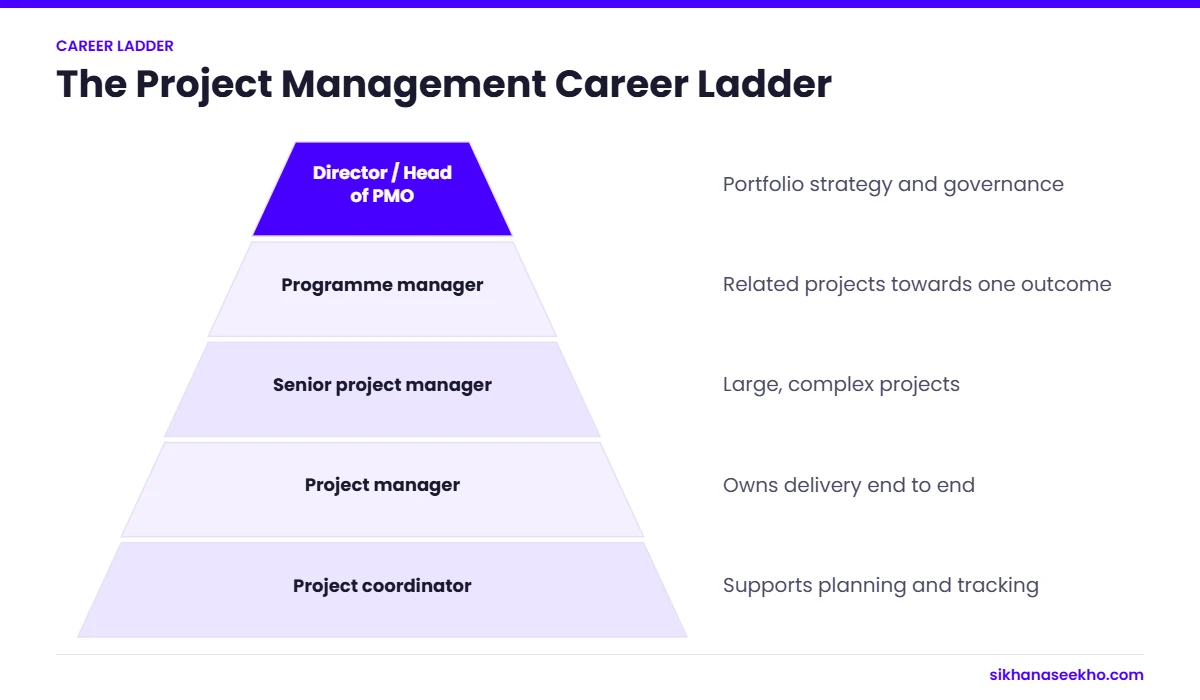
📋
Level 1 — Entry
Project Coordinator
Typical time at level: 1–2 years · Experience entering: 0–3 years total
UK Salary
£28–38K
per year
What You Do
Support the PM with scheduling and tracking
Write meeting minutes and action logs
Maintain the risk register and issue log
Manage project documentation
Distribute status reports
Skills to Build
MS Project, Jira or equivalent tools
Excel — schedules, trackers, reports
Meeting facilitation basics
Written communication clarity
Understanding of PMBOK / PRINCE2
To Move Up
Deliver a small project independently
Manage stakeholders without PM supervision
Demonstrate proactive risk identification
Show initiative beyond the task list
PRINCE2 Foundation CAPM (PMI)
🚀
Level 2 — Early Career
Junior / Associate Project Manager
Typical time at level: 1–2 years · Experience entering: 1–3 years PM
UK Salary
£38–52K
per year
What You Do
Manage small to medium projects end-to-end
Own the project schedule and budget tracking
Lead a small project team (2–5 people)
Run project governance meetings
Lead a workstream in a larger programme
Skills to Build
End-to-end project planning
Budget ownership and variance reporting
Stakeholder communication at team level
Risk and issue management independently
Change control process ownership
To Move Up
Deliver a £500K+ project successfully
Manage a senior stakeholder independently
Demonstrate budget management capability
Get PRINCE2 Practitioner certified
PRINCE2 Practitioner PSM I (Agile roles)
⚙️
Level 3 — Mid Career
Project Manager
Typical time at level: 2–4 years · Experience entering: 3–5 years PM
UK Salary
£52–72K
per year
What You Do
Own complex projects (£500K–£5M) end-to-end
Manage sponsor and steering committee
Lead cross-functional teams of 5–20 people
Operate with minimal supervision
Manage vendors and external contractors
Skills to Build
Senior stakeholder management
EVM and advanced budget control
Negotiation and commercial awareness
Benefits realisation tracking
Mentoring junior team members
To Move Up
Deliver a £2M+ project with measurable outcomes
Demonstrate strategic thinking beyond delivery
Earn PMP certification
Manage a team with direct reports or JuniorPMs
PMP (PMI) PRINCE2 Practitioner
🏛️
Level 4 — Senior
Senior Project Manager
Typical time at level: 2–4 years · Experience entering: 6–9 years PM
UK Salary
£70–95K
per year
What You Do
Lead strategically important projects (£5M+)
Manage C-suite and board-level stakeholders
Mentor and develop junior PMs
Contribute to PM standards and governance
Manage complex multi-vendor environments
Skills to Build
Strategic influence and business partnering
Programme-level thinking and dependencies
People development and coaching
Board-level presentation and communication
Commercial contract management
To Move Up
Lead a multi-project programme or portfolio
Build organisational PM capability
Demonstrate strategic leadership beyond delivery
Decide: Programme path or PMO path
PMP MSP Foundation/Practitioner
🗂️
Level 5 — Senior Leadership
Programme Manager / PMO Manager
Typical time at level: 3–5 years · Experience entering: 8–12 years
UK Salary
£80–120K
per year
What You Do
Manage a portfolio of related projects
Coordinate cross-project dependencies and resources
Report to Executive Sponsor / Board on programme health
Define and govern PM standards across the organisation
Manage benefits realisation post-delivery
Skills to Build
Portfolio governance and investment management
Organisational change management
Executive-level influencing and political navigation
Developing and retaining PM talent
Strategic benefits mapping
To Move Up
Deliver a transformational programme outcome
Build and lead a high-performing PM team
Establish enterprise PM governance frameworks
Demonstrate board-level strategic credibility
MSP Practitioner PMP + CPD
👑
Level 6 — Executive
PMO Director / Chief Project Officer
Typical experience entering: 12–18 years PM
UK Salary
£95–140K+
per year
What You Do
Lead the organisation's entire project portfolio
Set PM strategy, standards and governance
Report to CEO/COO on portfolio health and investment returns
Build and develop the PM profession within the organisation
Align project portfolio to corporate strategy
Skills Required
Executive leadership and board presence
Strategic portfolio management
Organisational design and capability building
P&L and investment portfolio management
Enterprise change and transformation leadership
What Got You Here
Track record of major programme delivery
Demonstrated PM capability development
Executive credibility and board relationships
Known in industry / sector peer network
PMP + MSP + Executive education
02 — Salary Progression

UK Salary Progression — Entry to Executive

Salary progression in PM is meaningful at every step — with the largest jumps occurring at the transition from Junior PM to PM, and from Senior PM into Programme Manager or PMO Manager. These jumps reflect the significant increase in scope, accountability and stakeholder complexity at each level.

UK PM Salary Ranges 2026 — Mid-Point Estimates
Project Coordinator
£28–38K
Junior PM
£38–52K
Project Manager
£52–72K
Senior PM
£70–95K
Programme / PMO Manager
£80–120K
PMO Director / CPO
£95–140K+
📌
Salary ranges vary significantly by sector and location. Financial services, management consultancy and tech typically pay 15–30% above these ranges. Public sector and not-for-profit typically pay 10–20% below. London adds 15–25% for most levels. Contracting rates for experienced PMs run at £450–£900 per day — significantly higher than permanent salaries but without employment benefits or job security. See the PM Salary Guide 2026 for a full breakdown by sector, location and experience.
03 — Senior Career Paths

The Two Senior Career Paths — Delivery vs PMO

At the Senior PM level, most experienced project professionals face a genuine fork in the road. Both paths lead to equivalent seniority and salary — but they require different strengths and lead to different work environments. Understanding which path suits you before you are forced to choose is one of the most useful career planning decisions you can make.

🚀
Path A
Delivery Leadership
Programme Manager → Programme Director → Chief Project Officer
Focus on delivering increasingly large and complex programmes
High accountability, high visibility, high pressure
Success measured by programme outcomes and benefits delivered
Strong stakeholder credibility from track record of delivery
Best if you love the adrenaline of live delivery and prefer project to permanent work
Certification accelerator: MSP Practitioner + PgMP
🏛️
Path B
PMO Leadership
PMO Manager → Head of PMO → PMO Director → CPO
Focus on building organisational PM capability and standards
Portfolio governance, reporting and resource management
Success measured by PM maturity, portfolio performance, talent
Strong credibility from developing the PM profession in the org
Best if you enjoy systems thinking, developing people and strategic influence over direct delivery pressure
Certification accelerator: PMP + MoP (Management of Portfolios)
💡
Most senior PMs have done both. The most credible PMO Directors have significant delivery experience — you cannot govern delivery effectively if you have never done it. The most effective Programme Directors have often had a stint in a PMO, where they developed the standards and frameworks they now use in delivery. The two paths are not mutually exclusive — a 2–3 year move into PMO leadership and back to delivery, or vice versa, is a common and valued career pattern.
04 — Certification Progression

The Certification Ladder — What to Get and When

Certifications should follow career progression, not precede it. The right certification at the wrong level adds cost and study burden without proportional career benefit. Here is the optimal certification sequence aligned to each career level.

Level 1 Entry
PRINCE2 Foundation
3–5 days · No prereqs · £200
Level 2 — 6–12 months in role
PRINCE2 Practitioner
+3–5 days · Foundation req. · £270
Level 3 — 3–5 yrs PM exp.
PMP
3–6 months · 35h training req. · £400
Level 4–5 — Senior
MSP Practitioner
Programme management · £300–400
Level 5–6 — Leadership
PgMP / MoP
PMI Programme or Portfolio Mgmt

Agile Certifications — Parallel Track

For PMs working in technology or digital delivery, an Agile certification runs in parallel with (not instead of) the PRINCE2/PMP track. PSM I (Professional Scrum Master) from Scrum.org ($150, 1–2 weeks, no prerequisites) is the most cost-effective starting point. SAFe (Scaled Agile Framework) certification is increasingly required for senior programme roles in large-scale Agile environments. PRINCE2 Agile bridges both worlds and is valuable for PMs working in hybrid environments.

05 — Accelerators

What Actually Accelerates PM Career Progression

Time in role is the floor for progression, not the ceiling. The PMs who move fastest are not the ones who wait the longest — they are the ones who actively seek the experiences, relationships and visibility that signal readiness for the next level. Here are the factors that consistently separate fast-track PMs from those who plateau.

Deliver something genuinely difficult
One high-visibility, high-complexity project delivered well is worth more than five straightforward ones. Seek out the projects others find intimidating — politically sensitive stakeholder landscapes, tight deadlines, ambiguous scope. These are the stories you tell for the rest of your career.
Move sectors deliberately
PMs who stay in one sector for their entire career often plateau at Senior PM. A deliberate sector move — from public sector to private sector, or from financial services to technology — broadens your toolkit and signals adaptability. Broad-sector PMs consistently earn more than narrow specialists at senior levels.
Build sponsor-level relationships
Your career advancement is largely driven by the sponsors who have seen you perform. A sponsor who became a Director while you were their PM is the most valuable career ally you can have — they will pull you into their next organisation or programme when they move. Invest in these relationships long after the project closes.
Get PMP before your peers do
The PMP is the clearest signal of professional seriousness in the PM field. PMs who earn it at the 3–4 year mark consistently report faster promotion cycles and higher salary reviews than those who wait until 6–8 years. The certification does not create the career step — it removes a barrier that was slowing it down.
Mentor and develop others
Taking visible responsibility for developing junior PMs signals readiness for leadership roles — not just technical PM skills. Volunteer to mentor a coordinator, run a lunchtime PM skills session or contribute to PMO knowledge-base development. People who develop others get noticed by the people making promotion decisions.
Contracting — the salary accelerator
Many experienced PMs significantly increase their earnings by moving into contracting at the Senior PM level. Day rates of £500–£900 for experienced contractors are common — 50–100% more than equivalent permanent salaries. The trade-off is job security and employment benefits. A 12–18 month contracting stint at the Senior PM level can permanently reset salary expectations when returning to permanent roles.
06 — FAQ

PM Career Path — FAQ

From a standing start with no prior PM experience, most people reach a full Project Manager title within 2–4 years. The typical route is project coordinator for 1–2 years, then junior PM for 1–2 years, then PM. Career changers with 5+ years of professional experience from another field often progress faster — reaching full PM in 1–2 years via a coordinator stepping stone, because their professional maturity and domain expertise compensates for limited PM tenure. The biggest accelerator is the quality and complexity of projects worked on, not simply time in role. See the full career transition guide for more on this path.
Within the PM career track, the most senior positions are PMO Director (responsible for the organisation's entire project portfolio and PM standards), Programme Director (responsible for a major strategic programme), and Chief Project Officer or VP of Project Delivery. At the executive level, PMs can progress into Chief Operating Officer, Chief Transformation Officer or CEO roles — particularly in organisations where major programmes are central to strategy. The PMO leadership route and programme management route represent different paths at the senior level, both leading to C-suite adjacency.
No — a degree is not required to become a project manager. PM is one of the few professional fields where certifications and demonstrated experience are consistently valued over academic qualifications. Many of the most experienced and well-paid PMs do not have a directly relevant degree. PRINCE2 Practitioner or PMP combined with a strong delivery track record opens more doors than most degrees. Some employers list a degree as preferred but rarely as an absolute requirement for PM roles.
A project manager delivers a single defined project — specific output, fixed scope, timeline and budget. A programme manager is responsible for a group of related projects that together deliver a broader strategic outcome. The programme manager manages interdependencies between projects, coordinates resources across them, manages programme-level risks and benefits and reports to an executive sponsor or board. Programme management requires everything a PM does, plus the ability to operate strategically and manage the politics and complexity of multi-project environments. MSP (Managing Successful Programmes) is the primary certification for this transition.