Earned Value Management
Formulas, Examples and Calculator
EVM answers two questions that no other PM technique can answer at the same time: are we ahead of or behind schedule, and are we over or under budget, right now, on the same scale? I teach EVM to every one of my PMP students. This guide explains all 10 EVM metrics using a single worked example throughout, so every formula connects to the same project.
What is Earned Value Management?
Earned Value Management (EVM) is a project performance measurement technique that integrates scope, schedule and cost into a single, coherent reporting framework. It was developed by the US Department of Defense in the 1960s and is now part of the PMBOK framework. It is one of the most heavily tested topics on the PMP exam.
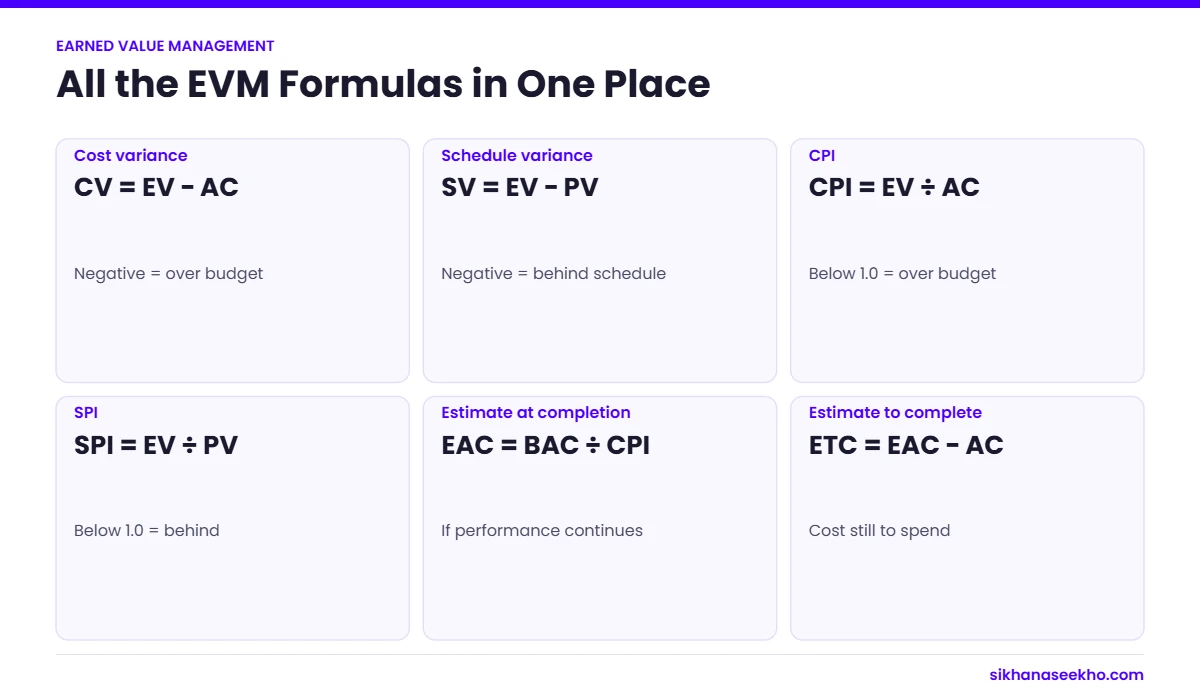
The central insight of EVM is deceptively simple: spending money is not the same as creating value. A project that has spent £200,000 of a £500,000 budget is not necessarily 40% complete. It might be 30% complete (over budget for the work done) or 50% complete (under budget). EVM measures the value of work actually completed, which is the Earned Value, and compares it to both the planned value and the actual cost.
The Three Core Values: PV, EV and AC
Everything in EVM builds from three numbers. Get these right and every other metric follows automatically.
Cost Variance and Schedule Variance
Variances compare Earned Value to the other two core values. Positive variances are good. Negative variances are bad. This sign convention is one of the most frequently tested points on the PMP exam and one of the most commonly confused in practice.
CPI and SPI: The Performance Indices
Indices express performance as a ratio rather than an absolute number, making them easier to compare across projects of different sizes and more useful for forecasting. Both use the same interpretation: above 1.0 is good, below 1.0 is a problem, exactly 1.0 is on plan.
EAC, ETC and VAC: Forecasting the Final Position
Forecast metrics use current performance data to project the final cost of the project. The PMP exam tests which EAC formula to use in different scenarios. This is one of the most frequently appearing EVM question types, and I see students lose marks here every time for picking the wrong formula.
EAC: Estimate at Completion
EAC is the forecast of total project cost at completion. There are three main formulas. Which one to use depends on your assumption about future performance.