Certifications PMP CertificationWorld’s top PM cert CSM — Certified ScrumMasterTop agile cert CAPMEntry-level PM cert PRINCE2UK & Europe standard View All Certifications ?
PM Guides Agile GuideComplete breakdown Scrum GuideRoles, ceremonies, artifacts EVM GuideAll formulas explained View All Guides ?
Career & Salary PM Salary 2026By country & level How to Become a PMStep-by-step roadmap 50 Interview QuestionsWith strong answers
PM Software Monday.com ReviewTop pick 2026 ClickUp ReviewBest value Best Free PM ToolsNo trials, truly free View All Software ?
Free Tools & Templates EVM CalculatorFree, no signup Gantt Chart MakerBuild & export free PMP Eligibility Checker30-second result Free PM Templates30 templates — Excel, Word, PDF
Get the Free PMP Guide ?
PM Guide · Updated March 2026

Stakeholder Management
Identify, Analyse & Engage

Most project problems are stakeholder problems in disguise. A sponsor who withdraws support, a business owner who changes requirements at the last minute, an IT lead who withholds resources — all of these are detectable and manageable early with a structured approach. This guide covers the complete stakeholder management process from identification through engagement.

4
PMBOK Processes
4
Grid Quadrants
5
Attitude Levels
Free
Register Template
01 — Overview

What is Stakeholder Management?

Stakeholder management is the systematic process of identifying everyone who has an interest in or is affected by a project, understanding their needs, concerns and level of influence, and actively engaging them throughout the project lifecycle to build and maintain the support the project needs to succeed.
It is one of the most consistently underinvested areas of project management — and one of the most visible failure points when it goes wrong. The UK Cabinet Office's Major Projects Authority reviews repeatedly found that stakeholder and communication failures — not technical problems — were the primary cause of major project overruns and failures. The same pattern appears in PMI's research: poor stakeholder engagement is cited as a top contributor to project failure in every annual survey.

The Four PMBOK Stakeholder Management Processes

1
Identify
Initiating
2
Plan
Planning
3
Manage
Executing
4
Monitor
M&C

Identify Stakeholders (Initiating) — produces the stakeholder register. Plan Stakeholder Engagement (Planning) — produces the stakeholder engagement plan and links to the communications management plan. Manage Stakeholder Engagement (Executing) — the active work of communicating, building relationships and resolving issues. Monitor Stakeholder Engagement (Monitoring and Controlling) — tracks whether engagement strategies are working and updates the approach when they are not.

💡
Stakeholder management is not the same as communication management. Communication management is about the mechanics of information flow — who gets what, when, through which channel. Stakeholder management is about relationships, influence and attitude change. Communication is a tool within stakeholder management — but sending a monthly status report is not the same as actively managing a stakeholder's engagement. The distinction matters on the PMP exam and in practice.
02 — Identification

Identifying Stakeholders — Beyond the Obvious Names

Most PMs identify the sponsor, the business owner and the project team without difficulty. The stakeholders who cause the most problems are usually the ones who were missed at initiation — identified only when they become a problem, at which point building a relationship from scratch is far harder.

A rigorous stakeholder identification process asks: who will be affected by the project's outputs? Who can affect the project's ability to deliver? Who has a formal or informal decision-making role? Who has influence over people with formal authority? Who is not in the room but whose work will change as a result?

1
Organisational chart analysis
Work through the org chart of every department whose processes, systems or staff will be affected. Identify both formal decision-makers and influential middle managers. A disengaged director is often less important than a highly influential senior manager below them.
2
Expert interviews
Ask each identified stakeholder: "Who else should I be talking to about this project?" Repeat until no new names emerge. This snowball technique reliably surfaces informal influencers and hidden stakeholders that the org chart doesn't reveal.
3
Process mapping
Map the business processes that the project will change. Every role that touches those processes — upstream and downstream — is a potential stakeholder. This is particularly important for system implementation projects where the ripple effects of process change are often wider than anticipated.
4
Lessons from similar projects
Review the lessons learned register from similar past projects. Which stakeholder groups caused unexpected friction? Which were missed at initiation? The same stakeholders who were problematic on the last CRM implementation will likely be problematic on this one.
5
External stakeholder scan
For projects with external impact: regulators, auditors, suppliers, customers, trade unions, media. Projects that forget external stakeholders often face delays at later stages when these groups surface unexpected requirements or objections.
6
Continuous re-identification
New stakeholders emerge throughout the project as scope evolves, organisations change and the project becomes more visible. Re-run the identification process at every phase gate — not just at initiation. A stakeholder register created once and never updated is a historical document, not a management tool.
📌
Record every stakeholder in the register immediately. Use the free Stakeholder Register template to capture name, role, organisation, interest, influence and initial attitude assessment as you identify each person. The register is confidential — it contains candid assessments of individuals' attitudes and influence and should never be shared with the stakeholders themselves.
03 — Analysis

The Power-Interest Grid

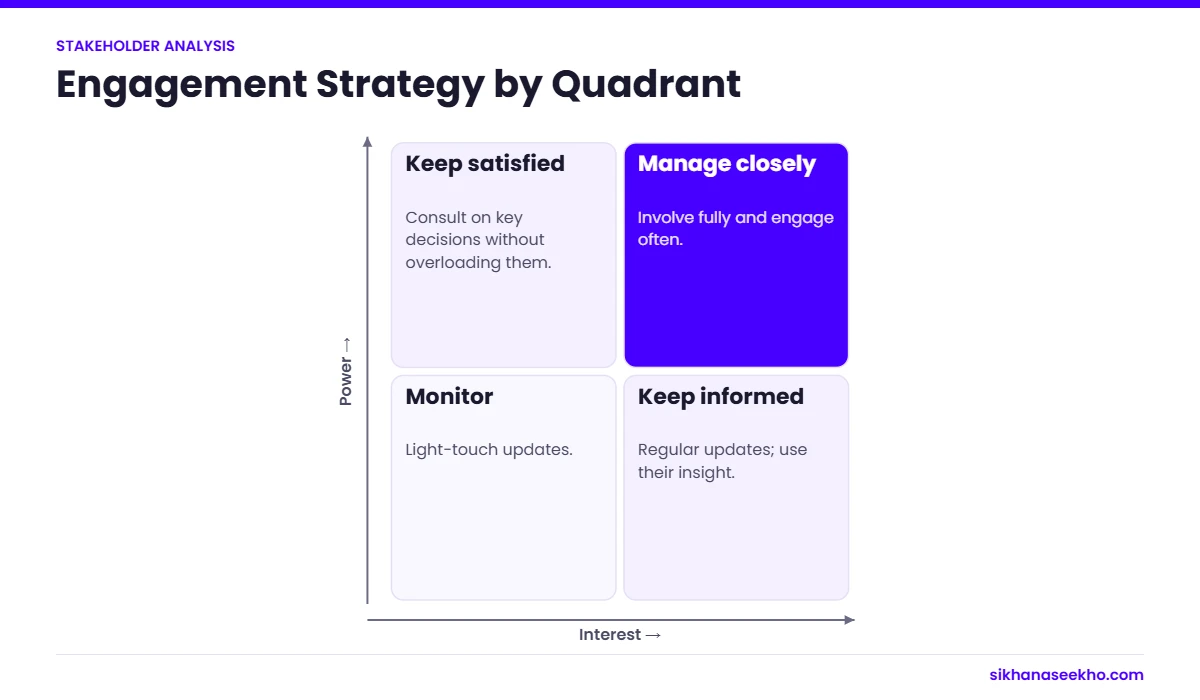
Once stakeholders are identified, they need to be prioritised — because you cannot give every stakeholder the same level of attention and still manage the project. The power-interest grid is the most widely used prioritisation tool: it maps each stakeholder on two dimensions and assigns a different engagement strategy to each resulting quadrant.

Power (vertical axis) measures ability to affect the project — authority to approve or block decisions, allocate or withhold resources, change requirements. Interest (horizontal axis) measures how significantly the stakeholder's work, priorities or outcomes are affected by what the project delivers.

Power / Interest Grid — Engagement Strategy by Quadrant
High Power · Low Interest
Keep Satisfied
Powerful but not focused on the project. Can block it if something triggers their attention. Headline updates, not detail. Avoid overwhelming them — over-communication can itself become an irritant.
Senior executives, divisional MDs, regulatory oversight bodies
High Power · High Interest
Manage Closely
Maximum engagement investment. Involve in key decisions. Share problems early — they have both the motivation and the authority to help. Regular 1-to-1 meetings, not just formal reporting.
Project sponsor, business owner, key customer decision-maker
Low Power · Low Interest
Monitor
Minimum active engagement. Keep on the general communications distribution. Monitor for changes in position — a change in role or scope expansion can move them to a different quadrant.
Peripheral departments, external observers, tangentially connected teams
Low Power · High Interest
Keep Informed
Significantly affected but limited power to change the project. Most vocal when ignored. Regular communication and active listening — show their concerns are heard even if they cannot always drive changes.
End users, affected operational staff, customer-facing teams
← Low Interest    High Interest → ↑ High Power    Low Power ↓
⚠️
Quadrant position is not permanent. A stakeholder in "Monitor" can move to "Manage Closely" if the project scope expands into their area, if they are promoted, or if a political event increases their interest. The most dangerous stakeholder is the one whose quadrant position changed and whose engagement strategy was never updated. Review the power-interest position of every stakeholder at each phase gate.
04 — Attitude Analysis

Measuring and Tracking Stakeholder Attitude

The power-interest grid tells you who matters and how much engagement effort they require. Attitude analysis tells you what kind of engagement — because a strongly supportive sponsor needs a different approach to a resistant business owner, even if they are in the same grid quadrant.

The Stakeholder Register template tracks two attitude fields for each stakeholder: current attitude (assessed from observation and direct conversation) and target attitude (where the PM needs them to be for the project to succeed). The gap between the two determines the engagement effort required.

🔴
Strongly Resistant
Actively working against the project
🟠
Resistant
Opposing or raising obstacles
Neutral
Neither supporting nor opposing
🟣
Supportive
Willing to help when asked
🟢
Strongly Supportive
Actively championing the project

Setting Realistic Target Attitudes

The target attitude should represent the minimum attitude needed for the project to succeed — not an ideal. Moving a Strongly Resistant stakeholder to Neutral in a 3-month project is a realistic and valuable outcome. Moving them to Strongly Supportive in the same timeframe is almost certainly not. Setting an unrealistic target leads to wasted engagement effort and a sense of failure when the target is not reached.

The current attitude column is the most important field to keep updated. It should be reviewed after every significant interaction with that stakeholder. An attitude assessment that is three months old is not an assessment — it is a guess. Attitude can change rapidly in response to project events, organisational changes or personal concerns that have nothing to do with the project.

Silence is not neutrality. A stakeholder who has stopped engaging — who no longer responds to meeting invites, emails or status reports — is not neutral. They have either withdrawn support or are dealing with something that has changed their priorities. Silence in a stakeholder who was previously engaged is always worth investigating. A brief, informal conversation ("I noticed you weren't at the last steering committee — is everything OK?") can surface concerns before they become blockers.
05 — Engagement

Engagement Strategies by Quadrant

The power-interest grid determines the engagement intensity. The attitude analysis determines the engagement approach. Together they define the specific strategy for each stakeholder — which should be documented in the Engagement Strategy column of the stakeholder register as a concrete plan, not a generic category.

High Power · High Interest
Manage Closely — Active Partnership
Frequency: Weekly or fortnightly 1-to-1 + monthly formal governance
Share problems early — they have motivation and authority to help
Involve in key decisions before they are finalised
Send status report 48 hours before governance meetings as pre-reading
Maintain the relationship between formal meetings — informal check-ins
Be specific about what you need from them and by when
High Power · Low Interest
Keep Satisfied — Headline Only
Frequency: Monthly briefing or dashboard only
One-page dashboard — not full status reports
Escalate to them quickly when their authority is genuinely needed
Never waste their time with detail they did not ask for
Brief them directly before any public announcement that affects their area
Keep a communication log — track when you last spoke
Low Power · High Interest
Keep Informed — Listen Actively
Frequency: Monthly comms + forums for feedback
Regular newsletters or email updates in plain language
Create structured feedback channels — surveys, workshops, user groups
Visibly act on feedback — show it was heard even if not always adopted
Involve them in UAT, pilots and user acceptance activities
Never ignore their concerns — they will amplify if they feel unheard
Low Power · Low Interest
Monitor — Broadcast Only
Frequency: General newsletter / milestone announcements
Include on general distribution list — do not personalise
Monitor for changes in role or interest at each phase gate
Respond promptly if they raise a concern — do not ignore them
Reassess quadrant position if project scope expands into their area
💡
Document the engagement strategy per stakeholder — specifically. "Manage closely" is a category, not a strategy. The Engagement Strategy column in the register should say something like: "Monthly 1-to-1 with PM on first Tuesday of each month to discuss budget position and upcoming milestones. PM sends agenda 48h before. Finance Director prefers verbal briefings over written reports — follow up key points in a 3-bullet email immediately after." This level of specificity is what makes the register a management tool rather than a contact list.
06 — Resistance

Managing Resistant Stakeholders

Resistant stakeholders are not the exception on complex projects — they are the norm. Any project that changes how people work, what they control or what they are measured on will generate resistance. The question is not whether resistance will appear but whether it will be managed proactively or discovered when it has already become a blocker.

1
Diagnose the cause of resistance before attempting to change it
Resistance has root causes. Common ones: fear of losing influence, budget or headcount; a bad experience with a similar project in the past; genuine concerns about the project's impact on their area; lack of information (they oppose what they do not understand); or a political relationship with someone else who is opposing the project. Applying the wrong intervention to the wrong cause makes resistance worse. A stakeholder who fears losing influence will not be reassured by better communication — they need to understand how the project affects their position.
2
Have the direct conversation
Most PMs avoid direct conversations with resistant stakeholders because they are uncomfortable. This avoidance makes the resistance worse. The direct approach: "I have noticed you have some concerns about this project. I would find it really helpful to understand them properly so we can address them. Can we set aside 30 minutes?" Most people respond to being asked directly — it signals respect, and it gives both parties an opportunity to move the relationship forward. The conversation will sometimes reveal that the concern is entirely addressable; sometimes it reveals information about the project's risks that the PM needed to hear.
3
Involve them early in decisions that affect their area
People resist decisions that are made without them and presented as final. The same person who resists a proposal they were not consulted on will often become a constructive contributor if involved in shaping it. This does not mean every decision needs a committee — it means identifying the specific decisions that matter to each resistant stakeholder and involving them before the outcome is determined. Involvement creates ownership; ownership reduces resistance.
4
Address concerns honestly — including valid ones
Some stakeholder concerns are valid. A resistant operations manager who warns that the new system will not handle their edge-case volume may be right. Dismissing valid concerns as obstructiveness damages trust and loses valuable information. When a concern is valid, acknowledge it, investigate it and tell the stakeholder what you are doing about it. When a concern is not valid, explain specifically why — not with corporate reassurance language but with facts. "We have tested the system at 150% of peak volume with no degradation" is a reassurance. "The system will be fine" is not.
5
Escalate through the sponsor when direct engagement fails
If a stakeholder remains resistant after good-faith direct engagement, this is an issue for the sponsor — not a sign that the PM needs to try harder. Document the engagement attempts and outcomes. Bring the issue to the sponsor's attention with a specific ask: "I have met with the IT Director three times and addressed each of the concerns they raised. They have not confirmed their team's availability for the integration testing slot we need. I need your help to resolve this." The sponsor has the authority and the relationship network that the PM does not — using them for genuine escalations is what good governance looks like.
07 — Common Mistakes

Six Stakeholder Management Mistakes That Derail Projects

Identifying stakeholders once and never updating the register
A stakeholder register created at initiation and never reviewed is a historical document. New stakeholders emerge as scope evolves. Existing stakeholders change roles. Attitudes shift in response to project events. A register that reflects the project at week 1 is not useful at month 6.
Fix: Review and update the register at every phase gate and after any significant scope change or organisational event.
Equating seniority with influence
A disengaged director at Grade 6 may have far less real influence than a respected and connected senior manager at Grade 7. Plotting stakeholders on the power-interest grid based on job title rather than actual influence produces the wrong engagement priorities.
Fix: Assess influence based on observed behaviour and ask: who does the organisation actually listen to on decisions that affect this project? That person is high-power regardless of their title.
Treating all stakeholders with the same communication approach
Sending the same 15-page status report to the sponsor, the end-user group and the IT team simultaneously means none of them receive information in a format that is useful to them. The sponsor wants the dashboard and key decisions. The IT team wants technical detail. The end users want to know what is changing and when.
Fix: Use the communications plan to define a tailored communication for each stakeholder group — format, frequency and channel matched to their needs and preferences.
Assuming silence means support
A stakeholder who stops engaging — who no longer attends meetings, responds to emails or asks questions — has not become neutral. They have withdrawn. Withdrawal often precedes active resistance or a late-stage escalation that is far harder to manage than the original concern would have been.
Fix: Treat unexplained disengagement as a signal worth investigating. A brief informal conversation is far cheaper than discovering a major concern at the wrong moment.
Only engaging the decision-maker and ignoring their influencers
Formal authority sits with the Director. Real influence often sits with their Chief of Staff, their most trusted direct report, or a peer whose opinion they respect. A Director who privately agrees with the project can still block it if their key influencer is resistant and they have not heard a compelling counter-argument.
Fix: Map the informal influence networks, not just the formal hierarchy. Who does the decision-maker consult before making decisions that affect this project? Those people need to be in the stakeholder register.
Keeping the stakeholder register as a personal document
A stakeholder register that lives in the PM's personal drive and is never shared with the sponsor or PMO means the risk of key stakeholder concerns is invisible to the people with the authority and relationships to help address them. The register is confidential — but confidential from the stakeholders, not from the project governance team.
Fix: Share the register (in appropriate form) with the sponsor and PMO as part of governance reporting. Stakeholder risks are project risks and should be visible at project board level.
08 — FAQ

Stakeholder Management — FAQ

Stakeholder management is the process of identifying everyone with an interest in or affected by a project, understanding their needs and concerns, and actively engaging them throughout the project lifecycle to maintain support and address concerns. In PMBOK, it spans four processes: Identify Stakeholders, Plan Stakeholder Engagement, Manage Stakeholder Engagement and Monitor Stakeholder Engagement. Poor stakeholder management is consistently cited as a top cause of project failure — not technical problems but people problems. See the free Stakeholder Register template to get started.
The power-interest grid categorises stakeholders by their power to affect the project and their interest in its outcomes. Four quadrants: High Power/High Interest → Manage Closely; High Power/Low Interest → Keep Satisfied; Low Power/High Interest → Keep Informed; Low Power/Low Interest → Monitor. The quadrant determines the engagement strategy and intensity. Stakeholders' quadrant positions can change throughout the project — review at every phase gate. The grid is heavily tested on the PMP exam as part of the Identify Stakeholders and Plan Stakeholder Engagement processes.
The most common mistakes: identifying stakeholders only at initiation and never updating the register; equating seniority with actual influence; treating all stakeholders with identical communication regardless of their needs; assuming silence means support; only engaging resistant stakeholders when they cause a visible problem; and ignoring the informal influencers behind formal decision-makers. The most damaging is treating stakeholder management as a one-time exercise — the register and engagement strategies must evolve as the project and its environment change.
First, understand the root cause — fear of losing influence, a bad past experience, genuine valid concerns, lack of information, or a political relationship with another opponent. Then have the direct conversation: ask them to share their concerns. Involve them early in decisions that affect their area. Address their concerns honestly — including acknowledging when they are valid. If direct engagement fails after genuine effort, escalate through the sponsor with documented evidence of the attempts made. The goal is rarely to create an enthusiastic supporter — moving from Resistant to Neutral is often the realistic and sufficient target.