How to Become a
Project Manager in 2026
A realistic, step-by-step roadmap for anyone starting from scratch. No PM title yet? No problem. I went from engineer to PMP-certified trainer myself, and this guide covers the exact path: what to learn first, which certification to get, how to build experience without the job title, and how long it actually takes.
To become a project manager: build foundational knowledge (free PMI resources plus an online course), lead informal projects in your current role, get certified (CAPM if new, PMP if 3 or more years experience), build a portfolio, update your resume, then apply for coordinator or junior PM roles. Most people land their first PM role within 1 to 2 years of focused effort.
Your PM Career Timeline
Realistic milestones from scratch
Is Project Management the Right Career for You?
Project management is not for everyone, and knowing this early saves you years of the wrong career. PMs spend most of their time communicating, coordinating, negotiating and problem-solving, not doing technical work. If you love making things happen through other people, this is a powerful career. If you prefer deep technical work, PM may feel like too much administration.
- Naturally organise and plan, even when no one asks you to
- Enjoy working with diverse teams and personalities
- Stay calm under pressure and think clearly in chaos
- Communicate clearly in writing and in meetings
- Can influence people without formal authority over them
- See risk before it becomes a problem
- Are comfortable with ambiguity and frequent change
- Prefer working alone on deep technical problems
- Dislike meetings, reporting or stakeholder management
- Struggle to stay organised across multiple work streams
- Find it hard to prioritise when everything feels urgent
- Want to be the technical expert, not the coordinator
- Avoid conflict and difficult conversations
- Need clear, predictable day-to-day work routines
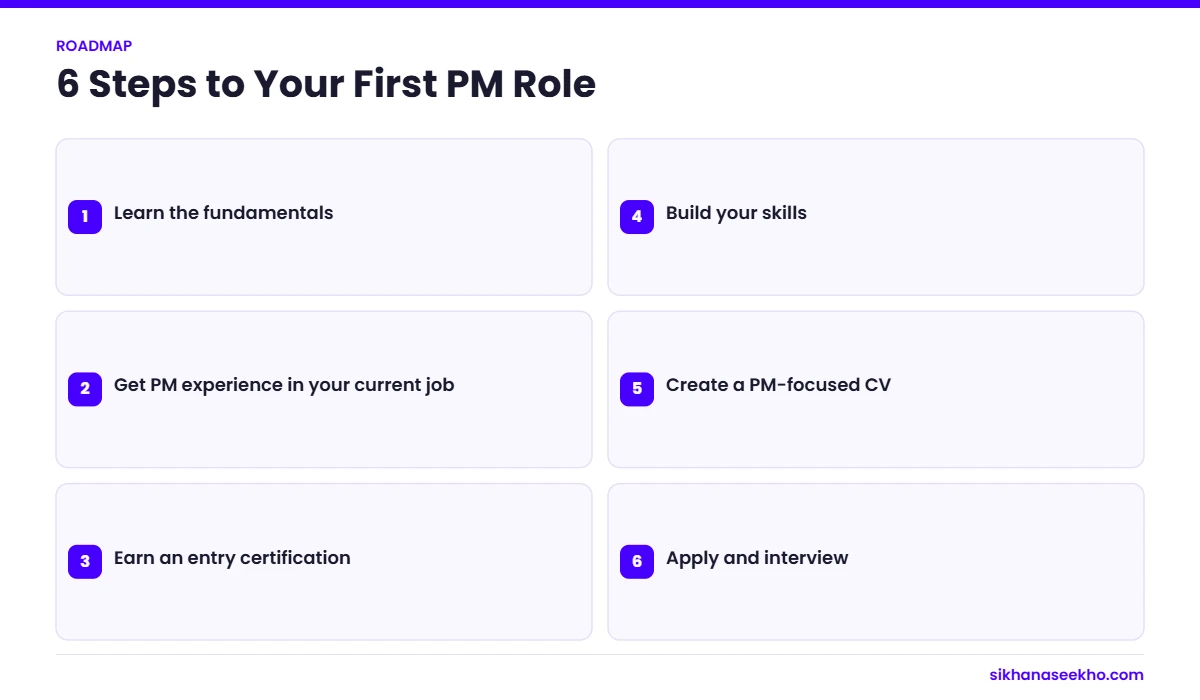
The 6-Step Roadmap to Your First PM Role
Follow these steps in order. Each step builds on the last. Skipping steps, particularly trying to get PMP before building real experience, wastes money and time.
- Download the PMI Examination Content Outline (ECO) free at pmi.org. It tells you exactly what project managers need to know.
- Watch 10 to 15 hours of free YouTube content on Agile, Scrum and Waterfall basics
- Read the PMBOK 7 summary, free with PMI membership ($139/year)
- Learn the vocabulary: scope, schedule, budget, risk, stakeholder, sprint, backlog
- Identify which PM tools are used in your industry (Jira, Asana, Monday.com, MS Project)
- Volunteer to lead any initiative at work: a system rollout, an office move, a process improvement, an event
- Take the lead on a community project, charity initiative or sports team logistics
- In your current role, look for cross-team coordination tasks that no one owns and own them
- Document every project immediately. Start date, end date, your role, scope, budget (if any), team size, challenges and outcomes. This becomes your portfolio.
- Ask your manager to give you PM responsibilities explicitly. Most will agree if you frame it as professional development.
- Under 3 years experience: start with CAPM. No work experience required, just 23 hours of contact time. Costs $225 to $300. Issued by PMI and globally recognised.
- 3 or more years experience: go straight for PMP. Higher cost ($405 to $555) but a 33% average salary premium makes it the highest-return PM investment
- Working in Agile teams: consider CSM first. Can be earned in a 2-day course, no prior experience needed.
- You must complete 35 hours of formal PM education before applying for PMP. Choose an online course that satisfies this (Udemy, Coursera, PrepCast).
- Use our free PMP eligibility checker to find out which path applies to you
- For each project write a one-page summary: project name, your role, scope, budget, team size, timeline, key challenges and measurable outcomes
- Quantify everything possible. "Reduced processing time by 30%," "managed a $50K budget," "coordinated a team of 8 across 3 departments."
- Include at least one project that went wrong and explain what you learned. This demonstrates maturity to experienced hiring managers.
- Create a simple LinkedIn profile section or PDF document you can share in applications
- Get a LinkedIn recommendation from someone you managed a project with, a peer or manager who can speak to your PM skills specifically
- Replace job-function language with PM language. "I processed invoices" becomes "I coordinated a month-end financial close process involving 6 teams and a $2M budget."
- Add a PM Skills section: certifications, software proficiency (Jira, Asana, Monday), methodologies (Agile, Scrum, Waterfall)
- Add a career objective at the top that clearly states you are targeting PM roles
- Optimise your LinkedIn headline: "Project Coordinator | CAPM Certified | Agile and Waterfall | [Your Industry]"
- ATS-optimise your resume by including keywords from job descriptions you are targeting
- Target your current industry first. Your domain knowledge gives you a major advantage over pure PM candidates with no industry context.
- Apply for Project Coordinator roles. These are the recognised entry point to a PM career and do not require PMP.
- Use LinkedIn Jobs, Indeed, specialist PM boards and your existing professional network
- Prepare STAR method answers for PM behavioural interview questions. See our 50 PM interview questions guide.
- Do not wait for the perfect role. Your first PM job is a learning environment, not your peak role.
How Long Does It Actually Take?
The honest answer is that it depends on how much transferable experience you already have. Here are realistic timelines for three different starting points.
Choosing Your First PM Certification
The right first certification depends entirely on how much experience you currently have. The table below maps your situation to the best starting point.
| Your Situation | Best First Cert | Cost | Time to Earn | Why |
|---|---|---|---|---|
| No PM experience at all | CAPM | $225 to $300 | 2 to 3 months | No experience required, just 23 hours of training. PMI-issued, globally recognised, clear upgrade path to PMP |
| Working in an Agile team right now | CSM | $995 to $1,500 | 2 to 3 days | No experience needed. Earnable in a weekend 2-day course. Immediately applicable if your team runs sprints. |
| 3+ years leading projects | PMP | $405 to $555 | 3 to 6 months | Highest global recognition plus a 33% average salary premium. Skip straight to this if you qualify. |
| UK or European career focus | PRINCE2 Foundation | ~£350 | 1 to 2 months | UK/European employers expect PRINCE2. Start with Foundation, then Practitioner. No experience required. |
| Already PMP certified | PMI-ACP | $435 to $495 | 3 to 4 months | Adds Agile credential alongside PMP. Increasingly expected at senior level in tech and financial services. |
Skills You Need to Build
You do not need to master every PM skill before applying for your first role. But you do need a working knowledge of the core skills. Here is what to prioritise at each stage.
- Project planning: scope definition, milestones, dependencies
- Risk identification: spotting issues before they happen
- Stakeholder communication: status reports, meeting facilitation
- Basic Agile: sprints, backlogs, daily standups, retrospectives
- Proficiency in one PM tool: Asana, Trello, Jira or Monday.com
- Microsoft Excel or Google Sheets for tracking and reporting
- Problem-solving under pressure, practised through real projects
- Budget management and cost tracking
- Formal change control processes
- Resource planning and capacity management
- Vendor and contract management
- Executive reporting and presenting to leadership
- Programme management across multiple projects
- AI tools for scheduling and reporting automation
Can You Become a Project Manager Without a Degree?
Yes. Many project managers started without a degree. Employers hiring for coordinator and junior PM roles care more about evidence that you can organise work, communicate and deliver. Certifications and documented experience can replace a degree for most roles.
| Step | What to do without a degree |
|---|---|
| 1. Learn the basics | Start with a low-cost course such as the Google PM Certificate or free PMI resources, so you learn the vocabulary employers use. |
| 2. Get a credential | The CAPM has no degree requirement and gives you a PMI credential early. It is the strongest substitute for a degree on an entry-level CV. |
| 3. Lead projects where you are | Volunteer to run small projects at work or in the community, and keep a record of scope, budget, team size and results. |
| 4. Log your hours | Without a four-year degree, the PMP needs 60 months of project experience instead of 36. Start logging it from your first project. |
| 5. Apply for coordinator roles | Project coordinator and PMO support roles are the usual entry point. Lead with your certification and the projects you have delivered. |