
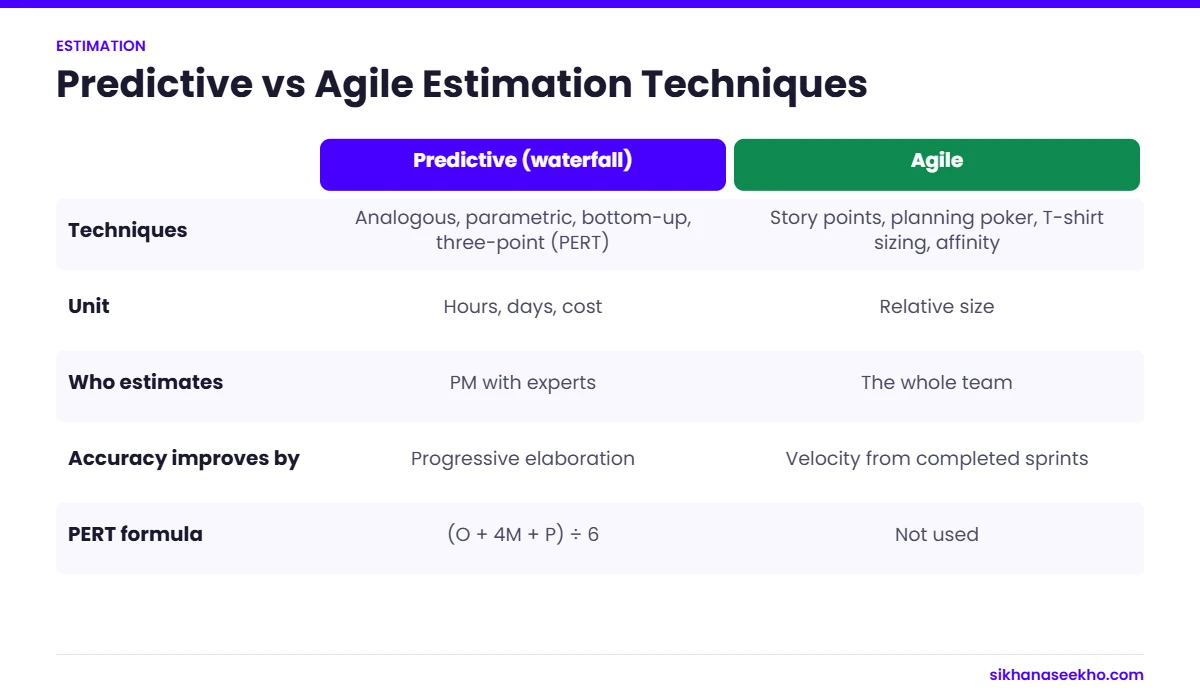
Project management estimation techniques fall into two broad families. Predictive (waterfall) techniques: analogous estimating, parametric estimating, bottom-up estimating, three-point estimating (PERT), and expert judgement: produce time and cost estimates in absolute units (days, dollars). Agile techniques: story points, planning poker, T-shirt sizing, affinity estimation and velocity-based forecasting: produce relative effort estimates used to plan sprints and forecast release dates. The right technique depends on how well requirements are understood, how much historical data exists, and how much precision is needed at the current stage of planning. No estimation technique is accurate: all produce approximations. The goal is to produce estimates that are good enough for decision-making at the appropriate level of precision, and to communicate their uncertainty honestly.
Estimation is one of the most consequential skills in project management, and one of the most consistently underestimated in difficulty. Most project schedules are built on estimates. Most budgets are built on estimates. When those estimates are wrong, the project is wrong from the moment planning begins.
The challenge is not that estimating is technically complex. It is that estimates are predictions about uncertain futures, made by humans with limited information, who are subject to optimism bias, anchoring effects and external pressure to produce numbers that look acceptable rather than numbers that are realistic. The techniques in this guide do not eliminate that uncertainty. They give you structured, defensible ways to quantify it, and communicate it honestly to the people who will make decisions based on it.
This guide covers the full toolkit: waterfall and predictive techniques for projects with defined scope, Agile techniques for iterative delivery, hybrid approaches for projects that blend both, and the decision framework for choosing the right technique in the right situation.
Why Estimation Is Hard: The Estimation Problem
Before learning the techniques, it helps to understand why estimation consistently goes wrong in practice. Four forces conspire against accurate estimates on almost every project.
The optimism bias. Humans systematically underestimate how long tasks will take and how much they will cost. Study after study confirms this: in software development, construction, infrastructure and knowledge work alike. The average software project runs roughly 2× over its original time estimate and 1.5× over budget. These are not outliers caused by poor planning. They are the expected outcome of optimism bias in normal planning.
Anchoring. When someone gives you a number first, even an arbitrary one, it anchors your subsequent estimate toward it. If a sponsor says "I was thinking this would cost about $200,000," your estimate will cluster closer to $200,000 than it would have if you had started from a blank page. Structured estimation techniques (particularly Agile techniques like planning poker) are specifically designed to prevent anchoring by having estimators commit independently before revealing numbers.
The planning fallacy. People plan based on best-case scenarios rather than realistic scenarios, ignoring the base rate of similar projects. Asked how long a project will take, people focus on the specific project's characteristics, not on the historical fact that most similar projects ran 30% over their initial estimates.
External pressure. Estimates do not exist in a vacuum. They are given to sponsors, clients and executives who have expectations, budgets and deadlines. The pressure to give an estimate that fits within an existing budget or timeline is enormous, and it silently distorts estimates toward what people want to hear rather than what the data suggests is realistic.
The Estimating Accuracy Spectrum: ROM to Definitive
Estimates are not equally precise at all stages of a project. PMBOK identifies a spectrum from Rough Order of Magnitude (ROM) at the start to Definitive estimates as planning matures. Understanding where you are on this spectrum, and communicating it clearly, is as important as the estimate itself.
A Rough Order of Magnitude estimate made at project initiation, when scope is still high level, has an accuracy range of −50% to +100%. That is not a failure of estimation skill. That is the honest reflection of how much is unknown at that stage. A sponsor who takes a ROM estimate and treats it as a commitment has misused the information.
As planning progresses and requirements are defined in more detail, estimates tighten. A budget estimate (made during early planning with a defined WBS but not yet detailed task plans) might be −10% to +25%. A definitive estimate (made during detailed planning with full task breakdowns, resource assignments and schedule network) narrows to −5% to +10%.
The practical implication: Give different types of estimates at different project stages. Clearly label them. A ROM estimate is not the same as a definitive estimate and should never be used as one.
Predictive (Waterfall) Estimation Techniques
Analogous estimating uses the actual cost, duration or resource quantities from a previous, similar project as the basis for estimating the current project. It is a top-down technique. You estimate the whole or large sections first, then break down if needed.
For example: "Our last ERP implementation for a company of similar size took 14 months and cost $1.8 million. This implementation has comparable scope, so we estimate 13–15 months and $1.6–2.0 million." The estimate is derived from the historical anchor and adjusted for known differences.
- Fast: can be produced in hours or days
- Useful at initiation when detail is unavailable
- Based on real historical performance
- Calibrated by expert judgement
- Only as good as the historical data: if past projects were poorly executed, estimates inherit those distortions
- Assumes similarity: differences between projects may be underestimated
- Low accuracy (ROM range typical)
- Does not scale well when the new project is significantly different from historical data
Best used when: Requirements are still high level, time for estimation is limited, and a rough magnitude is needed for go/no-go decisions or initial budgeting.
Parametric estimating uses a statistical relationship between historical data and measurable project variables to calculate cost or duration estimates. The model is: Estimate = Parameter × Unit Rate. For example: if historical data shows that installing 1 kilometre of network cable takes 8 hours of labour, and the project requires 45 kilometres, the parametric estimate is 45 × 8 = 360 hours.
The technique requires reliable historical unit rate data and a linear or quantifiable relationship between the parameter and the estimate. It is widely used in construction (cost per square metre), software (function points per developer-day), manufacturing and infrastructure projects.
- More accurate than analogous estimating when the unit rate data is reliable
- Scalable: easy to adjust as scope changes
- Transparent: the model is explicit and auditable
- Can achieve Budget to Definitive accuracy with good data
- Requires reliable historical unit rate data: if the data is poor, the model amplifies the error
- Assumes linearity: real-world relationships are often non-linear (complexity, learning curves, economies of scale)
- Does not account for project-specific factors not captured in the parameter
Example use cases: Cost per server rack installed, days per module of code developed, hours per inspection, cost per room renovated, days per document reviewed.
Bottom-up estimating starts at the lowest level of the WBS, individual work packages or activities, and estimates each one separately. The individual estimates are then aggregated (summed) up through the WBS hierarchy to produce the total project estimate. It is the most time-intensive estimation approach and requires a detailed WBS to execute properly.
The process: decompose the project into work packages in the WBS, estimate the cost and duration of each work package using the best available information (expert judgement, parametric rates, time-boxing), roll up estimates from work package level to WBS element level to project total.
- Highest accuracy of the three predictive techniques
- Forces thorough understanding of project scope
- Each estimate is independently justified
- Makes scope gaps visible: unestimated work = undiscovered scope
- Creates strong buy-in, the people doing the work help create the estimate
- Time-intensive: requires detailed WBS and substantial effort to produce
- Cannot be done until scope is well-defined: not useful at initiation
- Aggregation obscures uncertainty: summing estimates without their uncertainty ranges can create false precision
- Can be gamed: teams pad individual estimates, creating a sum that is inflated
Best used when: Scope is fully defined, a definitive estimate is required (budget baseline, contract pricing), and time is available to do it properly. This is the standard technique for creating the cost baseline used in EVM.
Expert judgement means using the knowledge of people with relevant experience to inform or validate estimates. It appears as a tool or technique in almost every PMBOK estimation process because experienced PMs and domain experts are often the most reliable source of estimation data: particularly when historical data is limited or the project is novel.
Used without structure, expert judgement is vulnerable to the biases described earlier: particularly anchoring (if experts hear each other's estimates) and social pressure (if a senior expert dominates). The Delphi technique addresses this by structuring expert input to be anonymous and iterative:
- Experts submit their estimates independently and anonymously
- A facilitator aggregates the estimates and shares the range with all experts (without attribution)
- Experts who gave outlier estimates are invited to explain their reasoning anonymously
- All experts revise their estimates in light of the shared reasoning
- The process repeats until the estimates converge to an acceptable range
The Delphi technique is particularly valuable for novel technology projects, innovation projects and situations where no reliable historical data exists. It surfaces disagreement and forces it to be resolved through reasoning rather than authority.
Three-Point Estimating and the PERT Formula
Three-point estimating addresses one of the core weaknesses of single-point estimates: they present one number as if the future is certain. In reality, every estimate has a range of plausible outcomes. Three-point estimating makes that range explicit by asking for three estimates instead of one.
The three points are:
- Optimistic (O): The best-case duration or cost: if everything goes better than expected
- Most Likely (M): The most probable duration or cost, the realistic, most common outcome
- Pessimistic (P): The worst-case duration or cost: if significant problems occur
These three values feed into two weighting formulas. The PERT (Program Evaluation and Review Technique) formula gives extra weight to the most likely estimate. The triangular distribution treats all three equally. PERT is more commonly tested on the PMP exam and more widely used in practice.
PERT Worked Example: Fully Calculated
| Task | Optimistic (O) | Most Likely (M) | Pessimistic (P) | PERT Expected (E) | Std Dev (SD) |
|---|---|---|---|---|---|
| Requirements analysis | 3 days | 5 days | 10 days | (3 + 20 + 10) ÷ 6 = 5.5 days | (10−3) ÷ 6 = 1.17 |
| System design | 5 days | 8 days | 15 days | (5 + 32 + 15) ÷ 6 = 8.67 days | (15−5) ÷ 6 = 1.67 |
| Development | 10 days | 15 days | 28 days | (10 + 60 + 28) ÷ 6 = 16.33 days | (28−10) ÷ 6 = 3.00 |
| Testing | 3 days | 5 days | 9 days | (3 + 20 + 9) ÷ 6 = 5.33 days | (9−3) ÷ 6 = 1.00 |
| Project Total | 35.83 days | SD not simply summed: add variances first |
Calculating project-level standard deviation: Individual task SDs cannot be simply added. Instead, sum the variances (SD²) and take the square root. Project SD = √(1.17² + 1.67² + 3.00² + 1.00²) = √(1.37 + 2.79 + 9.00 + 1.00) = √14.16 ≈ 3.76 days.
Confidence ranges: With a PERT expected duration of 35.83 days and a project SD of 3.76 days, statistical confidence ranges are: 68% confidence the project completes in 32.1–39.6 days (E ± 1SD), 95% confidence in 28.3–43.4 days (E ± 2SD), 99.7% confidence in 24.6–47.1 days (E ± 3SD).
Reserve Analysis: Building Estimation Uncertainty Into the Budget
Reserve analysis is the process of adding buffers to estimates to account for identified and unidentified uncertainty. PMBOK distinguishes two types of reserve:
Contingency reserve: added for identified risks. If the risk register contains a specific risk (e.g. "vendor may be 2 weeks late") and a response has been planned that involves additional cost if the risk occurs, the estimated cost of that response is the contingency reserve. Contingency reserve is part of the cost baseline and is included in the project budget. It is the PM's authority to use.
Management reserve, added for unknown unknowns, risks that have not been identified but that experience and project complexity suggest will materialise. Management reserve sits outside the cost baseline and requires management/sponsor approval to access. It is not included in EVM calculations (which are based on the cost baseline).
The practical decision: how much reserve is appropriate? This depends on project risk level, complexity, novelty and stakeholder risk appetite. Common guidance: 5–15% contingency for well-understood projects with a mature risk register; 15–25% for novel, complex or technically uncertain projects. Management reserve of 5–10% of the project budget is common on large capital projects.
Agile Estimation Techniques
Agile estimation works on a fundamentally different philosophy from predictive estimation. Rather than predicting exact durations and costs, Agile techniques estimate relative effort: how much work is required compared to other items. This sidesteps the precision bias of single-point estimates and embraces the reality that early estimates are inherently uncertain.
Story points are a unit of measure for the relative effort required to implement a user story. They are abstract, a story worth 5 points takes roughly 2.5× the effort of a 2-point story. They capture effort, complexity and uncertainty together in a single number.
Key principle: Story points are team-relative, not universal. A 5-point story for Team A may be a 3-point story for Team B. They are used to compare stories within a team's context, not across teams.
The standard scale uses Fibonacci numbers, 1, 2, 3, 5, 8, 13, 21, because the increasing gaps reflect genuine uncertainty: a 13-point story is not just 13× harder than a 1-point story, it is also fundamentally harder to estimate with precision.
T-shirt sizing assigns work items to categories, XS, S, M, L, XL, XXL, based on relative effort. It is faster than story point estimation and works well for large backlogs where rough categorisation is more useful than precise point values.
Common use: At product backlog refinement sessions for new epics or features. Once an item is planned for an upcoming sprint, it is broken down into stories and estimated in story points.
Some teams map T-shirt sizes to story point ranges: XS=1, S=2, M=3, L=5, XL=8, XXL=13+. Others use T-shirt sizes purely qualitatively without numerical mapping.
Affinity estimation (also called affinity mapping or silent sorting) is a technique for quickly estimating large numbers of stories, often 20–100 at once. Each story is written on a card, and team members silently sort the cards into size groups, moving cards they disagree with. The process continues until consensus emerges.
When to use it: At the start of a project or release planning session when a large, unestimated backlog needs to be sized quickly. Affinity estimation can estimate 100 stories in under an hour: far faster than individual story-by-story estimation.
Relative estimation means establishing a reference story, a "known" item the team has delivered before, and estimating all new stories relative to it. "Is this story bigger or smaller than the login screen we built in Sprint 3? Roughly how much bigger?"
This anchors estimation to real-world team experience rather than abstract time units. It is more accurate than absolute time estimates because humans are better at comparing things than measuring them in absolute units. The reference story is typically a 3 or 5-point story that serves as a calibration point for the team.
Planning Poker: The Standard Agile Estimation Ceremony
Planning poker (also called Scrum poker) is the most widely used Agile estimation technique. It combines relative estimation with anonymous simultaneous reveal to prevent anchoring and encourage honest assessment.
How it works:
- The Product Owner presents a user story and answers questions
- Each team member privately selects a card representing their story point estimate
- All cards are revealed simultaneously. Nobody sees others' estimates before committing their own
- If estimates vary significantly, the highest and lowest estimators explain their reasoning
- The discussion clarifies hidden complexity or assumptions, and the team votes again
- Repeat until consensus (or near-consensus) is reached
The card deck uses Fibonacci-ish values. Most decks also include special cards:
☕ = break needed (the session has gone too long) · ? = not enough information to estimate · ∞ = too large, needs to be split into smaller stories · 0 = already done or trivial
Why simultaneous reveal matters: If team members reveal estimates one at a time, anchoring occurs: later estimators cluster toward the first number they see. Simultaneous reveal forces every team member to commit independently. The disagreement that surfaces is information. It reveals different understandings of the story's scope or complexity that need to be resolved before work begins.
Velocity-Based Forecasting: The Agile Parametric Estimate
Velocity is the average number of story points a team completes per sprint, calculated over a rolling window of recent sprints. Once a team's velocity is established, it becomes a forecasting tool: divide the total story points remaining in the backlog by the team's velocity to estimate how many sprints are needed to complete the work.
| Sprint | Points Committed | Points Completed | Rolling Average Velocity |
|---|---|---|---|
| Sprint 1 | 32 | 28 | 28 |
| Sprint 2 | 35 | 31 | 29.5 |
| Sprint 3 | 30 | 33 | 30.7 |
| Sprint 4 | 34 | 30 | 30.5 |
| Sprint 5 | 32 | 32 | 30.8 |
| Established velocity | Average of Sprints 3–5: 31.7 points/sprint | Use this for forecasting | |
Forecasting remaining work: If the product backlog contains 220 story points of remaining work and the team's established velocity is 32 points per sprint, the forecast is 220 ÷ 32 = 6.9 sprints: approximately 7 two-week sprints, or roughly 14 weeks to complete the backlog.
Important caveats: Velocity is a lagging indicator. It tells you what the team has achieved, not what they will achieve. It assumes team stability (same people, same working patterns), consistent story point calibration (the team is estimating stories consistently over time), and no major changes in the nature of the work. A team that consistently over-estimates stories will appear to have a lower velocity than a team that under-estimates: velocity is calibrated to the team's own estimation scale.
Hybrid Estimation Approaches
Rolling Wave Planning
Rolling wave planning is the practice of planning in detail for the near term and at a high level for the future. It acknowledges that detailed estimation is only useful when requirements are sufficiently defined, and that forcing detailed estimates for work 6 months away is a false precision exercise.
In a rolling wave plan: the next 1–2 sprints are planned in detail (bottom-up estimates for each story), the next 1–2 months are planned at feature or epic level (T-shirt sizing or rough story point estimates), and everything beyond that is tracked as themes or capabilities in a high-level roadmap (analogous or ROM estimates).
As the project progresses, the planning horizon rolls forward: yesterday's medium-term plans become near-term plans and receive detailed estimation. Rolling wave planning is the default approach in Agile, but it is also applicable in predictive projects with uncertain scope.
The Cone of Uncertainty
The Cone of Uncertainty is a visual model that shows how estimation accuracy improves as a project progresses and more is known. Originally developed in the software industry, it has been adopted broadly in project management.
The cone illustrates why early estimates carry large uncertainty ranges and why demanding false precision at initiation is counterproductive. As the project moves through planning and execution, the cone narrows: uncertainty reduces as more is known about requirements, technology and constraints.
The cone also explains why projects that lock their budget to a ROM estimate at concept stage will almost always appear to overrun, not because the project was managed badly, but because the initial budget was based on an estimate with an inherent ±50% range.
Monte Carlo Simulation
Monte Carlo simulation is a computational technique that generates thousands of random scenarios based on probability distributions for each task's duration or cost. Each simulation run picks a random value from each task's distribution, calculates the total, and records the result. After thousands of runs, the results form a probability distribution for the overall project duration or cost.
The output answers questions like: "What is the probability this project completes within 12 months?" or "What budget gives us an 80% chance of not overrunning?" It is more sophisticated than PERT analysis and captures non-linear relationships and correlations between tasks that the PERT formula assumes away.
Monte Carlo requires software (Microsoft Project's risk analysis add-ons, Primavera Risk Analysis, or dedicated tools like @Risk) and is most commonly used on large, complex or high-risk projects where the cost of estimation error is substantial.
Which Estimation Technique to Use: Decision Guide
| Technique | Best When | Accuracy | Effort to Produce |
|---|---|---|---|
| Analogous (top-down) | Early stage, limited info, quick ballpark needed, similar historical projects exist | ROM (±50%) | Low: hours |
| Parametric | Well-defined scope units, reliable historical unit rate data, linear relationship exists | Budget to Definitive | Medium |
| Bottom-up | Detailed WBS available, highest accuracy needed, cost baseline required for EVM | Definitive (±5–10%) | High: days/weeks |
| Three-point (PERT) | Uncertainty must be quantified, confidence ranges needed, risk-aware planning | Medium to Definitive | Medium |
| Expert judgement / Delphi | Novel technology, no historical data, complex judgement required | Varies with expertise | Medium |
| Story points + planning poker | Agile delivery, iterative requirements, sprint planning, team-based estimation | Relative accuracy | Low per story |
| T-shirt sizing | Large backlog, quick rough sort needed, early product planning | Rough order | Very low |
| Velocity forecasting | Established Agile team with 3+ sprints of data, release date forecasting | Improves over time | Low (once velocity established) |
| Rolling wave planning | Hybrid projects, evolving requirements, phased delivery | Progressive precision | Low (ongoing) |
| Monte Carlo simulation | Large complex projects, probabilistic schedule/cost analysis, risk quantification | Probabilistic: most sophisticated | High: requires software and data |
The 6 Most Common Estimation Mistakes: and How to Avoid Them
Preparing for the PMP Exam?
Estimation techniques, including PERT calculations, reserve analysis and Agile velocity forecasting, appear across all three ECO domains. Test yourself with 200 free scenario-based questions.
Pingback: Precedence Diagramming Method - A Comprehensive Guide
Pingback: Top 10 APM PMQ Exam Tips to Pass First Time in 2026