CAPM Certification Guide 2026
How to Get Certified
The CAPM (Certified Associate in Project Management) is PMI's entry-level certification: designed for people at the start of their PM career. No work experience required, globally recognised and the fastest way to add credibility to a junior PM application.
The CAPM requires a secondary diploma and 23 hours of PM education: no work experience. The exam is 150 questions in 3 hours, costs $255 (PMI member) or $370 (non-member), and tests PMBOK knowledge areas and process groups. It is valid for 5 years and is the recommended first PM credential for students, career changers and early-career professionals.
CAPM at a Glance: 2026
PMI official requirements
What Is the CAPM Certification?
The Certified Associate in Project Management (CAPM) is PMI's foundational certification for project practitioners. It is designed for candidates who understand PM principles but have not yet accumulated enough project leadership experience to qualify for the PMP. While the PMP requires 36–60 months of leading projects, the CAPM has no work experience requirement whatsoever: only a secondary school diploma and 23 hours of PM education.
The CAPM tests knowledge of the PMBOK Guide, PMI's Project Management Body of Knowledge, covering the five process groups (Initiating, Planning, Executing, Monitoring & Controlling, Closing) and ten knowledge areas (Integration, Scope, Schedule, Cost, Quality, Resource, Communications, Risk, Procurement and Stakeholder Management).
It is most valued by: students preparing to enter PM roles, professionals transitioning into project management from another field, and people who work on projects as team members and want to formalise their knowledge with a recognised credential.
CAPM Eligibility: What You Need to Apply
The CAPM has the most accessible eligibility requirements of any major PM certification. There are two requirements, and neither involves work experience.
CAPM Exam Format and Structure
The CAPM exam is delivered online via Pearson VUE: either at a test centre or via online proctoring from home. Here is everything you need to know about the format.
| Detail | Specification |
|---|---|
| Number of questions | 150 questions (includes 15 unscored pretest items) |
| Time allowed | 3 hours (180 minutes) |
| Question types | Multiple choice, multiple response, matching, hotspot, fill-in-the-blank |
| Passing score | Not publicly disclosed: determined by psychometric analysis |
| Delivery method | Pearson VUE test centre or online proctored |
| Language | English (only) |
| Retake policy | 3 attempts within 1-year eligibility window. Retake fee applies. |
| Breaks | Two optional 10-minute breaks |
What the Exam Tests
The CAPM exam is knowledge-based. It tests your understanding of PMBOK process groups, knowledge areas, inputs, tools and outputs. Unlike the PMP (which is scenario-heavy and tests applied judgement), the CAPM has more direct recall questions. You need to know:
CAPM Exam Cost 2026
The CAPM is significantly cheaper than the PMP. Joining PMI before applying saves $115 on the exam fee: making membership pay for itself immediately.
| Cost Item | PMI Member | Non-Member | Notes |
|---|---|---|---|
| PMI Membership | $139/yr | $0 | Saves $115 on exam fee: joins for net saving of $24 before other benefits |
| CAPM Exam Fee | $255 | $370 | Paid after application approval via Pearson VUE |
| 23-Hour PM Course | $49 – $500 | Online Udemy/Coursera options from $49. Required for application. | |
| Practice Questions | $0 – $79 | Free questions available at Sikhana Seekho. Paid simulators from $49. | |
| Retake Fee | $150 | $200 | Per attempt. Up to 3 attempts within 1-year window. |
CAPM Study Guide: How to Prepare and Pass
Most candidates pass the CAPM in 4–8 weeks of part-time study. Here is a structured preparation approach.
Step 1: Complete Your 23-Hour Course First
The 23-hour PM education requirement is not just a box to tick, the course content is the foundation of your exam preparation. Choose a course specifically designed for CAPM, not a generic PM course. Udemy's CAPM prep courses (from $49 during sales) cover all PMBOK processes and are widely used by successful candidates.
Step 2: Master the PMBOK Structure
Download the PMBOK Guide from PMI.org (free with PMI membership). Create a summary table of all 49 processes mapped to their process group and knowledge area. This one-page reference becomes the spine of your revision. Focus especially on the ITTOs (Inputs, Tools & Techniques, Outputs) for each process. These are frequently tested.
Step 3: Learn the Key Formulas
The CAPM tests EVM calculations, float/critical path, communication channels and risk calculations. Use the free EVM calculator to practise until the formulas are automatic. The most commonly tested: CV = EV − AC, CPI = EV ÷ AC, EAC = BAC ÷ CPI, Communication Channels = n(n−1)/2.
Step 4: Practice Questions
Complete at least 300 practice questions before your exam. Focus on questions that test process knowledge: "which process does X belong to?", "what is the output of Y?", "which tool is used in Z?". Score consistently above 70% on full practice exams before booking.
CAPM vs PMP: Which Should You Get?
The most common question candidates ask. The answer depends entirely on your experience level.
| Factor | CAPM | PMP |
|---|---|---|
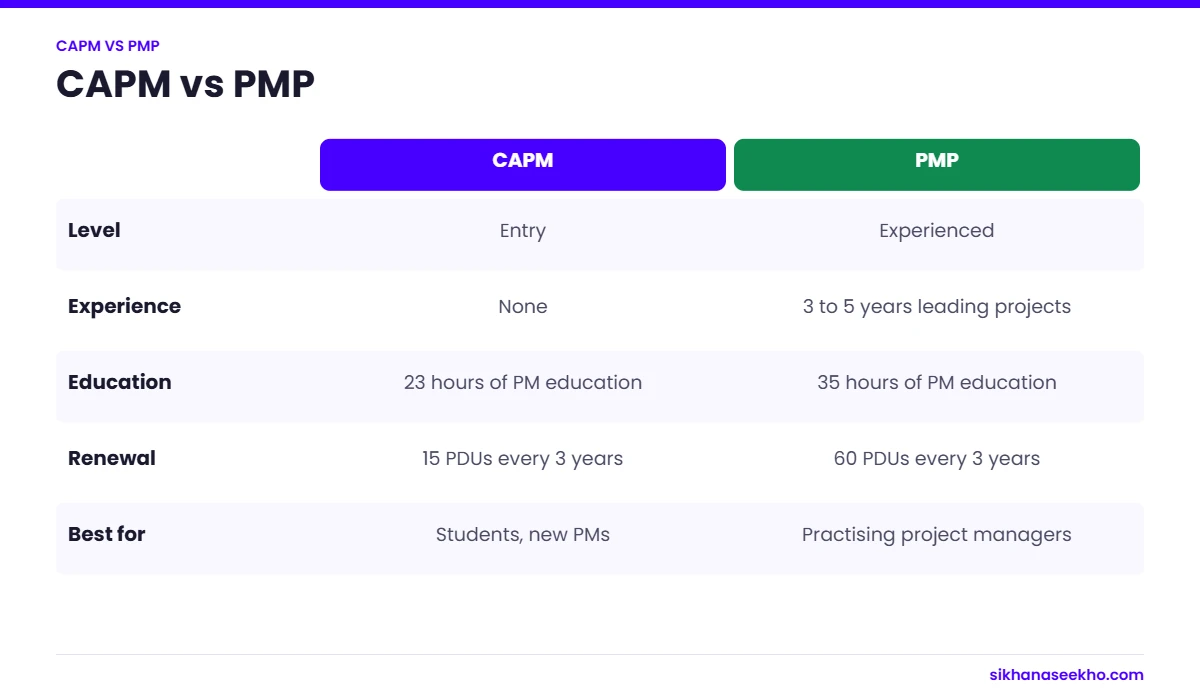
| Experience required | None | 36–60 months leading projects |
| Education required | Secondary diploma + 23 hrs | Secondary/degree + 35 hrs |
| Exam fee (member) | $255 | $405 |
| Exam difficulty | Moderate: knowledge-based | Hard: scenario and judgement-based |
| Questions | 150 questions, 3 hours | 180 questions, 4 hours |
| Validity | 5 years (no PDU renewal) | 3 years (60 PDUs to renew) |
| Employer recognition | Good: entry level | Excellent: global gold standard |
| Salary impact | Modest at entry level | +33% median premium (PMI data) |
| Best for | Students, career changers, team members | Experienced PMs, senior roles |
CAPM vs Other Entry-Level PM Certifications
The CAPM is not the only entry-level option. Here is how it compares to the other main alternatives in 2026.
| Certification | Issuer | Cost | Best Market | Difficulty |
|---|---|---|---|---|
| CAPM | PMI | $255 (member) | US, Middle East, global PMI orgs | Moderate |
| PRINCE2 Foundation | Axelos/PeopleCert | ~£250 exam only | UK, Europe, Commonwealth | Moderate |
| Google PM Certificate | Google/Coursera | $49/mo | Tech sector entry-level | Easy |
| CompTIA Project+ | CompTIA | ~$370 | IT project roles, US market | Moderate |
| IPMA Level D | IPMA | Varies by region | Europe, academic recognition | Moderate |
What to Do After Getting Your CAPM
The CAPM is a foundation, not a destination. Here is how to build on it strategically.
Build PM Experience Immediately
The CAPM opens doors to coordinator and junior PM roles. Take every project leadership opportunity you can, even internal improvement projects, volunteer work or freelance project management counts. You need 36 months of documented project leadership experience (with a degree) to qualify for the PMP. Start the clock now.
Move to PMP Within 5 Years
The CAPM expires after 5 years and cannot be renewed with PDUs. Before it expires, aim to have accumulated enough experience to apply for the PMP. If you let the CAPM lapse without moving to PMP, you would need to retake the CAPM exam from scratch. Plan your career progression to avoid this.
Consider Agile Credentials in Parallel
Many PM roles in 2026 require both traditional and agile knowledge. While building toward the PMP, consider adding the CSM (Certified ScrumMaster) or PSM I (Professional Scrum Master): both are achievable without extensive experience and round out your PM credential profile significantly.
Best CAPM Study Resources 2026
Here are the most-used and most effective resources for CAPM preparation in 2026, in order of recommended priority.
| Resource | Type | Cost | Why Use It |
|---|---|---|---|
| PMI CAPM Prep Course (Udemy) | Video course: 23+ hrs | $19–$49 | Satisfies PMI's 23-hour education requirement and covers all exam content |
| PMBOK Guide (6th or 7th ed.) | Reference text | Free (PMI member) | Primary exam reference: download free with $139 PMI membership |
| Sikhana Seekho Practice Questions | Free question bank | Free | PMBOK-aligned practice questions with detailed explanations |
| PM PrepCast (CAPM edition) | Practice simulator | $69–$99 | Most realistic exam simulation: 1,000+ questions |
| Rita Mulcahy's PMP Exam Prep | Study book | ~$79 | Excellent for process group and knowledge area mastery: works for CAPM too |
| EVM Calculator (Sikhana Seekho) | Free tool | Free | Practice EVM calculations until automatic: open calculator → |
Jobs the CAPM Can Help You Get
The CAPM will not make you a project manager on its own, but it shows employers you understand PMI's frameworks and vocabulary. That matters most for entry-level roles where candidates have little formal project experience. Typical roles CAPM holders apply for:
| Role | Why the CAPM helps |
|---|---|
| Project Coordinator | The most common first step. You schedule, track actions and keep documentation, which maps directly to what the CAPM tests. |
| Junior or Assistant Project Manager | Shows you can run smaller workstreams using standard processes while you build experience for the PMP. |
| PMO Analyst or Project Administrator | PMOs value people who know PMI terminology, reporting and governance. |
| Project roles in finance, IT and healthcare | Regulated sectors often prefer a recognised credential when hiring people without years of project experience. |
CAPM or the Google PM Certificate?
These are the two most popular entry-level options, and they work well together rather than against each other.
| CAPM | Google PM Certificate | |
|---|---|---|
| Issued by | PMI, the body behind the PMP | Google, delivered on Coursera |
| Assessment | A proctored 150-question exam | Course quizzes and projects, no proctored exam |
| Recognition | Globally recognised and a clear step towards the PMP | Well known in tech hiring, less weight in traditional PM job adverts |
| Best for | People who want a formal PMI credential on their CV | Career changers testing whether project management suits them |
A sensible route is to complete the Google certificate first, since PMI accepts it towards the 23 hours of project management education the CAPM requires, then sit the CAPM exam. See the Google PM Certificate review for details.