How to Transition into
Project Management in 2026
I made this exact move myself, from project engineer in the UAE to certified PMP trainer. I have also helped hundreds of students from the USA, UK, Canada, Australia, the Gulf and beyond do the same. You already have more PM experience than you think. It just is not labelled that way yet. This guide shows you exactly which skills transfer, what to do first and how to make the move without starting over.
Why Project Management Is One of the Best Career Transitions
I started as a project engineer on flagship UAE construction projects, including EGA Head Office Al Taweelah, The Constellation Abu Dhabi and Abu Dhabi Mall. I transitioned into project management, earned my PMP in 2019 and now train students from 20-plus nationalities with a 100% pass rate. Project management is one of the most accessible career changes available, and one of the most rewarding. Three things make it distinctive as a transition destination: it is skills-based rather than credential-locked, domain expertise from your previous career actively adds value, and the salary uplift is significant and fast.
No single required qualification. Unlike law, medicine, accounting or engineering, there is no professional body gatekeeping entry. Certifications matter but they are achievable in weeks, not years. This means you can start the transition immediately, not after a two-year conversion course.
Your domain expertise is a competitive advantage. An IT professional who becomes a PM manages IT projects better than a generic PM because they understand the technical constraints, the team dynamics and the delivery risks from the inside. A finance professional who transitions brings credibility with CFOs and rigour with numbers that most PMs cannot match. I see this pattern every time I train a career-changer student. Employers hiring for sector-specific PM roles frequently prefer candidates with domain depth over candidates with pure PM experience.
The salary progression is material. Most career changers into PM from professional backgrounds see a salary increase, not a decrease. A project coordinator role at £32K to £38K leads to a junior PM at £42K to £52K within 18 to 24 months, and a mid-level PM at £55K to £70K within 3 to 5 years of transition. For people in lower-paid professional roles, the salary trajectory is particularly strong.
Your Starting Point: Four Common Transition Backgrounds
The transition path is different depending on where you are starting from. Here are the four most common professional backgrounds for PM career changers, what transfers directly, what gaps you need to fill and which certification to target first.
How Your Current Skills Translate to PM
The single biggest blocker for career changers is not a skills gap. It is a language gap. You have done project management work. You just have not been using project management vocabulary to describe it. I see this in almost every student who comes to me from a non-PM background. The skills are there. The framing is not. This table shows how common professional skills translate directly into PM competencies.
| Your Current Skill | PM Translation | How to Demonstrate It |
|---|---|---|
| Coordinating a team to a deadline | Schedule management, resource coordination | Describe the timeline, team size, dependencies managed and outcome delivered |
| Managing a budget or P&L | Cost management, budget reporting, variance analysis | Quantify the budget size, the variance you managed and the reporting cadence |
| Presenting to senior stakeholders | Stakeholder management, executive communication | Name the audience level, the decision you enabled and the outcome |
| Identifying and solving problems proactively | Risk identification, issue management | Frame as: risk identified early, mitigation applied, impact avoided |
| Managing a supplier or vendor relationship | Procurement management, contract oversight | Describe the contract type, the SLAs managed and any performance issues resolved |
| Defining the requirements for a new system or process | Scope definition, requirements management | Describe the stakeholders consulted, how requirements were gathered and validated |
| Leading a team through organisational change | Change management, stakeholder engagement | Describe resistance encountered, how it was managed and adoption rate achieved |
| Producing regular reports and dashboards | Project reporting, status communication, monitoring | Name the audience, the metrics reported and the decisions the reporting enabled |
| Running regular team or steering meetings | Meeting facilitation, governance, decision management | Describe the meeting type, attendee levels, decisions made and actions tracked |
| Planning and launching a product or service | Project planning, deliverable management, go-live | Describe scope, timeline, team involved, risks managed and the outcome |
Reframing Your CV for PM Roles
Your CV does not need to be rewritten from scratch. It needs to be reframed. The goal is to surface the project management elements of your existing experience using PM vocabulary, structure and metrics that hiring managers and ATS systems recognise.
Before and After: CV Line Reframes
CV Structure for Career Changers
Use a functional or hybrid CV format rather than a purely chronological one. Lead with a strong professional summary that explicitly positions you as a PM career changer. State your background, your transferable strengths and your certification status. Then add a "Key Project Experience" section before your employment history, pulling the strongest PM examples from across your career regardless of when they happened. Your employment history follows, rewritten with PM language as shown above.
Keywords matter for ATS: include "stakeholder management", "risk management", "change control", "project delivery", "project planning", "budget management", "cross-functional team", "go-live", "milestone", "PRINCE2" or "PMP" as appropriate. Hiring managers search for these terms. Your CV will not surface without them.
Which Certification to Get First, and When
The right certification depends on your target market and employer. I always tell my students to search five to ten job descriptions in their target role and region first. Whichever certifications appear most frequently in "Requirements" or "Preferred" sections is the one to prioritise. Here is the standard progression for UK and global markets.
Alternative First Certifications by Target Role
Targeting Agile or tech sector roles: PSM I from Scrum.org ($150, no prerequisites, 1 to 2 weeks study) or CAPM from PMI (around $300 member rate, 23 hours training required). PSM I is the faster and cheaper option. CAPM provides a deeper PMBOK foundation. Targeting public sector, NHS or government: PRINCE2 Foundation is close to mandatory. Add PRINCE2 Practitioner within 12 months of your first PM role. Targeting programme or change management roles: MSP (Managing Successful Programmes) Foundation or APMG Change Management Foundation alongside PRINCE2. Already have PMP or equivalent: Add PRINCE2 if targeting UK public sector. The combination is particularly strong for consultancy and contracting roles.
How to Land Your First PM Role
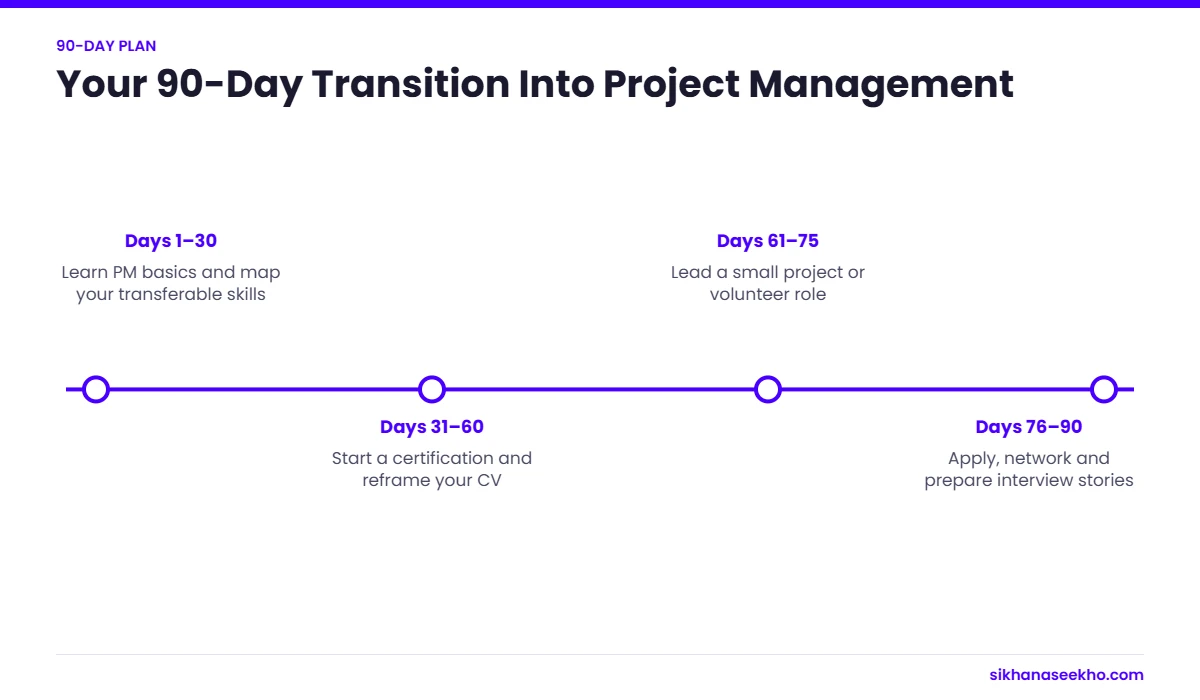
Your 90-Day Transition Plan
Most successful PM career changers complete the transition within 6 to 12 months of committing to it. This is the plan I recommend to every student who comes to me wanting to make the switch. The 90 days below cover the foundations, from knowledge building through to active job search. Adapt the timeline to your circumstances.