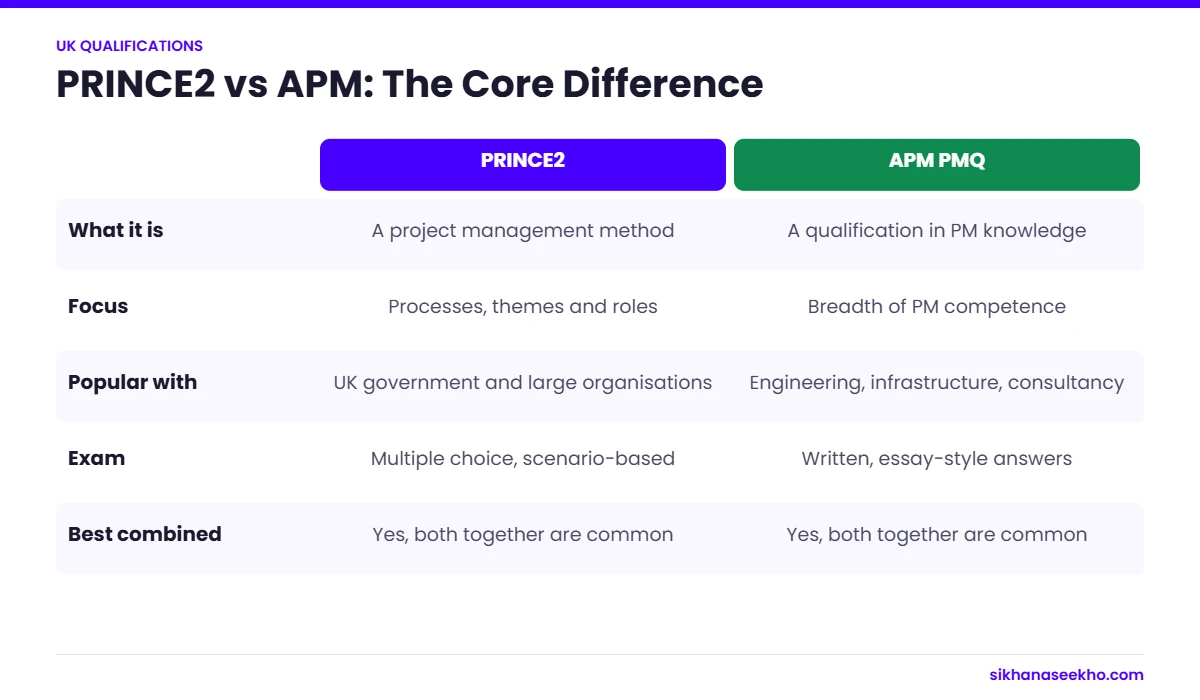
Here is the simple version. PRINCE2 is a method: a set way of running a project, with defined processes, roles, documents and stages. The APM PMQ is a qualification: it tests broad project management knowledge and judgement, not tied to any one method. PRINCE2 tells you what to do and in what order. The PMQ helps you decide how to run a project in your own setting. In UK job adverts, PRINCE2 shows up most in IT delivery, central government and the public sector. APM shows up most in infrastructure, defence, engineering, rail and senior project roles. Over a career you may want both, but your current sector should decide which comes first.
- A structured methodology with defined processes, roles and documents
- Tells you what to do and in what sequence: prescriptive by design
- Two levels: Foundation (knowledge) and Practitioner (application)
- Practitioner exam is open book: methodology reference permitted
- No experience prerequisite: accessible at any career stage
- Dominant in UK government IT, public sector and Central Government
- Requires renewal every 3 years
- A competency-based qualification assessing broad PM knowledge and application
- Tells you the tools and techniques available: you choose what applies
- Single intermediate qualification (with PFQ below, PPQ/ChPP above)
- Exam is closed book: includes written long-response questions
- Recommended for PMs with 2–3 years of experience
- Dominant in UK infrastructure, defence, rail, nuclear, engineering consultancy
- No expiry: permanent qualification once awarded
PRINCE2 and APM are the two qualifications UK project managers argue about most. People compare them as if they compete. They do not, and once you see what each one is, the choice gets much easier.
PRINCE2 is a method. It does not certify that you know project management in general. It certifies that you know one specific way of running projects. The Practitioner exam tests whether you can apply PRINCE2 7: its seven principles, seven practices, seven processes and how to tailor them to a project. A PRINCE2 Practitioner can join any organisation that uses PRINCE2 and work inside its governance from day one.
The APM PMQ is a qualification in the traditional sense. It shows you understand project management broadly and can apply it in different industries and delivery approaches. A PMQ holder knows a wider range of techniques, can work in agile, predictive or hybrid settings and is not tied to one method.
That one difference explains almost every other difference below, and it tells you which one should go on your CV first.
If you are choosing between APM and PMI instead, read my APM vs PMP comparison. This page is only about PRINCE2 versus APM, and which one to get first for a UK role.
PRINCE2 vs APM: The Core Philosophical Difference
PRINCE2 operates on the premise that successful project management is achievable through consistent, structured process. If you follow the right processes in the right order, with the right roles and the right documentation at each stage, projects will be better controlled and more likely to succeed.
This makes PRINCE2 particularly powerful in environments where multiple projects need to run consistently, where a programme director needs assurance that every project in their portfolio is being managed to the same standard, using the same language, producing the same governance artifacts.
The methodology covers: Starting Up a Project, Initiating a Project, Directing a Project, Controlling a Stage, Managing Product Delivery, Managing a Stage Boundary, and Closing a Project: seven processes that together span the complete project lifecycle.
APM operates on the premise that effective project management requires broad competency: knowledge of a wide range of techniques, the judgement to select the right ones for the specific project context, and the professional accountability to apply them well.
This makes APM PMQ particularly powerful for PMs who work across varied project types, industries and delivery approaches, where the right methodology varies by project and rigid adherence to a single framework would be inappropriate or counterproductive.
The qualification covers 24 learning objectives spanning governance, lifecycle management, planning, risk, stakeholder engagement, benefits management, leadership, quality, procurement and the strategic business context, a breadth that no single methodology covers.
PRINCE2 vs APM PMQ: Complete Comparison 2026
| Factor | PRINCE2 (Practitioner) | APM PMQ |
|---|---|---|
| What it certifies | Ability to apply the PRINCE2 methodology to manage a project | Broad knowledge and competence across all project management disciplines |
| Issuing body | PeopleCert / AXELOS | Association for Project Management (APM): UK's only Chartered body for PM |
| Type | Methodology certification | Professional competency qualification |
| Experience required | None: accessible with no PM experience | 2–3 years recommended (not formally enforced) |
| Prerequisites | Must hold PRINCE2 Foundation before sitting Practitioner | None formally required; APM PFQ recommended for beginners |
| Levels / structure | Foundation → Practitioner (two separate exams) | PFQ − PMQ − PPQ → ChPP (four-step career pathway) |
| Exam format | Foundation: 60 questions, 1 hour, pass mark 36/60. Practitioner: 70 objective questions, 2.5 hours, pass mark 42/70 | 40 questions (mixed format: MCQ, select-list, short-response, long-response), 2.5 hours |
| Open or closed book? | Practitioner is open book: the PRINCE2 manual permitted | Closed book: no reference materials permitted |
| Written components? | No: all objective format | Yes: long-response written questions (56% of marks) |
| Methodology coverage | PRINCE2 7 framework only: 7 principles, 7 practices, 7 processes | Methodology-agnostic: covers predictive, Agile and hybrid approaches |
| Agile content | Limited in standard PRINCE2 (PRINCE2 Agile is a separate certification) | Included: linear, iterative and hybrid lifecycle coverage |
| Renewal | Practitioner valid for 3 years: renew by retaking the exam or logging CPD through PeopleCert | No expiry: permanent qualification once awarded |
| Exam cost (UK) | Foundation ~£250–£350; Practitioner ~£350–£550 (exam fees vary by provider) | £471.60 (APM member) / £591.60 (non-member) inc. VAT |
| Total typical cost | £600–£1,800 (Foundation + Practitioner + training) | £600–£2,500 (depending on study route) |
| International recognition | Used in 150+ countries: particularly strong in Europe, Commonwealth and former UK territories | Strong UK + IPMA network (70+ countries): less widely known in North America and Asia |
| Chartered pathway | No: PRINCE2 does not lead to chartered status | Yes: PMQ − PPQ → ChPP (Chartered Project Professional) |
| CPD requirement | Required to keep Practitioner current (re-exam or CPD) | Expected as an APM member; no mandatory renewal for the qualification itself |
How the Exams Actually Differ: Beyond the Format
The Practitioner exam tests application of the PRINCE2 methodology: given a scenario, you select the correct PRINCE2-compliant response. Because the exam is open book, the challenge is not memorisation but speed: finding the right answer in the manual quickly under time pressure. Candidates who know the framework well do not need to look things up, the manual is a safety net, not a crutch.
The PMQ exam tests application of broad PM competency: given a scenario, you structure a written response using APM terminology. The long-response section (10 questions × 5 marks) is the critical differentiator: it rewards candidates who can apply knowledge structurally rather than just recall it. The closed-book format means all terminology and concepts must be internalised before the exam.
UK Employer Demand: Where Each Qualification Opens Doors
Both PRINCE2 and APM appear often in UK project manager job adverts, but in different sectors and for different kinds of role. Knowing the pattern tells you which one will help your next move fastest.
- UK Central Government: Cabinet Office, HMRC, DWP, MOJ: PRINCE2 is embedded as a governance standard
- UK IT delivery: IT services, digital transformation, ERP implementations
- NHS IT and digital projects: NHS Digital, NHS Trusts with IT-led change programmes
- UK financial services IT: banks, insurers running structured IT change
- Consulting and managed services: firms delivering to public sector clients
- MOD IT projects: defence IT contracts where PRINCE2 is mandated
- Most frequently cited qualification in UK public sector PM job ads
- UK major infrastructure: HS2, National Grid, Thames Water, National Highways
- UK defence (physical): BAE Systems, Babcock, QinetiQ, Rolls-Royce, Serco
- UK nuclear: EDF, Sellafield, NDA, Hinkley Point C
- UK rail: Network Rail, Transport for London, HS2
- Engineering consultancy: Atkins, Mott MacDonald, AECOM, Jacobs, WSP
- Senior strategic PM roles: PMO Director, Programme Director, Head of PM
- The ChPP pathway gives APM a unique advantage for senior career progression
A quick rule for UK job searches: If the advert is for an IT project manager in the public sector or a technology change programme, PRINCE2 Practitioner is usually expected or preferred. If it is for a project manager in construction, infrastructure, engineering, defence or a senior leadership role, APM PMQ and APM membership are mentioned more often. Many senior roles list both. Search Reed, LinkedIn or Indeed for the exact role and location you want, and the pattern will be clear within minutes.
Reading a UK Job Advert: A Worked Example
Say you see an advert for a "Project Manager, rail signalling upgrade" with a main contractor. It asks for "APM PMQ or equivalent, PRINCE2 desirable". Here is how I would read it:
- Essential beats desirable. The PMQ is the one that gets you shortlisted. PRINCE2 is a bonus.
- "Or equivalent" is not a free pass. It often means a PMP or a chartered status. A PRINCE2 Foundation alone rarely counts.
- Look at the client. If the client is a public body with its own stage gate process, PRINCE2 knowledge will help you in board meetings even if it is only desirable.
Now flip it. An advert for a "Digital Delivery Manager, government department" that asks for "PRINCE2 Practitioner" and says nothing about APM is telling you clearly which one to do first. Do this for ten adverts and count. The answer is usually obvious.
PRINCE2 or APM First?: The UK Decision Framework
Why the Best UK PMs Hold Both PRINCE2 and APM PMQ
Many strong UK project managers hold both, and it is not about collecting certificates. The two fill each other's gaps.
PRINCE2 gives you the governance framework: you know how to set up a project board, how to manage stage boundaries, how to apply the controls that keep projects from drifting out of scope and budget. APM PMQ gives you the PM toolkit: you know how to estimate a schedule accurately, how to facilitate a risk workshop, how to engage a resistant stakeholder, how to apply EVM to monitor cost performance.
A PM with only PRINCE2 knows the structure but may lack the depth of technique needed for complex planning, risk management or stakeholder challenges. A PM with only APM PMQ has the techniques but may work in environments where PRINCE2 governance is expected and their unfamiliarity with the methodology creates friction.
The order I suggest for most UK project managers: If you are early in your career, or your employer runs on PRINCE2, start with PRINCE2 Foundation and Practitioner. It is quicker and you can use it on Monday. Add the APM PMQ later. If you are mid-career with real project experience in infrastructure, engineering or a senior role, start with the APM PMQ and add PRINCE2 later. Either way, you are building towards both.
What About PRINCE2 Agile?
PRINCE2 Agile is a separate certification that combines the governance structure of PRINCE2 with Agile delivery practices. It is aimed at organisations that need PRINCE2's control framework but want to deliver work iteratively using Scrum, Kanban or other Agile approaches.
PRINCE2 Agile is a meaningful option for PMs in environments where PRINCE2 governance is mandated at the programme or portfolio level, but delivery teams are working in sprints. It provides a formally documented way to operate both frameworks together rather than treating them as incompatible.
However, PRINCE2 Agile does not replace the breadth of APM PMQ. It extends PRINCE2 into Agile delivery contexts. It is not a broad PM competency qualification. A PRINCE2 Agile Practitioner knows how to blend PRINCE2 governance with Agile delivery; they do not necessarily have the risk management depth, stakeholder engagement breadth or benefits management knowledge that the APM PMQ develops.
Explore Each Qualification in Depth
The full APM PMQ guide covers the 2026 exam format, all 24 learning objectives, costs and study strategy. The APM vs PMP comparison covers the choice for internationally mobile UK project managers.