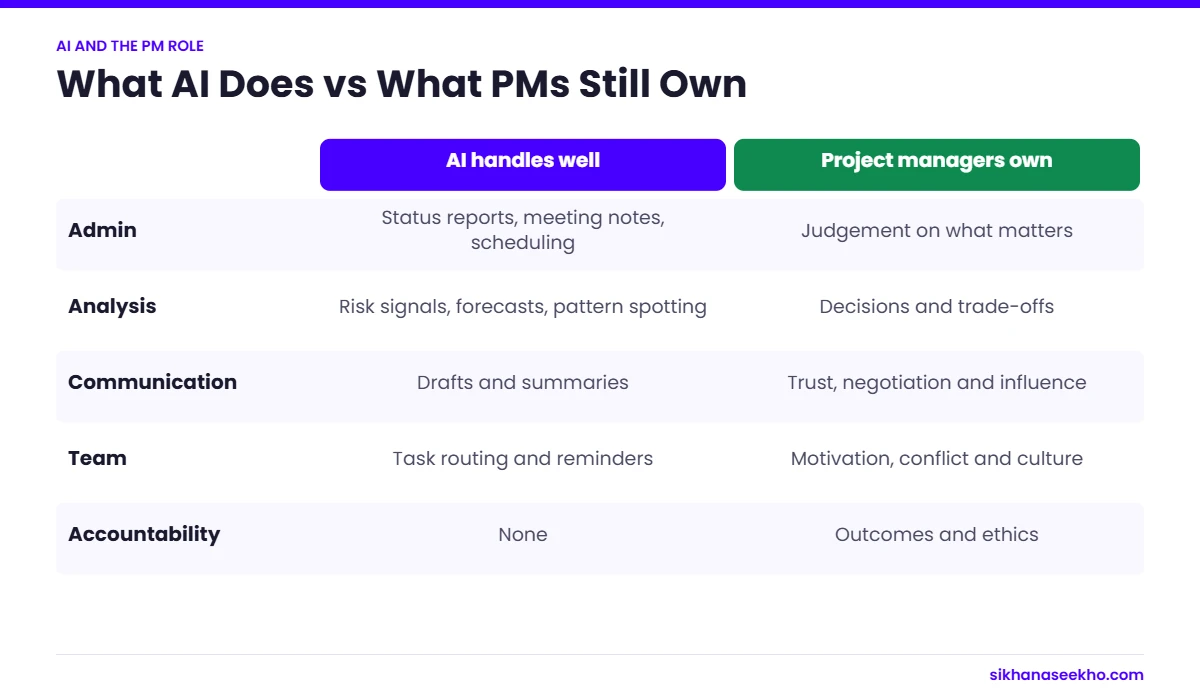
AI in project management is predominantly an opportunity: but with a genuine threat component that PMs who ignore it will pay for. AI is already eliminating large portions of project management's most time-consuming administrative work: scheduling optimisation, status reporting, meeting summarisation, risk prediction and resource allocation. Gartner predicts that 80% of the work currently done by project managers will be handled by AI by 2030. But the work that AI cannot do: political navigation, trust building, ethical judgement, crisis leadership, stakeholder relationship management and contextual decision-making in genuinely novel situations: is precisely the work that defines the difference between good and great project management. The PMs most at risk are those whose value proposition sits primarily in administrative coordination. The PMs best positioned are those whose value sits in human judgement, strategic thinking and stakeholder relationships.
✦
From my experience: I use AI tools in my own training work and encourage my students to do the same. In my experience they save time on drafting and analysis, but judgement, relationships and accountability still sit with the project manager.
Real Threats
Administrative PM roles face significant automation risk
Gartner: 80% of PM work eliminated by AI by 2030
Scheduling, reporting and status tracking largely automatable now
Entry-level coordination roles already being restructured
AI-illiterate PMs will be outcompeted by AI-augmented PMs
Bigger Opportunities
AI removes the work PMs dislike most: admin, status chasing, report formatting
PMs who use AI tools become 2–3× more productive
Human skills (trust, politics, ethics, crisis leadership) become more valuable
AI tools are creating new PM specialisms: AI project governance, data-driven PM
The PM of 2030 manages AI-assisted delivery at higher scale and complexity
Every few years, a new technology triggers the same question in every profession: is this the thing that makes us redundant? In the early 2000s, project management software was supposed to replace project managers. In the 2010s, Agile methodology was supposed to make traditional PMs obsolete. In 2026, AI is the new existential question.
This time, the question deserves a more honest answer than usual, because the technology underlying it is genuinely more capable than its predecessors. AI systems can now process project data, predict schedule risks, generate reports, summarise meetings, optimise resource allocation and answer complex project questions in natural language. That is not trivial. That is a meaningful portion of what many project managers spend their time on.
But the question is not whether AI can do those things. It clearly can. The real question is what remains when it does, and whether that remainder is worth more or less than what existed before AI arrived. This guide gives an honest assessment: what AI is actually doing in project management right now, what it cannot do, and specifically what project managers should do to remain valuable in a world where AI handles an increasing share of the work.
01 · The Prediction
The Gartner Prediction: What 80% Actually Means
80%
of project managers' current work will be eliminated by AI by 2030, according to Gartner
Gartner research, widely cited in PM industry reporting, the figure refers to tasks, not roles
Before treating this as either a catastrophe or a dismissible headline, it is worth understanding what 80% actually refers to. Gartner is not predicting that 80% of project manager jobs will disappear. The prediction is that 80% of the tasks that currently fill a project manager's working week will be handled by AI systems. That is a different, and in some ways more interesting, claim.
AI augments the project manager; it does not replace judgement and leadership.
Think about what fills a typical PM's week: updating status reports, reformatting project dashboards for different stakeholder audiences, chasing team members for progress updates, preparing meeting agendas, documenting meeting actions, checking whether the schedule still holds after a resource change, running resource levelling calculations, reviewing risks against the register, preparing the weekly summary email. Most of these tasks are information processing work: gathering data, transforming it into a format, distributing it. That is exactly what AI systems are already doing well.
What remains is the work that is genuinely hard to automate: understanding why a particular stakeholder is resistant to a change even though they are nodding in meetings, navigating the political dynamics that make a simple decision complicated, knowing when to escalate versus absorb a problem, building the kind of trust that makes teams perform above expectation. That work does not disappear when AI handles the reports. If anything, it becomes more visible, because less time is spent on reports.
✦
The honest reframing: The question is not "will AI replace project managers?" The right question is "which project managers will be replaced?" The answer: those whose value is primarily administrative coordination and information management. Not those whose value is leadership, judgement, trust and strategic navigation. AI is a mirror that reveals which skills are genuinely human and which were always just processing work that humans happen to do.
02 · What AI Does Now
What AI Is Actually Doing in Project Management in 2026
The following are not speculative future capabilities. They are documented, deployed features in project management platforms that are in active use by teams right now.
✦
Intelligent Scheduling and Optimisation
Available now
AI tools like Motion and Epicflow analyse task dependencies, resource availability and deadline priorities to continuously optimise schedules in real time. When a task slips or a team member's capacity changes, the schedule auto-recalculates. What used to take a PM hours of manual Gantt chart manipulation happens automatically within seconds. Tools can run "what-if" scenario analysis: "what happens to the schedule if the vendor delivers 2 weeks late?", and show the outcome instantly.
✦
Predictive Risk Identification
Available now
Platforms like Wrike use machine learning trained on historical project data to identify risk patterns before they materialise. The system analyses task completion rates, workload imbalances, overdue task patterns and team capacity trends to flag projects likely to miss deadlines, often weeks before a human reviewer would spot the signal. In one documented case in architecture and engineering, an AI system detected a permitting delay three weeks before it would have surfaced through normal status reporting.
✦
Meeting Summarisation and Action Capture
Available now
AI meeting tools (Microsoft Copilot, Otter.ai, Fireflies, integrated features in Teams and Zoom) transcribe meetings in real time, identify action items, assign owners and generate structured summaries within seconds of the meeting ending. A PM who once spent 45 minutes writing up meeting notes now reviews a machine-generated summary, makes any corrections and publishes it in under 5 minutes. This alone reclaims several hours per week for the average PM.
✦
Automated Status Reporting
Available now
AI systems integrated with project management platforms can pull live data from tasks, milestones, budget tracking and risk registers to generate formatted status reports automatically. The PM reviews and approves rather than writing from scratch. Asana's AI layer provides real-time project health insights and recommends next steps. ClickUp AI summarises task updates into progress snapshots without manual input. The time investment in weekly reporting drops from hours to minutes.
✦
Resource Allocation and Load Balancing
Available now
AI tools analyse resource workloads across multiple concurrent projects and recommend optimal allocation: flagging who is overloaded, who has capacity and which tasks should be reassigned to keep timelines intact. On portfolios of 10+ projects with 50+ team members, this analysis was previously either manual (slow and error-prone) or ignored entirely. AI systems like Epicflow can do it continuously and alert PMs to emerging bottlenecks before they cause delays.
✦
Cost Estimation and EVM Analysis
Partial: improving
AI tools are reaching 85–95% accuracy on cost estimates and schedule forecasts when trained on relevant historical data. Experts note that beyond that threshold, human intervention remains necessary: particularly for novel scope elements or projects in new domains where historical training data does not exist. AI EVM analysis can flag CPI and SPI trends automatically and project completion costs in real time without manual calculation.
✦
Document Drafting and Communication
Available now
Generative AI (ChatGPT, Claude, Microsoft Copilot) can draft project charters, project management plans, risk registers, stakeholder communication emails, change request templates and lessons learned reports from structured prompts. A PM who previously spent a full day drafting a project initiation document can now review and refine a draft produced in minutes. The PM's role shifts from writer to editor and quality guardian.
✦
AI Agents for Multi-Project Coordination
Emerging: rapidly evolving
The newest development in 2026 is autonomous AI agents that can take actions, not just provide information. These agents can update task statuses, send stakeholder notifications, trigger workflows and escalate issues based on defined rules and conditions. Wrike's AI agents can execute project management actions directly from conversational prompts. This moves AI from analytical assistant to autonomous coordinator, the most significant shift yet in what AI can do independently.
03 · What AI Cannot Do
What AI Cannot Replace: The Irreducibly Human Skills
The list of things AI cannot do well in project management is not a consolation prize. It is, in fact, the list of skills that separate average project managers from excellent ones. These are the areas where the gap between human and AI capability remains vast, and where investment in development creates durable competitive advantage.
What AI cannot replicate in project management
✦Trust and relationship building
Teams perform differently for PMs they trust. That trust is built through demonstrated integrity, personal investment and genuine human connection over time. An AI system can track what was promised and delivered. It cannot create the emotional safety that makes teams honest about problems early.
✦Political and organisational navigation
Projects operate inside political environments. A change request that should logically be approved gets blocked because of departmental territory disputes. A sponsor who supports the project in public undermines it in private. Reading these dynamics, adapting to them and navigating through them requires contextual human intelligence that AI cannot develop from data alone.
✦Ethical judgement and accountability
When a compliance issue is discovered late in a project with significant schedule and cost implications, the decision about how to escalate, what to disclose and how to navigate the consequences involves ethical judgement, professional accountability and legal knowledge. AI can flag the issue, the PM must own the decision and its consequences.
✦Crisis leadership under ambiguity
When a project hits genuine crisis: key team member resigned on a critical path week, a major deliverable fails acceptance testing three days before go-live, the sponsor unexpectedly changes priorities: effective leadership requires improvisation, emotional regulation and rapid decision-making under incomplete information. AI models perform poorly in genuinely novel situations outside their training distribution.
✦Stakeholder influence and persuasion
Persuading a resistant senior stakeholder to support a change requires reading their specific concerns, acknowledging their perspective with genuine empathy, and constructing an argument that speaks to their actual interests rather than generic business case language. AI can draft the talking points. It cannot deliver them with the credibility, warmth and adaptability of a skilled PM.
✦Strategic context and judgement
AI can tell you which project is most likely to miss its deadline based on current data. It cannot tell you which project you should prioritise cancelling when the organisation's strategy shifts. That requires understanding of the business landscape, competitive context, stakeholder priorities and organisational culture that AI systems genuinely do not have.
04 · The Augmented PM
The Augmented Project Manager: What the Role Looks Like in 2026 and Beyond
The most useful frame for understanding AI's impact on project management is not replacement but augmentation. The project manager of 2026 is not being replaced by AI. They are being equipped with a capability multiplier that makes them effective at a level that was previously impossible for one person.
Traditional PM (pre-AI)
1–2 hours/day on status updates and reports
Manual schedule recalculation after changes
Risk reviews at monthly intervals
Meeting notes written post-session (often incomplete)
Resource allocation based on intuition and spreadsheets
Document drafting from blank templates
Can manage 2–4 projects effectively
Historical performance tracked manually if at all
→
AI-Augmented PM (2026)
AI generates reports; PM reviews in 15 minutes
Schedule auto-recalculates on task updates
Real-time risk monitoring with predictive alerts
AI transcribes and extracts actions in real time
AI recommends optimal resource allocation across portfolio
First drafts produced in minutes; PM refines and approves
Can manage 6–10 projects with AI-assisted monitoring
Pattern analysis across dozens of past projects instantaneous
This augmentation creates a productivity doubling that does not come for free. The AI-augmented PM needs to develop new skills: prompt engineering (knowing how to get useful outputs from AI tools), AI output verification (knowing when to trust an AI recommendation and when to override it), data governance (ensuring the data feeding AI tools is accurate and appropriately protected) and AI ethics in PM (understanding bias in AI recommendations, accountability for AI-assisted decisions and transparency with stakeholders).
05 · The Tool Landscape
The 2026 AI Project Management Tool Landscape
The AI PM tool landscape has matured significantly. Most major project management platforms now have embedded AI capabilities. The distinction is shifting from "does this tool have AI?" to "how deep is the AI integration and does it help with the work that matters?"
ClickUp AI
Task descriptions, sprint health summaries, AI Agents for workflow automation. Good all-in-one hub.
All-in-one productivity
Wrike + Copilot
Industry-leading AI risk prediction using ML on your workspace data. Conversational risk queries.
Risk prediction
Asana AI
Real-time project health insights, risk flags, recommended next steps, goals tracking.
Project health monitoring
Motion
AI-native scheduling: automatically places tasks in calendar slots and continuously re-prioritises.
Intelligent scheduling
Epicflow
Multi-project AI resource management, bottleneck detection and what-if scenario planning.
AI automation across departments, customisable dashboards, workflow optimisation at scale.
Enterprise workflow
ChatGPT / Claude
Generative AI for document drafting, risk brainstorming, stakeholder communication, exam prep.
Generative AI assistant
Forecast PSA
AI-native platform integrating projects, people and financials: budgeting, capacity planning, profitability.
Financial + delivery AI
✦
The data quality caveat that every AI vendor glosses over: Every AI tool on this list is only as good as the data it is trained on and fed with. Scheduling AI that relies on inaccurate task completion data will produce inaccurate schedule recommendations. Risk prediction trained on past projects from a different domain produces unreliable risk predictions. Before adopting AI tools, the more urgent discipline is data hygiene: ensuring your PM data is accurate, consistent and well-maintained. AI amplifies both good and bad data quality.
06 · Exam Relevance
PMP Exam and APM PMQ: How AI Features in 2026 Exams
The PMP exam's new July 2026 ECO explicitly adds AI in project management to the Business Environment domain, which triples in weighting from 8% to 26%. The exam tests whether PMs can apply thoughtful, critical judgement to AI tool outputs rather than accepting them uncritically. Key tested scenarios include: when to trust an AI scheduling recommendation vs apply human override; ethical considerations in AI-assisted decision making; managing human-AI collaboration in project teams; and data governance responsibilities when using AI in project delivery. The APM PMQ 2026 syllabus also incorporates AI and data-driven decision making under its expanded domains. This guide's content maps directly to both qualifications' AI-related assessment criteria. See the PMP Exam Domains hub and the APM PMQ Guide for full exam coverage.
07 · Career Resilience
How to Make Your PM Career AI-Resilient: 7 Specific Actions
This is the section that matters most for practising project managers. Understanding that AI is mostly an opportunity is not enough. You need a concrete development plan. Here are seven specific actions that build genuine AI-resilience into a PM career.
✦
Learn one AI PM tool deeply, not many superficially
The PM who says "I've heard of AI tools" is in a worse position than the PM who says "I use Wrike AI daily and can tell you exactly which risk flags I trust and which I override, and why." Deep proficiency with one tool signals genuine AI capability. Shallow familiarity with many signals trend-following. Pick the AI tool most relevant to your current project environment and learn it thoroughly, not just the features, but the edge cases, limitations and where human judgement must override.
Start this week: if your current PM platform has an AI feature you have not used, spend 2 hours learning it properly this week.
✦
Develop your AI output verification instinct
The PM who blindly trusts AI recommendations is not augmented. They have just outsourced their judgement. The critical skill is knowing when to trust an AI output and when to question it. AI scheduling tools can recommend crashing a non-critical-path task (this is wrong and will be caught by a competent PM). AI risk prediction can miss context-specific risks that are obvious to someone who knows the stakeholder landscape. Practice critically evaluating AI recommendations as a discipline: treat them as intelligent suggestions, not instructions.
Habit to build: whenever an AI tool gives you a recommendation, ask "what information could this system not have had access to that would change its recommendation?"
✦
Invest heavily in the skills AI cannot replicate
If AI handles 80% of PM tasks, the remaining 20% becomes the entire value proposition of human PMs. That 20% is stakeholder relationship management, political navigation, crisis leadership, ethical judgement and genuine trust-building. These are not soft skills. They are the hardest skills in project management. They develop through deliberate practice, mentorship, reflection and experience, not through training courses. Seek out difficult stakeholder situations, not easy ones. Volunteer for projects with political complexity. Build relationships with sponsors that go beyond formal project interactions.
Identify the one human skill in the list above that you are weakest in and deliberately seek out situations that develop it over the next 6 months.
✦
Get certified: now more than ever
In a world where AI can produce competent-looking PM outputs (status reports, risk registers, project plans), professional certification becomes more, not less, important as a differentiator. A PMP, APM PMQ or APM ChPP demonstrates verifiable knowledge that was assessed by an independent body and cannot be faked by prompting an AI tool. In the 2026 job market, the question "can this person manage a project?" is increasingly answered by credentials and references rather than by the quality of their documentation, because AI can produce that documentation for anyone. This is particularly true for the APM's path to Chartered status, a credential that demonstrates professional maturity AI cannot manufacture.
If you do not hold a PM certification, plan to do so within the next 12 months. See the PMP guide or APM PMQ guide to decide which is right for you.
✦
Develop data literacy: AI PM tools run on data
Every AI tool in the PM space relies on well-structured, accurate, consistently maintained project data. PMs who understand data quality, data governance and how to set up projects to generate useful AI-ready data will be significantly more effective with AI tools than those who do not. This means understanding what data your PM platform collects, how AI models use it, and what data hygiene practices make AI outputs reliable. It also means being able to interpret the outputs of predictive analytics tools with appropriate statistical literacy: understanding confidence intervals, base rates and the difference between correlation and causation.
Read one article per week for a month on data-driven project management. Then assess your current project's data quality against what AI tools need to function well.
✦
Position yourself as an AI-PM bridge, not an AI sceptic
In most organisations, the adoption of AI in project management is being led by technology teams or operations, not by PMs themselves. The PM who steps forward to evaluate AI tools, run pilots, develop governance frameworks and train colleagues positions themselves as an irreplaceable bridge between technology capability and project delivery. This is a career-defining opportunity that most PMs are currently missing because they are watching AI adoption happen rather than leading it. Being the person in your PMO who understands both project management and AI implementation is a powerful and rare combination in 2026.
Volunteer to lead an AI tool evaluation or pilot project in your organisation. Frame it as a capability development initiative for the PM function.
✦
Understand AI ethics and governance in project delivery
As AI tools take on more decision-support roles in project management, flagging risks, recommending resource allocations, predicting outcomes, questions of accountability, bias, explainability and data privacy become the PM's responsibility. When an AI tool recommends a resource allocation that inadvertently disadvantages a protected group, who is accountable? When an AI schedule recommendation is followed and the project fails, what is the PM's professional responsibility? These questions are coming, and the PMs who have thought about them in advance will be better positioned than those who have not.
Read PMI's and APM's published guidance on AI ethics in project management. Both bodies are actively developing professional standards in this area that will become exam-tested knowledge.
08 · The Honest Bottom Line
The Honest Bottom Line: Threat, Opportunity or Both?
Both. But the opportunity is larger than the threat for PMs who respond thoughtfully.
The threat is real for a specific type of project management work: administrative coordination, information relay, mechanical compliance checking and report production. This work has always been the least satisfying part of the PM role, and it is being automated first. If your value proposition is primarily built on these activities, if what you mostly do is gather updates, format reports and chase actions, then your role is being restructured around you right now, and the restructuring is not coming to an end.
The opportunity is equally real for a different type of PM value: strategic thinking, stakeholder relationships, political navigation, ethical judgement and human leadership. These capabilities become more valuable, not less, as AI handles the administrative layer. An AI-augmented PM who has eliminated the administrative burden can devote that time to deeper stakeholder engagement, better risk thinking and more strategic project leadership. That PM is more effective than was previously possible for any individual.
The PM who will struggle in 2030 is the one who in 2026 is still spending most of their time on tasks that AI tools can handle, and who is not actively building the human capabilities that AI cannot. The PM who will thrive is the one who is learning to use AI tools fluently, investing in irreplaceable human skills, and positioning themselves as the trusted human in the human-AI partnership that project delivery is becoming.
✦
Perspective check: The same anxiety about automation was expressed when spreadsheets replaced manual project accounting, when project management software replaced manual Gantt charts, and when email replaced face-to-face coordination. Each time, the PM role changed. It did not disappear. The work that remained became more valuable because the mechanical layer was automated. AI is a step change in capability, not a step change in kind. The underlying pattern is the same: automation of mechanical work, elevation of human value.
Build the Skills That AI Cannot Replace
The PMP and APM PMQ certifications both now include AI in project management as tested content. Getting certified validates the human capabilities that matter most in an AI-assisted PM world.
AI will not replace project managers, but it will fundamentally change what project managers spend their time doing. Gartner predicts that 80% of the tasks currently filling a PM's working week: status reporting, scheduling updates, meeting documentation, risk register maintenance, resource allocation calculations: will be handled by AI by 2030. This means the PM role shifts toward the work AI cannot do: stakeholder relationship management, political navigation, ethical judgement, crisis leadership and strategic decision-making. PMs whose value is primarily administrative will face the most disruption. PMs whose value is in human judgement, trust and leadership will find AI makes them more powerful, not redundant. The question is not whether AI will replace project managers. It is whether a given project manager's skills are primarily administrative or primarily human.
In 2026, AI tools can perform the following project management tasks with meaningful effectiveness: schedule optimisation and real-time recalculation (Motion, Epicflow), predictive risk identification using pattern recognition on historical data (Wrike, Asana), automated meeting transcription and action extraction (Microsoft Copilot, Otter.ai), real-time status report generation (ClickUp, Asana), resource allocation optimisation across multiple projects (Epicflow, Forecast PSA), cost estimation with 85–95% accuracy when trained on relevant historical data, first-draft document generation (project charters, risk registers, status updates) using generative AI tools, and autonomous task management via AI agents that can take actions based on defined triggers. Most of these capabilities are embedded in mainstream PM platforms rather than requiring separate specialist tools.
The PM skills most valuable in an AI-augmented world are those that AI cannot replicate: stakeholder relationship building and management (particularly with resistant or difficult stakeholders), political and organisational navigation, ethical judgement and professional accountability, crisis leadership in genuinely novel and ambiguous situations, persuasion and influence without formal authority, strategic context and business judgement, and team trust and psychological safety building. Additionally, new skills that become more valuable: AI output verification (knowing when to trust and when to override AI recommendations), data literacy and data governance, prompt engineering for PM contexts, and AI ethics in project delivery. The combination of classic human PM skills plus AI tool fluency creates the most resilient and high-value PM profile for the decade ahead.
According to PM industry experts, AI tools can achieve 85–95% accuracy on cost estimates, risk forecasting and schedule predictions when trained on relevant historical project data. Beyond that threshold, human intervention remains necessary: particularly for novel scope elements, projects in new domains where limited historical training data exists, and situations where context outside the data (political dynamics, stakeholder relationships, organisational factors) significantly affects outcomes. AI scheduling tools are most accurate for well-understood, repeatable work types with a rich historical dataset. They are less reliable for first-of-kind projects, highly creative work and situations where external factors (regulation, weather, political events) create dependencies that historical patterns cannot capture. The practical implication: AI estimates should be used as intelligent starting points, not final answers, and human review remains essential for high-stakes decisions.
The best starting point depends on what your biggest PM time drains are. For meeting documentation and action tracking, Microsoft Copilot (if you use M365) or Otter.ai provide immediate ROI with minimal setup. For schedule optimisation and dynamic task prioritisation, Motion is highly accessible and effective for individual PMs. For risk prediction and project health monitoring, Wrike and Asana both have strong AI-embedded capabilities within platforms many teams already use. For generative AI document drafting, ChatGPT and Claude (for which you are reading this guide) are immediately useful for drafting project documents, communications and risk registers from structured prompts. The recommendation is to start with one tool that addresses your most painful current time drain, learn it deeply before moving to the next, and resist the temptation to collect tools without using any of them with enough depth to realise their potential.
Yes: AI in project management is explicitly added to the PMP exam's new July 2026 ECO under the Business Environment domain, which triples in weighting from 8% to 26% of the exam. The exam tests whether PMs can apply thoughtful, critical judgement to AI tool outputs, when to trust AI recommendations and when to override them, ethical considerations in AI-assisted decision making, managing human-AI collaboration in project teams, and data governance responsibilities. The APM PMQ 2026 syllabus also incorporates AI and data-driven decision making. Both certifications are signalling that AI competence is now considered a core PM skill, not an optional technology interest. Candidates sitting either exam after July 2026 should specifically study AI in PM contexts as part of their preparation.
The main risks of AI in project management are: data quality dependency (AI outputs are only as good as the data fed into them: poor data quality produces misleading recommendations), data privacy and security (AI tools process sensitive project and personnel information: robust data governance is essential), over-reliance and skills atrophy (PMs who stop exercising judgement because AI is always making the call may find their capabilities declining precisely when AI fails in a novel situation), algorithmic bias (AI models trained on historical data may perpetuate past biases in resource allocation and risk assessment), accountability gaps (when AI makes a recommendation that turns out to be wrong, who is accountable, the PM who followed it, or the tool?), and user adoption challenges (teams may resist AI tools or use them incorrectly, creating data inconsistencies that undermine the AI outputs). The PM's role increasingly includes being a thoughtful governor of AI tools rather than just a user of them.
AI is transforming the PMO from a reporting and compliance function into a strategic insight and governance function. Traditional PMO value was in consolidating project status reports, maintaining standards documentation, providing templates and running portfolio review meetings. Most of this is being automated: AI generates consolidated portfolio dashboards, flags at-risk projects and maintains up-to-date documentation without manual intervention. The PMO's remaining human value shifts toward: strategic portfolio prioritisation (which projects to start, continue or stop), governance of AI tools used across the project portfolio, capability development for project managers, handling exceptions and escalations that AI cannot resolve, and providing the contextual judgement that data alone cannot supply. PMOs that redefine their value proposition around strategy and governance will thrive; those that do not will face restructuring.

Pingback: How to Move Into Project Management from IT