PRINCE2 Agile is not a replacement for PRINCE2. It is an extension of it. PRINCE2 Agile combines the governance and control framework of PRINCE2 with the flexible, iterative delivery practices of Agile methods (primarily Scrum, Kanban and Lean). You cannot study PRINCE2 Agile independently. You must hold PRINCE2 Foundation as a prerequisite. Traditional PRINCE2 Practitioner is the right choice if your projects are primarily predictive (waterfall) in delivery. PRINCE2 Agile Practitioner is the right choice if your organisation uses PRINCE2 governance but wants or needs to deliver work iteratively using Agile. Most UK project managers in hybrid environments eventually benefit from both, with traditional PRINCE2 Practitioner first.
- Covers the complete PRINCE2 methodology end to end
- Designed for predictive (waterfall) project delivery
- Prerequisite: PRINCE2 Foundation
- The professional standard for PRINCE2 methodology
- Most widely cited in UK PM job requirements
- Renews every 3 years
- Start here: do this before considering PRINCE2 Agile
- Extends PRINCE2 to cover Agile delivery practices
- Designed for hybrid environments (PRINCE2 governance + Agile delivery)
- Prerequisite: PRINCE2 Foundation (not Practitioner, but highly recommended)
- Covers Scrum, Kanban, Lean within a PRINCE2 context
- Growing demand as organisations move to hybrid delivery
- Renews every 3 years
- Add this after Practitioner if your work is hybrid
PRINCE2 Agile often confuses people who encounter it for the first time: particularly those who already understand Agile frameworks like Scrum. The most common misunderstanding is treating it as a "newer, better version" of PRINCE2. It is not. It is a companion qualification that answers a specific question: how do you run an Agile delivery team within a PRINCE2 governance structure?
Many UK organisations face exactly this challenge. Their programme governance, stage gate approvals, business case reviews and exception management all operate through PRINCE2's framework, but their delivery teams want to work in sprints, use a product backlog and run retrospectives. PRINCE2 Agile provides the documented guidance on how to make these two approaches work together without creating governance chaos or bureaucratic overload for Agile teams.
This guide explains the relationship between the two, when each is appropriate, what each qualification actually involves, and how to decide which to study based on your current project environment.
How PRINCE2 Agile and Traditional PRINCE2 Relate to Each Other
The most important thing to understand is that PRINCE2 Agile does not replace traditional PRINCE2. It sits on top of it. PRINCE2 Agile guidance explicitly assumes you know and apply the full PRINCE2 methodology. It then explains how to adapt and tailor the PRINCE2 elements when delivery is handled iteratively using Agile methods.
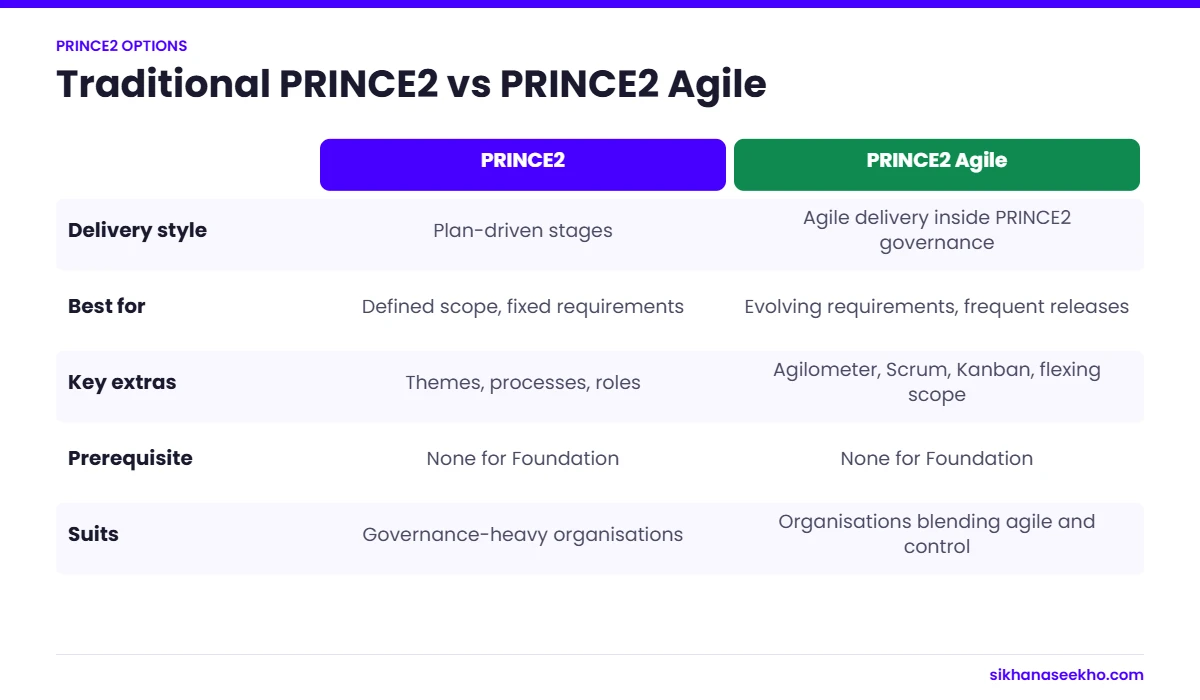
PRINCE2 Agile vs Traditional PRINCE2: Key Differences
| Factor | Traditional PRINCE2 Practitioner | PRINCE2 Agile Practitioner |
|---|---|---|
| What it covers | Full PRINCE2 methodology: all 7 principles, themes and processes in their standard application | PRINCE2 methodology tailored for Agile delivery: how to apply and adapt PRINCE2 when using Scrum, Kanban or Lean |
| Designed for | Predictive (waterfall) and sequential project delivery | Hybrid environments: PRINCE2 governance with iterative Agile delivery |
| Prerequisite | PRINCE2 Foundation | PRINCE2 Foundation (Practitioner not required but strongly recommended) |
| Exam format | 2.5 hours, objective scenario-based questions, open book (PRINCE2 7 manual) | 2.5 hours, objective scenario-based questions, open book (PRINCE2 Agile manual) |
| Agile frameworks covered | Not covered: no Agile delivery content | Scrum (primary), Kanban, Lean, and other Agile approaches within the PRINCE2 context |
| Key concepts introduced | Standard PRINCE2: stage plans, work packages, exception management, product descriptions, project board | Agilometer, fix or flex (time/cost vs scope), Agile behaviours, sprint within a stage, backlog as a work package, Definition of Done |
| Cost (typical) | ~£350–£550 exam + training | ~£400–£600 exam + training (typically studied after Practitioner) |
| Renewal | Every 3 years | Every 3 years |
| UK employer demand | Very high: cited in most PRINCE2 job requirements | Growing: particularly in IT, digital transformation and hybrid PM roles |
| Standalone value | High: the core PRINCE2 professional qualification | Lower without Practitioner, typically adds value on top of an existing PRINCE2 Practitioner certification |
How PRINCE2 Agile Actually Works in Practice
The central challenge PRINCE2 Agile addresses is this: PRINCE2 governance is built around defined stages with approved plans, exception thresholds and formal reporting. Agile delivery is built around iterative sprints where scope evolves. These approaches can conflict, a project board expecting a fixed delivery at the end of a stage cannot easily accommodate a team that discovers mid-sprint that some features are unnecessary while others were not originally planned.
PRINCE2 Agile resolves this by introducing a concept of "fixing time, cost and quality: and flexing scope". Instead of the PRINCE2 stage plan committing to a specific list of deliverables at fixed cost, it commits to a time and budget with a defined minimum viable delivery, and the Agile team decides which features within that scope to prioritise and deliver. The project board governs at stage level; the Agile team self-organises at sprint level.
The Agilometer is one of PRINCE2 Agile's most distinctive tools. It is a diagnostic framework that helps a PM assess how Agile a project can sensibly be given its specific constraints: contract type, customer relationship, supplier arrangements, team capability, governance requirements and so on. Projects with fixed-price contracts and well-defined deliverables cannot be run as freely Agile as internally-resourced innovation projects. The Agilometer provides a structured way to calibrate the level of Agile application that is appropriate.
Which Project Types Suit Each Approach
- Construction and infrastructure: defined deliverables, physical dependencies, contractor obligations
- Regulatory compliance projects: fixed outputs required by law or regulation, no scope flexibility
- Hardware procurement and installation: sequential dependencies, fixed specifications
- Formal contract delivery: fixed-price contracts with defined deliverables require predictive planning
- Projects with low tolerance for scope change: where the business case is tied to specific, defined outputs
- Large capital investment projects: where stage gate funding decisions require committed delivery plans
- Software and digital product development: iterative delivery within PRINCE2 governance
- Business change with an IT component: Agile IT delivery within a formally governed business change programme
- Organisations transitioning from waterfall to Agile: PRINCE2 Agile provides a bridge that allows progressive adoption
- Projects where requirements will evolve: but where formal governance, stage funding and exception management must be maintained
- Multi-disciplinary programmes: where some workstreams are Agile and others are predictive, all within a PRINCE2 programme structure
Exam Format: Traditional Practitioner vs PRINCE2 Agile Practitioner
Questions are based on a project scenario and test how to apply, tailor and interpret the PRINCE2 methodology in that specific context. All objective format: no written responses.
Questions test your ability to apply PRINCE2 Agile guidance to hybrid project scenarios, including how to set up Agile delivery within a PRINCE2 stage, how to use the Agilometer and how to flex scope while fixing time and cost.
Employer Demand: What UK Job Market Data Shows
- Cited in the majority of UK PM job requirements that mention PRINCE2
- Standard requirement in UK Central Government, NHS IT, public sector
- Frequently a minimum requirement rather than desirable: candidates without it are excluded
- Over 2 million PRINCE2 exams taken globally: highly recognised brand
- PRINCE2 alone (without Agile) sufficient for most traditional delivery environments
- The baseline credential for UK project managers working in PRINCE2 environments
- Growing demand as UK organisations adopt hybrid delivery approaches
- Increasingly cited alongside PRINCE2 Practitioner in IT and digital roles
- Particularly valued in organisations transitioning from waterfall to hybrid delivery
- Strong in defence and government IT where PRINCE2 governance is mandated but Agile delivery is preferred
- Differentiating credential: relatively fewer holders than traditional Practitioner
- Typically "desirable" rather than "required": adds competitive advantage rather than being a minimum bar
The market reality in 2026: PRINCE2 Agile Practitioner is a growing differentiator but is not yet as universally cited in job requirements as traditional Practitioner. Candidates who hold both PRINCE2 Practitioner and PRINCE2 Agile Practitioner are increasingly competitive for roles in hybrid delivery environments: particularly in UK government digital transformation, defence IT and enterprise-scale change programmes. For most UK PM roles, traditional Practitioner remains the primary requirement; Agile is the valuable addition that signals hybrid capability.
Which Should You Study?: Decision Framework
The Recommended Study Path: Getting Both
For the majority of UK project managers in hybrid or digital environments, the recommended path is: PRINCE2 Foundation → PRINCE2 Practitioner → PRINCE2 Agile Practitioner. Many providers offer a combined Practitioner + Agile Practitioner package that covers both at a discount.
The sequencing matters for a specific reason: PRINCE2 Agile Practitioner exam questions test your ability to apply PRINCE2 Agile guidance to scenarios, and the scenarios assume you understand the full PRINCE2 framework as the backdrop. Candidates who sit PRINCE2 Agile without a strong Practitioner-level understanding of PRINCE2 itself often find the Agile guidance harder to interpret because they are missing the contextual framework it is tailored against.
Most training providers recommend a preparation time of 2–3 additional days for PRINCE2 Agile Practitioner on top of an existing Practitioner qualification. Candidates without Practitioner will need longer to build the necessary PRINCE2 foundation knowledge alongside the Agile-specific content.
Ready to Plan Your PRINCE2 Journey?
The Foundation vs Practitioner guide covers the first decision. The PRINCE2 online courses guide helps you choose the right training provider for both levels.