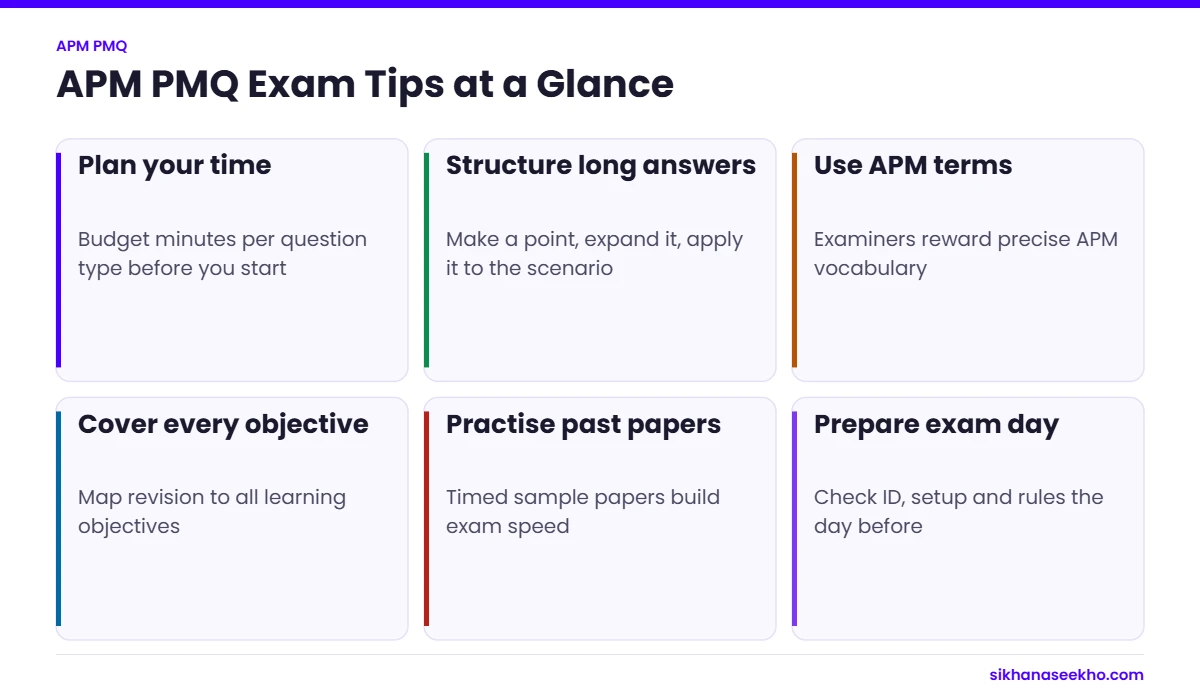
Most people who fail the APM PMQ do not fail on knowledge. They fail on how they write. The 10 long-response questions are worth 56% of the marks, and that is where weak structure and poor timing cost the most. My advice is simple: answer each long question with Point, Expand, Apply. Use APM's own words. Answer only what the question asks. Keep enough time for the 5-mark questions. Study against the published learning outcomes, not the whole Body of Knowledge, and practise writing answers to the clock.
✦
From my experience: Many of the people I coach sit more than one certification, and the APM PMQ catches out those who expect it to work like the PMP. The PMP rewards picking the best option. The PMQ rewards writing a clear answer linked to the scenario. On my projects in the UAE, a site report that buried the key point on page three got ignored by the consultant. Exam markers are the same. Put your point first, then explain it, then tie it to the project in front of you. Practise writing, not just reading.
2.5hrs
exam + optional 30-min break
40
questions across 4 formats
90
total marks available
56%
of marks from long-response alone
APM changed the PMQ format in August 2024. The old three-hour essay paper was replaced by a mixed format with multiple choice, short answers and long answers. Every tip on this page is for the current format.
What the exam tests has not changed: can you apply project management ideas to a real situation, using APM words and clear writing? The people who pass first time are rarely the ones who read the most. They are the ones who practised the way the exam marks, and walked in with a plan for their time.
If you want the full picture of the PMQ first (format, costs, eligibility and learning objectives), read my ultimate guide to the APM PMQ. This page is different. It is a trainer's list of study and exam-day tips to help you pass on your first attempt.
✦
Before reading these tips: If you have not yet downloaded the APM PMQ Qualification Handbook and the full syllabus (including all 73 learning outcomes), do that first. Both are free from apm.org.uk. The 73 learning outcomes are the exact blueprint for what the exam can test. Every tip in this guide assumes you are studying against that list.
The 10 Tips
Top 10 APM PMQ Exam Tips for 2026
Tip 01Study the 73 learning outcomes: not the whole BoK
The APM Body of Knowledge (BoK8) is a big reference book. It is not your syllabus. The PMQ tests a set list of learning outcomes. If you read the BoK cover to cover, you spend hours on things the exam never asks and still miss the depth it does want on the outcomes.
Six habits that help candidates pass the APM PMQ first time.
Download the PMQ syllabus document from apm.org.uk. Print it or save it as your primary study guide. For each of the 73 learning outcomes, ask three questions: Can I explain this concept clearly? Can I apply it to a project scenario? Can I distinguish it from related concepts that might appear as wrong-answer options? Only when you can answer yes to all three should you consider a learning outcome fully prepared.
This week: Download the PMQ syllabus. Highlight every learning outcome you cannot currently answer confidently. That highlighted list is your study plan.
Tip 02Master the long-response technique: this is where the exam is won
The 10 long-response questions are worth 5 marks each. That is 50 of the 90 marks, or 56% of the exam. You cannot pass while doing badly here. This is where most first-time fails happen.
The marker can only give marks for what is written on the page. They cannot guess what you meant, and they cannot give you credit for something you said in another answer. Every mark needs its own clear evidence.
Use the Point → Expand → Apply structure for every long-response answer:
Point → Expand → Apply: 5-mark answer structure
Point: state your answer explicitly using APM terminology
"One risk response strategy appropriate here is risk mitigation." State it clearly. Do not bury it in contextual rambling. The marker needs to find your point immediately.
Expand: explain what the concept means
"Risk mitigation involves taking proactive steps to reduce the probability or impact of a threat before it occurs, making it less likely to affect project objectives."
Apply: connect it to the specific scenario in the question
"In this scenario, the project manager could mitigate the risk of supplier delays by dual-sourcing key components, ensuring an alternative supplier is qualified and contracted before the critical procurement window."
Repeat for each required point if the question asks for multiple examples
A 5-mark question asking for two examples needs two complete P→E→A cycles. Two solid answers on two points outscores five incomplete answers on five points.
Practice drill: Set a 5-minute timer. Write a complete Point → Expand → Apply answer to a 5-mark question from a sample paper. Review it. Could a marker identify your point, your explanation and your application clearly? Repeat daily for 2 weeks before the exam.
Tip 03Use APM terminology throughout: not PRINCE2, not PMI, not general industry language
This is the most common reason good project managers lose easy marks. The PMQ is marked by APM assessors against APM mark schemes. If APM says "stakeholder engagement" and you write "stakeholder management", you may not get the mark, even though the ideas are close. If you write "project initiation document", the marker sees PRINCE2 thinking, not APM thinking.
Some terminology to embed before the exam:
APM uses stakeholder engagement: not stakeholder management
APM uses project management plan: not project plan or PID
APM uses benefits management: not benefits tracking
APM uses linear, iterative and hybrid lifecycles: not waterfall, Agile and hybrid
APM uses governance in a specific sense: understand the APM definition
APM uses issue to mean a risk that has materialised: not a general problem
Your primary terminology reference is the APM Body of Knowledge 8th Edition (BoK8). Every technical term you use in the exam should come from this source. If you are unsure whether the APM uses a term, check the BoK8 glossary.
Before your exam: Build a personal glossary of APM-specific terms from the BoK8 glossary and review it once a week during your study period.
Tip 04Answer the question that is asked: not the question you wish had been asked
This sounds obvious, but under exam pressure it is hard. When you know a topic well, you want to write everything you know. The marker can only give marks for content that answers the actual question. The rest wastes your time.
The two most common forms of this error on the PMQ:
"Describe two benefits of X" candidates write about what X is, how it works, and then eventually get to two benefits in the last paragraph. Only the benefits earn marks. The description earns nothing.
"Explain how a project manager should respond to Y" candidates explain what Y is in detail before describing the response. APM already knows what Y is, the question is asking about the response.
Before you start writing each long-response answer, underline the key instruction word (describe, explain, identify, justify, compare) and the specific aspect being asked about. Then write only about that.
Exam technique: Read each question twice before writing. On the second read, underline the instruction verb and the specific subject. Do not begin writing until you can state in one sentence exactly what this question is asking for.
Tip 05Build your time budget before the exam: and stick to it
The PMQ gives you 150 minutes for 90 marks. That is about 1 minute 40 seconds per mark. If you spend too long on the early questions, you run out of time on the long-response section, which carries more than half the marks.
Section
Questions
Marks
Time Budget
% of Exam
Multiple response (1 mark each)
20
20
~25 minutes
22%
Select-from-list (2 marks each)
5
10
~12 minutes
11%
Short response (2 marks each)
5
10
~15 minutes
11%
Long response (5 marks each)
10
50
~75 minutes
56%
Review buffer
:
:
~23 minutes
:
Total
40
90
150 minutes
100%
So the long-response section needs about 75 minutes, half the exam. If you spend 4 or 5 minutes on a 1-mark question, you are stealing time from the marks that matter. If you do not know a multiple-choice answer quickly, pick your best option, flag it and move on.
Time management rule: Set a personal rule: if you have not selected an answer on a multiple-choice question within 90 seconds, take your best guess, flag it for review and move forward. Protect your long-response time above all else.
Tip 06Use the official sample papers under timed exam conditions
APM publishes free sample papers on its website. They are the closest thing to the real exam. Most candidates read them. Far fewer do what actually helps: sit them in full, with the timer on and notes closed.
Your first timed attempt should never be the real exam. Writing structured answers against the clock is a skill of its own, separate from knowing the content. You only build it by doing it.
Ideally, complete at least two full timed practice attempts in the final two weeks of preparation: one to identify gaps, and one closer to the exam date to build confidence and calibrate your time management.
Schedule this now: Block two dates in your diary before the exam for full timed practice sittings. Treat them like the real exam: closed notes, quiet environment, strict timing.
Tip 07Do not write everything you know: write the minimum to earn the mark
More words do not mean more marks. A 5-mark long-response question that asks for two examples needs two well-structured Point → Expand → Apply answers, not six examples with shallow coverage. The APM mark scheme rewards completeness and relevance over volume.
Once you have made your point, explained it and applied it to the scenario, you have earned the marks for that point. Stop there and move on. Extra description, extra examples nobody asked for and long caveats earn nothing and eat your time.
This is especially important for short-response questions (2 marks). A short-response question wants two specific pieces of information: one point per mark. Two clear, focused sentences will outscore a paragraph of vague prose on the same topic.
Review your practice answers: After writing a practice answer, highlight every sentence that directly earns a mark. If more than 30% of your sentences are not earning marks, you are over-writing. Cut ruthlessly.
Tip 08Prepare for the scenario context: read the scenario carefully before answering
PMQ questions sit inside a project scenario. You get a short description of a project or organisation, and the questions refer back to it. Many candidates skim the scenario and then write textbook answers that could fit any project. Those answers score less.
The application part of every long-response answer (the A in Point → Expand → Apply) must reference the specific scenario. Generic application earns fewer marks than scenario-specific application. "The project manager should conduct risk identification workshops" scores less than "Given that the scenario involves a multi-vendor implementation in a regulated environment, the project manager should conduct risk identification workshops with representatives from each vendor and the compliance team to identify interface risks and regulatory constraints."
Technique: Before answering any question in a scenario set, spend 60–90 seconds reading the scenario carefully and note 2–3 key facts about the project context. Use those facts in your application sentences.
Tip 09Treat the break option strategically: not as a reward
The APM PMQ allows an optional break of up to 30 minutes between Part 1 and Part 2. This break is in addition to the 2.5-hour exam time. Two important rules most candidates do not know:
Once you submit Part 1, you cannot return to it. Review Part 1 thoroughly before submitting, particularly if you flagged any questions for review. Once submitted, it is locked.
The break is not extra thinking time. Use it only if you really need to reset, not because you feel you should.
When is the break worth it? If you feel overwhelmed, cannot concentrate or keep making typing mistakes, a short break can help Part 2. If you are calm and on time, think about skipping it.
Decision rule: Take the break if you are noticeably fatigued or stressed. Skip it if you are calm and on schedule. Do not take it out of habit or curiosity about how much time has passed.
Tip 10Prepare your exam environment: the online format creates specific risks
The PMQ is taken online with remote proctoring, from home or the office. That brings risks an exam centre does not have: a computer crash, a dropped internet line, noise, someone walking in, or notes left in view of the webcam. All of these can be prevented with a little planning.
Run the system check well before exam day, not that morning. Make sure your computer, webcam, microphone and internet meet the proctoring requirements. Read the requirements the exam provider sends you at least a week before.
Use the exam day checklist below.
My 7-Day Countdown Before the PMQ
This is the plan I give students in the last week before a written exam:
Day 7: Sit a full sample paper with the timer on. Mark it honestly.
Day 6: List the learning outcomes where you dropped marks. Revise only those.
Day 5: Write five long answers using Point, Expand, Apply. Check each one against the scenario.
Day 4: Go through your APM glossary. Swap any PMP or PRINCE2 words you still use.
Day 3: Sit a second full timed paper. Compare your timing with your budget.
Day 2: Do the proctoring system check and set up your room.
Day 1: Light review only. Sleep early.
The mistake I see most in the final week is cramming new content. At that point, better technique earns you more marks than new facts.
What should you check on APM PMQ exam day?
✓ Complete every item before your exam begins
Technical test done: complete the proctoring system check at least 48 hours before
Internet connection stable: use wired connection if possible; test your speed
Quiet room secured: door locked or sign up, no interruptions for 3+ hours
Clear desk: no notes, books, phones or unauthorised materials visible to webcam
ID ready: valid photo ID as required by the proctoring provider
Log in 15 minutes early: identity verification takes time; do not cut it close
Water bottle filled: check if this is permitted by your proctoring provider
Rough paper / notepad ready: confirm if rough notes are permitted and how they will be monitored
Break decision made: have you decided in advance whether you will take the optional break?
Time budget confirmed: remind yourself: 25 mins MCQ, 12 mins select-list, 15 mins short, 75 mins long
Eaten and rested: do not sit a 2.5-hour exam hungry or sleep-deprived
Charger plugged in: laptop must not run out of power during the exam
What are the most common APM PMQ mistakes?
Using PRINCE2 or PMI terminology instead of APM terminology
Writing "project initiation document" instead of "project management plan," or "risk owner" instead of "risk response owner." The marker awards marks for APM-specific language. Always use the BoK8 glossary as your terminology reference.
Writing generic answers that ignore the scenario context
Answering "what should a PM do about stakeholder resistance" with a textbook definition of stakeholder engagement that could apply to any project. The application sentence must reference the specific project, organisation or situation described in the question's scenario.
Running out of time on long-response questions
Spending too long on 1-mark multiple-choice questions and arriving at the long-response section with 30 minutes left for 50 marks of questions. Build your time budget in advance and enforce it ruthlessly during the exam.
Writing too much on too many points rather than completing fewer points fully
A 5-mark question asking for two examples with justification needs two complete Point → Expand → Apply cycles. Providing five brief, incomplete examples scores significantly less than two complete, well-structured ones.
Preparing with materials from before the August 2024 format change
Practice papers from the old 3-hour essay format are not representative of the current exam. Essay-format preparation does not prepare you for the structured long-response format or the multiple-choice sections. Ensure all study materials reference the current 40-question, 90-mark format.
✦
Check your materials are current: APM reviews the PMQ syllabus from time to time to keep it in line with BoK8. Before you rely on a course or workbook, compare it with the current syllabus and handbook on apm.org.uk. If it still talks about a three-hour essay exam, it is out of date.
Ready for the Full APM PMQ Picture?
The complete APM PMQ guide covers the full exam format, all 24 learning objectives, costs, the APM vs PMP comparison and the study plan.
APM's guidance is around 72 hours in total: about 40 hours of self-study and 32 hours of guided learning. In practice it depends on your background. If you already manage projects, much of your time will go on APM terms, the long-answer technique and timed practice. If structured project management is new to you, plan for more. The hours that count most are timed writing practice, not reading.
There is no fixed pass mark. APM sets the pass mark for each paper based on how hard that paper is, so it can move a little between sittings. Do not chase a magic number. Aim to answer every question type well, especially the long-response section, where most of the marks are.
No. The PMQ is closed book. You cannot take notes, books or any reference material in with you. This is different from PRINCE2 Practitioner, which allows the official manual. So you need the APM terms, the learning outcomes and the long-answer structure in your head before exam day.
The most important materials are the official APM resources: the PMQ Qualification Handbook (free from apm.org.uk: contains the full syllabus and 73 learning outcomes), the APM PMQ Study Workbook (official preparation workbook aligned to the syllabus), the APM sample exam papers (free, essential for timed practice), and the APM Body of Knowledge 8th Edition (BoK8, the definitive terminology and concept reference). For training-led preparation, well-regarded providers include Wellingtone, Parallel Project Training and Training ByteSize. For the 2026 exam specifically, ensure any course materials are aligned with BoK8 and the current 40-question format: materials from 2023 or earlier may still reference the old essay format or an earlier syllabus.
Yes, you can resit the PMQ. Check the current resit fee on apm.org.uk before you book, because fees change. APM gives you feedback on the areas where you were below the standard. Use it. In my experience coaching students for other exams, a resit is usually won by fixing technique, not by reading more. If your weak area was the long answers, practise Point, Expand, Apply against the clock before you sit again.