
The APM Competence Framework is the Association for Project Management’s description of the skills, knowledge and behaviours a project professional needs. It groups competences into areas such as planning, governance, people and commercial management, and it is used for self-assessment, career development and chartered status applications.
Explore the APM Competence Framework with practical examples and self-assessment tips. Master key project management competencies to boost your career. Mastering key skills is essential for anyone committed to advancing their career in project management. Developed by the Association for Project Management (APM), this structured guide outlines the core competencies that every project professional should aim to cultivate. Whether you’re an emerging PM, a trainer, or part of an organization focused on building capability, understanding these standards is crucial for long-term success.
What is the APM Competence Framework?
Essentially, this comprehensive tool outlines the knowledge, skills, and behaviors required for successful project execution. It helps individuals and organizations assess and develop project management competencies in a consistent and measurable way.
Why is the APM Competence Framework Important?
In today’s fast-paced project environment, relying solely on technical skills isn’t enough. A broad range of abilities, from leadership to risk management, is crucial for success. There are comprehensive guidelines available to help you develop and excel in your role.
Key Areas of the APM Competence Framework
The framework encompasses various competence areas. Here’s a summary of the most vital ones:
1. Project Planning and Control
This domain emphasizes outlining the project scope, scheduling, resource allocation, and managing changes. Excelling in this area guarantees timely and budget-compliant deliveries.
2. Risk and Issue Management
Successful PMs are adept at foreseeing potential challenges. This competence ensures you can identify, evaluate, and mitigate risks throughout the project lifecycle.
3. Leadership and Communication
Project success hinges on effective teamwork. Leadership and communication skills are crucial for engaging stakeholders and enhancing team performance.
4. Teamwork and Collaboration
The framework emphasizing project management highlights the importance of collaboration. Exceptional project managers enable their teams, encourage diverse viewpoints, and handle conflicts skillfully.
5. Governance and Reporting
A solid understanding of governance ensures your project aligns with strategic objectives. Reporting skills foster stakeholder engagement and build trust in project execution.
Real-World Applications of the APM Competence Framework
Let’s illustrate this with an example.
Scenario:
- Consider you’re in charge of a digital transformation initiative. Leveraging a structured set of project management standards enables you to:
- Employ planning skills to craft an extensive roadmap.
- Deploy risk management strategies to foresee challenges with new software integrations.
- Utilize communication methods to keep executives updated.
- Foster team cooperation to alleviate resistance to change.
- Ensure governance protocols align your efforts with organizational policies.
- This strategy not only enhances your credibility but also leads to improved project outcomes.
Using the framework for self-assessment
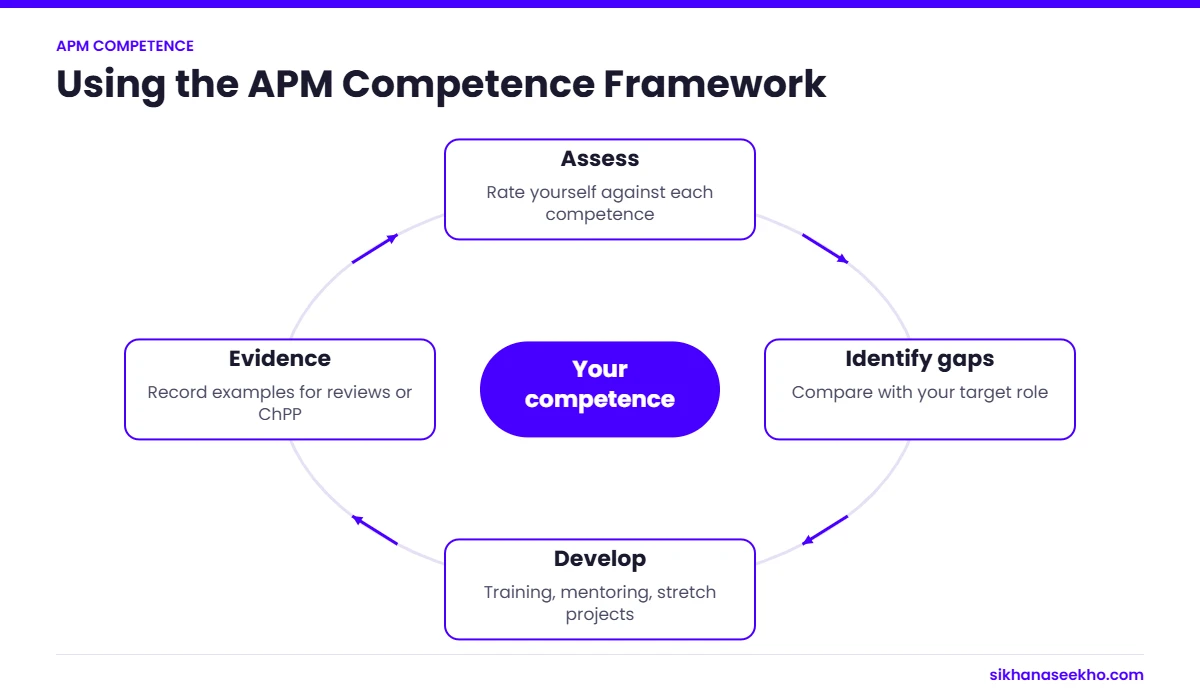
| Step | What you do | Output |
|---|---|---|
| 1. Choose your target role | Pick the role you want in the next 12 to 24 months | A clear goal |
| 2. Rate each competence | Score yourself from 1 (aware) to 4 (expert) with evidence | A personal competence profile |
| 3. Find the gaps | Compare your scores with what the target role needs | A short list of 3 to 5 priority areas |
| 4. Plan development | Choose training, projects or mentoring for each gap | A development plan with dates |
| 5. Review | Re-score every 6 months | Evidence of progress |
The 1 to 4 scale is a simple self-assessment approach; APM provides its own guidance for formal assessments.
Self-Assessment: Where Do You Stand?
A key advantage of the framework is its facilitation of self-assessment. Reflect on these questions:
- Do I have a clear understanding of stakeholder needs?
- Am I skilled in managing project risks?
- Can I effectively lead diverse teams?
Responding to these questions enables you to identify growth opportunities and create a clear roadmap for improving your project management capabilities.
Utilizing the APM Competence Framework as a Trainer
Instructors can leverage the framework to craft targeted learning experiences. Begin by pinpointing your learners’ existing skill gaps, then employ the framework to shape your content. The outcome? More skilled, confident, and effective project managers.
This structured approach goes beyond a simple checklist. It acts as a strategic resource for career growth, team development, and successful project delivery. Whether you’re starting out or guiding others in their professional journey, it provides the clarity and direction needed to achieve excellence in project management.
How is the framework used in practice?
Organisations use the framework to write job descriptions, design training and assess promotion cases. A PMO might, for example, map its project manager roles to the framework and expect a senior project manager to show strong evidence in governance, risk and stakeholder management.
Individuals use it to plan their careers. By rating yourself against each competence with real examples, you can see where you are strong and where you need experience. That evidence is exactly what APM looks for in Chartered Project Professional applications.
Trainers and mentors use it to focus coaching. Instead of general advice, they can work on the 2 or 3 competences that matter most for a person’s next step.
How does it relate to APM qualifications?
APM’s qualifications build knowledge at each stage: the Project Fundamentals Qualification (PFQ) for newcomers, the Project Management Qualification (PMQ) for practitioners and the Project Professional Qualification (PPQ) for experienced professionals. The competence framework describes how that knowledge shows up in practice.
APM, founded in 1972, received its Royal Charter in 2017, and the Chartered Project Professional register opened in 2018. Chartered applications are assessed against competences, so keeping a record of your evidence from today makes a future application far easier.
A practical habit is to spend 30 minutes at the end of each project writing 1 short example for each competence you used: the situation, what you did and the result. After 2 or 3 projects you will have a strong evidence bank.
Common mistakes when self-assessing
The first is rating yourself on knowledge instead of evidence. Knowing what a risk register is does not show competence; leading a risk workshop that changed the plan does.
The second is trying to improve everything at once. Pick 3 to 5 gaps for the next 6 months and leave the rest.
The third is never asking for feedback. Share your ratings with a manager or mentor, because most people either over-rate or under-rate themselves in at least 1 area.
Example: building evidence for one competence
Take stakeholder management as an example. Weak evidence says: ‘I communicated with stakeholders throughout the project.’ Strong evidence says: ‘On a 9-month IT upgrade with 14 stakeholder groups, I mapped each group on a power/interest grid, set up fortnightly briefings for the 3 most affected departments and resolved a dispute over go-live timing by agreeing a phased roll-out. User complaints after go-live were half the level of the previous upgrade.’
The strong version names the situation, your actions and a measurable result. Writing 2 or 3 examples like this for each key competence gives you material for appraisals, job interviews and, later, a chartered application.
How often should you review your competences?
Every 6 months works well for most people, and after any large project. A quick review takes 30 to 45 minutes: update your scores, add new evidence and choose the next 2 or 3 areas to develop. Keep the record somewhere you will not lose it, such as a single document or spreadsheet.
If you manage a team, use the same review with each person. Comparing scores helps you plan training budgets, decide who should lead which project and spot gaps across the whole team, not just in individuals.
Share the summary with your line manager before your annual review, so development goals are agreed rather than guessed.
FAQs Regarding the APM Competence Framework:
1. What is the purpose of the APM Competence Framework?
It is designed to evaluate and develop project management capabilities, assisting individuals and organizations in enhancing their skills.
2. Is the APM Competence Framework ideal for novices?
Absolutely! It is particularly beneficial for emerging project managers aiming to grasp essential skills for success.
3. How many competencies does the APM Competence Framework encompass?
It features more than 27 competencies categorized into technical, behavioral, and contextual domains.
4. Can I conduct a self-assessment using the APM Competence Framework?
Certainly. It is an excellent resource for recognizing your strengths and areas in need of improvement throughout your project management career.
5. What advantages do organizations gain from implementing the APM Competence Framework?
It fosters consistent project execution, encourages professional growth, and aligns team capabilities with organizational.
Keep learning
- Key Differences Between PRINCE2 and APM Certifications
- What is APM’s Chartered Project Professional (ChPP) Status?
- Top APM Accredited Training Providers You Should Know
- Project Management Tools for APM Professionals
- Top 10 APM PMQ Exam Tips to Pass First Time in 2026
- APM PMQ Qualification Guide for 2026