What Is Project Management? Complete Beginner Guide 2026
I have managed multi-million dollar projects in the UAE. I have trained hundreds of PMP students worldwide. One question comes up constantly from people just starting out. What is project management and how do I get into it? This guide gives you my complete answer. What it is, what PMs actually do, what the methodologies are, which tools you need and how to start your career from zero.
Project management is the application of knowledge, skills, tools and techniques to project activities in order to meet project requirements. It is the discipline that turns an idea, a business need or a strategic objective into a delivered outcome. Within an agreed scope, timeline and budget.
Every project, large or small, moves through these stages.
Before defining project management, you need to understand what a project is. A project is a temporary endeavour with a defined beginning and end, undertaken to create a unique product, service or result. This is what separates projects from operations. Running a call centre is an operation. Implementing a new CRM system for that call centre is a project. Building a factory is a project. Manufacturing goods in that factory is an operation. I saw this distinction clearly on every project I managed in the UAE. The construction of EGA Head Office was a project. The ongoing operation of that building after handover was not.
The job of project management is to successfully navigate the three core constraints every project faces. These are called the triple constraint or the project management triangle.
✦
Scope
What the project will deliver. The features, functions, work and deliverables that are in and out of the project.
✦
Time
When the project will be delivered. The schedule, milestones and deadline that define the project timeline.
✦
Cost
What the project will cost. The budget covering labour, materials, software, consultancy and contingency.
The triple constraint has a fourth element at its centre: quality. Any change to scope, time or cost affects quality. And any quality shortcut has consequences for one or more of the three constraints. Project management is fundamentally the skill of balancing these four dimensions in a way the sponsor and stakeholders find acceptable.
✦
Why project management matters: PMI research consistently shows that organisations without structured project management waste up to 12% of their investment through failed or poorly delivered projects. For a £10M project, that is £1.2M of wasted spend. Project management is not bureaucracy. It is the systematic reduction of that waste. I saw this on every major project I worked on.
02 · Project Lifecycle
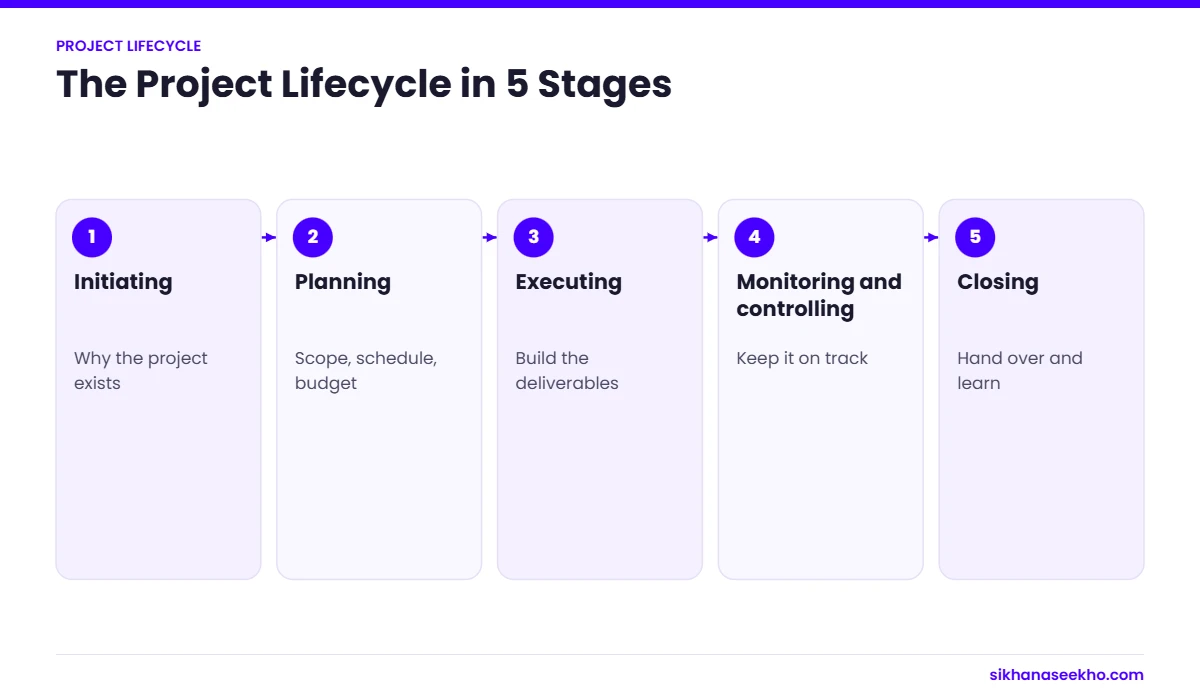
The Project Lifecycle: Five Process Groups
PMBOK organises project management into five process groups. They describe the flow of work from the first idea to final closure. These are not strictly sequential phases. Many overlap and iterate. But they give you a useful map of when different management activities happen. I teach these to every PMP student I train.
1
Initiating
~5% of effort
2
Planning
~20% of effort
3
Executing
~60% of effort
4
Monitoring
Runs alongside
5
Closing
~5% of effort
Initiating
Authorise the project
Project charter signed Sponsor identified PM appointed High-level scope defined
Planning
Define how to deliver
WBS created Schedule built Budget confirmed Risks identified Stakeholders mapped
Executing
Deliver the work
Team managed Deliverables produced Stakeholders engaged Changes controlled
Monitoring
Track and control
Progress tracked Status reported Risks monitored Issues resolved
Closing
Close formally
Deliverables signed off Resources released Lessons captured Project archived
✦
Planning is the most underinvested process group. Many PMs jump from initiation straight into execution. Then they spend the rest of the project fighting problems that good planning would have prevented. The rule I give my students: one hour of planning saves ten hours of rework. A project with a 20-week delivery needs at least 3 to 4 weeks of serious planning before a single deliverable is built.
03 · The Role
What Does a Project Manager Actually Do?
The PM role is one of the most misunderstood in organisations. PMs are often seen as administrators who run meetings and write status reports. That is a very incomplete picture. A skilled PM is the person who gives a project its best chance of success. They plan it rigorously, spot problems before they materialise, manage the people dynamics and make the right calls under pressure.
A typical project manager's week divides roughly into three types of work.
Technical PM Work (around 40% of time)
Planning and maintaining the schedule and budget. Managing the risk register and issue log. Writing and distributing status reports. Facilitating project meetings. Managing the change control process. Tracking earned value. Maintaining the project management plan and subsidiary plans. This is the science of PM. Structured, process-driven and tool-dependent. I used EVM tracking on all my UAE projects as a standard part of the monthly review cycle.
Stakeholder and People Management (around 40% of time)
Managing the relationship with the sponsor. Briefing and engaging the steering committee. One-to-one engagement with resistant stakeholders. Leading and motivating the project team. Managing vendor and supplier relationships. Facilitating difficult conversations between stakeholders with conflicting interests. Negotiating for resources. This is the art of PM. It is context-dependent, relationship-driven, and it separates average PMs from exceptional ones. On my UAE projects I worked with over 20 nationalities. This skill mattered every single day.
Leadership and Decision-Making (around 20% of time)
Setting the team's direction and priorities. Making the calls that cannot be escalated. Deciding when to raise an issue versus manage it within the project. Determining when the project plan needs to change. Escalating risks and issues to the sponsor at the right moment. The PM is the single point of accountability for delivery. That means absorbing uncertainty and making decisions with incomplete information.
✦
The PM authority paradox: A project manager is accountable for delivering outcomes they do not directly control. The project team often does not report to the PM in the HR sense. The budget is controlled by finance. Scope decisions sit with the sponsor. PM success depends on influence without authority. The ability to get things done through people you do not manage. This is why communication, stakeholder management and leadership skills matter as much as technical planning skills. It is something I learned on the ground on real projects.
04 · Roles and Salaries
PM Roles: Career Levels and UK Salary Ranges
Project management is a defined career path with clear progression from entry-level support roles through to programme and portfolio director. Here are the main levels, what each involves and indicative UK salary ranges for 2026.
✦
Project Coordinator
Entry Level
Supports the PM with scheduling, tracking, meeting minutes, document management and reporting. The standard entry point for people transitioning into PM. Typically works within a PMO under the direction of a PM.
UK Salary: £28,000 to £38,000
✦
Junior / Associate PM
Early Career
Manages smaller, lower-risk projects independently or co-manages larger projects alongside a senior PM. Typically 1 to 3 years of experience. May be leading a workstream within a programme.
UK Salary: £38,000 to £52,000
✦
Project Manager
Mid Career
Owns the end-to-end delivery of medium-complexity projects valued at £500K to £5M. Manages the full team, stakeholder network and governance. The core PM role. 3 to 8 years of experience typical.
UK Salary: £52,000 to £75,000
✦
Senior PM / Lead PM
Senior
Manages high-value or strategically important projects over £5M. May mentor junior PMs. Expected to operate with minimal supervision and handle senior executive stakeholders independently.
UK Salary: £70,000 to £95,000
✦
Programme Manager
Senior
Manages a portfolio of related projects with interdependencies, delivering broader business change. Coordinates across multiple PMs, manages programme-level risks and reports to an Executive Sponsor or board.
UK Salary: £80,000 to £120,000
✦
PMO Manager / Director
Leadership
Leads the Project Management Office. Sets PM standards, governs the project portfolio, develops PM capability and reports to the C-suite on portfolio health and investment performance.
UK Salary: £90,000 to £130,000+
05 · Methodologies
Project Management Methodologies Explained
A methodology is a system of practices, techniques and procedures used to manage a project. There is no single correct methodology. The right approach depends on the nature of the project, the organisation's culture and the degree of uncertainty in the requirements. I teach this to my students from day one. The methodology follows the project. Not the other way around.
Change is formally controlled and expected to be minimal
Strong governance, documentation and audit trail
Best for: infrastructure, construction, regulated industries, fixed-price contracts
Agile / Iterative
Scrum / Kanban / SAFe
Delivered in short iterations (sprints) of 1 to 4 weeks
Requirements evolve. Backlog is reprioritised each sprint.
Working product delivered early and continuously
Self-organising teams with daily standups and retrospectives
Best for: software development, product development, digital transformation
Hybrid
PRINCE2 Agile / PMI Hybrid
Predictive planning and governance for the project overall
Agile delivery execution within each phase or workstream
Combines governance rigour with delivery flexibility
Increasingly the standard in large UK organisations
Best for: large transformation programmes with IT and business change components
Other Frameworks to Know
PRINCE2 is a prescriptive method widely used in the UK public sector and government. It defines roles, stages and management products in detail. MSP (Managing Successful Programmes) is the programme-level equivalent of PRINCE2. PMBOK is the Project Management Body of Knowledge published by PMI. It is a framework rather than a prescriptive method and forms the basis of the PMP certification. IPMA is the International Project Management Association competence framework, stronger in continental Europe. DSDM / AgilePM is an Agile framework often used in the UK public sector alongside PRINCE2.
06 · Tools
Essential Project Management Tools
You do not need expensive tools to manage projects effectively. But you do need the right tools for the right purpose. Here are the most widely used tools across each PM function, including free options. I have used most of these on real projects.
Scheduling
Microsoft Project
The industry standard for Gantt charts, critical path analysis and resource scheduling on complex projects.
Scheduling · Free
Excel Gantt Chart
For most projects, a well-structured Excel Gantt chart is sufficient and far faster to maintain than specialist software.
Free template available
Agile · Free
Jira / Trello
Jira for sprint tracking, backlog management and Agile reporting. Trello for lightweight Kanban boards on smaller projects.
Collaboration
Microsoft Teams / Confluence
Teams for day-to-day team communication. Confluence for project documentation, decision logs and shared knowledge bases.
Portfolio · Free tier
Asana / Monday.com
Cloud-based project and portfolio management tools with good dashboards and stakeholder-facing views. Both have free tiers for small teams.
Reporting · Free
Excel / Power BI
Excel for status reports, budgets and EVM tracking. Power BI for portfolio dashboards when multiple projects need consolidating.
30 free templates at sikhanaseekho.com
✦
My advice for beginners on tools: Start with Excel and the free template library. Master the fundamentals of tracking a project in a spreadsheet before moving to specialist software. The discipline transfers directly to any tool you use later. A PM who understands WBS, Gantt charts and earned value in Excel will use MS Project or Jira far more effectively than one who learned the tool before learning the concept.
07 · Certifications
PM Certifications: What to Know as a Beginner
Certifications signal to employers that you have invested in structured PM knowledge. They are not mandatory to get a PM job. But they open doors, justify salary expectations and give you a structured learning path. As a PMP trainer with a 100% student pass rate, I see the difference certifications make for my students. Here are the six most relevant certifications in the UK and global markets.
Entry Level
PRINCE2 Foundation
PeopleCert / Axelos
Experience req.None
Study time3 to 5 days
Cost~£200 to 260
Best marketUK, Middle East
Entry Level
CAPM
PMI
Experience req.23 hours training
Study time2 to 3 months
Cost~$300 (member)
Best marketUS, global tech
Entry Level
PSM I
Scrum.org
Experience req.None
Study time1 to 2 weeks
Cost$150
Best marketTech, Agile teams
Professional
PRINCE2 Practitioner
PeopleCert / Axelos
Experience req.PRINCE2 Foundation
Study time+3 to 5 days
Cost~£270 to 330
Best marketUK public sector
Professional
CSM
Scrum Alliance
Experience req.None (2-day course)
Study time2-day course
Cost~$1,000 to $1,400
Best marketAgile and digital teams
Senior
PMP
PMI
Experience req.3 to 5 years + 35h
Study time3 to 6 months
Cost~£400 to 500
Best marketGlobal, all sectors
08 · Career Start
How to Start a PM Career from Zero Experience
Project management is one of the most accessible professional careers to enter from a non-traditional background. There is no single required qualification or degree. People enter PM successfully from operations, administration, finance, engineering, teaching, the military and many other fields. They often bring domain expertise that makes them highly effective PMs in specific sectors. I started in engineering and construction. Many of my PMP students come from teaching, finance and IT support backgrounds. Every one of them found a path in.
1
Build foundational knowledge first
Read the PMBOK Guide 7th edition or PMI's free study materials. Take a PRINCE2 Foundation course if you are UK-focused. It is the fastest structured qualification with no experience prerequisite. Work through the free guides on this site to build practical understanding of the key concepts: project charter, WBS, risk management, stakeholder management and EVM. Knowledge before certification is always the better order.
2
Identify and document the project experience you already have
Almost everyone has managed something that qualifies as project experience. Organising a fundraiser. Leading a team change initiative. Coordinating a product launch. Managing an office relocation. Running a volunteer programme. Reframe this experience using PM language: scope, timeline, budget, stakeholders, risks. The PMP requires documented PM experience. The habit of recording it starts now, not when you apply.
3
Target project coordinator or project support roles
These are the standard entry point for career changers and graduates entering PM. Look in PMO environments where you will be exposed to multiple projects and multiple experienced PMs. Government and public sector organisations hire large numbers of project coordinators and have structured development programmes. Management consultancies and large technology firms also hire junior PM talent in structured graduate or associate schemes.
4
Use the free tools to build practical skills now
Download the 30 free PM templates and practise using them on a real or hypothetical project. Build a Gantt chart in Excel. Write a project charter using the template. Map stakeholders on the power-interest grid. Calculate EVM metrics using the free EVM calculator. Practical familiarity with PM tools and documents is more impressive in an interview than knowing the theory. This is something I tell all my students.
5
Get your first certification, then get experience, then PMP
The optimal sequence for most UK-based career starters: PRINCE2 Foundation (achievable in days, opens public sector doors), then a Project Coordinator role, then PRINCE2 Practitioner once working, then 3 or more years of documented PM experience, then PMP. Do not wait until you have PMP to start applying for PM roles. The certification follows the experience for most people, not the other way around.
09 · FAQ
What is Project Management: FAQ
Project management is the application of knowledge, skills, tools and techniques to project activities to meet project requirements. A project is a temporary endeavour with a defined beginning and end, undertaken to create a unique product, service or result. Project management is the discipline of planning, executing and controlling this work. It delivers the defined scope within the agreed time, budget and quality constraints while managing stakeholders, risks and change. Every industry runs on projects. Project management is the skill that makes them succeed. I have spent my career doing exactly this, from flagship construction in the UAE to training PMs worldwide.
A project manager plans and tracks the schedule and budget, manages stakeholder relationships, identifies and responds to risks and issues, leads the project team, reports progress to the sponsor, controls scope changes and ensures the project delivers its objectives. The role divides into three types of work: technical PM work (around 40% of time, covering planning, tracking and reporting), stakeholder and people management (around 40%, covering engagement, communication and relationship management) and leadership and decision-making (around 20%, covering direction, prioritisation and escalation). A PM is accountable for delivery without necessarily having direct authority over the team.
Waterfall (predictive) follows a sequential process. You define requirements fully, then design, build, test and deploy in order. It works well when requirements are stable. This is how every construction project I managed in the UAE worked. Agile delivers work in short iterative cycles called sprints, incorporating feedback and adapting as the project progresses. It works well when requirements are likely to change. Most organisations today use a hybrid approach. Waterfall planning and governance at the programme level with Agile delivery at the team level. See our PMP vs PRINCE2 guide for how each certification maps to these approaches.
Start by building foundational knowledge through free resources and entry-level certifications. PRINCE2 Foundation for UK and Middle East roles. CAPM for global and US roles. Target project coordinator or project support roles. These are the standard entry points. Document any project work you have done in any role using PM language. Practise with free tools: download the 30 free templates, use the EVM calculator, build a Gantt chart. The most effective path is a junior PM role in a PMO where you shadow experienced PMs on live projects. Certification follows experience for most people. Get into a PM environment first.