PMP vs PRINCE2 2026
Which Certification Is Better?
I hold the PMP. I have trained hundreds of PMP students worldwide. Many of my students from the UK and Middle East ask me this exact question. This guide gives you my honest answer. Recognition, salary impact, exam difficulty, cost and a country-by-country verdict.
PMP vs PRINCE2: Full Comparison
I will cover every dimension that matters when choosing between these two certifications. Eligibility requirements, exam format, cost, recognition and more. I call a winner for each dimension where one clearly leads.
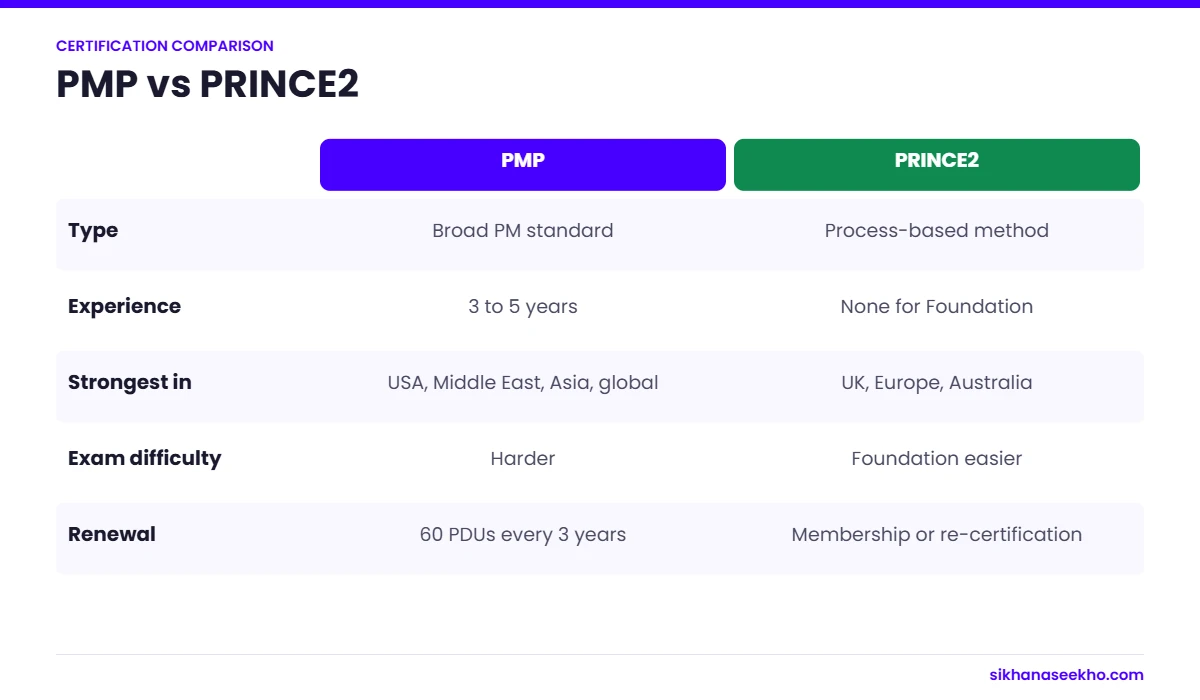
| Dimension | PMP | PRINCE2 Practitioner |
|---|---|---|
| Owner | PMI (Project Management Institute, USA) | PeopleCert / Axelos (UK) |
| Type | Certification of PM competence. Methodology agnostic. | Certification in one specific method. PRINCE2 only. |
| Experience required | 3 to 5 years PM experience plus 35 hours training PRINCE2 easier | None formally. Open to anyone who has passed Foundation. |
| Questions | 180 scenario-based questions PRINCE2 easier | 70 questions |
| Duration | 240 minutes | 150 minutes |
| Pass mark | Around 61% (no fixed published mark) | 60% (42/70). Published and fixed. |
| Exam format | Closed book. Scenario-heavy. Mixed predictive and Agile. | Open book. PRINCE2 manual permitted. |
| Exam cost | Around £400 to £500 (PMI member). Around £520 to £620 (non-member). PRINCE2 cheaper | Around £270 to £330 for the exam voucher. |
| Study time | 3 to 6 months typical PRINCE2 faster | 3 to 5 days Foundation plus 3 to 5 days Practitioner |
| Validity | 3 years / 60 PDUs | Practitioner: 3 years / CPD. Foundation: no expiry. |
| Global recognition | Recognised in 200+ countries. Strongest in US, Canada, Middle East, global tech. PMP wins globally | Dominant in UK. Strong in Middle East, Europe, Australia. |
| Methodology scope | Predictive, Agile and hybrid. Very broad. PMP more versatile | PRINCE2 method only. Prescriptive. |
| Salary premium | 25 to 32% premium (PMI survey). Highest globally. PMP leads globally | Strong in UK and Middle East. Comparable at senior levels. |
| UK public sector | Valued but not required. | Often mandatory for PM roles. PRINCE2 wins UK govt |
| Renewal cost | Around £60 per year (PMI membership plus PDU activities) | Recertification exam or CPD via PeopleCert portal Similar |
Which Is Harder to Pass?
PMP is significantly harder to earn. Both in eligibility requirements and in the exam itself. PRINCE2 Foundation is one of the most accessible professional certifications in project management. Practitioner is more demanding but still far below PMP in total preparation required.
Which Pays More?
PMP delivers the largest salary premium globally. PMI's annual Earning Power report consistently shows PMP-certified professionals earning 25 to 32% more than non-certified peers. PRINCE2 Practitioner delivers a strong salary premium in UK and Middle East markets. At senior levels in the UK, holding both certifications consistently commands the highest salaries. I have seen this pattern repeatedly with my students.
Country-by-Country Verdict
The right certification depends heavily on your location and the type of organisations you want to work for. I have trained students from many of these countries. Here is a direct verdict for 18 countries and regions based on job market demand, employer requirements and real-world recognition.
| Country / Region | Verdict | Rationale |
|---|---|---|
| United States | PMP | PMP is the de facto standard. PRINCE2 is rarely listed in US job descriptions. PMP is required or strongly preferred for virtually all senior PM roles. |
| Canada | PMP | PMP dominates. Some federal government projects use PRINCE2 influence but PMP remains the primary hiring credential across provinces. |
| United Kingdom | Both: PRINCE2 first | PRINCE2 is mandatory or strongly preferred for public sector, NHS, MOD and government contracts. PMP adds significant value in private sector and consultancy. Senior PMs should hold both. |
| Ireland | PMP edge | Strong tech sector presence (Google, Meta, Pfizer) means PMP is more widely valued. PRINCE2 recognised in financial services and public sector roles. |
| Germany | PMP edge | PMP is more widely recognised in German enterprise and tech. PRINCE2 has a presence in consulting and UK-headquartered multinationals. GPM certification is also considered locally. |
| Netherlands | Both valued | Strong PRINCE2 tradition in government and IT projects alongside high PMP recognition in international firms. Either credential is well received. |
| UAE / Dubai | Both: PMP slightly ahead | PMP is the primary requirement in multinational and technology firms. PRINCE2 is well recognised in UK-connected organisations, construction and government contracts. I saw this first-hand when working in the UAE. Both are strong credentials here. |
| Saudi Arabia | Both: PMP leads | Vision 2030 mega-projects frequently specify PMP. PRINCE2 is recognised in UK and European contractor organisations. PMP has stronger government and infrastructure project currency. |
| Qatar | PMP | PMP is dominant in Qatar's infrastructure, energy and construction sectors. PRINCE2 is recognised but less frequently listed in job requirements. |
| India | PMP | PMP is overwhelmingly the dominant PM certification in India. Particularly in IT services, consulting and multinational firms. PRINCE2 has limited recognition except in UK-headquartered organisations. |
| Australia | Both valued | Strong PRINCE2 tradition from UK influence. Widely used in government, defence and infrastructure. PMP equally valued in private sector. Both certifications appear regularly in Australian job postings. |
| New Zealand | Both valued | Similar to Australia. PRINCE2 in government and public sector. PMP in private sector and multinationals. Both credentials have good recognition. |
| Singapore | PMP | PMP is the primary standard in Singapore's financial services, technology and logistics sectors. PRINCE2 has some government and construction recognition but PMP leads clearly. |
| South Africa | Both recognised | PRINCE2 has strong penetration from UK influence. PMP increasingly required in multinational and technology firms. Both are widely listed in PM job postings. |
| Pakistan | PMP | PMP is the dominant credential for PMs targeting Gulf, US and European employers. It is the most sought-after certification for internationally focused Pakistani PMs. I train many Pakistani students who are targeting Gulf roles. PRINCE2 is recognised in UK-connected firms. |
| Rest of Africa | PMP edge | PMP is more universally recognised across African markets, particularly in development, infrastructure and multinational contexts. PRINCE2 has penetration in anglophone Africa through UK development programmes. |
| Southeast Asia | PMP | PMP is the primary PM certification across Malaysia, Philippines, Thailand and Vietnam. PRINCE2 has limited recognition outside organisations with UK headquarters. |
| Europe (broader) | PMP slight edge | PMP has broad European recognition. PRINCE2 is stronger in Scandinavia, Benelux and former UK trading partners. In France and Southern Europe, PMP and IPMA are the primary standards. |
Which Should You Choose?
Use this framework to make your decision. The answer is almost always determined by one thing. Where you will be working and what your target employers specify. I give my students the same advice I am giving you here.
Where the Google PM Certificate and APM ChPP Fit
Two other credentials often come up in this decision. Neither replaces PMP or PRINCE2, but each has a clear place in a career path.
| Credential | What it is | When it makes sense |
|---|---|---|
| Google PM Certificate | An online entry-level course from Google on Coursera, with no experience requirement and no proctored exam. | Career changers with no PM experience. Use it to land a first role, then move on to PRINCE2 or the CAPM. |
| APM Chartered Project Professional (ChPP) | Chartered status from the Association for Project Management in the UK, awarded after an assessment of substantial project experience. | Senior UK project professionals, especially in infrastructure, engineering and defence. It usually follows the APM PMQ or PMP. |
| Your stage | Recommended path |
|---|---|
| No PM experience | Google PM Certificate, then PRINCE2 once you have a first PM role |
| 1 to 2 years, UK IT or public sector | PRINCE2 Foundation and Practitioner |
| 3 to 5 years | PMP for technology, consulting or international roles; APM PMQ for UK infrastructure and engineering |
| 5+ years, senior roles | PMP plus PRINCE2 or APM PMQ, with ChPP as the long-term goal in the UK |