
PRINCE2 is a structured project management method that tells you how to run a project, while APM qualifications such as the PMQ test broad project management knowledge based on the APM Body of Knowledge. In the UK, PRINCE2 is common in government and public sector roles; APM PMQ is valued for showing wider professional competence.
Understand how PRINCE2 vs APM certifications differ in structure, usage, and global acceptance. Compare PRINCE2 vs APM to choose the right project certification in the UK. Project managers in the UK frequently encounter an important decision between PRINCE2 and APM certifications. Both credentials are highly esteemed and recognized, but they serve distinct purposes and career trajectories. If you’re determining which project certification UK professionals tend to favor, this guide will clarify their differences to assist you in making an informed choice.
Exploring PRINCE2 Certification
Project managers use PRINCE2 (Projects IN Controlled Environments) as a methodology to control all aspects of a project. Originally developed by the UK government, it is particularly prevalent within the public sector and larger organizations that handle intricate projects.
Key Features of PRINCE2:
- Built upon seven principles, themes, and processes.
- Applicable to all project types.
- Modular structure with Foundation and Practitioner stages.
- Focus on roles, responsibilities, and well-defined phases.
This certification suits professionals seeking a systematic and standardized method for project management.
What Is APM Certification?
Project professionals in the UK recognize the Association for Project Management (APM) as the premier chartered organization. In contrast to PRINCE2, which is based on methodology, APM certification prioritizes individual competency and development.
Key Features of APM:
- Grounded in the APM Body of Knowledge (BoK).
- Encompasses a wide range of project management skills.
- Features certifications like APM PFQ (Project Fundamentals Qualification) and APM PMQ (Project Management Qualification).
- Facilitates career advancement towards Chartered Project Professional (ChPP) designation.
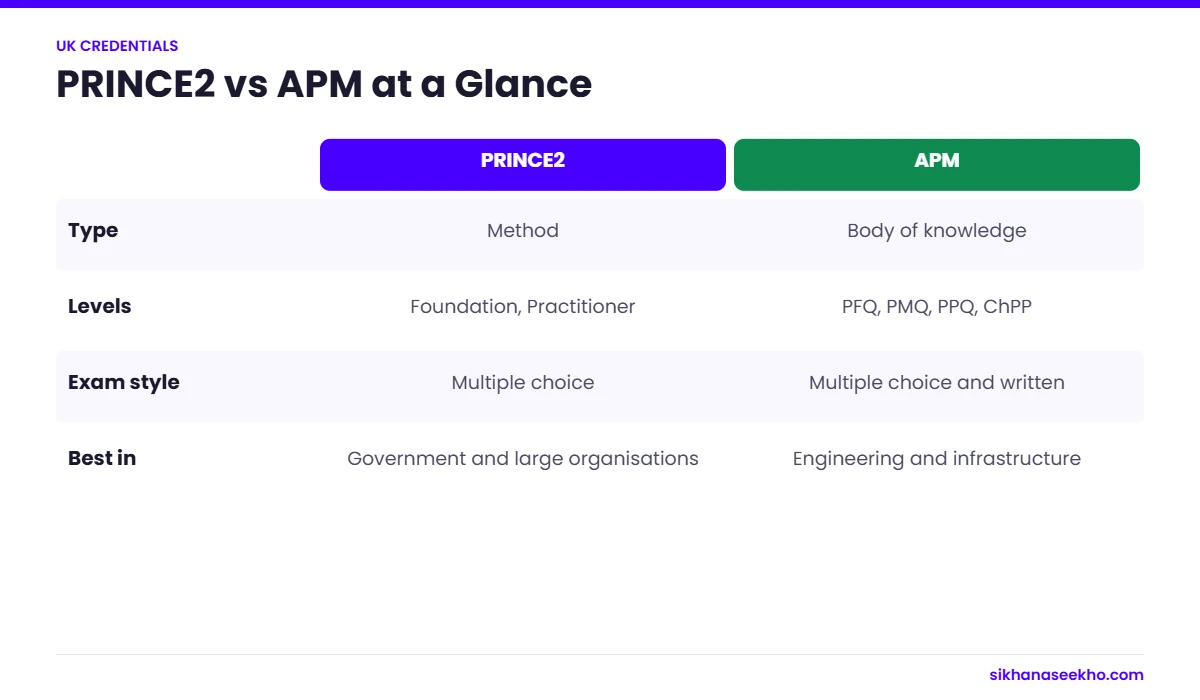
| Feature | PRINCE2 | APM |
|---|---|---|
| Focus | Methodology | Competency-based |
| Recognition | UK & international | Strong in the UK |
| Learning Style | Process-driven | Knowledge & skills-based |
| Best For | Structured project environments | Broader professional development |
| Certifications | Foundation, Practitioner | PFQ, PMQ, Chartered status |
| Practical Application | Emphasizes processes and roles | Emphasizes personal capability |
Individuals aiming for comprehensive, ongoing growth in their project management careers often choose APM.
PRINCE2 vs APM at a glance
| Feature | PRINCE2 | APM (PFQ, PMQ, PPQ) |
|---|---|---|
| What it is | A method: principles, practices and processes | Qualifications based on the APM Body of Knowledge |
| Awarding body | PeopleCert | Association for Project Management |
| Current edition | PRINCE2 7th edition (2023) | APM Body of Knowledge, 7th edition (2019) |
| Levels | Foundation, then Practitioner | PFQ, PMQ, then PPQ and Chartered status |
| Exam style | Objective multiple-choice questions | PFQ multiple choice; PMQ written answers |
| Experience needed | None for Foundation | None for PFQ; PMQ suits people with some experience |
| Where it is most valued | UK government, public sector, Europe | UK organisations across sectors |
Check PeopleCert and APM for current exam formats and fees.
PRINCE2 vs APM: Which Project Certification Should UK Professionals Choose?
In selecting between PRINCE2 and APM, factors such as your job role, industry, and future aspirations should guide your choice:
- PRINCE2 suits those in settings where consistent processes and thorough documentation are vital, such as within government sectors or major infrastructure initiatives.
- APM is advantageous for individuals focused on extensive professional growth, particularly those pursuing Chartered status.
Which should you take first?
If you are new to project management in the UK, PRINCE2 Foundation is the quickest start: it needs no experience and can be completed in 2 to 3 weeks. APM PFQ is a similar entry-level option if your employer prefers APM.
If you already manage projects, the choice depends on your sector. Public sector and infrastructure roles often ask for PRINCE2 Practitioner. Organisations that value broad professional competence, including many engineering, defence and consultancy firms, often ask for APM PMQ.
Many UK project managers eventually hold both: PRINCE2 for the method used on their projects and APM PMQ for wider knowledge and a route towards Chartered Project Professional status. If you plan to work internationally, consider adding the PMP, which is the most widely recognised credential outside the UK.
How do they work together on a real project?
They are complementary rather than competing. PRINCE2 gives you a clear structure: a project board, defined stages, management by exception and documents such as the business case and highlight reports. APM’s body of knowledge covers the wider context: stakeholder engagement, leadership, procurement, and the governance around programmes and portfolios.
A project manager on a UK public sector programme might run each project using PRINCE2 stages and reports, while using APM-style thinking on stakeholder strategy and benefits. Knowing both makes you more flexible and more valuable to employers in 2026.
How long and how much?
PRINCE2 Foundation and Practitioner each usually take 2 to 3 weeks of part-time study or a few days of training. PRINCE2 Practitioner is valid for 3 years, after which you renew it.
APM PMQ courses commonly run over 5 days or several weeks part time, with self-study on top, and the qualification does not expire. Costs for both are usually bought as a course package from an accredited provider, so compare what is included.
What do UK employers ask for?
Read 10 to 20 recent UK job adverts for the role you want and count the mentions. Typically, central government, local authority and NHS project roles mention PRINCE2 most often, while engineering, defence, utilities and consultancy roles more often mention APM qualifications or chartered status. Many adverts accept either, or list them as desirable rather than essential.
Experience matters more than either. A PRINCE2 or APM qualification helps you through screening, but interviews focus on what you have delivered: the size of projects, how you handled risk and change, and how you managed stakeholders. Build your examples alongside your study.
Can you study both at once?
It is possible but rarely wise. The 2 use different vocabulary, and mixing them during exam preparation causes confusion. Finish one, ideally within 4 to 8 weeks, then start the other.
What about the PMP?
If your career may take you outside the UK, the PMP is worth considering alongside PRINCE2 or APM. It needs 36 months of project leadership with a degree, so it usually comes later, once you have several years of experience on record.
Many UK project managers follow exactly that path: PRINCE2 or APM first, then the PMP when an international role or employer makes it worthwhile.
Key takeaway
Choose PRINCE2 if your target employers use the method or work in the public sector, and APM if you want broad UK professional standing and a route to chartered status. Whichever you pick first, plan your next qualification so your learning builds steadily over the next 2 to 3 years rather than in random steps.
Which certification helps your career more?
Both certifications significantly enhance job prospects, though in distinct ways:
- PRINCE2 is frequently essential for project positions within governmental and large organizational contexts, particularly those utilizing structured methodologies.
- Employers often favor APM as it indicates candidates possess adaptability and a diverse skill set needed for project leadership.
For newcomers to the field, the PRINCE2 Foundation could provide a swift entry, whereas APM PMQ could pave the way for a lasting career path.
The choice between PRINCE2 vs APM hinges on your professional objectives, sector, and preferred project management style. Both are respected in the UK, making either a solid option, but selecting the one that aligns with your aspirations will enhance your competitiveness in the job market.
FAQs
1. Which is more recognized in the UK: PRINCE2 or APM?
Both certifications are well-regarded; however, APM serves as the UK’s chartered body for project management, granting it substantial local credibility.
2. Is it possible to pursue both PRINCE2 and APM certifications?
Many professionals choose both to integrate the structured approach of PRINCE2 with the competencies developed through APM, resulting in a comprehensive skill set.
3. Is PRINCE2 considered more practical than APM?
PRINCE2 focuses more on established processes, making it practical for environments where standardized methods are required.
4. How do PRINCE2 and APM PMQ costs compare?
The combined cost for PRINCE2 Foundation and Practitioner is approximately £600–£900, while APM PMQ ranges from £600 to £1,000, varying by provider.
5. Which certification offers better career advancement in the UK?
APM provides a clearer route to attaining Chartered status and sustained growth, while PRINCE2 helps quickly fulfill the prerequisites for various UK project roles.
PRINCE2 vs APM: common questions
Is PRINCE2 or APM better for UK jobs?
Both are respected. PRINCE2 appears more often in public sector adverts; APM PMQ is valued across many sectors and supports a path to chartered status.
Can you take APM PMQ without PRINCE2?
Yes. They are independent qualifications.
Which is harder?
Many learners find PMQ harder because it requires written answers, while PRINCE2 Foundation uses multiple-choice questions.
Does PRINCE2 expire?
Foundation does not expire. Practitioner is valid for 3 years.
Keep learning
- What is APM’s Chartered Project Professional (ChPP) Status?
- Top APM Accredited Training Providers You Should Know
- Project Management Tools for APM Professionals
- Top 10 APM PMQ Exam Tips to Pass First Time in 2026
- APM PMQ Qualification Guide for 2026
- Best PRINCE2 Online Courses 2026: Foundation and Practitioner Options Compared