
PRINCE2 Foundation tests whether you understand the PRINCE2 methodology: its principles, themes, processes and terminology. It is a knowledge test: 60 multiple-choice questions, 1 hour, closed book, 60% pass mark. PRINCE2 Practitioner tests whether you can apply the PRINCE2 methodology to manage a real project scenario. It is an application test: objective format, 2.5 hours, open book (your PRINCE2 manual is permitted), 60% pass mark. You must hold Foundation before sitting Practitioner. Most people aiming for a career in project management should target both: Foundation alone is rarely sufficient for professional recognition, and Practitioner is the level cited in UK job advertisements.
- Tests knowledge and understanding of the PRINCE2 framework
- 60 multiple-choice questions, 1 hour, closed book
- Pass mark: 36/60 (60%)
- No prerequisites: accessible with no PM experience
- Does not expire: permanent once passed
- Required before sitting Practitioner
- Typical cost: £250–£500 (exam + training)
- Tests ability to apply PRINCE2 to manage a real project scenario
- Objective format, 2.5 hours, open book (PRINCE2 manual permitted)
- Pass mark: 60% (42/70)
- Prerequisite: must hold PRINCE2 Foundation
- Requires renewal every 3 years
- The level cited in most UK PM job advertisements
- Typical cost: £350–£700 (exam + training)
PRINCE2 has two levels, Foundation and Practitioner, and the question of which to take first, or whether to take both, is one of the most common questions from UK project managers considering certification.
The short answer is that Foundation is the gateway and Practitioner is the destination. Foundation tests whether you understand the framework. Practitioner tests whether you can use it. For most career purposes, Practitioner is the level that matters. It is the level that appears in job descriptions, the level that demonstrates professional capability, and the level that gives you the working knowledge to operate effectively in a PRINCE2 environment. Foundation alone is rarely sufficient for senior PM roles.
This guide covers what each level tests, how the exams differ, the costs, and the decision on which to take, and when.
PRINCE2 Foundation vs Practitioner: Complete Comparison 2026
| Factor | Foundation | Practitioner |
|---|---|---|
| What it tests | Knowledge and understanding of PRINCE2 principles, themes, processes and terminology | Ability to apply PRINCE2 concepts to manage, tailor and adapt the methodology to a real project scenario |
| Cognitive level | Remember and understand: can you define and describe the framework? | Apply and analyse: can you use the framework to make decisions in complex scenarios? |
| Exam duration | 1 hour | 2.5 hours |
| Number of questions | 60 multiple choice | 70 questions across scenarios |
| Exam format | Closed book: no reference materials permitted | Open book: PRINCE2 7 manual permitted (no internet or other resources) |
| Pass mark | 36/60 (60%) | 60% (42/70) |
| Prerequisites | None: no PM experience or prior qualification required | Must hold PRINCE2 Foundation (current version) |
| Open or closed book? | Closed book | Open book: PRINCE2 7 manual only |
| Expiry | Does not expire: Foundation is permanent | Expires every 3 years: maintenance exam required to renew |
| How taken | Online proctored exam or at an accredited centre | Online proctored exam or at an accredited centre |
| Typical exam fee | ~£250–£350 (varies by provider) | ~£350–£550 (varies by provider) |
| Training required? | Not mandatory: can self-study | Not mandatory: open book self-study is viable for experienced PMs |
| Typical total cost (exam + training) | £300–£600 | £400–£900 |
| Value for career | Useful entry point; insufficient on its own for most senior PM roles | The professional-level qualification: cited in UK job advertisements |
| Renewal needed? | No | Yes: every 3 years via maintenance exam |
What Each Exam Actually Looks Like
Foundation questions test recall and understanding. "Which of the following is a PRINCE2 principle?" or "What does the Business Case theme address?": straightforward knowledge questions testing whether you have learned the framework's terminology, definitions and structure. There are no project scenarios to analyse. The most effective preparation is reading, flashcards and timed practice papers.
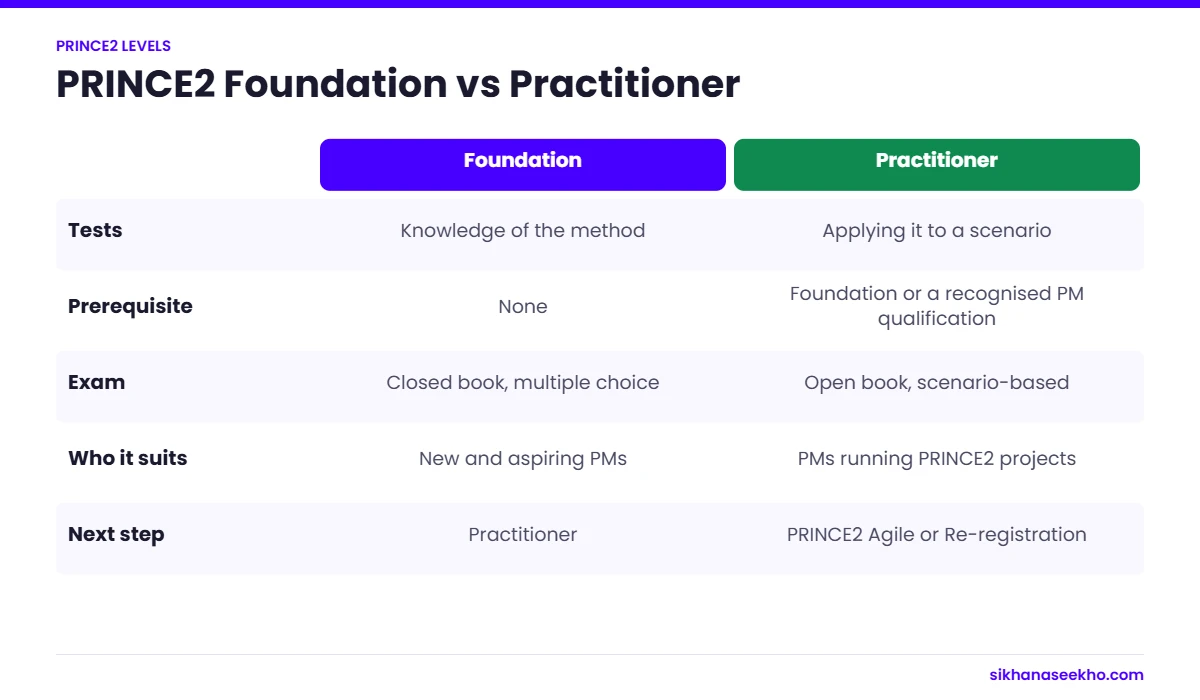
Practitioner questions are based on a project scenario described in the exam. Questions ask how to apply, adapt or tailor PRINCE2 to that specific situation. "Given this scenario, which of the following management products should be updated?" or "The project manager wants to escalate this issue, which PRINCE2 process applies?" The open book format means you can reference the manual, but speed matters. Candidates who know the framework well use the manual as a safety net, not a crutch.
PRINCE2 Foundation vs Practitioner: Cost Comparison 2026
| Item | Foundation | Practitioner |
|---|---|---|
| Exam fee (typical range) | £250–£350 | £350–£550 |
| Online self-study course | £100–£250 | £150–£300 |
| 2–3 day classroom / virtual | £400–£700 | £500–£900 |
| Combined F+P classroom course | £800–£1,800 (both levels together) | |
| PRINCE2 7 manual (needed for Practitioner) | : | ~£50 (if not included with course) |
| Resit fee (if needed) | ~£150–£250 | ~£200–£350 |
| Practitioner renewal (every 3 yrs) | : | ~£150–£250 (maintenance exam) |
| Typical total (self-study route) | £350–£600 | £500–£850 |
| Typical total (classroom route) | £500–£1,000 | £700–£1,400 |
The combined course advantage: Most training providers offer a combined Foundation and Practitioner course (often called an "F&P" course) at a significant discount compared to booking each separately. A combined 4–5 day course that covers both levels typically costs £800–£1,800 all-in including both exam fees: meaningfully cheaper than two separate courses. If you are planning to do both levels, book a combined course from the start.
Which Level Should You Start With?
Where Foundation and Practitioner Fit in the Broader PRINCE2 Path
After PRINCE2 Practitioner, experienced UK PMs often add either PRINCE2 Agile Practitioner (which combines the PRINCE2 governance structure with Agile delivery practices: useful in environments delivering iteratively within a PRINCE2 framework) or an APM PMQ (which broadens competency across all PM disciplines and opens the pathway to Chartered Project Professional status). The PRINCE2 vs APM comparison covers that decision in detail.
Self-Study vs Training Course: Which Route?
PRINCE2 Foundation self-study is very viable. The exam is closed book and tests knowledge of a well-defined framework. The PRINCE2 7 manual, combined with timed practice papers and systematic note-taking, is sufficient preparation for most candidates. Self-study Foundation preparation typically takes 2–4 weeks of part-time study.
PRINCE2 Practitioner self-study is also viable, particularly for experienced PMs who already understand project management principles and primarily need to develop familiarity with the PRINCE2 application. The open-book format means the Practitioner exam rewards understanding over memorisation: self-study candidates who genuinely understand the framework often perform as well as those who attended courses.
When a course adds the most value: If you are new to project management entirely (the framework concepts are unfamiliar), if you prefer structured pacing with a defined schedule, or if your employer requires accredited training for reimbursement purposes. Combined Foundation and Practitioner classroom courses (4–5 days) provide the most efficient path for candidates with limited self-study time.
Explore More PRINCE2 / APM Decisions
The PRINCE2 vs APM guide covers which qualification to prioritise for your UK sector. The APM PMQ guide covers the next step after PRINCE2 Practitioner for senior career progression.
Pingback: Best PRINCE2 Online Courses 2026 Compared
Pingback: PRINCE2 Agile vs PRINCE2: Which to Learn in 2026?