
A project management technique is a proven method for planning, tracking or improving work, such as SMART objectives, SWOT analysis, the critical path method or Kanban. Choosing the right approach for the project, setting clear objectives, analysing strengths and risks, and building a few core skills can noticeably improve team productivity.
Let me share how project management can help improve your productivity by 47% without any extra effort.
People who use these few techniques to manage their work can produce 53% more work daily.
Let’s have a look at these simple yet valuable techniques.
What is project management?
“Project management is the application of knowledge, skills, tools, and techniques to get the work done efficiently”.
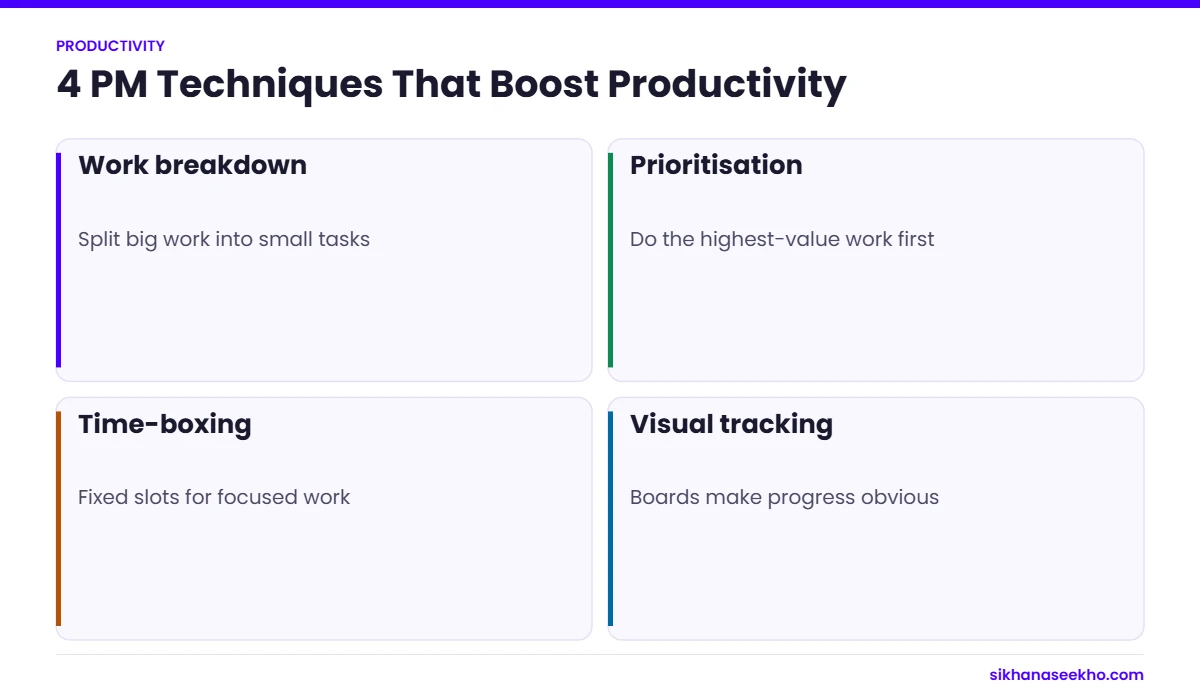
1. Choose an Appropriate Project Management Approach
How do you make objectives SMART?
S-Specific
It’s too ambiguous to say you “want to earn more.” Instead, decide on a figure that represents how much money you wish to make. Do you wish to make $120,000, $200,000, or even $10 million each year? Do you want to increase your business profits by 50%? Set a specific goal for yourself to work toward. You can better envisage your outcome – image all those zeroes in your bank account – and you’ll know without a doubt when you’ve reached it if you have a precise aim.
M-Measurable
You can’t objectively declare you’ve reached a goal if it isn’t measurable. The precise goal in our example is already measurable: You can check your figures throughout the year to see if you’ve hit $120,000. Other goals can likewise be made measurable.
A-Achievable
Setting an attainable goal entails selecting a goal that challenges you to push yourself but is also reachable. If you set a goal that you know is unrealistic – for example, if you’re currently making $30,000 and want to earn $5 million next year – you’ll almost certainly fall short. When you set a goal that is too lofty, it may seem impossible to achieve, and you may give up. Use SMART goal-setting to make sure you’re making progress and not setting yourself up for failure by establishing unrealistic goals.
R-Realistic
Realistic objectives in project management are ones that you are willing and capable of achieving by modifying your current habits. You have to know what you’re trying to do, why you’re trying to do it, and what your skill sets are?. If your ambitions aren’t grounded in your current reality, they’re meaningless.
T-Time Bound
Set aside a reasonable amount of time to complete your task. Do you believe you’ll be able to start earning the wage you want in six months, a year, or two years? It’s critical to have a defined time frame to track your progress toward your objective.
If you don’t meet your deadline, it’s time to rethink your strategy: Was your objective attainable and realistic? Was your time limit too restrictive? Or did you simply not put forth your best effort? There’s nothing wrong with re-setting your objectives if you use the SMART goals acronym to map out what you want, as long as you understand why you didn’t reach them in the first place.
How do you use a SWOT analysis on a project?
S-Strength
A strong brand, a loyal client base, a robust balance sheet, distinctive technology, and so on are examples of strengths. A hedge fund, for example, may have created a proprietary trading technique that outperforms the market. The company must next decide how to use the data to attract fresh investors.
W-Weakness
Weaknesses prevent an organization from reaching its full potential. A bad brand, higher-than-average turnover, high levels of debt, an inadequate supply chain, or a lack of capital are examples of areas where the company has to improve to stay competitive.
O-Opportunity
External elements that may provide a competitive edge to a company are referred to as opportunities. If a country lowers tariffs, a car manufacturer, for example, can export its vehicles to a new market, boosting sales and market share.
T-Threat
Threats are circumstances that have the potential to cause harm to a company. A drought, for example, poses a risk to a wheat-producing company since it might destroy or reduce crop yield. Other prevalent threats include growing material costs, increased competition, and a limited labor supply, among others.
Common project management techniques at a glance
| Technique | Use it to | Best for |
|---|---|---|
| SMART objectives | Write goals that are specific, measurable, achievable, relevant and time-bound | Every project, at the start |
| SWOT analysis | Review strengths, weaknesses, opportunities and threats | Choosing an approach and spotting risks |
| Work breakdown structure (WBS) | Break scope into manageable pieces | Planning any project |
| Critical path method | Find the longest path and the tasks that cannot slip | Projects with fixed deadlines |
| Kanban | Visualise work and limit work in progress | Continuous or support work |
| Timeboxing | Fix the time and adjust scope | Agile sprints and meetings |
| RACI matrix | Clarify who is responsible, accountable, consulted and informed | Teams with shared responsibilities |
4. Grasp These Easy to Learn Skills
Communication Skills
The project manager must effectively communicate with the team and project stakeholders, not only as a manager but also as a support, a motivator, and a leader.
Leadership
Of course, the project manager must be nice and supportive of the team, but the project manager must also be capable of leading and taking initiative.
Organization
The ability to organize is crucial to success. Because the manager’s job include overseeing numerous parts of the project, all processes must be well-organized.
Problem-Solving
It is unavoidable that large or minor issues would develop during the project. The Project Manager is in charge of resolving them. The Project Manager must maintain composure and work to resolve all issues gradually so that the project does not suffer.
By adhering to the aforementioned guidelines, you may ensure that your projects are well-managed and successful.
There are a few other project management techniques:
Forward Pass Project Management, Schedule Compression Techniques, and Engagement Model
There are a few constraints as well, try to avoid them to stay on track.
Last but not the least, a context diagram also plays an important role in your project’s success. So it is recommended to learn and implement it.
How do you choose the right technique?
Match the technique to the problem. If people are unclear about goals, start with SMART objectives. If they are unclear about who does what, use a RACI matrix. If deadlines keep slipping, build a WBS and find the critical path. If work keeps piling up half-finished, use a Kanban board with work-in-progress limits.
Start small. Introducing 1 technique at a time and using it consistently for 4 to 6 weeks works better than launching 5 new methods at once. Review whether it helped, keep it if it did, and then add the next.
Use templates to save time. A ready-made charter, RACI, risk register and Gantt chart let you apply these techniques in minutes rather than hours, and keep your team’s documents consistent across projects.
How does a SMART objective look in practice?
Compare ‘improve the website’ with ‘reduce checkout abandonment on the website from 70% to 55% by 31 March 2026, within a $20,000 budget’. The second version is specific, measurable, achievable for the budget, relevant to sales and time-bound. Everyone on the team knows what success looks like and when the project is finished.
Which tools support these techniques?
You do not need expensive software. A spreadsheet can hold SMART objectives, a RACI matrix and a risk register. Free tools such as Trello support Kanban, and most project tools include Gantt views for the critical path. Start with free templates and upgrade only when the team outgrows them.
Where to start this week
Pick 1 live project and write 1 SMART objective for it today. Next week, add a simple RACI. Small steps build lasting habits.
After a month, review what changed and keep what worked.
Project management techniques: common questions
What are the most important project management techniques for beginners?
SMART objectives, a work breakdown structure, a simple schedule such as a Gantt chart, a risk register and regular status updates cover most small projects.
Which technique improves productivity the most?
Limiting work in progress, as in Kanban, often has the biggest immediate effect, because teams finish tasks before starting new ones.
Are agile techniques better than traditional ones?
Neither is better in general. Agile suits changing requirements; traditional planning suits fixed scope and deadlines. Many teams use a hybrid.
Keep learning
- Scope of Project Management in Different States of USA
- 5 Best Tips to Improve Project Management Skills
- When to Hire a Project Manager
- How ChatGPT Is Changing Project Workflows in India
- 7 Soft Skills Every Project Manager Needs
- Top 10 Mistakes New Project Managers Make (And How to Avoid Them)