
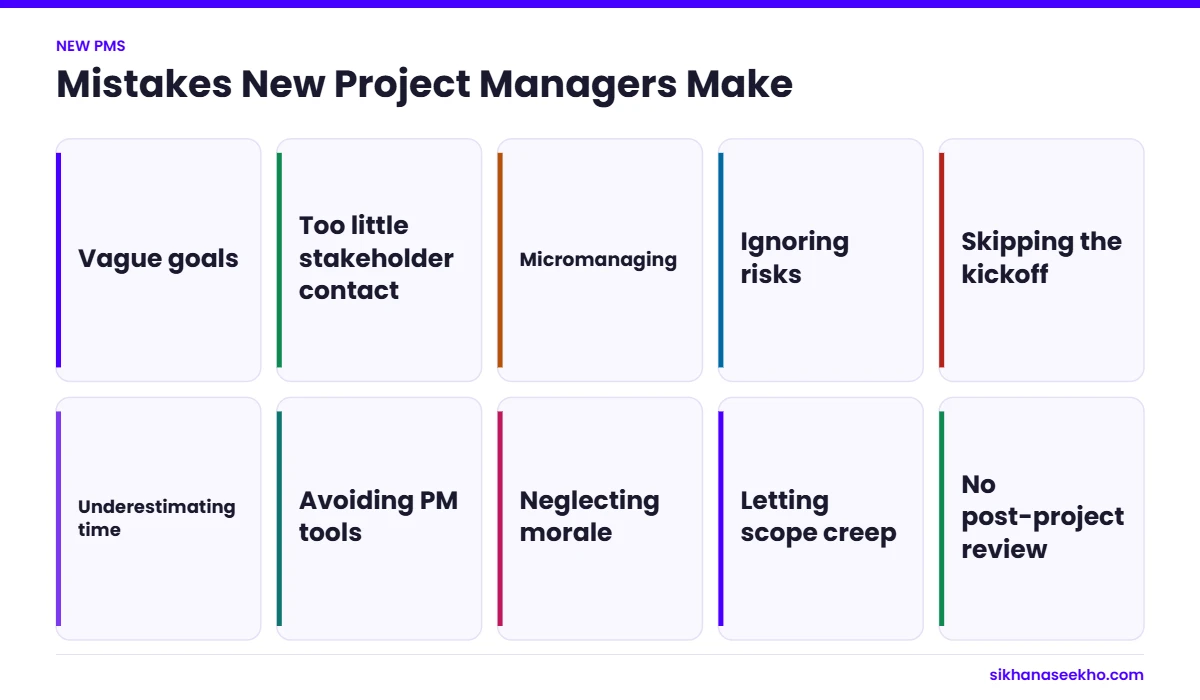
A project management mistake is a decision or habit that puts a project’s scope, schedule, budget or relationships at risk. The 10 most common for new project managers are unclear goals, weak communication, micromanaging, ignoring risk, skipping the kickoff, poor estimates, avoiding tools, neglecting morale, scope creep and skipping the lessons learned review.
Avoid the most common new PM mistakes with this expert guide. Learn how to tackle project management errors before they derail your projects. Initiating your path as a project manager can be thrilling yet daunting. Many novice PMs approach their initial tasks with enthusiasm, only to quickly realize how easy it is to stumble. To help you navigate this learning journey, we’ve outlined the top 10 common mistakes for new PMs: and, more importantly, how to steer clear of them.
Let’s explore these pitfalls so you can lead effectively.
The 10 mistakes and their fixes
| Mistake | Early warning sign | Fix |
|---|---|---|
| Unclear goals | Team members describe the goal differently | Write SMART objectives in a 1-page charter |
| Weak stakeholder communication | Sponsors are surprised by news | Agree a reporting rhythm, such as a weekly 1-page update |
| Over-controlling the team | People wait for your approval on small things | Delegate decisions with clear limits |
| Ignoring risk | No risk list exists after week 2 | Run a 30-minute risk workshop and keep a register |
| Skipping the kickoff | Roles and ways of working are unclear | Hold a 60-minute kickoff in week 1 |
| Poor estimates | Tasks regularly take twice as long | Estimate with the people doing the work and add contingency |
| Avoiding tools | Status lives in emails and memory | Use 1 shared board or schedule |
| Neglecting morale | Quiet team members disengage | Recognise effort and check in 1-to-1 |
| Scope creep | Small extras arrive without paperwork | Route every change through a change request |
| No lessons learned | The same problems repeat | Hold a 45-minute review at each phase end |
Why do unclear goals cause projects to fail?
One of the most significant mistakes in project management is starting without clear objectives. If you don’t define what success means, how can your team?
Prevent it: Initiate every project by collaborating with stakeholders to document SMART goals (Specific, Measurable, Achievable, Relevant, and Time-bound). This clarity aligns everyone’s focus.
2. Neglecting Stakeholder Communication
A frequent error among new PMs is underestimating the frequency of updates required by stakeholders.
Prevent it: Develop a communication plan early on. Utilize status reports, dashboards, or regular check-ins to keep everyone engaged and informed.
3. Overcontrolling the Team
While it may seem appealing to oversee everything, micromanagement can lead to burnout: both yours and your team’s.
Prevent it: Cultivate trust. Delegate tasks, clarify expectations, and then allow autonomy. Frequent check-ins are beneficial, but avoid hovering excessively.
Why should new project managers manage risk from day one?
Many inexperienced PMs tend to hope for positive outcomes without adequately planning for potential setbacks. That’s a significant risk itself.
Prevent it: Draft a risk log at the outset. Consistently identify, evaluate, and strategize responses to possible issues. Addressing risks proactively is essential to effective leadership.
5. Skipping the Kickoff Meeting
Rushing into execution often results in team misalignment.
Prevent it: Organize a kickoff meeting to unify the team, clarify roles, and establish the project’s tone. This straightforward step can avert significant project management blunders later.
6. Misjudging Time and Resources
A common mistake for new PMs is being overly optimistic in planning, which can lead to delays and demoralized teams.
Prevent it: Reference historical data or consult experienced team members when making estimates. Always build in buffers for unforeseen challenges. It’s better to under-promise and over-deliver.
7. Avoiding Project Management Tools
Reliance on spreadsheets alone may not suffice for intricate projects. Neglecting PM tools can result in chaos.
Prevent it: Utilize software like Trello, Asana, or MS Project. These tools enhance collaboration, streamline task management, and ensure visibility: critical for successful project outcomes.
8. Overlooking Team Morale
Projects can fail not only due to poor planning but also due to low team morale. Teams that feel overworked and undervalued seldom excel.
Prevent it: Celebrate achievements, acknowledge progress, and invite feedback. A motivated team is your greatest resource.
How do you stop scope creep?
Introducing features or deliverables without assessing their impact is a rookie mistake.
Prevent it: Implement a change control process. Inform stakeholders that every modification requires analysis: consider time, cost, and quality implications.
10. Neglecting the Post-Mortem Review
Many novice PMs feel such relief upon project completion that they overlook the review process.
Prevent it: Conduct a project retrospective. What succeeded? What fell short? Learn from each project to avoid repeating mistakes as a new PM.
Avoiding new PM mistakes early on can set the foundation for long-term success. By building strong habits, choosing the right tools, and maintaining a mindset focused on growth, you can lead projects that stay on track and exceed expectations. Keep learning, stay humble, and continuously reflect on how to improve.
Which mistakes cost the most?
In most projects, the most expensive mistakes are made in the first 2 weeks: unclear goals, no kickoff and no agreed change process. Problems that start there grow quietly until they surface as late, costly rework.
A useful rule from quality management is that fixing a defect gets more expensive the later it is found. A misunderstanding about scope that costs an hour to clarify in week 1 might cost days or weeks to fix after delivery.
That is why experienced project managers spend so much time at the start of a project on objectives, roles, risks and communication. It feels slow, but it is the cheapest time to get things right.
A 30-day checklist for new project managers
Week 1: read the business case or brief, meet the sponsor, and write a 1-page charter with SMART objectives. Hold a kickoff with the whole team.
Week 2: build a work breakdown structure and a first schedule with the people doing the work. Start a risk register with at least 10 risks and owners.
Week 3: agree a communication plan: who gets what, how often and in what format. Send your first weekly status update.
Week 4: set up change control so every new request is logged, assessed and approved before work starts. Hold a short check-in with each team member to ask what is getting in their way.
Repeat the review every month. Most new project manager mistakes come from skipping 1 of these basics when the project gets busy.
What should you do after making a mistake?
Tell the people affected quickly, explain the impact in plain terms, and bring a recovery plan with options. Then log the lesson so the team does not repeat it. Sponsors forgive mistakes far more readily than surprises, and owning a problem early is one of the fastest ways a new project manager earns trust.
A short, honest message such as “the supplier date slipped by 2 weeks; here are 3 options” works better than a long explanation.
Learn from other people’s mistakes
Ask an experienced project manager in your organisation to share the 3 mistakes they wish they had avoided in their first year. Most will happily spend 20 minutes on it, and their stories will be specific to your industry and culture in a way no article can be.
New project manager mistakes: common questions
What is the biggest mistake new project managers make?
Saying yes to everything. Without a change process, small requests add up to scope creep that breaks the schedule and budget.
How do new project managers gain confidence?
By using simple, proven tools consistently: a charter, a schedule, a risk register and a weekly update. Confidence grows as stakeholders see reliable information.
Should a new project manager be friends with the team?
Be friendly and supportive, but keep decisions fair and transparent. Teams respect a project manager who is approachable and consistent.
Frequently Asked Questions (FAQs)
1. What common mistakes do new PMs make?
Failing to set clear goals, inadequate communication, neglecting risk, and micromanaging are among the top errors.
2. How can I minimize project management errors early in my career?
Begin by defining clear goals, establishing a communication plan, and leveraging PM tools. Always analyze each project for insights gained.
3. Which tools are beneficial for new PMs?
Popular options include Trello, Jira, Asana, and Microsoft Project. Choose based on your team’s requirements.
4. How should I manage difficult stakeholders?
Communicate regularly, grasp their expectations, and manage scope creep through formal change processes.
5. Is it necessary to document all project decisions?
Yes, documenting decisions helps prevent confusion later and ensures your project stays on track.
Keep learning
- Best Universities for Project Management Degrees in the UK and USA
- How to Fund Your Project Management Education in the USA and UK: Scholarships, Grants and Low-Cost Options
- Is a Master’s in Project Management Worth It?
- Best Project Management Bootcamps in the UK and US
- Best Online Master’s Degrees in Project Management (USA/UK)
- Top Project Management Jobs and How to Land Them