
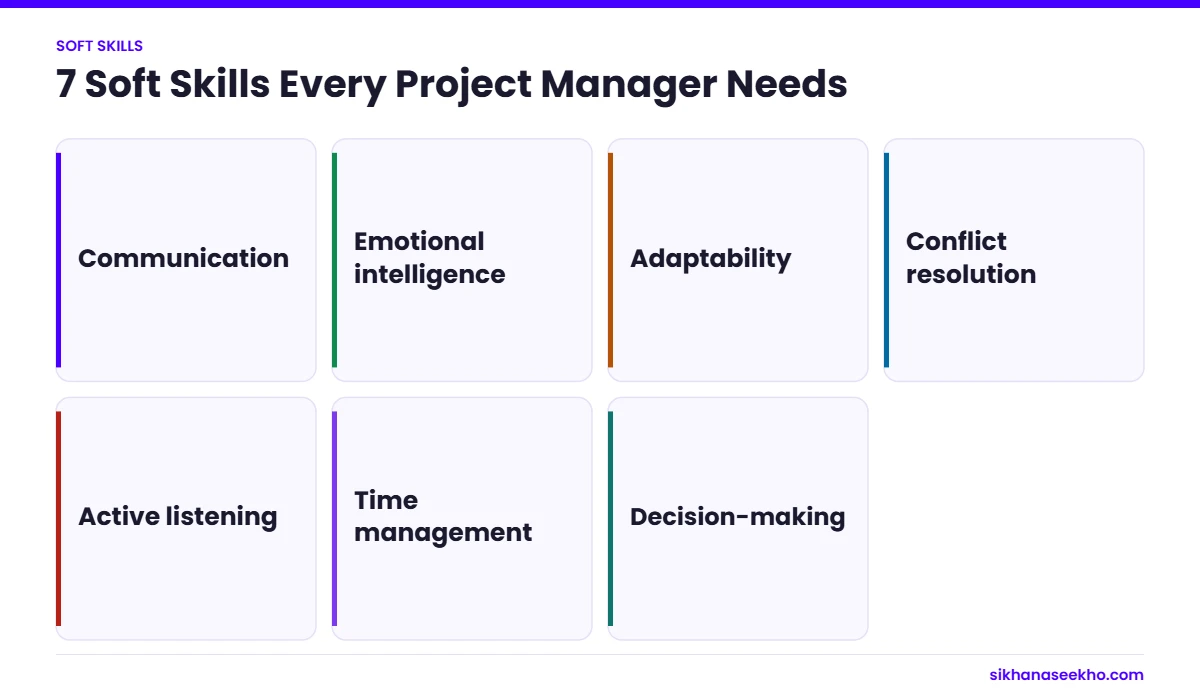
Project management soft skills are the interpersonal and personal abilities that help a project manager lead people, such as communication, emotional intelligence, adaptability, conflict resolution, active listening, time management and decision-making. They matter more than ever in 2026, because hybrid and remote teams depend on trust and clear communication.
Build the project manager soft skills you need to thrive in 2025. Discover essential PM skills for leading remote and hybrid teams effectively. In the rapidly changing work landscape of today, mere technical proficiency is insufficient. To effectively lead teams: particularly in remote or hybrid environments: project managers must develop soft skills that are more important than ever. Whether you’re a newcomer or an experienced manager, boosting these vital PM skills can distinguish you in 2025.
Here’s a closer look at the seven project manager soft skills that can enhance your leadership capabilities.
Why is communication the most important soft skill?
Effective project management hinges on clear and consistent communication. A proficient project manager must be able to express ideas, share updates, and clarify expectations distinctly. This is especially crucial in virtual settings, where strong communication keeps everyone aligned and engaged.
2. Emotional Intelligence: Cultivate Trust and Team Spirit
Recognizing and managing emotions: both yours and those of your team: is essential. Emotional intelligence nurtures empathy, minimizes conflicts, and builds trust. In 2025, this will remain one of the primary PM skills to motivate remote teams and deal with stress effectively.
3. Adaptability: Flourish Amid Change
Projects seldom unfold according to plan. Shifting deadlines, changing priorities, and unforeseen challenges are common. The capacity to adjust swiftly distinguishes competent project managers from exceptional ones. This soft skill allows you to maintain composure, flexibility, and proactivity in high-pressure situations.
How do project managers resolve conflict?
Disputes are a natural part of teamwork, particularly in diverse or cross-functional groups. A capable PM must facilitate conflict resolution and promote constructive discussions. Strong conflict resolution skills enhance collaboration and foster a more cohesive work atmosphere.
5. Active Listening: Comprehend Before Responding
Being an exceptional listener is often undervalued. Active listening empowers project managers to grasp team concerns, collect feedback, and make well-informed choices. By honing this key PM skill, you can minimize misunderstandings and elevate team morale.
6. Time Management: Meet Deadlines Efficiently
Balancing tasks, timelines, and team capacities necessitates excellent time management. A PM needs to prioritize wisely and support their team in doing so. Mastering this soft skill will be essential in maintaining productivity during hybrid work scenarios in 2025.
7. Decision-Making: Lead with Assurance
Quick yet well-considered decision-making is part of the role. When obstacles present themselves, a strong PM must evaluate options, weigh risks, and act decisively. This crucial PM skill ensures that projects stay on track and the team remains confident in their leadership.
How to practise each soft skill
| Soft skill | Practise it by | Sign you are improving |
|---|---|---|
| Communication | Sending a 1-page weekly update | Fewer follow-up questions from stakeholders |
| Emotional intelligence | Naming your own reaction before responding in tense meetings | Calmer conversations under pressure |
| Adaptability | Reviewing the plan every 2 weeks and adjusting openly | Changes absorbed without panic |
| Conflict resolution | Meeting people separately before a joint discussion | Disagreements settled faster |
| Active listening | Summarising what you heard before replying | People say they feel understood |
| Time management | Blocking 2 hours a week for planning | Fewer last-minute crises |
| Decision-making | Recording each decision with its reason | Faster, better-supported decisions |
How are soft skills tested on the PMP exam?
The People domain of the PMP exam is all about soft skills. Expect scenarios about team conflict, a disengaged team member, a stakeholder who resists change or a remote team that is not communicating. The best answers usually involve listening first, understanding the root cause, collaborating on a solution and supporting the team rather than giving orders.
Learn the classic models behind these questions: Tuckman’s 5 stages of team development, the 5 conflict resolution techniques (collaborate, compromise, smooth, force and withdraw), and motivation theories such as Maslow and Herzberg. They give you a vocabulary for both the exam and real teams.
On the current exam, aligned with PMI’s new content outline since July 2026, the People domain makes up 33% of questions, so soft skills are worth serious study time.
How do soft skills look in a remote team?
Remote and hybrid work changes how soft skills show up. Communication shifts to writing, so clear, short messages and a single source of truth become essential. Emotional intelligence means noticing who has gone quiet in chat, not just who looks upset in a meeting.
Build rituals that replace corridor conversations: a short weekly 1-to-1 with each team member, an open video call where people can drop in, and a channel for recognising good work. Agree response-time expectations so people are not always on.
Decision-making also needs more structure. Record decisions in the project tool with the reason and owner, so people in other time zones can see what was agreed and why.
How can you build soft skills faster?
Ask for feedback after key meetings: what helped, and what could I do better? Most people will answer honestly if you ask specifically and act on what they say.
Practise in low-risk settings. Chairing a team meeting, mentoring a junior colleague or volunteering to facilitate a workshop all build skills without the pressure of a critical project.
Learn from others. Watch how respected leaders in your organisation handle difficult conversations, and ask them how they prepare. Many PMI chapters and APM branches run mentoring schemes that pair you with experienced project managers.
A 30-day soft skills challenge
Week 1: after every meeting, write 1 sentence on what went well in how you communicated and 1 thing to change. Week 2: in each 1-to-1, ask an open question and listen for at least 2 minutes before offering advice. Week 3: when a disagreement appears, meet each person separately first and summarise their view back to them. Week 4: record every decision you make with its reason and share the log with your team.
At the end of 30 days, ask 3 colleagues what they noticed. Most people see a difference quickly, and the habits build on each other over the following months.
Key takeaway
Technical skills get you hired; soft skills get projects delivered. Pick 1 skill from this list, practise it deliberately for the next 30 days, and ask for feedback at the end. Repeat with the next skill, and within a year you will notice a real difference in how teams and stakeholders respond to you.
Soft skills also compound: better listening improves conflict resolution, which improves decisions and trust across the whole team.
Why These Soft Skills Are More Crucial Than Ever
As technology increasingly automates technical skills, human-oriented abilities become vital differentiators. These project manager soft skills are not just beneficial. They are critical for success in intricate, people-centric projects. Moreover, as AI and automation expand, soft skills will give you a distinctive advantage.
To thrive in 2025 and beyond, prioritizing the mastery of these essential PM skills is paramount. By consistently enhancing your project manager soft skills, you’ll motivate your team, navigate challenges successfully, and deliver results consistently: regardless of where or how your team operates.
FAQs
1. Why are soft skills important for project managers?
Soft skills enable project managers to communicate effectively, lead, and mediate conflicts: essential for team achievement.
2. Which soft skill is most crucial in remote project management?
Communication is paramount, as remote teams depend on clear, concise, and timely interactions.
3. Can soft skills be improved over time?
Certainly! With dedication, feedback, and self-awareness, any PM can enhance their project manager soft skills.
4. How do soft skills influence project results?
They promote teamwork, decrease delays, and enhance stakeholder satisfaction: all vital for successful project completion.
5. What distinguishes hard skills from soft skills in project management?
Hard skills are technical (like utilizing PM software), whereas soft skills are interpersonal (like adaptability and empathy).
Project management soft skills: common questions
What is the most important soft skill for a project manager?
Communication, because almost every project problem is made worse by information that arrives late or is misunderstood.
Can soft skills be learned?
Yes. Like technical skills, they improve with deliberate practice, feedback and reflection.
Do employers test soft skills in interviews?
Yes, usually through behavioural questions such as “tell me about a time you handled a conflict”. Prepare 3 or 4 real examples using the STAR structure.
Keep learning
- Top 10 Mistakes New Project Managers Make (And How to Avoid Them)
- Best Universities for Project Management Degrees in the UK and USA
- How to Fund Your Project Management Education in the USA and UK: Scholarships, Grants and Low-Cost Options
- Is a Master’s in Project Management Worth It?
- Best Project Management Bootcamps in the UK and US
- Best Online Master’s Degrees in Project Management (USA/UK)