You should hire a project manager when a piece of work becomes too complex, risky or important for people to coordinate alongside their day jobs. Typical signs are multiple teams or suppliers, a fixed deadline or budget, many stakeholders, significant risk, repeated delays, or rapid organisational growth and change.
Why does project management matter?
Introduction
Effective project management is paramount to achieving success in the dynamic and ever-evolving landscape of business. A skilled project manager is the driving force behind successful project execution, ensuring that goals are met and resources are optimized. However, hiring a project manager should not be taken lightly. It requires a thorough assessment of project complexity, organizational needs, and available resources. This article will delve into the critical considerations for determining when to hire a project manager, exploring scenarios where their expertise can make a difference.
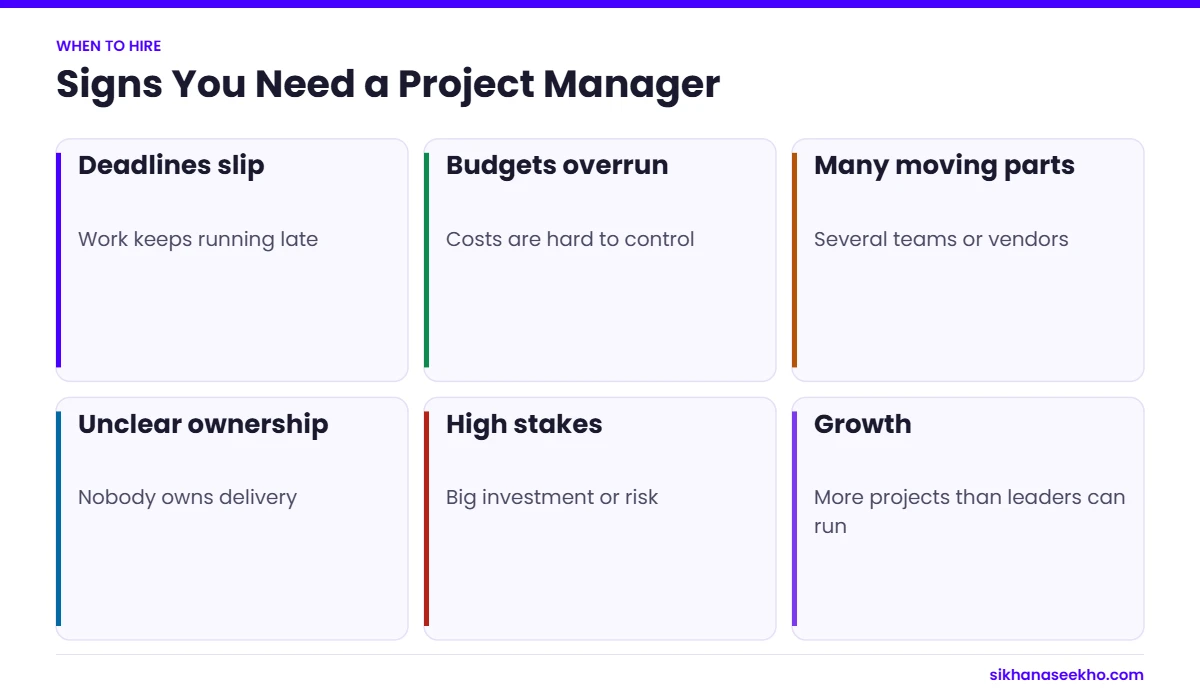
What are the signs you need a project manager?
Project Complexity and Scope

The primary indicator that signals the need for a project manager is the complexity and scope of the project.
Projects that involve multiple stakeholders, intricate workflows, and interdependencies among various tasks are more likely to benefit from a project manager’s involvement. The project manager coordinates and aligns these diverse elements to ensure smooth execution.
Moreover, more significant projects with extended timelines often require careful planning and monitoring to prevent scope creep and resource wastage. A project manager’s ability to break down complex tasks, allocate resources effectively, and manage risks can significantly enhance project outcomes.
Resource Allocation and Optimization

Resource allocation is a critical aspect of project success, which can suffer delays and budget overravoidmet objectives without proper allocation. A project manager’s skillset becomes essential when resources are spread thin across multiple projects or when competing priorities arise. They possess the expertise to identify bottlenecks, allocate resources based on preference, and make necessary adjustments as the project progresses.
Project managers also play a vital role in optimizing resource utilization. They ensure that team members are assigned tasks that align with their skills and expertise, leading to increased efficiency and higher-quality deliverables. By monitoring resource allocation and workload distribution, project managers mitigate the risk of burnout and enhance team morale.
Stakeholder Management and Communication
Effective communication is the cornerstone of successful project management. In projects involving various stakeholders – such as clients, team members, vendors, and executives – miscommunication can lead to misunderstandings, delays, and even project failure. Project managers are skilled in managing communication channels, fostering collaboration, and ensuring that all parties are well-informed about project progress.

When projects require input from multiple departments or external partners, a project manager acts as the central point of contact, streamlining communication and minimizing the risk of information silos. Their ability to facilitate clear and consistent communication ensures that everyone involved remains aligned with project goals and expectations.
Risk Management

All projects carry inherent risks that can impact timelines, budgets, and outcomes. While some risks can be anticipated, others may arise unexpectedly. Project managers are trained to identify, assess, and mitigate risks throughout the project lifecycle. Their proactive approach to risk management can save organizations from potential disasters.
When considering whether to hire a project manager, organizations should evaluate the potential risks associated with the project. If the project involves high levels of uncertainty, regulatory compliance, or technical challenges, a project manager’s expertise can prove invaluable in developing risk mitigation strategies and contingency plans.
Timeline Adherence and Deliverable Quality

Meeting project deadlines and ensuring the quality of deliverables are essential for maintaining client satisfaction and organizational reputation. Project managers excel in timeline management, creating detailed project schedules, monitoring progress, and implementing strategies to keep the project on track.
Hiring a project manager becomes crucial when projects are time-sensitive, such as product launches or marketing campaigns. They excel at identifying bottlenecks, reallocating resources, and taking corrective actions to ensure that project milestones are achieved as planned.
Organizational Growth and Change

As businesses expand and evolve, their project management needs also change. Scaling up operations, entering new markets, or introducing innovative products can strain existing resources and processes. In such cases, hiring a project manager can facilitate a smooth transition and ensure that growth opportunities are capitalized upon effectively.
Additionally, project managers play a vital role in maintaining stability and continuity during organizational change, such as mergers, acquisitions, or restructuring. They provide structure and direction during uncertain times, helping the organization navigate the complexities of change.
Do you need a project manager? A quick test
| Question | If the answer is yes |
|---|---|
| Does the work involve 3 or more teams or suppliers? | Coordination alone justifies a project manager |
| Is the budget or deadline fixed and visible to leadership? | You need someone accountable for delivery |
| Have similar projects run late or over budget before? | A project manager can introduce planning and control |
| Are there legal, safety or reputational risks? | You need structured risk management |
| Will the work last more than 3 months? | Ongoing coordination will exceed spare capacity |
| Is the organisation growing or changing quickly? | Projects will compete for resources and need prioritising |
If you answer yes to 2 or more, a dedicated or part-time project manager is usually worth the cost.
Full-time, part-time or contract?
Not every organisation needs a permanent project manager. For a single large project, a contract project manager for 6 to 12 months may be the best fit. For a growing business with a steady flow of projects, a permanent hire usually pays off. For small organisations, a part-time or fractional project manager working 1 or 2 days a week can bring structure without a full salary.
Another option is to train an existing employee. Someone who knows the business well can often learn project management faster than an outsider can learn the business, especially with a recognised course such as CAPM, PRINCE2 Foundation or APM PFQ, followed later by the PMP.
What should you look for when hiring?
Look for evidence of delivering similar projects: size, sector, budget and the results achieved. Ask for specific examples of handling a missed deadline, a difficult stakeholder or a budget overrun.
Check certifications relevant to your market, such as PMP internationally or PRINCE2 and APM in the UK, but weigh them alongside experience. A certification shows knowledge of a method; examples show the person can apply it.
Finally, assess communication. Ask candidates to explain a past project to a non-specialist in 2 minutes. Clear, honest communication is the skill that matters most in the first 90 days.
What does a project manager cost compared with failure?
The cost of a project manager is visible on the payroll; the cost of not having one is often hidden in delays, rework, unhappy customers and staff burnout. PMI’s research has repeatedly found that organisations with mature project practices waste significantly less money than those without. For a project worth $500,000 or more, even a small improvement in delivery usually covers a project manager’s cost.
Key takeaway
If 2 or more of the signs above apply, hire or appoint a project manager now rather than after the first missed deadline. In 2026, with tighter budgets and faster change, the cost of 1 failed project is usually far higher than 12 months of a project manager’s salary.
How quickly can a project manager make a difference?
In most organisations, a capable project manager makes a visible difference within 30 to 90 days: a clear plan, a risk register, regular reporting and fewer surprises for leadership.
How do you decide whether to hire a project manager?
Deciding when to hire a project manager requires carefully assessing project complexity, resource allocation, stakeholder communication, risk management, timeline adherence, and the organization’s growth trajectory. A project manager’s expertise can significantly enhance project outcomes, prevent costly mistakes, and drive efficient project execution. By recognizing the scenarios in which a project manager’s involvement is essential, organizations can pave the way for successful project delivery, improved collaboration, and sustained growth. Whether it’s a complex project, a resource-intensive initiative, or a time-sensitive endeavor, a skilled project manager can be the key to unlocking the full potential of any project.
Hiring a project manager: common questions
What size of project needs a project manager?
There is no fixed threshold, but projects with several teams, a fixed deadline or budget, or significant risk usually benefit.
Can a team lead manage projects instead?
For small, simple projects, yes. As complexity grows, combining both roles often overloads the team lead.
Should I hire someone with PMP?
PMP shows experience and knowledge of recognised practices; combine it with evidence of similar projects.
Keep learning
- How ChatGPT Is Changing Project Workflows in India
- 7 Soft Skills Every Project Manager Needs
- Top 10 Mistakes New Project Managers Make (And How to Avoid Them)
- Best Universities for Project Management Degrees in the UK and USA
- How to Fund Your Project Management Education in the USA and UK: Scholarships, Grants and Low-Cost Options
- Is a Master’s in Project Management Worth It?