The Triple Constraint in Project Management: Scope, Time, Cost and Beyond
The triple constraint in project management is the link between scope, time and cost: change one and at least one of the others must change too, with quality sitting in the middle. Modern practice adds further constraints such as quality, resources, risk, communication and stakeholders that a project manager must balance.
Project management is a complex process that involves managing multiple constraints that can impact project success. These constraints include time, cost, scope, quality, resources, risk, communication, and stakeholders. Each constraint presents unique challenges that must be managed effectively to ensure project success. In this article, we will discuss the constraints of project management in detail and their impact on project success. We will also provide insights into how project managers can effectively manage these constraints to deliver successful projects that meet stakeholder needs and expectations.
What is the triple constraint in project management?
Project management is a systematic approach to planning, executing, and controlling projects. It is a crucial process for organizations as it helps them achieve their goals and objectives within the given time, budget, and resources. However, like any other process, project management has constraints. These constraints limit the project manager’s ability to deliver the project successfully, and it is essential to understand them to develop effective project management strategies. In this article, we will discuss the various constraints of project management and their impact on project success.
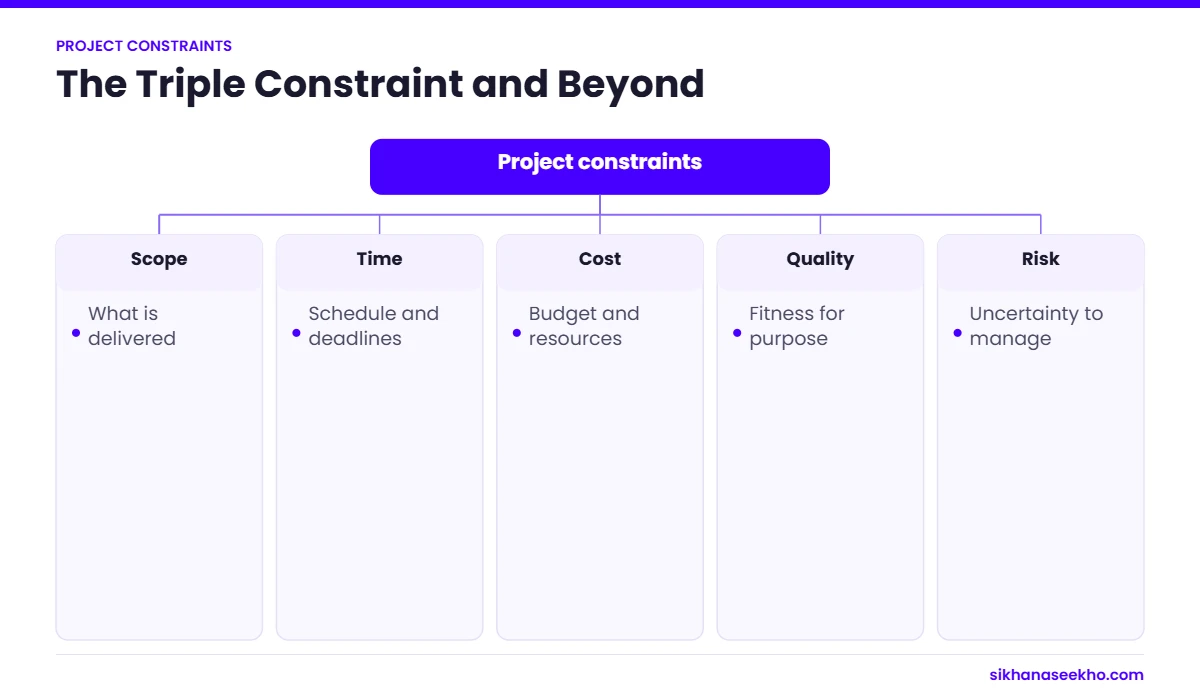

What are the Constraints of Project Management?
Time Constraint
Time is one of the critical constraints of project management. Every project has a specific timeline or deadline within which it needs to be completed. The project manager must ensure the project is completed within the given time frame. Failure to meet the deadline could lead to cost overruns, missed opportunities, and loss of revenue.
Impact:
Failure to manage the time constraint effectively could lead to project delays and missed deadlines. Project delays can have severe consequences for the organization, including increased costs, missed opportunities, and loss of revenue. Projects completed within the given time frame could also become irrelevant, making all efforts and resources invested in them a waste.
Solution:
To manage the time constraint effectively, the project manager must develop a project timeline that outlines the tasks that need to be completed, their dependencies, and the timeline for each task. The timeline should also include contingency plans to address unexpected delays or issues that may arise during the project. The project manager must also monitor the project’s progress regularly to ensure it is on track to meet the deadline.
Cost Constraint
Cost is another crucial constraint of project management. Every project has a specific budget within which it needs to be completed. The project manager must ensure the project is completed within the allocated budget. Please do so to avoid cost overruns, which can have severe consequences for the organization.
Impact:
Failure to manage the cost constraint effectively could lead to cost overruns, which can have severe consequences for the organization. In extreme cases, cost overruns can reduce profitability, financial losses, and even bankruptcy.
Solution:
To manage the cost constraint effectively, the project manager must develop a detailed project budget that outlines all the project costs, including labor, materials, equipment, and overheads. The project manager must also regularly monitor the project’s expenditure to ensure it is within the allocated budget.
Scope Constraint
The project’s scope refers to the tasks, deliverables, and outcomes that the project aims to achieve. The project’s scope is usually defined at the beginning, and it is essential to ensure that the project stays within the defined scope. Please do so to avoid scope creep, leading to cost overruns, missed deadlines and reduced project quality.
Impact:
Effective management of the scope constraint could lead to scope creep, cost overruns, missed deadlines, and reduced project quality. Scope creep can also impact the project’s success by diverting resources and attention from critical tasks.
Solution:
To manage the scope constraint effectively, the project manager must develop a detailed project scope that outlines all the tasks, deliverables, and outcomes the project aims to achieve. The project manager must also ensure that the relevant stakeholders properly document and approve any changes to the project scope.
Quality Constraint
Quality is an essential constraint of project management. The project manager must ensure that the project delivers the desired quality of work within the given time and budget. Delivering the desired quality of work could result in customer satisfaction, lost opportunities, and damage to the organization’s reputation.
Impact:
Failure to manage the quality constraint effectively could lead to customer dissatisfaction, lost opportunities, and damage to the organization’s reputation. Projects that fail to deliver the desired quality of work can also impact the organization’s future business prospects.
Solution:
To manage the quality constraint effectively, the project manager must develop a detailed quality plan that outlines the project’s quality requirements and the processes that will be used to ensure that these requirements are met. The project manager must also regularly monitor the project’s quality to ensure that it meets the desired standards.
Resource Constraint
Resources refer to the people, equipment, and materials required to complete the project. The project manager must ensure that the project has the necessary resources to complete the project successfully within the given time and budget. Failure to have the necessary resources could lead to delays, cost overruns, and reduced project quality.
Impact:
Failure to manage the resource constraint effectively could lead to delays, cost overruns, and reduced project quality. Projects that do not have the necessary resources could also impact employee morale and motivation, leading to reduced productivity and quality.
Solution:
To manage the resource constraint effectively, the project manager must develop a detailed resource plan that outlines the people, equipment, and materials required to complete the project. The project manager must also ensure that the necessary resources are available when needed and that they are used efficiently.
Risk Constraint
Risk is an inevitable part of any project. The project manager must identify, assess, and mitigate risks that could impact the project’s success. Failure to manage risks could lead to project delays, cost overruns, and reduced project quality.
Impact:
Failure to manage the risk constraint effectively could lead to project delays, cost overruns, and reduced project quality. Unforeseen risks could impact the project’s progress and outcome, leading to missed deadlines, increased costs, and reduced quality.
Solution:
To manage the risk constraint effectively, the project manager must develop a risk management plan that outlines the process for identifying, assessing, and mitigating risks. The project manager must also monitor the project’s risks regularly and implement contingency plans to address any unexpected risks that may arise.
Communication Constraint
Communication is crucial for project success. The project manager must ensure all stakeholders know the progress, issues, and changes. Failure to communicate effectively could lead to misunderstandings, delays, and reduced project quality.
Impact:
Failure to manage the communication constraint effectively could lead to misunderstandings, delays, and reduced project quality. Communication can also impact stakeholder satisfaction and engagement, reducing support and commitment to the project.
Solution:
To manage the communication constraint effectively, the project manager must develop a communication plan outlining the communication process with stakeholders. The project manager must also ensure timely, accurate, and consistent communication.
Stakeholder Constraint
Stakeholders are individuals or groups with an interest or stake in the project. The project manager must ensure that the project meets the needs and expectations of all stakeholders. Failure to do so could lead to stakeholder dissatisfaction, which can have severe consequences for the organization.
Impact:
Management of the stakeholder constraint effectively could lead to satisfaction, which can have severe consequences for the organization. Stakeholders who are satisfied with the project’s outcome may withdraw support or even take legal action against the organization.
Solution:
To manage the stakeholder constraint effectively, the project manager must identify all stakeholders and their needs and expectations. The project manager must also develop a stakeholder management plan that outlines the process for managing stakeholder needs and expectations.
Project constraints and typical trade-offs
| Constraint | Question it answers | Typical trade-off |
|---|---|---|
| Scope | What exactly will we deliver? | Adding features usually needs more time or money |
| Time | When must it be done? | A tighter deadline usually needs more people or less scope |
| Cost | How much can we spend? | A smaller budget usually means less scope or a longer schedule |
| Quality | How good must it be? | Cutting time or cost often puts quality at risk |
| Resources | Who and what is available? | Scarce specialists can delay critical tasks |
| Risk | What could go wrong? | Lower risk tolerance needs bigger reserves |
| Stakeholders | Whose expectations must we meet? | Conflicting demands need agreed priorities |
Where did the triple constraint come from?
The idea is usually credited to Dr Martin Barnes, who described the time, cost and quality triangle in 1969 while developing project control courses in the UK. Over time it became known as the iron triangle or triple constraint, with scope often replacing quality on one corner.
The PMBOK Guide later expanded the idea. Earlier editions talked about competing constraints including scope, quality, schedule, budget, resources and risk, recognising that real projects balance more than 3 factors.
On the PMP exam, the key lesson is the same: you cannot change one constraint without considering the impact on the others. A change request that adds scope must be assessed for its effect on schedule, cost, quality and risk before it is approved.
A worked example of constraint trade-offs
Imagine a 12-week website project with a $60,000 budget. Halfway through, the sponsor asks for a new payment feature. The project manager estimates it adds 3 weeks and $9,000.
The sponsor now has 3 choices. Accept the change and move the go-live date to week 15 with a budget of $69,000. Keep the date by adding a second developer, which might cost around $12,000 and adds coordination risk. Or keep both date and budget by removing another feature of similar size.
The project manager’s job is not to choose for the sponsor, but to make the trade-offs clear and to record the decision through change control. That is the triple constraint in action.
In agile projects, the same logic applies differently. Time and cost are usually fixed per sprint, and scope flexes: the product owner chooses which backlog items fit in the next 2 weeks.
Since PMBOK 7 was published in 2021, PMI frames constraints within the uncertainty and delivery performance domains, but the trade-off logic is unchanged.
Project constraints: common questions
What are the 3 constraints of project management?
Scope, time and cost. Quality is usually shown in the middle, because it is affected by all 3.
What are the 6 project constraints?
A common extended list is scope, time, cost, quality, resources and risk. Some models add stakeholders and communication.
Which constraint is most important?
It depends on the project. A product launch tied to a trade show may have a fixed date; a public project may have a fixed budget. Agree with the sponsor which constraint is fixed and which can flex.
How are constraints tested on the PMP exam?
Usually through change requests and trade-off scenarios. The correct answer analyses the impact on all constraints before any change is approved.
How do you balance project constraints?
In conclusion, the constraints of project management are time, cost, scope, quality, resources, risk, communication, and stakeholders. Each constraint must be managed effectively to ensure project success. Project managers must develop a comprehensive project management plan that outlines the processes for managing each constraint and includes contingency plans to address unexpected events. By effectively managing the constraints of project management, organizations can deliver successful projects that meet stakeholder needs and expectations, enhance their reputation, and improve their bottom line.
Keep learning
- Beginner’s Guide to Earned Value Management (EVM)
- What Are Stakeholders in Project Management?
- PMBOK Process Groups Explained: All 5 with Examples
- Critical Path Method (CPM): Step-by-Step Guide
- Earned Value Management Formulas, Examples & Calculator
- Project Risk Management Identify, Analyse & Control