
Chartered Project Professional (ChPP) is the chartered standard awarded by the Association for Project Management, made possible by the Royal Charter APM received in 2017. It recognises experienced project professionals who can show competence, ethics and ongoing development, and it is assessed through a written application and an interview.
Understand how to become a Chartered Project Professional (ChPP) through APM. Discover what ChPP status means, its benefits, and the steps to achieve this career-defining recognition. If you’re an established project manager in the UK, you’ve likely come across the APM ChPP designation. But what exactly does it involve? As a Chartered Project Manager UK, earning the Chartered Project Professional (ChPP) status from the Association for Project Management (APM) marks a major achievement in your career: signifying advanced expertise, leadership, and professional credibility.
The ChPP designation represents the highest level of acknowledgment in project management. Granted by APM, this title reflects your sophisticated skills, adherence to ethical standards, and a validated history of success.
Why Pursue Chartered Project Professional Status?
Achieving ChPP status is not simply about holding a distinguished title. It conveys to employers and clients that you meet the utmost standards of professional excellence. Here are several persuasive reasons to earn it:
- Improved professional credibility
- Greater access to job advancements and promotions
- Acknowledgment from colleagues and industry experts
- Dedication to ongoing professional growth
- Confirmation of practical project experience
In the current competitive environment, ChPP status sets you apart.
Who Qualifies to Apply for APM ChPP?
The APM’s ChPP status targets seasoned professionals who can showcase:
- A solid history of managing intricate projects.
- Strong ethical principles and professional integrity.
- Commitment to Continuous Professional Development (CPD).
- Strategic leadership and effective communication skills.
Applicants typically require a minimum of five years of project work experience, with ten years being common.
APM qualifications and where ChPP sits
| Level | Qualification or status | Typical candidate |
|---|---|---|
| Entry | APM Project Fundamentals Qualification (PFQ) | New to project work |
| Practitioner | APM Project Management Qualification (PMQ) | Working project managers |
| Advanced | APM Project Professional Qualification (PPQ) | Experienced project managers |
| Chartered | Chartered Project Professional (ChPP) | Experienced professionals with proven competence |
Source: Association for Project Management (apm.org.uk). Check APM for current routes and fees.
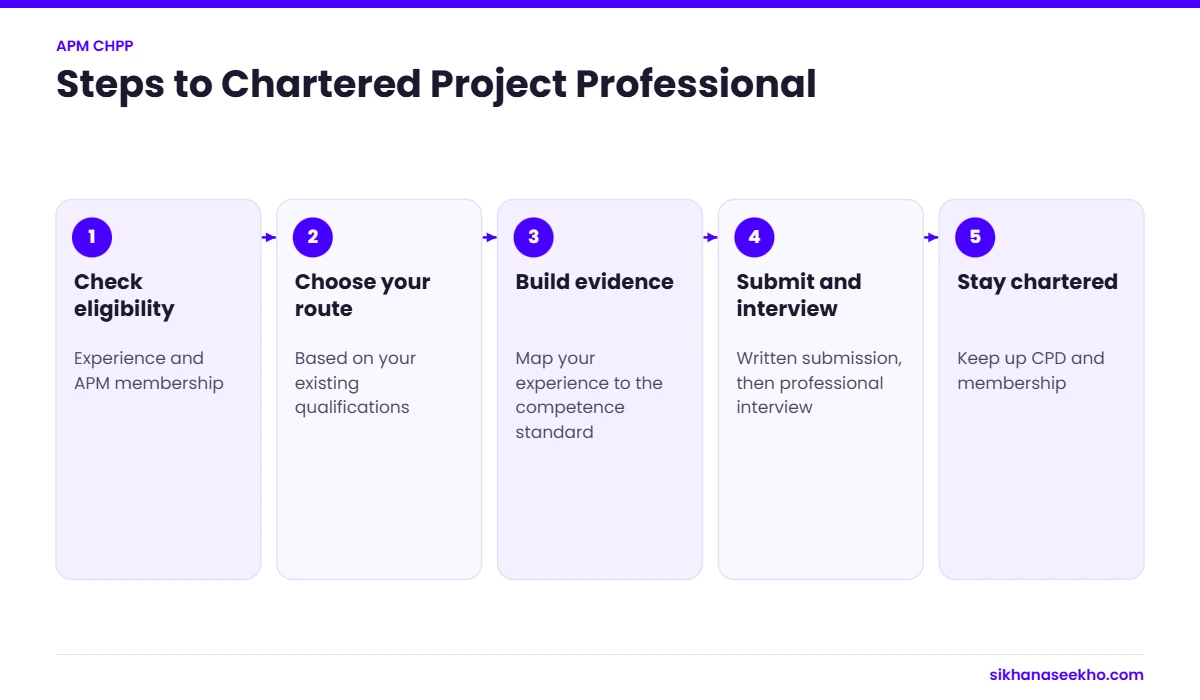
Steps to Attaining APM ChPP Status
Let’s outline the steps necessary to achieve this credential. Although the process may appear rigorous, it is accomplishable with adequate preparation.
1. Select the Appropriate Pathway
There are three pathways to gain ChPP status:
- Pathway 1: Recognized Assessment and Professional Practice.
- Pathway 2: Professional Practice and Elective Competencies.
- Pathway 3: Academic Route (for those possessing specific qualifications).
Most candidates opt for Pathway 2, which requires demonstrating expertise through a written submission and subsequent interview.
2. Finalize Your Application
You’ll be required to provide:
- A comprehensive project portfolio or evidence of your experience.
- Referee endorsements.
- Proof of ongoing professional development.
- Evidence of ethical conduct in your work.
It is crucial to be meticulous and truthful. APM favors authentic examples and thoughtful professional reflections.
3. Prepare for Your APM ChPP Interview
Upon acceptance of your application, you will be scheduled for a professional review interview. This is your chance to:
- Discuss your project decisions and style of leadership.
- Illustrate how you align with the ChPP criteria.
- Highlight your contributions to the success of projects.
4. Wait for the Outcome
Following the review, APM will evaluate your submission and inform you of the result. Successful candidates are then included in the ChPP Register, a publicly accessible list of chartered professionals.
What do assessors look for in a ChPP application?
Assessors want evidence, not job descriptions. For each competence, describe a real situation, what you personally did, and what changed as a result. Use the STAR structure: situation, task, action, result.
Pick examples from the last few years where your role is clear. If a team delivered the result, say exactly which decisions were yours.
Show ongoing development. Chartered status depends on keeping up continuing professional development, so a record of recent learning strengthens your case.
Finally, prepare for the interview as you would for a senior job interview. Expect follow-up questions on your examples and on ethical judgement.
How long does the ChPP process take?
Allow several months from deciding to apply to receiving the outcome. Gathering evidence is usually the slowest part, especially if your best examples are from projects that finished 2 or 3 years ago and you need to check dates and figures.
A sensible plan is to spend the first 4 to 6 weeks choosing examples and drafting, then ask a chartered colleague or mentor to review your draft before you submit. After submission, APM schedules the interview, and you should keep at least 2 weeks free to prepare for it.
Chartered status is not a one-off. Once awarded, you are expected to keep your continuing professional development up to date every year to stay on the register.
APM, founded in 1972, became a chartered body in 2017, and the first Chartered Project Professionals were registered in 2018. If you hold the PMQ or PPQ, you have already covered much of the knowledge the assessors expect.
Is ChPP right for you?
ChPP is aimed at experienced professionals who can show sustained competence, not at people early in their careers. If you have led projects for several years, hold an APM qualification such as the PMQ or PPQ, and can describe your decisions in detail, it is a strong way to stand out in the UK market.
If you are earlier in your career, the PMQ is the better step now. It builds the knowledge assessors expect and gives you a structured way to gather the examples you will need for a chartered application later.
In 2026, ChPP is increasingly listed in senior UK public-sector and infrastructure job adverts, so it is worth planning for even if you apply in a few years.
Common mistakes in ChPP applications
The most common mistake is describing what the team did instead of what you did. Assessors look for your personal decisions, so use “I” and explain your reasoning.
The second is choosing examples that are too old or too small to show the level of responsibility expected. Pick recent work where you carried real accountability for scope, budget or people.
The third is weak reflection. Saying a project went well is not enough; explain what you would do differently next time and how it changed your practice.
Finally, applicants sometimes underestimate the interview. Practise answering follow-up questions aloud with a colleague, and be ready to discuss ethical dilemmas and how you handled them.
How does ChPP compare with PMP?
They do different jobs. PMP is an exam-based certification from PMI, recognised worldwide. ChPP is a chartered status assessed on your proven competence, and it carries most weight in the UK. Many senior UK project professionals hold both: the PMP for international recognition and ChPP for standing in the UK profession.
Tips for a Successful Application
To enhance your likelihood of success, consider these strategies:
- Start gathering your evidence early.
- Request input from peers or mentors.
- Familiarize yourself with the APM Competence Framework.
- Maintain clarity and conciseness in your written submissions.
- Reflect on how your work impacts project stakeholders and outcomes.
Is ChPP a Valuable Credential?
Definitely. Achieving the status of Chartered Project Professional not only advances your career but also boosts your confidence as a leader. It serves as a badge of excellence, indicating that you uphold the highest standards within the profession.
In a landscape where professional integrity is paramount, the APM’s Chartered Project Professional status presents an invaluable opportunity for experienced project managers based in the UK. From augmenting your professional profile to unlocking new pathways, ChPP represents a meaningful investment in your career.
Frequently Asked Questions (FAQs)
1. What defines the APM Chartered Project Professional (ChPP) status?
It’s a professional credential conferred by the APM to individuals who exhibit advanced capabilities in project management alongside ethical standards.
2. How long does it usually take to achieve ChPP status?
The entire process generally requires several months, influenced by the chosen pathway and the completeness of your submission.
3. Is ChPP acknowledged outside the UK?
While APM is UK-centric, the ChPP designation is increasingly recognized globally, particularly within Europe and across the Commonwealth.
4. Can I pursue ChPP without holding a formal degree?
Indeed, many candidates qualify through experience-oriented routes rather than academic paths.
5. What support resources are available for applicants?
APM provides guidance documents, workshops, and networking forums to assist candidates in their journey.
Keep learning
- Top APM Accredited Training Providers You Should Know
- Project Management Tools for APM Professionals
- Top 10 APM PMQ Exam Tips to Pass First Time in 2026
- APM PMQ Qualification Guide for 2026
- Best PRINCE2 Online Courses 2026: Foundation and Practitioner Options Compared
- APM vs PMP (APM PMQ vs PMP): Which Is Better in 2026?