PMP (Project Management Professional) is PMI’s globally recognised certification for experienced project managers. For freelancers it signals to clients that you can plan, budget and deliver to a recognised standard, which helps you win larger contracts, charge higher rates and stand out on freelance platforms.
Freelancing has become an increasingly popular career choice in recent years, offering numerous benefits to those pursuing it. One of the most significant advantages of freelancing is its flexibility, allowing individuals to set their hours and work from anywhere. Freelancers also have the opportunity to work on various projects and clients, which can help them develop a diverse skill set and expand their professional network.
Additionally, freelancing can offer greater earning potential and the ability to take on work that aligns with personal interests and values. Overall, the importance and benefits of freelancing make it an appealing option for those seeking a more flexible and fulfilling career path.
Importance and Benefits of PMP for Freelancers
The Project Management Professional (PMP) is a globally recognized certification offered by the Project Management Institute (PMI) to professionals in project management. It validates their expertise in managing projects, ensuring their success, and meeting the organization’s goals.
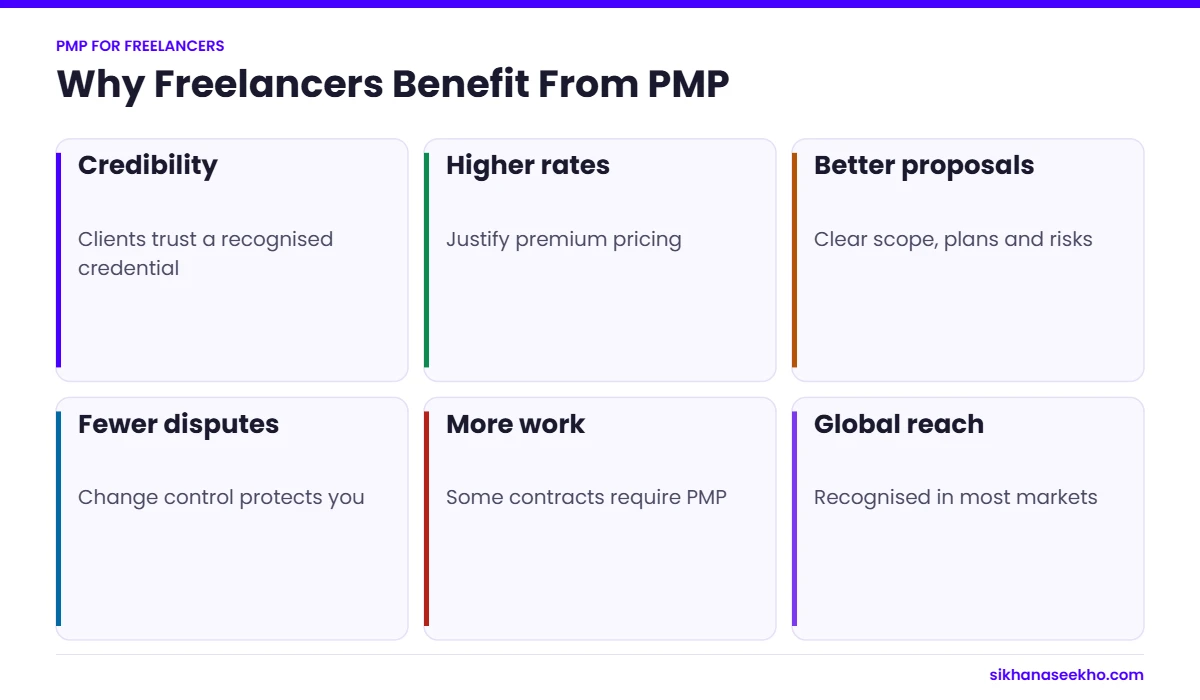
Freelancers, like any other professionals, need to demonstrate their skills and expertise in their field of work to succeed. PMP certification can help freelancers establish their credibility and expertise in project management. Leading to better job opportunities and higher earnings.
This article explains the importance and benefits of PMP certification for freelancers. How it can help them improve their project management skills, boost their career prospects, and increase their earning potential.
Freelancing refers to working as an independent contractor, providing services to clients without being tied to any employer or organization.
Freelancing offers various advantages, such as flexibility in work hours. The ability to choose projects and clients, and the freedom to work from anywhere.
Freelancers also face challenges such as competition, unstable income, and the need to constantly upgrade their skills to stay relevant.
PMP certification validates the project management skills and expertise of professionals. It is offered by the PMI and is recognized globally.
To be eligible for PMP certification, candidates must have a secondary degree, 5 years of leading and directing projects, and 35 hours of project management education. Alternatively, they can have a four-year degree, 3 years of leading and directing projects, and 35 hours of project management education.
The PMP certification exam is a 230 minute, 180-question test. It assesses candidates’ knowledge and understanding of project management concepts, principles, and practices.

What are the benefits of PMP for freelancers?
Increased Credibility: PMP certification is a globally recognized validation of a freelancer’s project management skills, enhancing their credibility and marketability.
Higher Earnings: PMP-certified freelancers can earn higher pay rates than their non-certified counterparts. As clients perceive them as more capable and reliable.
Better Opportunities: PMP certification opens up better job opportunities for freelancers, especially in large organizations that require project management professionals.
Professional Development: PMP certification requires continuing education, ensuring freelancers stay updated with the latest project management practices and trends.
Enhanced Networking: PMP certification allows freelancers to network with other project management professionals. Creating business connections that can lead to future job opportunities.

How does PMP help freelancers on real projects?
Improved Project Management Skills: PMP certification teaches freelancers best practices in project management. Enabling them to plan, execute, and monitor projects more efficiently.
Effective Communication: PMP certification emphasizes effective communication skills. Enabling freelancers to communicate better with clients, stakeholders, and team members, ensuring successful project outcomes.
Risk Management: PMP certification teaches freelancers how to identify and mitigate project risks, minimizing the chances of project failure.
Quality Control: PMP certification emphasizes the importance of quality control in project management. By enabling freelancers to deliver projects that meet or exceed clients’ expectations.
Time Management: PMP certification teaches freelancers how to manage project timelines and deadlines, ensuring the timely completion of projects.
PMP requirements for freelancers at a glance
| Requirement | Detail | Tip for freelancers |
|---|---|---|
| Experience | 36 months leading projects in the last 8 years with a 4-year degree, or 60 months without | Client projects count if you led and directed the work |
| Education | 35 contact hours of project management training | Online courses that document the hours are accepted |
| Exam fee (2026) | $405 PMI members, $655 non-members | Membership usually pays for itself |
| Renewal | 60 PDUs every 3 years | Many PDUs can come from learning you already do |
| Audit | PMI randomly audits some applications | Keep client contacts and dates for each project |
Source: PMI PMP Handbook. Check pmi.org for current rules.
How should freelancers prepare for the PMP?
Start by listing every project you have led in the last 8 years, with start and end dates, the client, your role and what you delivered. Freelancers often have many short projects; PMI counts the months you spent leading projects, and overlapping projects do not add extra months, so a clear timeline matters.
Next, complete the 35 contact hours. Many freelancers choose self-paced online courses that fit around client work. Then plan 2 to 4 months of study at around 8 to 10 hours a week, using a prep book or course aligned with the current exam outline and plenty of timed practice questions.
Finally, protect your study time like a client deadline. Block 2 or 3 sessions a week in your calendar and take at least 2 full-length mock exams before booking the real one.
How do you market your PMP to clients?
Add it to your profile headline, proposals and email signature, and explain what it means for the client: a clear plan, regular reporting, managed risks and controlled changes. Clients rarely care about the letters; they care about fewer surprises.
Use PMP tools visibly. Sending a short project charter at the start, a simple risk list and a weekly status update shows professionalism that many competitors do not offer, and it gives you natural moments to agree changes and extra fees in writing.
Over time, collect results: projects delivered on time, budgets met and repeat clients. Combined with the PMP, those numbers make a strong case for higher rates in 2026 and beyond.
Common PMP mistakes freelancers make
The first is under-documenting experience. Freelancers often have many short projects and forget dates; keep a running log from today with client, dates, role and results.
The second is describing tasks instead of leadership. PMI wants evidence that you led and directed project work, such as planning, managing risks, coordinating people and reporting progress, not only that you did technical work.
The third is studying without a deadline. Book a target exam window as soon as your application is approved, then plan backwards from it so client work does not swallow your study time.
How long does it take?
Most freelancers who already meet the experience requirement prepare in 2 to 4 months. Planning 8 to 10 hours a week around client work keeps the pace steady without losing income.
Treat it like a client project: set a deadline, a budget and weekly milestones, and review progress every Friday.
PMP for freelancers: common questions
Can freelancers get PMP certified?
Yes. PMI counts experience leading and directing projects whether you are employed or self-employed. Describe each client project with dates, your role and outcomes.
Who verifies a freelancer’s experience if PMI audits me?
You provide contacts who can confirm the work, such as clients or partners. Keep their details and project dates from the start.
Does PMP help on platforms like Upwork?
It can. A recognised credential helps your profile stand out, especially for larger projects where clients want evidence of structured delivery.
Is PMP worth the cost for a freelancer?
If you manage projects for clients, usually yes: winning 1 larger contract or raising your rate slightly often covers the exam and training cost.
Summary
In short, PMP certification can help freelancers establish their credibility and expertise in project management. Leading to better job opportunities and higher earnings. It can also help them improve their project management skills, boost their career prospects, and increase their earning potential.
Freelancers who want to succeed in project management should consider getting PMP certified. As it can provide them with the skills, knowledge, and credibility needed to excel in their field.
Freelancers who want to take their project management career to the next level should consider getting PMP certified. The certification can help them stand out, increase their earning potential, and open new career opportunities.
Keep learning
- Does PMP Certification Help You Get a Job? (2026)
- PMP Login: How to Log In to PMI and Use Your PMP Dashboard
- PMP® Exam Prep 2026 by Mujeeb Rehman
- PMP Certification Guide 2026: Everything You Need to Pass
- Free PMP Study Guide 2026: Full PMBOK 8 Prep Plan
- 200 PMP Practice Exam Questions 2026: With Answers