
A Master of Science (MSc) in project management is a postgraduate degree, usually 1 to 2 years long, that teaches project, programme and leadership skills alongside research and strategy. It is worth it when you want an academic credential, a career change or a route into senior or international roles; for many working professionals, certifications offer a faster return.
Explore the pros and cons of pursuing a project management master’s degree vs certifications in today’s competitive job market. Is a project management masters worth it in 2025?
As project-based work continues to dominate industries across the globe, many professionals are asking: Is a project management masters worth it in 2025? With evolving job roles, increasing demand for agile skills, and growing competition, the decision isn’t as straightforward as it once was. Let’s break it down.
The Value of a Project Management Masters in Today’s Job Market
In 2025, companies face rapid digital transformation and organizational shifts. This means skilled project managers are in higher demand than ever. A project management master’s program offers structured learning, strategic leadership training, and hands-on project simulation: benefits that on-the-job learning or certifications may not fully provide.
Moreover, universities have updated their curricula to include agile frameworks, data-driven decision-making, and remote team management: all essential in today’s dynamic work environment. So, if you aim for long-term leadership roles, a project management masters might just be the career accelerator you need.
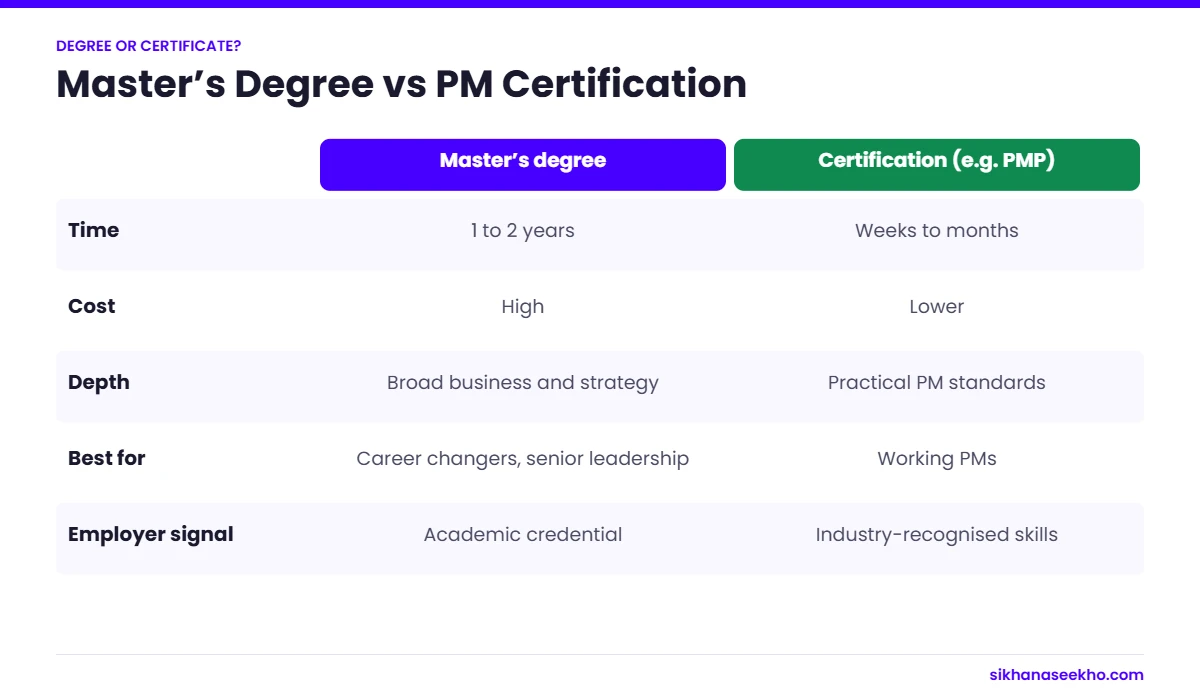
Master’s degree vs certification
| Factor | Master’s in project management | Certification such as PMP or PRINCE2 |
|---|---|---|
| Time | 1 year full time in the UK; often 2 years in the USA | Weeks to a few months |
| Typical cost | Thousands to tens of thousands in fees | Hundreds to a few thousand, including training |
| Experience needed | Usually none for entry | PMP needs 36 to 60 months leading projects |
| What it proves | Academic depth and strategic thinking | Recognised method and, for PMP, experience |
| Best for | Career changers, academic or senior strategic roles, visa routes | Working project managers wanting fast career impact |
Fees vary widely by university and country; check each programme for current figures.
Certifications vs Degrees: Which Delivers More ROI?
Here’s the key dilemma for most professionals: Should I invest in a master’s degree or opt for certifications like PMP, PRINCE2, or PMI-ACP?
Certifications are often cheaper, quicker, and industry-recognized. They’re ideal for mid-career professionals who need credentials without leaving the workforce. However, they may lack the depth and networking opportunities that a project management master’s program offers.
On the other hand, a project management masters, although more time-consuming and expensive, equips you with both soft skills and strategic insights. It signals commitment, depth, and a long-term vision: attributes valued in executive-level positions.
Is a Project Management Masters Worth It for Career Growth?
Absolutely, especially if you’re targeting roles like Program Manager, PMO Director, or Portfolio Manager. These positions often require not just tactical know-how but also strategic thinking, stakeholder management, and business acumen: all areas a project management master’s can sharpen.
Plus, many employers view advanced degrees favorably when promoting internal candidates. So if you’re stuck in a mid-level position, a project management masters could be your stepping stone to the next level.
Cost and Time Investment: What You Should Know
A legitimate concern for many is the return on investment. Tuition fees for a project management master’s can range from $15,000 to $60,000 depending on the institution. Additionally, completing the degree typically takes 1–2 years.
But think long-term. Graduates often report higher earning potential, greater job stability, and access to leadership pipelines. When weighed against lifetime earnings, a project management masters often pays for itself within a few years.
When a Project Management Masters Might Not Be Worth It
Of course, this degree isn’t for everyone. If you’re just starting out, lack clarity about your career path, or simply want quick recognition, a certification might serve you better.
Also, in highly specialized industries like IT or construction, employers sometimes prefer niche certifications over academic degrees. In such cases, a project management masters may not offer the best ROI.
Is a Project Management Masters Worth It in 2025?
The answer largely depends on your career goals, industry, and personal circumstances. If you’re aiming for long-term leadership, strategic impact, and professional credibility, a project management master’s in 2025 is a solid investment. But if you’re looking for quick upskilling or cost-effective credentials, certifications may be the better route.
Regardless of the path you choose, continuous learning is non-negotiable in today’s ever-changing business landscape.
Who benefits most from a master’s degree?
Career changers often get the most value. A master’s gives a structured route into project management, a network of classmates and access to university careers services and internships, which can be hard to get any other way.
International students also benefit, because a degree from a UK or US university can open post-study work routes and employer networks in that country. Check the latest visa rules before you apply, as they change.
Experienced project managers moving into strategy, portfolio or academic roles can benefit from the research and leadership modules. For them, a part-time or online master’s alongside work is often the most practical option.
If you already manage projects and want a quick, recognised boost, a certification such as the PMP will usually deliver more return for less time and money.
How do you choose a programme?
Look at 5 things: accreditation, such as APM accreditation in the UK or a PMI-accredited programme through PMI’s Global Accreditation Center; the balance of theory and practical projects; links with employers; the experience of the teaching staff; and graduate outcomes.
Ask whether the programme prepares you for a certification. Some UK programmes include APM qualifications, and some US programmes cover the 35 contact hours required for the PMP.
Finally, talk to recent graduates. Their experience of teaching quality and job support is often more useful than any ranking.
Can you combine a degree and certification?
Yes, and many people do. A common path is a master’s early in your career, followed by the PMP once you have 3 years of experience leading projects. A master’s degree does not reduce the PMP experience requirement below 36 months, but it covers much of the knowledge, so exam preparation is usually quicker.
What do you study on a master’s in project management?
Most programmes cover project planning and control, risk, cost and procurement, leadership and team management, agile and hybrid delivery, programme and portfolio management, and research methods. Many end with a dissertation or a consultancy project with a real organisation, which can become a strong portfolio piece and interview example.
Is an online master’s respected?
Yes, if it comes from an accredited university. Employers rarely distinguish between online and campus degrees today; they care about the institution, the content and what you can do.
Check the programme’s teaching mode, contact hours and assessment style before enrolling, and ask how online students access careers support and alumni networks, which are often the most valuable parts of a degree.
FAQs
1. Is a project management masters worth it compared to a PMP certification?
Yes, if you’re targeting strategic leadership roles. PMP is great for immediate skill validation, while a master’s provides broader competencies and deeper learning.
2. Can I do a project management masters while working full-time?
Many programs now offer part-time or online formats specifically designed for working professionals.
3. How long does it take to complete a project management masters?
Typically, 12–24 months depending on whether you study full-time or part-time.
4. Will a project management masters increase my salary?
Generally, yes. Graduates often report higher earnings and better promotion prospects within 2–3 years of graduation.
5. What’s the best time in my career to pursue a project management masters?
Mid-career is ideal, especially when aiming to transition from technical roles to strategic leadership positions.
Master’s in project management: common questions
How long does a master’s in project management take?
Usually 1 year full time in the UK and 1 to 2 years in the USA. Part-time and online programmes often take 2 to 3 years.
Do employers prefer a degree or a PMP?
For most project manager roles, employers ask for experience and a certification such as the PMP more often than a master’s degree.
Can I do a master’s in project management without experience?
Yes, most programmes accept graduates without project experience, which makes them a popular route for career changers.
Keep learning
- Best Project Management Bootcamps in the UK and US
- Best Online Master’s Degrees in Project Management (USA/UK)
- Top Project Management Jobs and How to Land Them
- Top Project Management Trends to Watch
- AI in Project Management 2026: Threat or Opportunity?
- Project Coordinator vs Project Manager: Key Differences in Roles, Responsibilities and Career Growth