Top Project Management Skills
in 2026: Full List
The PM skills that employers actually pay for have shifted. Technical planning skills remain essential, but the highest-demand skills in 2026, the ones that unlock senior roles and salary jumps, sit at the intersection of leadership, data literacy and stakeholder influence. This guide covers all four skill categories with specific development advice for each one.
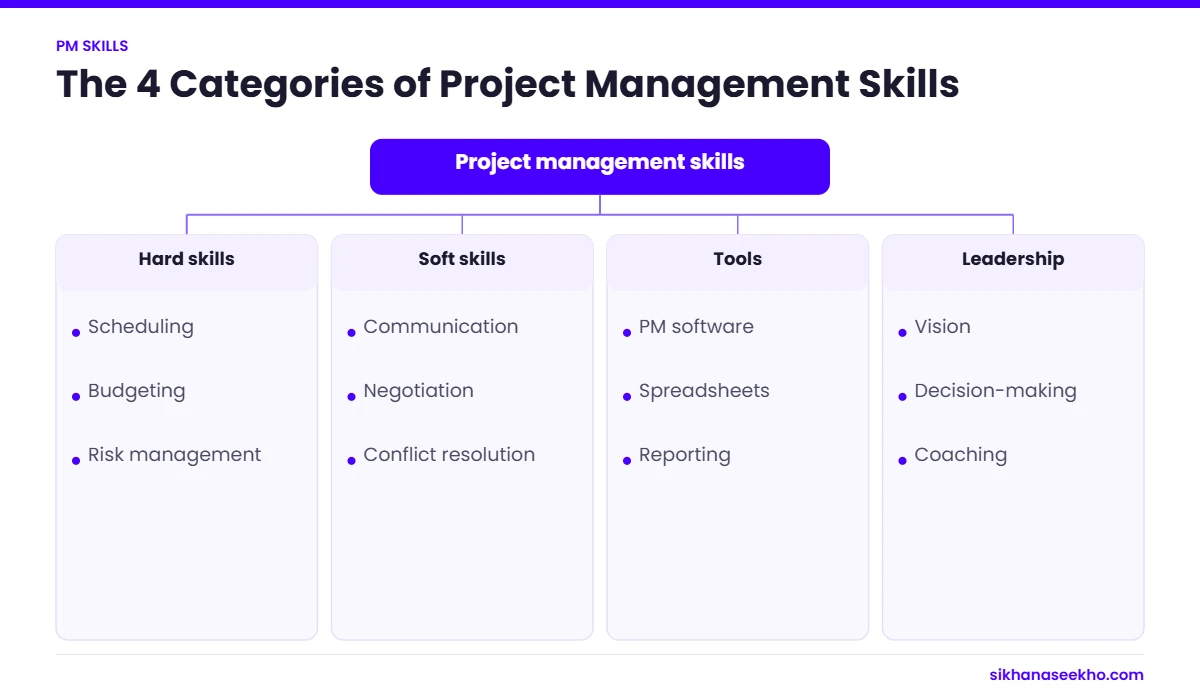
PM Skills: Four Categories That All Matter
Project management is unusual among professional roles in requiring genuine competence across four fundamentally different skill domains simultaneously. Technical planning knowledge, interpersonal skill, tool proficiency and leadership capability are all required. You cannot substitute strength in one category for weakness in another. The PMs who plateau are almost always strong in one or two categories and weak in the others.
Hard Skills: Technical PM Competencies
Hard skills are the technical knowledge and methods that define project management as a discipline. These are testable, certifiable and directly visible to hiring managers. They are the foundation: without them, you cannot function as a PM regardless of how strong your soft skills are.
Soft Skills: People, Influence & Communication
Soft skills are the most important determinant of PM career progression at senior levels, and the hardest to develop deliberately. They cannot be learned from a book or a course in the way that EVM can. They are built through deliberate practice, feedback and reflection over years of real project experience.
Essential PM Tools: What to Know at Each Level
Tool proficiency is expected, not impressive: hiring managers assume you can use common PM tools. What stands out is using tools effectively: a well-structured Jira board is not the same as having Jira on your CV. Below are the tools with the highest hiring frequency in UK PM job descriptions in 2026, organised by category.
Leadership Competencies: What Senior Roles Demand
Leadership competencies are the skills that determine whether a PM is considered for senior, programme and director-level roles. They cannot be demonstrated in isolation. They are observable only in the context of real, complex project environments. They are what separates PMs who plateau at mid-level from those who progress to the top of the profession.
2026 PM Skills Demand: How Employers Rate Each Skill
Based on analysis of UK PM job descriptions in 2026, here is how frequently each skill appears as a requirement or preference: from near-universal to emerging. Use this table to prioritise where to invest development time.
| Skill | Category | 2026 Demand Level | Trajectory |
|---|---|---|---|
| Stakeholder Management | Soft Skill | Universal | Stable: always #1 |
| Project Planning & Scheduling | Hard Skill | Universal | Stable |
| Risk Management | Hard Skill | Universal | Stable |
| Communication | Soft Skill | Universal | Stable |
| Budget Management | Hard Skill | Very High | Stable |
| Agile / Scrum | Hard Skill | Very High | Growing fast |
| Scope Management / Change Control | Hard Skill | Very High | Stable |
| PRINCE2 Practitioner | Certification | Very High (UK) | Stable in UK |
| PMP | Certification | High | Growing |
| Jira / Agile Tools | Tool | High (Tech) | Growing |
| EVM / Performance Measurement | Hard Skill | High (Gov/Infra) | Stable |
| Power BI / Data Dashboards | Tool | Growing | Accelerating |
| Leadership Without Authority | Leadership | High | Stable |
| Benefits Realisation | Hard Skill | Growing | Growing |
| AI Tool Proficiency | Tool / Leadership | Emerging Premium | Fast moving |
Skills Self-Assessment: Where to Focus
Most PMs over-invest in skills they already have (because they are comfortable there) and under-invest in their weakest category. The highest-ROI skill development investment is almost always closing the biggest gap, not extending the longest strength. Use this framework to identify your focus area.