Certifications PMP CertificationWorld’s top PM cert CSM: Certified ScrumMasterTop agile cert CAPMEntry-level PM cert PRINCE2UK & Europe standard View All Certifications ?
PM Guides Agile GuideComplete breakdown Scrum GuideRoles, ceremonies, artifacts EVM GuideAll formulas explained View All Guides ?
Career & Salary PM Salary 2026By country & level How to Become a PMStep-by-step roadmap 50 Interview QuestionsWith strong answers
PM Software Monday.com ReviewTop pick 2026 ClickUp ReviewBest value Best Free PM ToolsNo trials, truly free View All Software ?
Free Tools & Templates EVM CalculatorFree, no signup Gantt Chart MakerBuild & export free PMP Eligibility Checker30-second result Free PM Templates30 templates in Excel, Word and PDF
Get the Free PMP Guide ?
Free Template · Word · Updated March 2026

Free Change Request Form Template
Word Download

Every change to scope, schedule, cost or quality should be written down properly before anyone decides. This 7-section Word template gives the change control board (CCB) what it needs: what the change is, why it is needed, its impact on every baseline, the options and what happens next.

✓Word (.docx)
✓Free: no signup
✓Updated March 2026
✓PMI & PRINCE2 aligned
✦
7 structured sections
Header through to implementation. Every field the CCB needs to make a confident decision is already there.
✦
Integrated impact analysis
Separate fields for scope, schedule, cost, quality, resources and risk impact: true integrated change control.
✦
CCB decision section
Approve / Reject / Defer / More Info: with conditions, decision date and chair signature fields.
✦
Change Request Form
Free Word template: instant download
Format Word (.docx)
Sections 7 structured sections
Impact fields 6 baselines assessed
Decision outcomes 4 CCB decision options
Framework PMI & PRINCE2 aligned
Price Free: no signup needed
↓ Download Free Template

No email required. Instant Word download.

Quick answer

A change request form is the formal submission used to propose a change to a project's scope, schedule, cost or quality. This free seven-section Word template captures the change, its impact analysis and the change control board decision, aligned with PMI and PRINCE2.

This form is for proposing and assessing one change. Once the change board decides, record the outcome and the reason in my decision log template, so anyone can find it later.
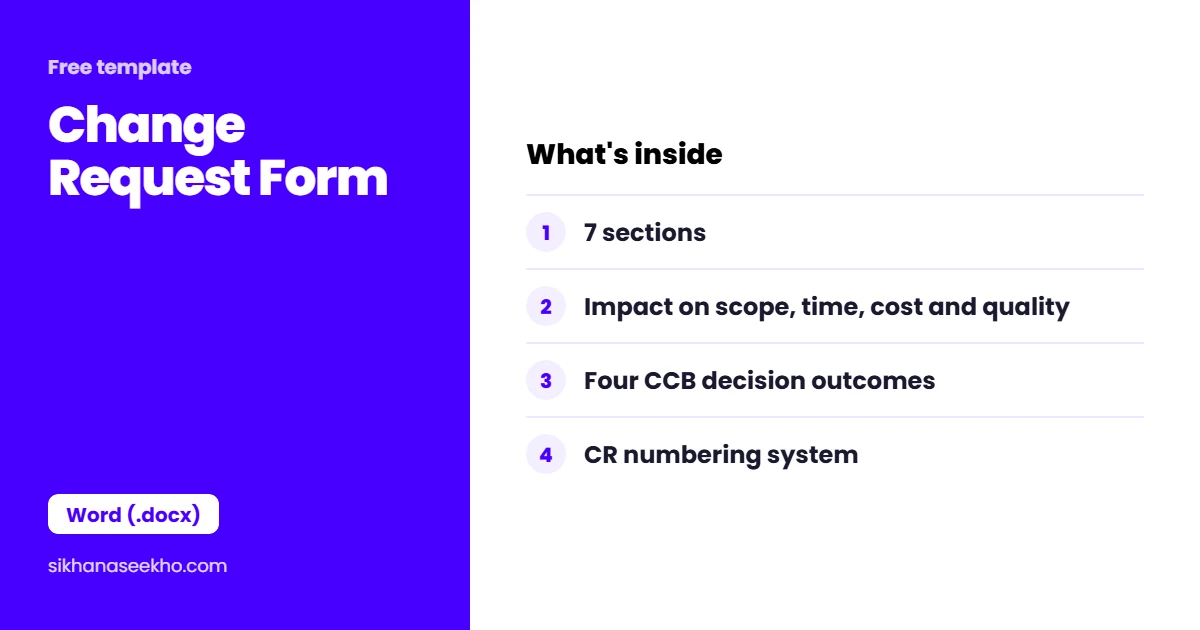
Change Request Form template preview: 7 sections, Impact on scope, time, cost and quality, Four CCB decision outcomes, CR numbering system
What is inside the free change request form template.

Change Request Form template at a glance

FormatWord (.docx)
Sections7, including impact analysis and decision
Lifecycle phaseExecuting and monitoring
Decided byChange control board (CCB) or sponsor
Best forDocumenting a change so it can be assessed fairly
01 · Form Sections

What's in the change request form?

Anyone can raise a change request with this form, but every request is assessed the same way. Each section collects what is needed at one stage of the change control process.

✦
From my experience: Change control was a daily part of my work on UAE construction projects. Clients and consultants asked for changes on site walks all the time. The rule I followed, and still teach my PMP students: no change starts until its impact on scope, time, cost and risk is written down and signed by the right person.
1
Header / Identification
Unique CR number, date raised, who raised it, the project name, PM and priority level. The CR number links this form to the change register entry.
CR Number Date Raised Raised By Priority
2
Change Description
A clear, specific description of what is being changed, added or removed. Guidance in the template prompts the requester to describe the change precisely, not just name it.
What changes What is added / removed
3
Business Justification
Why is this change needed? What risk, issue, opportunity or requirement is driving it? The justification must make the case for why the project is better off making this change than not.
Driver Risk if not approved
4
Impact Analysis Most Critical
Six separate impact fields: one per baseline. This is integrated change control: every baseline must be assessed even if the change seems to affect only one area. The schedule and cost fields include prompts for quantified values, not just qualitative statements.
Scope Schedule (+/- days) Cost (+/- $) Quality Resources Risk
5
Options Considered
Three option slots: implement as described, an alternative approach, and do nothing. Each option shows its impact so the CCB can compare genuinely. Do nothing is always an option.
Option A: Implement Option B: Alternative Option C: Do Nothing
6
PM Recommendation
The PM's recommended course of action with rationale. This is not the decision. That is for the CCB. But a clear PM recommendation anchors the discussion and makes it harder to approve a poor change without justification.
Recommended option Rationale
7
CCB Decision & Implementation
The formal CCB decision (Approve / Reject / Defer / More Info), any conditions attached, decision date, CCB chair signature, implementation owner, planned implementation date and date closed.
Decision Conditions Signature Implementation date Date closed
02 · Impact Analysis

How do you write the impact analysis?

Section 4 matters most, and it is the one people rush. Assess every baseline, not just the obvious one. A change that looks small often affects schedule, cost and risk in ways you only see when you look on purpose.

✦
Scope Impact
What deliverables, features or requirements are being added, modified or removed? Update the scope baseline and WBS if approved.
"Adds 3 new API endpoints to the integration layer. WBS elements 1.3.2 and 1.3.3 to be updated."
✦
Schedule Impact
Express as +/- days to the nearest milestone and to the project end date. If the critical path is affected, say so explicitly.
"+ 8 days to milestone M3 (System Testing). No impact on project end date: absorbed within existing float on the integration path."
✦
Cost Impact
Express as +/- $ with a breakdown. Show your assumptions. "Approximately $12,000" is not enough: "3 developer days × $450/day + $2,000 testing = $3,350" is.
"+ $3,350 (3 dev days × $450 + $2,000 QA). Within contingency reserve: no budget increase required."
✦
Quality Impact
Does the change affect any quality standards, acceptance criteria or testing requirements? Does it introduce technical debt?
"No change to acceptance criteria. Additional regression testing required: covered in the cost estimate above."
✦
Resource Impact
Does the change require additional or different resources? Does it affect team members already committed to other work?
"Requires the lead integration developer for 3 days: currently allocated to CR-012. Sequencing with CR-012 to be confirmed."
✦
Risk Impact
Does the change introduce new risks, increase existing risks or reduce them? If new risks are introduced, add them to the risk register.
"Increases integration complexity: adds new risk RK-018 (integration failure at go-live). Mitigation: additional integration test cycle."
✦
The field people skip: Risk impact is the one most often left blank. People focus on cost and time and forget risk. But many changes that cost little still bring new risk that shows up later, such as a new long-lead item or a new approval. Update the risk register every time a change is approved.

How to fill it in: a construction example

This is an example only, of a typical client change on a UAE building project. Look at how the impact is written in numbers and how the options give the CCB a real choice.

Form fieldFilled example
CR number / raised byCR-014. Raised by the Client Representative after a site walk.
DescriptionReplace the porcelain floor tiles in the ground floor lobby with marble, as per the sample the client selected.
ImpactSchedule: marble is a long-lead import, lobby finishes move by about 3 weeks, not on the critical path. Cost: variation priced by the QS with a breakdown. Risk: new long-lead item, consultant must approve the sample first.
OptionsA: marble for the whole lobby. B: marble only around the reception area. C: do nothing, keep porcelain.
PM recommendationOption B. It gives the look the client wants at lower cost and less schedule risk.

Mistakes I see on change requests

  • Starting the work because the client asked on site, then raising the form later.
  • Assessing only cost and forgetting schedule, approvals and risk.
  • Leaving out the do nothing option.
  • Getting approval but not updating the schedule, budget and registers.
  • Not recording the decision and the reason, so nobody remembers why it was approved.
03 · CCB Decisions

What are the four CCB decision outcomes?

Section 7 covers the four decisions a CCB can make. Each one needs different follow-up from the PM, and the template has fields for all of them.

✦
Approved
Change is authorised. Update all affected baselines, notify stakeholders, assign implementation owner and set a target date.
✦
Rejected
Change will not proceed. Record the reason. Close the CR in the register. Notify the requester with the rationale.
✦
Deferred
Decision postponed to a later date, often for budget cycle reasons or dependency resolution. Set a review date.
✦
More Info
CCB cannot decide without additional data. Specify exactly what is needed, who will provide it and by when.

Writing a Strong Change Description

How well you write Section 2 decides whether the CCB can decide quickly or has to send it back for more information. Compare these two:

✗ Weak description
"The client wants to add some reporting functionality to the dashboard. This will require development work and may affect the timeline."
Vague. "Some reporting functionality" could mean 2 hours or 2 weeks of work. "May affect the timeline" is not an impact assessment. The CCB cannot approve or reject this.
✓ Strong description
"Add a PDF export button to the Executive Summary dashboard report. On click, the report renders as a 2-page A4 PDF including all charts. Triggered by CR-021 from the client review meeting on 14 March."
Specific. The CCB knows exactly what is being added, in what form, and why. Impact analysis can now be completed accurately against this description.
04 · Best Practice

Setting Up a CR Numbering System

A consistent CR numbering system makes the change register easy to navigate and audit. The template uses CR-XXX format (CR-001, CR-002 etc.), a simple sequential number that works for any project size. For larger programmes with multiple work streams, consider a prefix that identifies the stream: INT-CR-001 (integration stream), MIG-CR-001 (migration stream) etc.

What to Number and What Not to

Give a change request a number as soon as it is formally submitted, even if you already expect it to be approved. The CR number is your audit trail. If someone later asks whether a change was properly approved, the number links the register entry to the signed form.

Do not number informal queries, stakeholder questions or exploratory discussions. Only formal submissions on the Change Request Form get a CR number. This distinction keeps the register clean and the process credible.

✦
PMP exam note: In PMBOK 6 terms, which are still useful for learning, a change request can be a corrective action, preventive action, defect repair or an update to documents or baselines. The exam tests whether you know that changes to baselines go through Perform Integrated Change Control. The PM does not approve them informally. Try our 200 PMP practice questions for change control scenarios.
05 · FAQ

Change Request Form: 4 Common Questions

A change request is a formal proposal to change part of a project: scope, schedule, cost, quality or project documents. Anyone can raise one, but it must go through the change control process before work starts. The CCB can approve, reject or defer it. On the PMP exam, raising a change request is the right answer for almost any situation that would change a baseline.
A complete form has: a CR number and date, a clear description, the justification, the impact on scope, schedule, cost, quality, resources and risk, the options (including do nothing), the PM's recommendation, and the CCB decision with date and signature. The impact section matters most. Assess every baseline, even if the change seems to touch only one.
A change management plan sets the rules: how changes are raised, assessed, approved and implemented. A change request form is one submission that follows those rules. You have one plan per project and many change request forms.
It depends on the approval limits in your change management plan. Small changes within the PM's agreed authority can be approved by the PM and logged. Anything above that goes to the CCB or higher. Never approve on your own a change that materially affects scope, budget or the business case. That breaks governance and puts you personally at risk.