Certifications PMP CertificationWorld’s top PM cert CSM: Certified ScrumMasterTop agile cert CAPMEntry-level PM cert PRINCE2UK & Europe standard View All Certifications ?
PM Guides Agile GuideComplete breakdown Scrum GuideRoles, ceremonies, artifacts EVM GuideAll formulas explained View All Guides ?
Career & Salary PM Salary 2026By country & level How to Become a PMStep-by-step roadmap 50 Interview QuestionsWith strong answers
PM Software Monday.com ReviewTop pick 2026 ClickUp ReviewBest value Best Free PM ToolsNo trials, truly free View All Software ?
Free Tools & Templates EVM CalculatorFree, no signup Gantt Chart MakerBuild & export free PMP Eligibility Checker30-second result Free PM Templates30 templates in Excel, Word and PDF
Get the Free PMP Guide ?
Career Guide · Updated March 2026

Project Management Jobs 2026
Where to Find PM Roles

Project management jobs exist in almost every country and industry: construction, IT, banking, energy, healthcare and government. The hard part is knowing which kind of PM job to aim for and where to find it. I coach PM students from 20+ nationalities, and many of them ask me the same thing: how do I get my first PM role? This guide shows the main types of PM jobs, where to find them, which sectors pay well and how to make your application stand out.

25M
Global PM Jobs by 2030
£72K
Avg Perm PM (London)
£650
Avg Contract Day Rate
70%
Senior Roles via LinkedIn
01: Market Overview
Quick answer

A project management job is any role that leads or supports projects, from project coordinator to programme manager. You find them on general job boards like LinkedIn, public sector portals, contract boards and through specialist recruiters. Candidates stand out with clear results on their CV and a recognised certification such as PMP, CAPM or PRINCE2. If you are looking only at the United States, read my project manager jobs in the USA guide. This page takes a wider, global view: the types of PM jobs, where to look in the UK, Gulf and other markets, and how to land your first PM role.

What does the PM job market look like in 2026?

Project management is a steady career. When organisations cut costs, they still run projects: cost reduction programmes, system upgrades and restructuring. Someone has to deliver them. That keeps demand for PMs fairly stable through good and bad years.
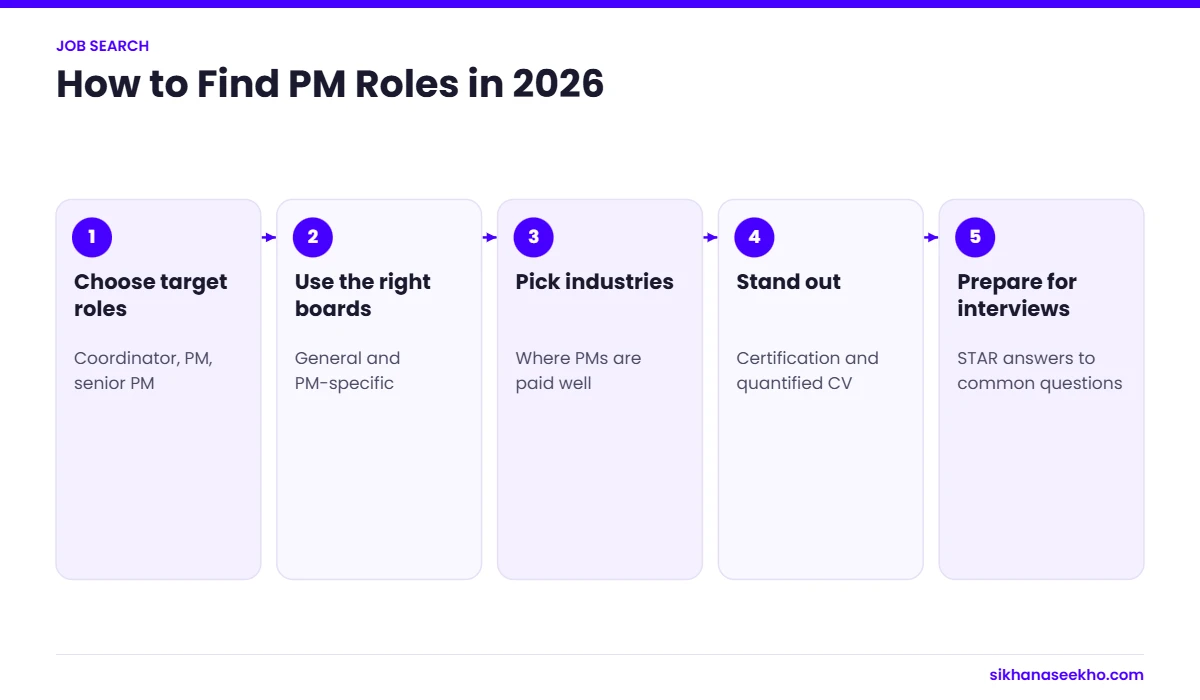
Five steps to find project management jobs in 2026
A focused search beats applying everywhere.

In the UK, much of the demand comes from AI and data projects, NHS and public sector digital work, energy and infrastructure (such as offshore wind and grid upgrades), and banking regulation programmes. In the Gulf, construction, real estate, energy and large government projects drive most PM hiring. In India and other tech hubs, IT services and global capability centres hire many PMs.

✦
Permanent or contract? In the UK, a good share of senior PM roles are filled on contract. Contract PMs are paid a day rate, which is usually higher than the daily equivalent of a permanent salary. The trade-off: no employment benefits and less structured career development. Contracting makes most sense once you have several years of PM experience and a strong network.

Types of PM Jobs and How to Get Your First One

Job titles differ by country, but most PM roles fall into a few types:

  • Project coordinator or PMO analyst: supports the PM with schedules, reports, minutes and document control. The usual entry point.
  • Project manager: owns delivery of one project or a few small ones.
  • Specialist PMs: construction PM, IT PM, technical PM, scrum master or delivery manager. Sector knowledge matters as much as PM skill.
  • Programme manager or PMO lead: runs several related projects or the reporting and governance behind them.

Getting your first role. When I coach students for their first PM job, I give them four steps. First, list the project work you already do: planning, coordinating suppliers, tracking costs, reporting to a manager. Second, get a certification that fits your level: CAPM or PRINCE2 Foundation if you are new, PMP if you already have the experience. Third, aim for coordinator roles or PM roles in the industry you already know, because a construction engineer is far easier to hire as a construction PM than as an IT PM. Fourth, ask your current employer for a small project to lead. One real project on your CV is worth more than any course. For the longer route, see my guide on moving into project management.

02: Job Boards
✦
From my experience: I help my students prepare PM applications, and the ones who get interviews lead with numbers: budget, team size and results. In the UAE I worked with engineers who were already doing PM work, like coordinating subcontractors, chasing consultant approvals and planning handovers, but their CVs only said "site engineer". Once they described that work in PM terms, recruiters started to see them as project managers. Tailoring every CV to the advert matters more than applying to more jobs.

Best Job Boards for PM Roles, By Role Type

No single job board has every PM role. Different boards are strong for different levels, sectors and contract types. Pick the boards that match your target role and you will save a lot of time.

UK Permanent Roles

Best for Senior PM / Programme
LinkedIn Jobs
The main channel for mid-level and senior PM roles in most countries. It is also where recruiters search for candidates, so keep your profile up to date and searchable. That matters as much as applying.
Tip: Set up job alerts with keywords "project manager", "programme manager" and your sector. Enable "Open to Work" privately so recruiters can find you without advertising it publicly.
Best for Volume, All Levels
Reed.co.uk
The UK's largest job board by volume. Strong for coordinator through to PM level across all sectors. Good for regional roles outside London. Reed's email alerts are highly configurable and reliable.
Tip: Reed's "PM jobs near me" feature works well for regional candidates. Use salary range filters to cut through coordinator-level results when searching for PM-level roles.
Best for IT / Tech PM
CWJobs
Specialist technology jobs board with a strong PM category. Particularly good for IT project manager, technical PM and digital transformation roles. Heavy on contract listings alongside permanent.
Tip: CWJobs' contract rate display is one of the more transparent on any UK board. Useful for benchmarking day rates before negotiating.
Best for Broad Search
Indeed UK
Aggregates roles from multiple sources including company websites and other boards. Good for casting a wide net at the start of a search. Less curated than specialist boards but highest raw volume.
Tip: Use "project manager" with quotation marks to exclude coordinator-level roles from broad search results. Filter by date posted (last 7 days) to avoid stale listings.

Public Sector and Government

Civil Service
Civil Service Jobs
The official portal for all UK central government roles. A very large proportion of government PM and programme manager roles, including Cabinet Office, HMRC, DWP, MOD, are advertised exclusively or first here. Not indexed by other boards.
Tip: Civil service applications use the Success Profiles framework (Behaviours, Strengths, Technical, Experience). Tailor your examples to the listed behaviours. Generic CVs are filtered out. PRINCE2 or GDS experience is frequently listed.
NHS and Health
NHS Jobs
The exclusive portal for all NHS England, NHS Trust and related health sector PM roles. NHS PM roles are not typically listed on commercial boards. Roles range from Band 6 project manager to Band 8c programme director.
Tip: Understand NHS pay bands before applying. Band 7 (£43,000 to 50,000) is mid-level PM. Band 8a to 8b (£50,000 to 62,000) is senior PM. Band 8c to 8d (£63,000 to 75,000) is Programme Manager. Bands are non-negotiable but TUPE transfers can preserve higher salaries.
Scotland
Myjobscotland
The primary portal for Scottish public sector roles: Scottish Government, local councils, NHS Scotland, police and fire services. Most Scottish public sector PM roles are listed here rather than on UK-wide boards.
Tip: Scottish Government digital and transformation PM roles are listed here and consistently well paid relative to the cost of living in Scottish cities.
Infrastructure
TfL / Network Rail / HS2 Careers
Major infrastructure employers post primarily on their own careers pages rather than job boards. TfL, Network Rail, HS2 (now integrated into other programmes), National Highways and Crossrail legacy all have active PM pipelines.
Tip: Bookmark these directly and check monthly. APM membership gives early notification of infrastructure PM roles through regional chapter networks.

Contract Roles

Contract Specialist
Contractor UK
The leading UK platform for IT and PM contract roles. Strong day rate transparency, good contractor community forums and reliable contract PM listing volume across London and major cities.
Tip: The Contractor UK forums are valuable for rate benchmarking and sector-specific contract market intelligence, particularly useful when entering contracting from permanent employment.
Public Sector Contracts
PublicTechnology.net
Specialist board for public sector technology and digital transformation contracts. Strong NHS digital, NHSX, DLUHC and Cabinet Office Digital contract listings. Often first to post newly approved programme contract opportunities.
Tip: Public sector contracts under IR35 rules are typically "inside IR35." Factor this into day rate negotiations. Rates are typically lower than private sector equivalents but volume and stability are higher.

Specialist PM Recruitment Agencies

Agencies fill a meaningful proportion of PM roles, particularly senior and contract positions, before they reach job boards. Registering with two or three agencies in your target sector is worth doing in parallel with active board searching. The most active UK PM agencies are Hays Project Management (broad sector coverage, strong in finance and technology), Harvey Nash (technology and digital PM, strong in public sector), Penna (public sector and not-for-profit programme roles), Sellick Partnership (public sector and housing), and Lorien (IT and digital programme management, strong contractor network).

✦
Many PM roles are never advertised. Senior PM roles in particular are often filled through referrals, former colleagues and direct approaches. A warm introduction from someone who knows your work is worth more than a cold application. So build your network all through your career, not only when you need a job.
03: Highest-Paying Industries

Which Industries Pay Project Managers the Most?

PM pay depends a lot on the sector. The skills are similar, but the size of the projects and the cost of failure are very different. A PM running a large banking system change carries more risk than one running a small local upgrade, and the pay reflects that.

IndustryDemandUK Mid-Senior PM SalaryContract Day Rate
Investment Banking / Capital MarketsVery High£80,000 to £130,000£650 to £950/day
Management ConsultancyVery High£75,000 to £120,000£600 to £900/day
Defence & AerospaceHigh£70,000 to £110,000£550 to £850/day
Technology / SoftwareVery High£65,000 to £100,000£500 to £800/day
Pharmaceuticals / Life SciencesHigh£65,000 to £100,000£500 to £750/day
Insurance & Financial ServicesHigh£60,000 to £95,000£450 to £750/day
Energy & UtilitiesHigh£60,000 to £90,000£450 to £700/day
Construction & InfrastructureHigh£55,000 to £90,000£400 to £700/day
Retail & ConsumerMedium£50,000 to £75,000£350 to £550/day
Public Sector / GovernmentVery High£45,000 to £75,000£350 to £600/day
NHS / HealthcareVery High£43,000 to £72,000£300 to £550/day
Not-for-Profit / CharityMedium£35,000 to £58,000£250 to £400/day
✦
Public sector pays less but gives more security. NHS and government PM roles pay less than banking, but they offer good pensions, job security, leave and flexible working. If you value stability or work-life balance, this is a sensible choice. Many PMs move between private and public sector at different stages of life.
04: Global Job Hotspots

Cities and Countries with the Most PM Openings

PM jobs cluster where big industries, governments and head offices are. Here are the cities and countries with the most PM openings in 2026.

City / RegionPrimary Demand SectorsTypical Senior PM Salary
London, UKFinancial services, tech, consulting, government, infrastructure£65,000 to £110,000
Manchester, UKDigital, NHS, public sector, media, financial services£50,000 to £75,000
Birmingham, UKPublic sector, HSBC/Lloyds operations, manufacturing, HS2 legacy£48,000 to £72,000
Edinburgh, UKScottish Government, financial services, tech£48,000 to £72,000
New York, USAInvestment banking, consulting, tech, media$120,000 to $175,000
San Francisco / Bay AreaTechnology, AI, biotech$130,000 to $185,000
Dubai, UAEConstruction, energy, real estate, government mega-projectsAED 25,000 to 40,000/mo
Riyadh, Saudi ArabiaVision 2030 mega-projects, infrastructure, energySAR 20,000 to 35,000/mo
Sydney, AustraliaBanking, government, infrastructure, miningAUD 115,000 to 155,000
SingaporeFinancial services, tech, logistics, government digitalSGD 90,000 to 140,000
Bangalore / Hyderabad, IndiaIT services, tech, global captive centres₹20 to 45 LPA (varies widely)
Toronto, CanadaFinancial services, tech, government, healthcareCAD 100,000 to 145,000
05: Stand Out

How to Stand Out as a PM Candidate in 2026

The PM job market is competitive at every level. For coordinator roles you compete with many applicants. For senior roles the pool is smaller but very experienced. A neat CV is not enough. You need a clear plan for how you present yourself. This is the advice I give every student moving from study into a real job search.

1
Quantify every delivery claim, without exception
Every PM role on your CV should show at least one result with a number: budget managed, team size, schedule result or business outcome. Hiring managers read many CVs that say "managed complex projects". The one that says "delivered a 340-user system rollout six weeks early and under budget" gets the call. Be specific, and only use numbers you can explain in an interview.
2
Match your keyword density to the job description
Many large employers use an Applicant Tracking System (ATS) that checks your CV against the job advert before a person reads it. Read the advert carefully. Use the same terms where they are true for you: methods (PRINCE2, Agile, PMBOK), tools (MS Project, Primavera P6, Jira) and sector words. A CV that scores badly in the ATS may never reach the hiring manager.
3
Get a referral wherever possible
A referral often gets you an interview faster than a cold application. Before you apply, check LinkedIn for people who work or worked there. Send a short message: "I am applying for the PM role at [Company]. I see you worked there. Any advice on what they look for?" It costs nothing and often helps more than anything else you do.
4
Write a sector-specific cover letter, or none at all
A generic cover letter is worse than none. It shows low effort. If you write one, make it specific: mention the company's projects, the certification you hold, and why your sector experience fits this role. If you cannot write a specific letter, send your CV without one.
5
Keep LinkedIn current, complete and active
A lot of PM hiring starts with a recruiter finding you on LinkedIn. Make your headline specific, for example "Project Manager | Construction | PMP". Write a 3 to 4 sentence summary of what you have delivered, and add results with numbers to each role. Comment on PM posts now and then. It makes you more visible without announcing that you are job hunting.
6
Register with specialist recruiters proactively
Specialist PM recruiters keep shortlists and often fill roles before they are advertised. Send a short email with your CV and one paragraph about your target role, sector and availability. Then follow up with a call. A recruiter who places you once will call you again. Build that relationship even when you are not looking.
06: CV Strategy

PM CV Dos and Don'ts

A PM CV should show what you delivered, to what standard and with what resources. The most common mistakes: listing duties instead of results, no numbers, and a generic summary that could fit anyone.

Do
Lead with a "Key Deliveries" section. Your 3 to 4 strongest project outcomes before your employment history.
Quantify every claim: budget (£), team size (#), timeline (delivered X weeks ahead), outcomes (% improvement)
Name the methodology used for each project (PRINCE2, Agile, Waterfall, hybrid)
List certifications prominently, above employment history, not buried at the bottom
Tailor the professional summary to match the target role's sector and level
Keep it to 2 pages maximum. Ruthlessly cut anything that does not add to your case.
Use PM vocabulary throughout: stakeholder, risk register, change control, sponsor, milestone, governance
Don't
Describe job responsibilities, "responsible for managing project schedules," without outcomes
Use a generic objective statement ("seeking a challenging role in a dynamic organisation")
List certifications as "In Progress" unless you are sitting the exam within 4 weeks
Include a photo, date of birth, marital status, nationality (UK standard is no personal details)
Use a functional-only format that buries employment history. Chronological or hybrid only.
List every project. Pick the 6 to 8 most relevant and impressive ones for the target role.
Send an identical CV to every role. At minimum tailor the summary and skills section.
07: Interview Prep

Most Common PM Interview Questions, With Answer Guidance

Most PM interviews are competency-based and expect the STAR format (Situation, Task, Action, Result). Prepare one real, specific example with numbers for each theme below. Vague or made-up answers are the most common reason PM candidates fail at interview.

Q1Tell me about a project you delivered end-to-end. What was your role, what were the challenges and what was the outcome?
This is the core PM question. Prepare a single, well-rehearsed example: the project type, budget, team size, your specific role, the main challenge encountered, the action you took and the measurable outcome. Have the numbers ready: budget, team size, timeline, delivery result.
Q2Describe a time you identified a significant risk before it became an issue. How did you manage it?
Demonstrates proactive risk management. Show that you had a functioning risk register, identified the risk early through a specific technique (assumption analysis, expert interview, lessons learned), took a deliberate mitigation action and monitored it. Include the impact that was avoided.
Q3How have you managed a difficult or resistant stakeholder? What approach did you take?
Tests stakeholder management maturity. Show you diagnosed the root cause of resistance (rather than labelling them "difficult"), held a direct conversation, involved them in relevant decisions, and either moved them to a more supportive position or found a workable accommodation. Avoid describing the stakeholder in negative terms. This looks unprofessional.
Q4Tell me about a time your project was significantly behind schedule or over budget. What did you do?
Tests recovery, transparency and decision-making under pressure. Show that you identified the problem early (not when it was too late), communicated it to the sponsor proactively, assessed the options and recommended a course of action with a clear rationale. Do not pretend a project you managed was always smooth. That is not credible.
Q5How do you manage scope creep on a project with an active stakeholder group?
Tests change control discipline. Describe your specific process: formal change request, impact assessment (scope, schedule, budget, quality), sponsor decision, update to project baseline. The key phrase hiring managers want to hear is "change control." Informal accommodation of scope additions should not appear in your answer.
Q6How do you prioritise when you have multiple projects or competing deadlines?
Tests workload management and strategic thinking. Show you use a structured approach: dependency analysis, business impact ranking, resource constraint visibility. Describe a real example where competing priorities required a decision and how you made it, including who you involved (sponsor, PMO) and how you communicated the trade-offs.
08: FAQ

PM Jobs 2026 FAQ

For UK permanent roles: LinkedIn (mid and senior), Reed.co.uk (volume) and CWJobs (tech PM). For UK public sector: Civil Service Jobs and NHS Jobs, which are not copied to commercial boards. For contracts: Contractor UK and specialist agencies. In most other countries, LinkedIn is the main channel for senior roles, alongside local job boards and company career pages. Register with two or three specialist recruiters, and use your network, because many senior roles are filled before they are advertised.
In the UK, investment banking and capital markets pay the most (£80,000 to 130,000 perm, £650 to 950/day contract), followed by management consultancy (£75,000 to 120,000), defence and aerospace (£70,000 to 110,000) and technology (£65,000 to 100,000). Public sector and NHS pay the least but offer the best security and benefits. Contracting in financial services or defence at senior level often yields 50 to 100% more than equivalent permanent roles. See the full PM Salary Guide 2026 for a complete sector and location breakdown.
Yes. PM is one of the most steadily in-demand professional roles. PMI's talent gap research projects a need for about 25 million new project professionals worldwide by 2030. Demand is strong in AI and data projects, public sector digital work, energy and infrastructure, construction in the Gulf, and banking regulation. Because organisations run change projects in hard times too, PM demand tends to hold up when other hiring slows.
A strong PM CV includes a professional summary positioning you clearly as a PM in your target sector, a "Key Deliveries" section with 3 to 4 quantified project outcomes (budget, team size, timeline, result), certifications listed prominently (PRINCE2, PMP), technical skills (tools and methodologies), and employment history rewritten using PM vocabulary with quantified achievements per role. Keep it to 2 pages. The most common mistake is describing activities rather than outcomes. "Led 12-person cross-functional team to deliver £3.2M ERP on schedule and 3% under budget" beats "managed project team and reported to steering committee" on every dimension that matters to a hiring manager.