
A healthcare project management certification is a credential that shows you can manage projects in clinical, hospital or health-technology settings, where patient safety and regulation add extra constraints. Most healthcare project managers combine a general credential such as the PMP with sector-specific training.
Specialized certifications and training for healthcare project managers. Explore top healthcare project management certification options to advance your career.
Healthcare is a rapidly evolving industry where successful project delivery can directly impact patient outcomes, operational efficiency, and regulatory compliance. As a result, healthcare project management certification has become increasingly valuable for professionals seeking to lead complex initiatives in hospitals, clinics, research organizations, and beyond. This guide explores the most respected certifications, their benefits, and how to choose the right healthcare project management certification for your career.
Why Pursue a Healthcare Project Management Certification?
Obtaining specialized credentials in healthcare project management showcases your ability to lead initiatives in the complex and regulated medical environment. These qualifications confirm your understanding of essential methodologies, effective stakeholder collaboration, risk mitigation, and compliance with industry standards. Additionally, earning such certifications can pave the way to leadership positions, increased earning potential, and enhanced professional status within your workplace.
Top Healthcare Project Management Certification Options
1. Certified Healthcare Project Management Professional (CHPMP)
The CHPMP is a specialized credential designed for professionals who want to enhance project success, minimize risks, and control costs within healthcare environments. Offered by organizations such as the PIQC Institute of Quality and Dow University of Health Sciences, this program aligns with the latest project management standards and addresses all phases of managing healthcare projects-from initiation through to completion. It is ideal for healthcare practitioners seeking practical, industry-focused skills as well as preparation for advanced project management exams.
Key Features:
- Focuses on healthcare-specific project management terminology and approaches
- Includes modules on high-performance teams, stakeholder engagement, and business alignment
- Taught by experienced healthcare project managers
- Suitable for those with a bachelor’s degree and some work experience
2. Project Management Professional (PMP) for Healthcare
The certification provided by the Project Management Institute (PMI) is internationally recognized and highly regarded across various industries, including the healthcare sector. Although it is not specific to healthcare, many training programs customize preparation to address the unique challenges found in healthcare projects. Professionals holding this credential are skilled in standardizing processes, managing risks, and delivering high-quality results in complex healthcare settings.
Key Features:
- Emphasizes standardized project management methodologies.
- Enhances communication, collaboration, and risk management skills.
- Opens doors to leadership positions and higher credibility in healthcare project management.
3. Certified Clinical Research Professional (CCRP)
For professionals involved in clinical research, the CCRP credential from the Society of Clinical Research Associates (SOCRA) is a leading certification. It validates expertise in managing clinical trials and research projects, emphasizing regulatory compliance, ethical standards, and effective study coordination.
Key Features:
- Recognized by research institutions and pharmaceutical companies.
- Focuses on clinical trial management and compliance.
- Suitable for professionals in research, nursing, or regulatory affairs.
4. Certified Healthcare Project Manager (CHPM) by SSGI
The CHPM credential, provided by the Six Sigma Global Institute (SSGI), offers an accessible and practical program tailored for healthcare professionals. This fully online, self-paced course grants lifetime access and allows unlimited exam attempts at no extra cost. It covers essential topics such as project initiation, scheduling, risk management, and incorporates both traditional and Agile project management methodologies.
Key Features:
- Online, self-paced, and suitable for busy professionals.
- Lifetime certification with no renewal required.
- Covers both traditional and Agile project management frameworks.
5. Certified Clinical Research Associate (CCRA) and Related Certifications
The CCRA credential, awarded by the Association of Clinical Research Professionals (ACRP), is a respected certification for those managing clinical research projects. Other recognized credentials include the Certified Clinical Research Coordinator (CCRC) and Clinical Trial Investigator (CTI), which highlight specialized expertise in the clinical research field.
Healthcare project management certifications at a glance
| Certification | Focus | Best for |
|---|---|---|
| PMP (PMI) | General project management, recognised in every sector | Experienced project managers moving into or within healthcare |
| CAPM (PMI) | Entry-level project management knowledge | New coordinators in hospitals or health tech |
| Clinical research credentials (for example CCRP, CCRA) | Running clinical trials and research studies | Project managers in research and pharma |
| Specialist healthcare PM certificates | Health-sector processes and terminology | Adding sector knowledge to a general credential |
| Lean Six Sigma | Process improvement | Quality and operational improvement projects |
Requirements and recognition vary by country, so check what local employers ask for.
What makes healthcare projects different?
Healthcare projects carry constraints most sectors do not: patient safety, clinical governance, data protection and regulators who can stop work. A typical electronic patient record roll-out, for example, has to keep wards running 24 hours a day while the system changes.
That is why healthcare employers value project managers who understand clinical stakeholders. Doctors, nurses and administrators measure success differently, and the project manager has to translate between them.
A practical route is to earn a widely recognised certification such as the PMP or PRINCE2 first, then add healthcare-specific training or a short course in clinical safety and information governance.
How long does it take to get certified?
Timelines vary with the credential. CAPM preparation typically takes 4 to 8 weeks once you have the 23 hours of education PMI requires. PMP preparation usually takes 8 to 16 weeks after the 35 contact hours, and you need 36 months of project leadership with a 4-year degree.
Clinical research credentials generally require documented experience in research roles, so check each body’s eligibility rules before you start studying.
A realistic plan for a hospital coordinator is CAPM in year 1, project leadership experience in years 2 to 4, then PMP. Along the way, add short courses in information governance and clinical safety, which healthcare employers in 2026 increasingly list in job adverts.
Which healthcare projects need project managers?
Common examples include electronic patient record and IT system roll-outs, new hospital buildings and refurbishments, clinical trials, service redesign programmes and medical device launches. Each needs the same core skills of scope, schedule, cost and risk control, plus close work with clinicians who have little time to spare. Projects that touch patient data also need early involvement from information governance teams.
What do healthcare employers look for besides a certificate?
Beyond the credential, healthcare employers look for evidence that you can work with clinical teams, understand patient safety and data protection, and keep services running while changes happen. Examples of projects delivered in a live hospital or clinic setting are often worth more in an interview than an extra certificate. Volunteering for an improvement project in your current organisation is a practical way to build that evidence.
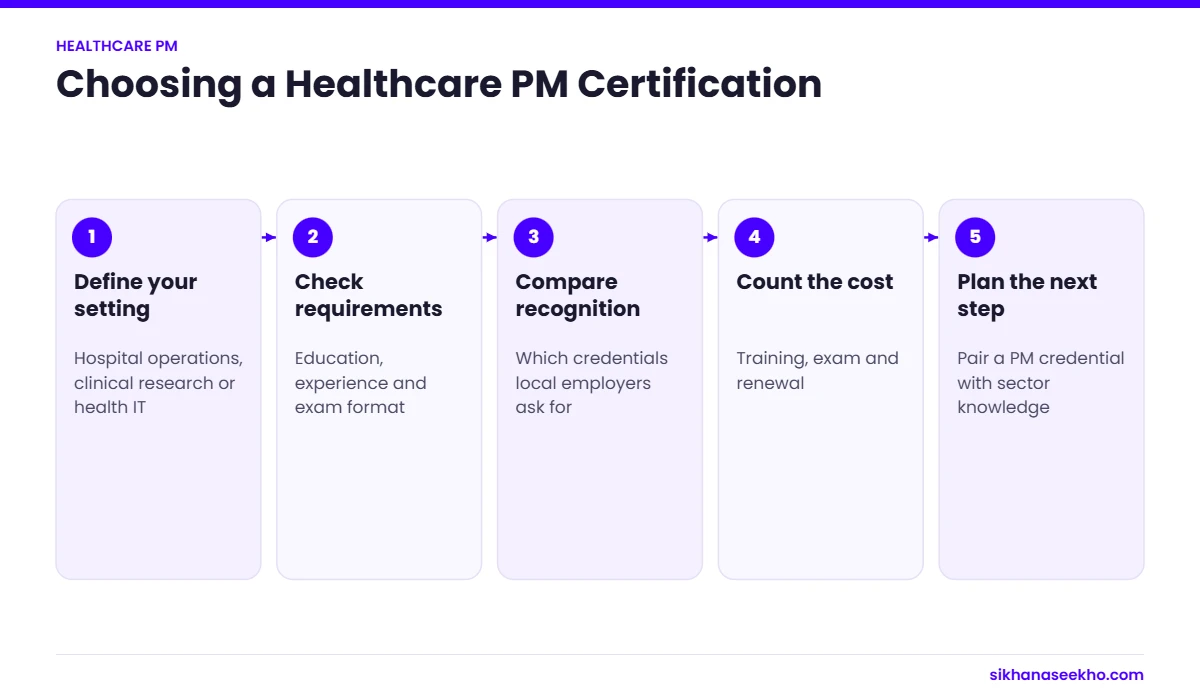
Choosing the Right Healthcare Project Management Certification
When selecting a healthcare project management certification, consider your current role, career aspirations, and the specific healthcare environment in which you work. For example:
- Hospital administrators may benefit most from PMP or CHPMP.
- Clinical research professionals should consider CCRP, CCRA, or CCRC.
- Those seeking flexible, online options might prefer CHPM by SSGI.
Evaluate prerequisites, program duration, costs, and whether the curriculum aligns with your daily responsibilities and long-term goals.
The Value of Healthcare Project Management Certification
A healthcare project management certification not only validates your skills but also:
- Enhances your ability to manage multidisciplinary teams and complex projects.
- Increases your competitiveness for promotions and new roles.
- Provides a framework for continuous improvement and professional growth.
- Connects you with a network of certified peers and mentors.
FAQs:
Which healthcare project management certification is best for hospital administrators?
The PMP and CHPMP are both excellent choices, offering broad project management skills tailored to healthcare environments.
How long does it take to earn a healthcare project management certification?
Program durations vary: CHPMP typically takes three months, CHPM can be completed in a few weeks, and PMP preparation may require several months depending on your background.
Are there healthcare project management certifications specific to clinical research?
Yes, the CCRP, CCRA, and CCRC are highly regarded for clinical research project managers and coordinators.
Do I need a healthcare background to pursue these certifications?
Most programs prefer or require healthcare experience, especially for specialized certifications like CHPMP and CCRP.
Do these certifications require renewal?
Some certifications, like CHPM by SSGI, are lifetime credentials, while others (PMP, CCRP) require periodic renewal or continuing education credits.
Pursuing a healthcare project management certification is a strategic move for medical PMs looking to stand out, lead with confidence, and drive meaningful change in the healthcare sector. Choose the credential that best matches your role and ambitions, and take the next step in your project management journey.
Keep learning
- How to Become a Disciplined Agile Scrum Master
- Top 5 Free Project Management Courses Worth Taking
- How to Pass Google Project Management Certificate in 3 Months
- Best Project Management Certifications 2026: Ranked
- PMP vs CSM 2026: Which Should You Get First?
- PMP vs PRINCE2 2026 Which Certification Is Better?