Certifications PMP CertificationWorld’s top PM cert CSM — Certified ScrumMasterTop agile cert CAPMEntry-level PM cert PRINCE2UK & Europe standard View All Certifications ?
PM Guides Agile GuideComplete breakdown Scrum GuideRoles, ceremonies, artifacts EVM GuideAll formulas explained View All Guides ?
Career & Salary PM Salary 2026By country & level How to Become a PMStep-by-step roadmap 50 Interview QuestionsWith strong answers
PM Software Monday.com ReviewTop pick 2026 ClickUp ReviewBest value Best Free PM ToolsNo trials, truly free View All Software ?
Free Tools & Templates EVM CalculatorFree, no signup Gantt Chart MakerBuild & export free PMP Eligibility Checker30-second result Free PM Templates30 templates — Excel, Word, PDF
Get the Free PMP Guide ?
Certification Comparison · Updated 2026

PMP vs CSM 2026 — Which Should You Get First?

PMP vs CSM: which pays more, which is harder, and which actually makes sense for where you are right now. Full comparison with salary data, difficulty breakdown and a decision framework to find your answer in 60 seconds.

📅 Updated: January 2026 🏆 Certifications: PMP vs CSM head-to-head Decision tool: included below
⚡ Quick Answer

Get PMP if you have 3+ years of PM experience, work across any industry, and want the highest global salary premium (+33%). Get CSM if you are entering agile/Scrum teams, work in tech or software, or need a fast credential with no experience requirement. Get both — in that order — if you want to be a well-rounded senior project manager in 2026.

★ Higher overall ROI
PMP
Project Management Professional · PMI
Salary boost+33% average globally
Exam fee$555 (non-member)$405 with PMI membership
DifficultyHard — 2–4 months study
Experience needed3–5 years PM experience
Validity3 years (60 PDUs to renew)
RecognitionGlobal — all industries
Best forAny experienced PM
VS
CSM
Certified ScrumMaster · Scrum Alliance
Salary boost+15–22% (tech sector)
Training + exam fee$800–$1,200 (bundled)Training mandatory, can't separate
DifficultyEasy — 2-day training + exam
Experience neededNone — open to all
Validity2 years (SEUs to renew)
RecognitionStrong in tech / software
Best forAgile / dev team roles

Which certification is right for you?

Answer three questions — get a personalised recommendation instantly.
1. How many years of project management experience do you have?

0–2 years

I am relatively new to project management or changing careers

3–5 years

I have solid PM experience and have led real projects

6–10 years

I am a senior PM or programme manager

10+ years

I have extensive experience at a senior or director level

→ Get your PMP first
Based on your answers, the PMP is the higher-impact choice for you right now. It delivers the broadest recognition, the strongest salary premium and opens the most doors globally. Once you have PMP, you can add CSM relatively quickly to cover agile environments too.
→ Start with CSM
Based on your answers, CSM is the more practical starting point. No experience requirement, fast to obtain, and highly valued in agile and tech environments. Once you have built more PM experience, PMP should be your next step — the two complement each other well.
→ Get both — PMP first, then CSM
You are at a stage where both certifications add real value. Start with PMP — it is the harder exam and delivers the bigger salary jump. Then add CSM to complete your agile credentials. Many senior PMs hold both and the combination is extremely powerful in hybrid environments.
Salary Comparison

PMP vs CSM Salary Data — 2026

Salary data from PMI's 2025 Earning Power Report, Glassdoor and LinkedIn Salary Insights. PMP delivers a higher premium in most markets — but CSM commands strong rates specifically in tech and software roles.

PMP Certified — Average Salaries 2026
United States$123,000 / yr
United Kingdom£65,000 / yr
UAE / DubaiAED 270,000 / yr
CanadaCAD 110,000 / yr
AustraliaAUD 138,000 / yr
India₹1,900,000 / yr
Average global premium+33%
CSM Certified — Average Salaries 2026
United States$105,000 / yr
United Kingdom£55,000 / yr
UAE / DubaiAED 210,000 / yr
CanadaCAD 92,000 / yr
AustraliaAUD 115,000 / yr
India₹1,500,000 / yr
Average premium (tech roles)+15–22%

Sources: PMI Earning Power Report 2025, Glassdoor, LinkedIn Salary Insights, Payscale. Figures represent median salaries for mid-senior level professionals holding the respective certification.

Full Comparison

PMP vs CSM — Every Factor Compared

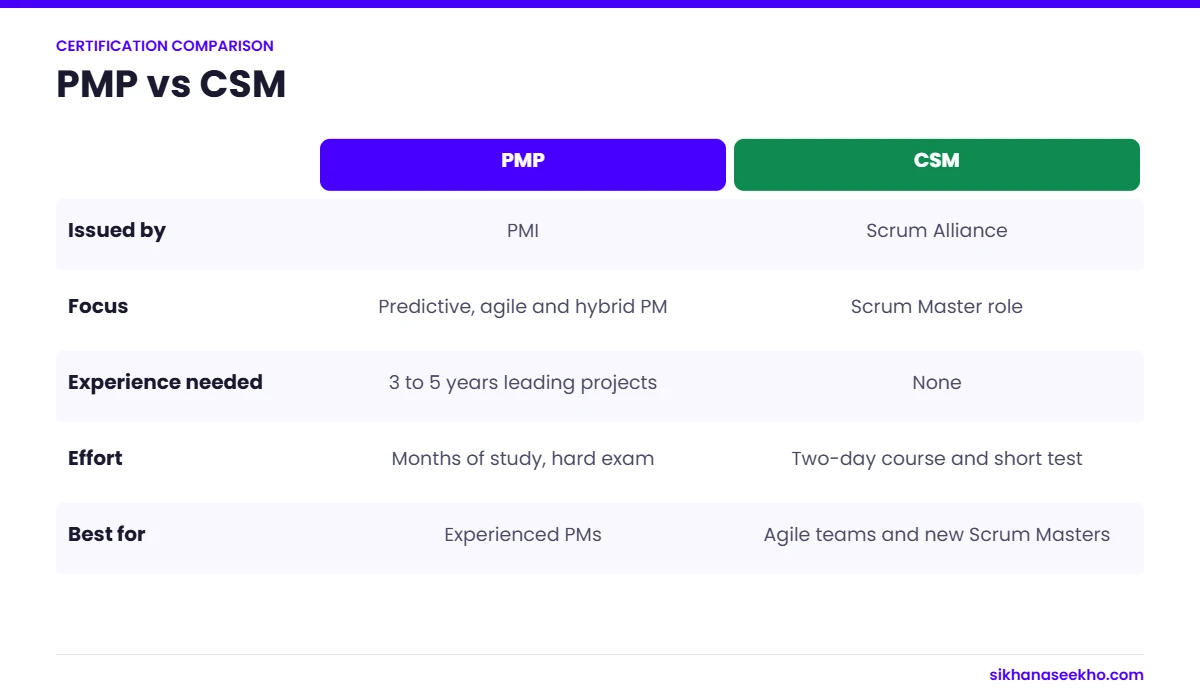
FactorPMPCSM
Issuing bodyPMI (Project Management Institute)Scrum Alliance
Experience required3–5 years PM experienceNone — open to all
Training required35 contact hours PM educationMandatory 2-day instructor-led training
Exam fee$555 non-member / $405 member$800–$1,200 (bundled with training)
Exam format180 questions / 230 minutes50 questions / 60 minutes
DifficultyHard — 2–4 months preparationEasy — 2-day training + exam
Pass rate~60–70% (well-prepared candidates)~90%+ (open book style)
Validity3 years (60 PDUs to renew)2 years (SEUs to renew)
Renewal cost$60 (member) / $150 (non-member)$100 renewal fee
Global recognitionAll industries, 214 countriesStrong in tech / software globally
Salary premium+33% average globally+15–22% (tech roles)
Methodology coveredPredictive + Agile + HybridScrum framework only
Holders worldwide1.2 million+500,000+
Best industry fitAny industry globallyTechnology, software, product
Time to obtain3–6 months (including study)1–2 weeks from registration
By Situation

PMP vs CSM — What's Right for Your Situation

You have 3+ years PM experience

You meet the PMP eligibility requirements. The salary premium (+33%) will pay back the exam fee within months.

→ Get PMP — no question

You are new to PM (0–2 years)

You don't yet qualify for PMP. CSM requires no experience and gets you into agile teams fast. Work towards PMP in parallel.

→ Start with CSM

You work in software / tech

Tech employers heavily value Scrum credentials. CSM is widely recognised and often listed as a requirement in job specs.

→ CSM first, then PMP

You work in construction / engineering

Traditional project environments rarely require Scrum credentials. PMP is the universal standard in your sector.

→ PMP only — skip CSM

You want global career mobility

PMP is the only PM certification recognised in the USA, UAE, UK, India, Canada and Australia equally.

→ PMP is the only choice

You are a senior PM or director

You likely have PMP. Adding CSM strengthens agile credentials and makes you more versatile across hybrid environments.

→ Add CSM to your PMP
FAQ

PMP vs CSM — Common Questions

Is PMP harder than CSM?
Yes — significantly. The PMP requires 2–4 months of structured preparation, covers predictive, agile and hybrid approaches across 180 scenario-based questions, and has an estimated 60–70% pass rate for well-prepared candidates. The CSM involves a 2-day training course followed by a relatively straightforward 50-question exam with a pass rate of 90%+. The difficulty gap is one of the biggest differences between the two certifications.
Which pays more — PMP or CSM?
PMP pays more in most markets and industries. PMI's 2025 data shows PMP-certified professionals earn an average of 33% more than non-certified peers globally. CSM delivers a 15–22% premium, primarily in technology and software roles. In the USA, PMP-certified PMs earn around $123,000 vs $105,000 for CSM holders. The gap is even wider in the UAE and Middle East where PMP is the dominant credential.
Can I get CSM without any project management experience?
Yes — the CSM has no experience requirements. All you need to do is attend a 2-day Certified ScrumMaster training course (available in-person or online) and pass the online exam. This makes it one of the most accessible PM credentials available, and a natural starting point for people new to the profession or transitioning from other roles.
Should I get PMP or CSM first?
It depends on your experience and industry. If you have 3+ years of PM experience, get PMP first — it delivers a bigger salary premium and broader recognition. If you have less experience or work in agile/tech environments, start with CSM. The ideal long-term combination is PMP + CSM, with PMP as the foundation. Use the decision tool above for a personalised recommendation based on your specific situation.
Is CSM worth it if I already have PMP?
Yes — especially if you work in or want to move into agile environments. PMP covers agile at a high level, but CSM gives you deep Scrum-specific credibility. Many employers in tech and product management explicitly list CSM alongside PMP. The 2-day investment is low relative to the credential value it adds.
Does PMP cover agile? Do I still need CSM?
The PMP exam now has approximately 50% agile and hybrid content, so PMP holders have solid agile knowledge. However, PMP covers multiple agile frameworks at a broad level — not Scrum in depth. CSM goes deep on Scrum specifically: ceremonies, artifacts, roles, sprint planning and backlog management. For roles where Scrum is the primary delivery framework, CSM adds specific credibility that PMP alone doesn't fully deliver.

Ready to start your certification journey?

Check your PMP eligibility in 30 seconds or read our full certification guides — free, no sign-up required.