
The Google Project Management Certificate is an online, self-paced professional certificate on Coursera for beginners. Finishing it in 3 months is realistic if you study about 8 to 10 hours a week and follow a fixed weekly plan, with the capstone project left for the final two weeks.
Complete google PM certificate study plan with tips, tools, and a roadmap to pass the Coursera project management course quickly and efficiently in 3 months.
How to Complete the Google Project Management Certificate in 3 Months
If you’re committed to a career in project management, the Google Project Management Certificate on Coursera is a practical and cost-effective way to start. However, many prospective learners ask: How can I finish it in a hurry? This guide will detail a tried-and-true study plan to help you complete the course in just three months.
Why Complete the Coursera Project Management Certificate in 3 Months?
Speed is key. Whether you’re a student keen to begin your job search or someone switching careers, finishing quickly keeps your enthusiasm high. Additionally, completing the Coursera project management course efficiently reduces the costs associated with your subscription.
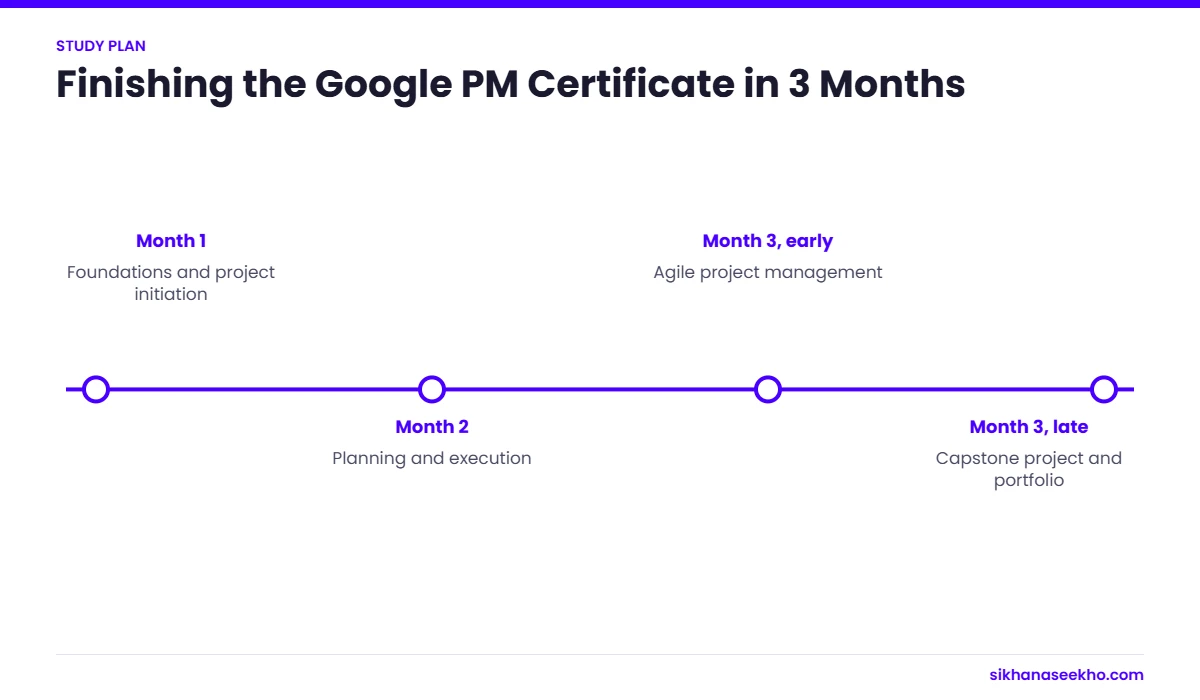
Week-by-Week Google PM Certificate Study Plan
Weeks 1–2: Project Management Foundations
Start on the right foot with fundamental concepts. During these weeks:
- Learn essential terminology and the stages of the project lifecycle.
- Engage in reflective exercises to solidify your knowledge.
- Dedicate 1–2 hours daily to watching videos and taking quizzes.
Transition Tip: Keep notes as you progress for easier review later.
Weeks 3–4: Project Initiation and Planning
Now you’ll dive into more substantive content. Concentrate on:
- Project charters, stakeholder engagement, and establishing SMART goals.
- Defining project scope and boundaries.
This section is vital to your study plan as it fosters practical abilities.
Weeks 5–6: Project Execution and Team Dynamics
At this juncture, you’ll cover aspects like communication, leadership, and resource management.
- Utilize the Coursera project management templates for planning simulations.
- Complete peer-reviewed tasks thoroughly.
Pro Tip: Implement your learning through a mock project to enhance comprehension.
Weeks 7–8: Risk Management and Quality Control
This phase may challenge some learners: but not you!
- Study risk mitigation techniques.
- Understand how to gauge project success and client satisfaction
This section consolidates earlier lessons and is crucial for mastering your study plan.
Weeks 9–10: Agile Project Management
Agile and Scrum methodologies are prevalent in many work environments.
- Differentiate between Agile, Scrum, and conventional practices.
- Engage in sprint planning activities and retrospectives.
Proficiency in agile methodology often stands out on resumes, so be sure to give it proper attention.
Weeks 11–12: Capstone Project and Final Review
Now it’s time to tie it all together.
- Review your notes and quizzes.
- Execute the final capstone project, replicating authentic project scenarios.
Upon completion, you’ll officially have the Coursera project management certificate to add to your LinkedIn and CV.
The 12-week plan at a glance
| Weeks | Topic | Suggested hours per week | Output by the end |
|---|---|---|---|
| 1 to 2 | Project management foundations | 8 | Notes on the project life cycle and roles |
| 3 to 4 | Initiation and planning | 8 to 10 | A sample project charter and plan |
| 5 to 6 | Execution and team dynamics | 8 to 10 | A status report and RACI for a practice project |
| 7 to 8 | Risk and quality | 8 | A risk register with 10 risks |
| 9 to 10 | Agile project management | 8 to 10 | A product backlog and sprint plan |
| 11 to 12 | Capstone and review | 10 | Completed capstone and portfolio pieces |
Hours are a guide. Coursera shows the official estimated time for each course.
How do you turn the certificate into a job?
The certificate on its own rarely gets someone hired. What helps is evidence. Save the charter, risk register and status report you create during the course and put them in a short online portfolio.
Next, use them in applications. When a job advert asks for stakeholder management or planning experience, point to the documents you produced and explain the decisions behind them.
Finally, plan the next step. Google states the certificate counts towards the education requirement for PMI’s CAPM, so once you finish, CAPM is a natural way to add a globally recognised credential.
What does a typical study week look like?
A plan only works if it fits your week. If you can give the certificate about 8 to 10 hours, split them into 4 sessions: 2 weekday evenings of 90 minutes for videos and readings, 1 weekday evening of 60 minutes for quizzes, and a longer weekend session of 3 to 4 hours for assignments.
Protect the weekend session. Most people who fall behind lose it first, and the graded assignments are where the real learning happens.
If you miss a week, do not try to double up. Push the whole plan back by 1 week and keep the weekly hours steady. Finishing in 13 or 14 weeks is far better than burning out in week 6.
Finally, track progress visibly. A simple checklist of the 12 weeks on your wall or phone makes it obvious when you are slipping and gives you a small win each Sunday.
Who is the Google certificate best for?
The certificate is designed for beginners. It suits career changers, recent graduates and people who already coordinate work informally and want a structured foundation. It needs no prior experience or degree.
It is less useful if you already lead projects. In that case, the time is better spent preparing for a more senior credential such as the PMP or PRINCE2, which employers ask for in more experienced roles.
Whatever your starting point, the course is only worth what you do with it. Treat each graded assignment as a portfolio piece, apply the templates at work if you can, and talk about real decisions in interviews.
What comes after the Google certificate?
There are three common next steps. The first is a job: entry-level roles such as project coordinator, project administrator or junior project manager are the most realistic targets, and the portfolio you built during the course is your strongest evidence.
The second is CAPM. Because the Google certificate counts towards CAPM’s education requirement, many learners sit CAPM within 2 or 3 months of finishing, which adds a PMI credential to their CV.
The third, for people already working on projects, is to start logging project experience towards the PMP. Record dates, roles and outcomes as you go, because PMI asks for these details when you apply.
Whichever path you choose, keep using the templates from the course at work. Applying them to real tasks is what turns a certificate into skill.
Tips for Staying on Track with Your Google PM Certificate Study Plan
- Set Daily Goals: Even committing 60–90 minutes daily could keep you on schedule.
- Utilize a Planner: Treat this as a genuine academic course: plan study sessions in advance.
- Join Study Groups: Engage in Coursera forums or Discord communities to maintain motivation.
- Celebrate Accomplishments: Treat yourself after completing each course segment.
- Apply Skills at Work: If employed, implement project management tools you’ve learned about in your role.
What should you do in the final 2 weeks?
Use weeks 11 and 12 for the capstone and for review. Re-take any quizzes where you scored under 80% and re-read your own notes rather than re-watching videos.
Then prepare your portfolio. Choose 3 documents from the course, such as a charter, a risk register and a status report, and write 2 or 3 sentences for each explaining the decisions you made. Employers care more about your reasoning than the template.
Once you finish, add the certificate to your LinkedIn profile and CV in the same week, while the projects are fresh enough to talk about in interviews.
Is It Possible to Finish in 3 Months?
Absolutely! Many learners achieve this within the timeframe. With commitment, a clear study plan, and consistent effort, you can do the same.
Frequently Asked Questions about the Google PM Certificate
1. How long does each course within the Coursera project management program take?
Each course typically requires around 10–15 hours to complete, depending on your pace and prior knowledge.
2. Is it possible to finish the Google PM Certificate in less than 3 months?
Yes! Some learners wrap it up in 1–2 months if they commit additional time daily.
3. Is this certificate sufficient to land a project management job?
It serves as a robust foundation, but you’ll still need to apply strategically and gain experience.
4. Is completing the capstone project necessary for the certificate?
Yes, it is mandatory and provides an excellent opportunity to demonstrate your skills.
5. Is the Google PM certificate study plan adaptable?
Very much so. You can modify your schedule to fit around work, family, or other obligations.
Keep learning
- Best Project Management Certifications 2026: Ranked
- PMP vs CSM 2026: Which Should You Get First?
- PMP vs PRINCE2 2026 Which Certification Is Better?
- CSM Certification Guide 2026: Certified ScrumMaster
- PRINCE2 Certification Foundation & Practitioner
- Google Project Management Certificate: An In-Depth Review 2026