PMI-CPMAI Certification 2026 PMI's New AI Project Management Credential
PMI acquired Cognilytica in September 2024 and launched this brand-new credential in 2025. It is the first PMI certification built specifically for managing AI projects. Not coding AI. Not building models. Managing the full lifecycle of AI initiatives from business problem to production deployment. If you hold the PMP and work with AI projects, this is the next credential to understand. I have been tracking it since launch and this guide covers everything you need.
PMI-CPMAI stands for Certified Professional in Managing AI. It is a professional credential from the Project Management Institute that validates your ability to lead and manage AI-driven projects using a structured, vendor-agnostic methodology.
PMI-CPMAI applies this data-first cycle to AI projects.
This is not a data science or machine learning certification. You will not learn how to write code, design neural networks or engineer model architectures. The PMI-CPMAI is for the person on the other side of the table: the project manager who needs to govern, oversee and deliver AI initiatives. That is a genuinely different skill set from general project management, and it is one that most organisations are still figuring out how to fill.
The certification builds on the CPMAI (Cognitive Project Management in AI) Methodology, which was developed by Cognilytica before PMI acquired the company in September 2024. PMI enhanced the credential, ran a rigorous job analysis using the DACUM methodology with eight AI project management subject matter experts, and published the current Examination Content Outline in September 2025.
✦
Why this credential matters right now. AI projects fail at a significantly higher rate than traditional software projects. The common reasons are not technical: unclear business problem definition, poor data quality management, weak governance, no deployment plan and failure to operationalise responsibly. Those are project management problems. The PMI-CPMAI was built to address exactly these gaps. If you are a PMP who is already managing or being pulled into AI initiatives, this credential gives you a formal framework to do it properly.
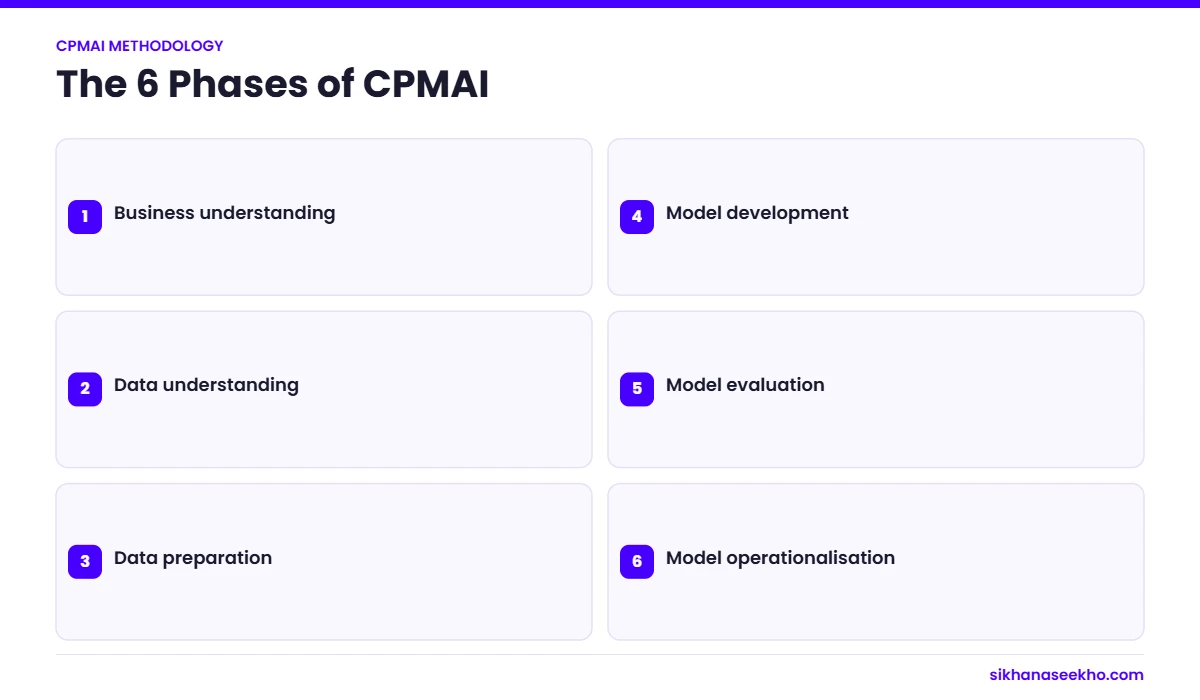
The Six-Phase CPMAI Methodology
The exam is built around the six phases of the CPMAI methodology. Understanding this structure is fundamental to passing the exam and to managing real AI projects.
1
Business Need Identification
Define the problem the AI solution will solve. Map it to a business objective. Assess feasibility. Determine whether AI is actually the right approach. Many AI projects fail here because the problem was never clearly stated.
2
Data Need Identification
Identify what data is needed, where it exists, who owns it, whether it is sufficient and whether it meets quality and compliance requirements. AI projects live and die by data. This phase is not optional.
3
Data Preparation
Oversee the cleaning, transformation, normalisation and validation of data for model training. The PM does not do this work but must manage it, track quality gates and make go/no-go decisions on data readiness.
4
Model Development and Evaluation
Oversee the iterative model build, training and evaluation cycle. Manage the technical team. Track performance against the success criteria defined in Phase 1. Make the go/no-go decision for deployment.
5
Operationalisation
Plan and manage the deployment of the AI solution into production. Establish monitoring, drift detection, performance metrics and governance procedures. Manage the transition from project team to operational support.
6
Ongoing Monitoring and Management
Oversee the live AI system: monitor for model drift, data drift and performance degradation. Manage retraining schedules, regulatory compliance and incident response. Prepare final reports and lessons learned.
02: Eligibility
PMI-CPMAI Eligibility Requirements
This is one of the most important things to know about PMI-CPMAI. The eligibility requirements are very different from the PMP.
✦
No prior experience required. The PMI-CPMAI has no minimum project management experience, no minimum education level and no minimum AI or technical experience. The only requirement to sit the exam is completion of the official PMI-CPMAI Exam Prep Course. You must be at least 18 years old. That is it.
The PMI-CPMAI Exam Prep Course is a self-paced online course available through PMI's learning platform. It covers seven modules aligned to the CPMAI methodology and takes approximately 21 hours to complete. Upon completing the course you earn 21 PDUs, which count toward maintaining an existing PMP if you hold one.
The course is not optional. PMI requires completion before you can schedule the exam. You cannot bypass it regardless of how much AI project management experience you have. This means the timeline to exam day includes the course time plus your exam preparation time.
✦
Free introduction available. PMI offers a free introductory module to the PMI-CPMAI course through their website. Use it before purchasing the full course bundle. It lets you assess whether the CPMAI methodology and exam approach suit your learning style before committing any money. Search "Free Introduction: PMI Certified Professional in Managing AI" on pmi.org.
03: Exam Domains
The Five PMI-CPMAI Exam Domains
The exam is structured around five domains from the September 2025 Examination Content Outline. Each domain has a specific weighting that determines how many of the 120 questions come from that area. I have pulled this directly from the official PMI ECO document so you can trust these numbers.
26%
Domain I: Identify Business Needs and Solutions
Define the problem, evaluate AI feasibility, conduct risk assessment, develop scope, determine ROI, manage adoption risks, define success criteria and identify project resources.
26%
Domain II: Identify Data Needs
Define required data, identify data sources and SMEs, coordinate AI workspace, gather data, check privacy and compliance, oversee data evaluation and make go/no-go data readiness decisions.
17%
Domain III: Operationalize AI Solution
Manage deployment planning and execution, oversee model governance, track AI solution metrics, prepare final reports and lessons learned, manage transition and contingency planning.
16%
Domain IV: Manage AI Model Development and Evaluation
Oversee model technique selection, QA/QC, model training, data transformation for preparation, data quality gates and make the go/no-go decision for operationalisation.
15%
Domain V: Support Responsible and Trustworthy AI Efforts
Oversee privacy and security, manage AI transparency, conduct bias checks, monitor regulatory and policy compliance (GDPR, CCPA, EU AI Act), and manage accountability documentation and audit trails.
✦
Domains I and II together account for 52% of the exam. This is where you need to be strongest. Business need identification and data need identification are the two areas where AI projects most commonly fail, and PMI has weighted the exam to reflect that. Trustworthy AI (Domain V) is only 15% of questions but covers increasingly important regulatory territory including EU AI Act compliance, GDPR, bias detection and audit trail management.
04: Exam Format
PMI-CPMAI Exam Format and Structure
Total Questions
120
100 scored + 20 unscored pre-test questions. Pre-test questions do not affect your result.
Time Allowed
160 min
2 hours 40 minutes. No scheduled breaks. Tutorial and survey time is not counted.
Delivery
Pearson VUE
Computer-based test at a test centre or online proctored from home through Pearson VUE.
Validity Period
1 year
From date of purchase. Up to 3 attempts within that 12-month window.
Languages
11
English plus Arabic, Brazilian Portuguese, French, German, Japanese, Korean, Simplified Chinese, Spanish and more from April 2026.
Maintenance
30 PDUs
Every 3 years to keep the certification active. Lower than the PMP's 60 PDUs per cycle.
The pace works out to approximately 80 seconds per question. That is tighter than most candidates expect for a first sitting. Practise working through scenario-based questions under timed conditions before exam day. The exam tests scenario reasoning and application of the CPMAI methodology, not simple recall of definitions.
05: Cost and Fees
PMI-CPMAI Certification Cost 2026
The PMI-CPMAI is a bundled credential. The exam prep course and the exam fee are both required, and PMI sells them together. Here is the cost breakdown you need to plan for.
✦
Exam fee: $899 USD without PMI membership, $699 USD with PMI membership. PMI membership costs $129 per year (plus a $10 application fee). If you plan to sit the exam, becoming a member first saves $200 and makes membership cost-neutral in year one. Check the official PMI website for the most current pricing as fees can change and regional pricing applies in some markets.
If you do not pass on your first attempt, each retake requires an additional exam fee payment before you can reschedule. PMI recommends a minimum of 30 days study before retaking. You get up to 3 attempts within the 12-month eligibility window. The course fee covers the course access only. Retakes are paid separately.
The total cost of getting certified, including course, exam, and optional PMI membership, typically runs between $900 and $1,200 USD depending on your membership status and whether you need third-party study materials. Salary data for certified AI project managers in 2026 ranges from $115,000 to $165,000 annually in the US market, making the certification investment straightforward to justify.
06: Application Process
How to Apply for PMI-CPMAI: Step by Step
1
Create or log in to your myPMI account
Go to pmi.org and log in or create a free account. If you plan to benefit from member pricing, join PMI as a member before purchasing the certification bundle.
2
Purchase the PMI-CPMAI Exam Prep Course and Certification bundle
Buy through your myPMI dashboard. PMI accepts credit card, wire transfer, Klarna and Afterpay (for orders over $50). You get 12 months from purchase to complete the course, sit and pass the exam.
3
Complete the 21-hour PMI-CPMAI Exam Prep Course
Work through all seven course modules. This step is mandatory before you can access exam scheduling. The course earns you 21 PDUs which count toward PMP renewal if you already hold the PMP.
4
Schedule your exam through Pearson VUE
After completing the course, access your myPMI dashboard to schedule the exam. Choose between a test centre (recommended by PMI) or online proctored from home. Check Pearson VUE's site for test centre availability near you.
5
Sit the exam and receive your result
120 questions in 160 minutes. Official results appear in your myPMI dashboard after the exam. If you pass, your certification is active immediately and appears in the PMI Certification Registry.
07: PMI-CPMAI vs PMP
PMI-CPMAI vs PMP: How They Differ
I get this question from every PMP student who asks me about the PMI-CPMAI. Here is the honest comparison.
PMI-CPMAI
Certified Professional in Managing AI
No experience prerequisite. Course completion only.
Focused entirely on AI project management methodology.
The CPMAI 6-phase methodology is the exam framework.
120 questions, 160 minutes.
30 PDUs every 3 years to maintain.
Strong focus on data governance, responsible AI, regulatory compliance.
New credential still building market recognition.
Salary range $115K to $165K USD (US market, 2026 data).
PMP
Project Management Professional
36 or 60 months experience required depending on education level.
Broad project management across all project types and methodologies.
Average 33% salary uplift on certification, per PMI data.
The two credentials are complementary, not competing. If you hold the PMP and are working on or moving toward AI projects, the PMI-CPMAI adds AI-specific methodology to your existing PM foundation. If you do not yet hold the PMP, I would get the PMP first. It has stronger market recognition and the experience-based requirement ensures you enter with a solid delivery track record. Then add the CPMAI when AI projects become part of your portfolio.
08: Is It Worth It?
Is the PMI-CPMAI Worth It in 2026?
This depends entirely on your situation. I will give you a direct answer based on what I see in the market.
Get it now if:
You are already managing AI initiatives or are being pulled into them. You hold the PMP and want a formal framework for the AI-specific challenges you are already encountering: data dependencies, model governance, responsible AI, deployment monitoring. You work in financial services, healthcare, government or any regulated sector where AI governance is becoming a compliance requirement. You want to differentiate before training providers fully saturate this credential space. The window of being an early mover is open right now. It will not stay open long.
Wait or skip if:
You do not yet hold the PMP and have under 3 years of PM experience. Get the PMP first. It has 20 years of global recognition behind it and the experience requirement ensures you build a proper foundation. If you are not working on AI projects and have no near-term prospect of doing so, the credential investment is hard to justify right now. The market recognition is still building. In two to three years the PMI-CPMAI will likely sit alongside the PMP as a recognised standard for AI project delivery. Right now it is still earning that position.
✦
My view as a PMP trainer: The PMI-CPMAI addresses a real gap. Most PM certifications were designed before AI projects became mainstream. Managing a machine learning project is genuinely different from managing a software delivery: the scope is uncertain until the data is understood, the definition of "done" is probabilistic, the operational lifecycle continues after go-live in ways traditional projects do not. The CPMAI methodology is a solid response to those differences. Whether the market fully prices that in over the next few years will determine how significant this credential becomes. My students who are active in AI project delivery are moving quickly on it.
09: Study Tips
How to Prepare for the PMI-CPMAI Exam
Average preparation time based on 2026 candidate data is 5 to 8 weeks after completing the course. Here is the approach I recommend.
1
Complete the official course first, then study the ECO
The ECO (Examination Content Outline) is freely available on pmi.org. Download it and read every task and enabler in all five domains. This is the blueprint for every question on the exam. I have seen students neglect the ECO and underperform. Do not make that mistake.
2
Master the six CPMAI phases and their sequence
Many exam questions test whether you know what happens in which phase and in what order. The distinction between a PoC (Proof of Concept) and a Pilot is one of the highest-frequency topics. Know the difference precisely. Know when each phase is complete and when you move to the next.
3
Focus 50% of study time on Domains I and II
Business need identification and data need identification together account for 52% of the exam. If you are strong in these two areas you give yourself a significant advantage before you even open the Trustworthy AI or Model Development sections.
4
Do not skip Trustworthy AI (Domain V)
Only 15% of questions but increasingly the area where candidates get caught. GDPR, CCPA, EU AI Act compliance, bias detection, model transparency and audit trail management are all tested. These are also the topics most PM students have the least background in. Give Domain V dedicated time.
5
Practice at exam pace: 80 seconds per question
120 questions in 160 minutes is approximately 80 seconds per question. Set a timer when practising. Candidates who do not practise under time pressure often run short in the final 30 questions. Build the habit of moving decisively on scenario questions before exam day.
10: FAQ
PMI-CPMAI: Frequently Asked Questions
PMI-CPMAI stands for Certified Professional in Managing AI. It is a professional credential from the Project Management Institute (PMI) that validates your ability to manage AI-driven projects using the CPMAI (Cognitive Project Management in AI) methodology. PMI acquired Cognilytica in September 2024 and launched the enhanced PMI-CPMAI credential in 2025. It is not a data science or coding credential. It is for the project manager responsible for governing, overseeing and delivering AI initiatives from business need definition through to production operationalisation.
No. The PMI-CPMAI has no prerequisite certifications. You do not need the PMP, any technical certification or any prior AI or project management experience. The only requirement is completing the official PMI-CPMAI Exam Prep Course (approximately 21 hours) and being at least 18 years old. That said, if you do not hold the PMP and have limited PM experience, I recommend getting the PMP first. It has stronger market recognition and ensures you build a solid general PM foundation before specialising in AI project management.
120 total questions: 100 scored and 20 unscored pre-test questions. The pre-test questions are indistinguishable from the scored questions and do not affect your result. They are used by PMI to validate future exam questions. You have 160 minutes (2 hours 40 minutes) to complete the exam. That works out to approximately 80 seconds per question. There are no scheduled breaks.
The exam fee is $899 USD for non-PMI members and $699 USD for PMI members. PMI membership costs $129 per year plus a $10 application fee, making membership cost-neutral in the first year given the $200 exam saving. Completing the mandatory PMI-CPMAI Exam Prep Course is also required. Check pmi.org for current pricing as fees are subject to change and regional pricing applies in some markets.
The mandatory PMI-CPMAI Exam Prep Course takes approximately 21 hours. Most candidates then spend a further 4 to 6 weeks of dedicated study before sitting the exam. Total time from purchase to exam day is typically 6 to 10 weeks depending on your pace through the course and your existing familiarity with AI project management concepts. Aim for a consistent 80% on practice questions before booking your exam date.
You need 30 PDUs (Professional Development Units) every 3 years to maintain the PMI-CPMAI. This is significantly lower than the PMP's requirement of 60 PDUs per 3-year cycle. If you hold both the PMP and the PMI-CPMAI, the 21 PDUs earned by completing the CPMAI Exam Prep Course count toward your PMP renewal cycle. Track and submit your PDUs through your myPMI dashboard via the PMI Continuing Certification Requirements (CCR) programme.