PMI-PMOCP Certification 2026 Requirements, Cost and Is It Worth It for PMO Roles?
I spent years working across PMOs on projects including EGA Head Office Al Taweelah, The Constellation Abu Dhabi and Abu Dhabi Mall. Then I became a full-time PMP trainer and have helped students from 20-plus nationalities get certified. Now PMI has launched the first credential built specifically for PMO professionals: the PMI-PMOCP. Not another general PM cert. A credential for the people who actually build, run and improve Project Management Offices. I have read every page of the official ECO so you do not have to. This guide gives you every requirement, all six exam domains, the real cost and my honest view on whether it is worth your time right now.
PMI-PMOCP stands for PMO Certified Professional. PMI launched it in February 2026, taking over the PMO-CP credential originally built by PMO Global Alliance (PMOGA). It validates your ability to support, create and lead a Project Management Office.
Check PMI’s current handbook for exact requirements.
Here is what I want you to understand about this credential. It is not the PMP applied to a PMO setting. It is not a general PM cert with a different name. The exam tests a completely separate body of knowledge: how PMOs are designed, structured, operated, measured and evolved over time. I have seen experienced PMs underestimate this and walk into the exam underprepared because they assumed their PMP knowledge would carry them through. It will not be enough on its own.
The most important thing the certification teaches is that there is no single correct PMO model. Every organisation is different. Every PMO should be designed for the context it operates in. The exam tests whether you can assess that context and adapt the PMO accordingly. This is a big shift from the more prescriptive methodologies many PMs come from.
✦
Why this credential exists. PMO roles have been around for decades but have never had a dedicated PMI credential. I have watched good PMs move into PMO leadership and struggle, not because they lack PM skills but because leading a PMO is genuinely different from delivering a project. The political work, the governance design, the maturity frameworks, the way you measure PMO value to the organisation: none of that is covered by the PMP. The PMI-PMOCP finally addresses that gap. In my PM career path guide I describe the PMO Director route as one of the two senior leadership paths. This credential is built specifically for that track.
Who is the PMI-PMOCP For?
This is for mid-career and experienced professionals already working in or moving toward PMO roles: PMO Directors, PMO Managers, PMO Analysts, Portfolio Managers and Programme Managers who operate within a PMO structure. It is also a strong fit for PMs being asked to establish a PMO from scratch, which I see more and more as organisations build out their governance functions.
It is not for someone just starting out. The experience requirement reflects that. If you are new to project management, start with the CAPM or PMP and build your delivery track record first. Come back to the PMI-PMOCP when PMO leadership becomes part of your role.
02: Eligibility
PMI-PMOCP Eligibility Requirements
This is one of the most accessible PMI credentials in terms of what is required to apply. Three things. That is it. And if you already hold the PMP, one of those three things is already taken care of. Let me walk through each one.
Requirement
Details
Education
Secondary degree or equivalent. This means a high school diploma, GED or global equivalent. No degree required. This is a lower bar than the PMP, which requires a four-year degree for the faster eligibility path.
Experience
36 months of project-related experience within the last 8 years. Alternatively, if you hold a current PMP in good standing, the experience requirement is waived entirely. The PMP shortcut is significant: it means any practising PMP can apply without documenting 3 years of project hours.
PMO Education
10 hours of formal PMO education. Not general PM training. Specifically PMO content. The official PMI on-demand PMI-PMOCP Exam Prep Course satisfies this requirement. Training from PMI authorised partners, universities, distance learning providers and corporate training programmes also qualifies. Self-study (books, YouTube, coaching) does not count.
Time Frame
All project experience must fall within the last 8 years from your application date. The PMO education hours have no time limit: they can have been accrued at any point in your career.
Age
No minimum age specified in the ECO. Standard PMI application requirements apply.
✦
Already hold the PMP? The experience requirement is waived entirely. You need your secondary degree, a current PMP in good standing, and 10 hours of PMO-specific education. That is all. I tell my PMP students who are moving into PMO roles that this is the most straightforward path to a second PMI credential they will ever have. The 10 hours can be done through PMI's own on-demand prep course, which you need for exam preparation anyway.
✦
What counts as project-related experience? Experience does not have to be paid work but must be in a professional setting. School projects and personal event planning do not qualify. Multiple concurrent projects can all count toward the total. All hours on each project count, unlike the PMP, which counts months rather than hours. Document projects individually on the application.
03: Exam Domains
The Six PMI-PMOCP Exam Domains
Six domains. I pulled the percentages below directly from the official PMI Examination Content Outline (February 2025 version). These are the exact weights used to set every question on the exam. Know these numbers before you build your study plan. They tell you exactly where to spend your time.
18%
Domain I: PMO Strategic Elements
Architect PMO strategy, define vision and mission, steward the PMO mandate, establish and maintain PMO governance, secure executive sponsorship and align the PMO to organisational goals.
18%
Domain II: PMO Design and Structuring
Manage PMO customers, identify and prioritise their needs, articulate and evolve the PMO value proposition, design and implement PMO services and create service level agreements.
18%
Domain III: PMO Enhancement and Effectiveness
Optimise PMO service performance, assess and improve PMO services maturity, develop team competencies, quantify PMO value and benchmark against industry standards.
16%
Domain IV: Organizational Development and Alignment
Elevate organisational project management capability, shape OPM culture, drive OPM maturity using established frameworks, cultivate capabilities and coach teams on risk management.
15%
Domain V: PMO Operation and Performance
Onboard PMO services, manage service delivery processes and workflows, allocate and manage PMO resources, implement capacity planning and quality control for service consistency.
15%
Domain VI: People
Enable a value-driven mindset, foster customer-centricity, build interpersonal relationships, communicate effectively, manage conflicts, demonstrate adaptability, integrity and strategic leadership.
✦
Domains I, II and III together account for 54% of the exam. PMO strategy, PMO design and PMO effectiveness are where this credential is won or lost. If I were sitting this exam, I would spend at least half my study time in these three domains before touching anything else. The People domain (15%) is not soft filler. It is tested in a PMO leadership context: how you build buy-in for a PMO, manage conflict between the PMO and project teams, and communicate value to executive sponsors. Practise scenario questions set inside PMO environments, not generic project delivery scenarios.
04: Exam Format
PMI-PMOCP Exam Format and Structure
Total Questions
120
100 scored, 20 unscored pre-test questions placed randomly throughout. Pre-test questions do not affect your result.
Time Allowed
165 min
2 hours 45 minutes. Includes an optional 10-minute break after question 60. Once you take the break you cannot return to the first 60 questions.
Question Format
MCQ
Multiple-choice and multiple-answer select questions. Scenario-based throughout. Tests application of PMO knowledge, not recall of definitions.
Delivery
Pearson VUE
Computer-based test at a Pearson VUE test centre (recommended) or online proctored from home. Online requires system checks before exam day.
Validity Period
1 year
From date of application approval. Up to 3 attempts within that 12-month window. After 3 failed attempts, you must wait 1 year before reapplying.
Maintenance
30 PDUs
Every 3 years to keep the certification active. Same as PMI-CPMAI. Lower than the PMP's 60 PDUs per 3-year cycle.
The optional 10-minute break after question 60 is something I want to flag specifically. You do not get this on the PMP or CAPM. Use it. Every time. In my experience, exam fatigue in the final third of a long scenario-based exam is where marks are lost, not in the first half. A 10-minute reset at halfway makes a real difference to your sharpness on questions 61 to 120. The one rule to remember: once you start the break, you cannot return to the first 60 questions under any circumstances.
05: Cost and Fees
PMI-PMOCP Certification Cost 2026
PMI does not print a fixed fee in the ECO. Fees vary by region and by membership status. I have pulled together what you realistically need to budget based on current market data and PMI's standard pricing structure. Always verify the exact figure on pmi.org before applying, as fees do change.
✦
Always verify current fees on pmi.org before applying. PMI fees change and regional pricing applies. The figures below reflect current market data from multiple authorised sources as of July 2026. Membership reduces the exam fee and is worth calculating before you apply. PMI membership costs approximately $129 per year plus a $10 application fee.
Based on PMI's standard credential fee structure and third-party course data, the total cost of obtaining the PMI-PMOCP typically includes: the exam application fee (reduced for PMI members), the 10-hour PMO education requirement (which can be met through PMI's official on-demand prep course), and optional third-party study materials. Certified professionals earn between 15% and 30% more than non-certified peers in PMO roles according to current market data, which makes the investment relatively straightforward to justify for anyone in a PMO leadership track.
Retake fees apply if you do not pass on your first attempt. Each retake within the 1-year eligibility window requires a separate fee payment. The retake fee is discounted compared to the initial exam fee. Budget for one attempt and aim to be fully prepared before sitting.
06: Application Process
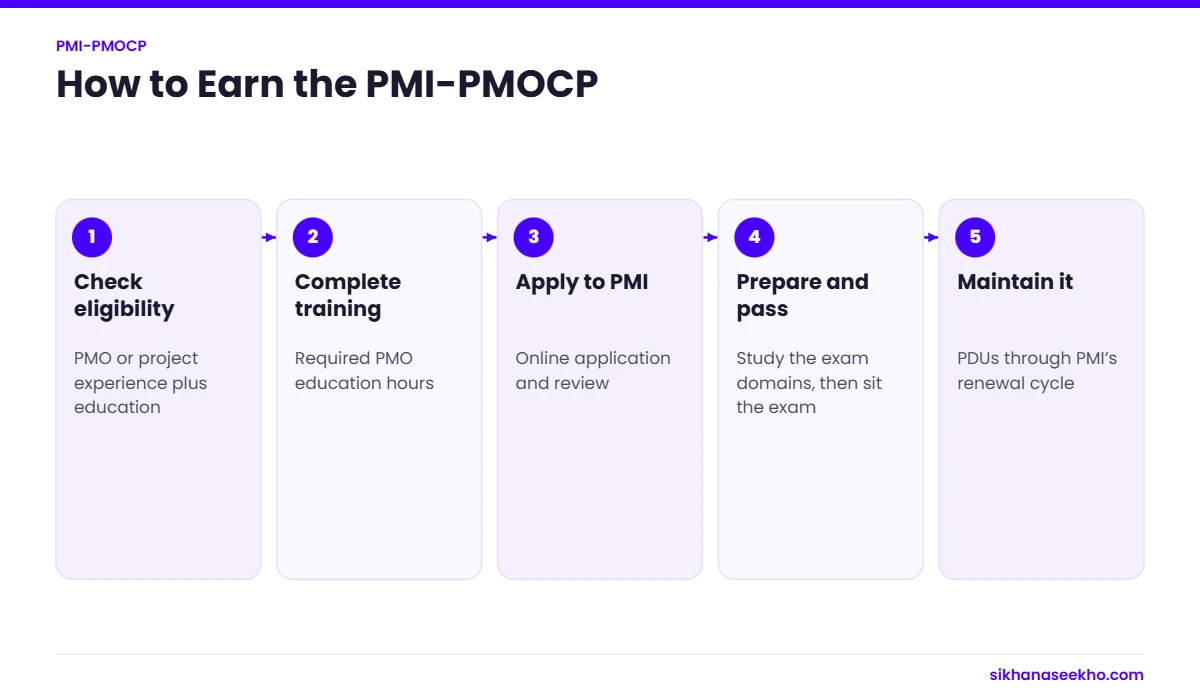
How to Apply for PMI-PMOCP: Step by Step
1
Confirm you meet the eligibility requirements
Check your education (secondary degree or equivalent), your experience (36 months of project-related work in the last 8 years, or a current PMP in good standing), and your 10 hours of PMO education. All three must be in place before you submit. If you already hold the PMP, the experience requirement is waived.
2
Log in to your myPMI account and start the application
Go to pmi.org and log in or create a free account. Submit your application through the online certification system. Once you start the application you cannot cancel it, but you can save and return to it. The application stays open for 90 days before PMI closes it.
3
Document your experience and education
Record your project experience in the experience verification section. List each project individually with the hours contributed. If you hold the PMP, you skip this section entirely. Record your 10 hours of PMO education, including the course name, provider and hours. Only formal education counts. Self-study does not.
4
Pay the exam fee and await approval
Pay the initial exam fee after submitting the application. PMI accepts credit card and wire transfer. Klarna and Afterpay are also available for orders over $50. PMI will review your application and notify you by email. If selected for audit (random), you will have 90 days to provide supporting documentation.
5
Schedule and sit the exam through Pearson VUE
Once approved, PMI emails your eligibility code. Use it to schedule your exam at a Pearson VUE test centre or online. You have 12 months from approval to pass. 165 minutes, 120 questions, optional 10-minute break at the halfway point.
07: How It Compares
PMI-PMOCP vs PMP vs PgMP
This is the question I get most from experienced PMs who are considering the PMI-PMOCP. How does it sit alongside the PMP and the PgMP? The answer is simpler than most people expect. They are not competing. They are for three different jobs.
PMI-PMOCP
PMO Certified Professional
Secondary degree. 36 months experience OR current PMP.
10 hours of PMO-specific education.
Focus: PMO design, governance, strategy and value delivery.
120 questions, 165 minutes.
30 PDUs per 3-year cycle.
New credential. Building market recognition.
Best for: PMO leaders, PMO managers, portfolio governance roles.
PMP
Project Management Professional
Four-year degree plus 36 months, or secondary degree plus 60 months.
35 hours of PM education.
Focus: leading and directing individual projects across all methodologies.
180 questions, 240 minutes.
60 PDUs per 3-year cycle.
Gold standard. 20+ years of global recognition.
Best for: project managers across all sectors and geographies.
PgMP
Program Management Professional
Four-year degree, 4 years PM experience, plus 7 years programme experience.
Multiple references required.
Focus: managing groups of related projects for strategic outcomes.
170 questions, 4 hours.
60 PDUs per 3-year cycle.
Senior credential. One of the hardest PMI exams to pass.
Best for: senior programme directors and heads of portfolio.
PMP is for delivering individual projects. PgMP is for leading groups of related projects at programme level. PMI-PMOCP is for the function that makes all of that delivery possible: the PMO. Three different roles, three different credentials. In my PM career path guide I explain that senior PM leadership splits into two routes: Delivery Leadership and PMO Leadership. The PgMP sits on the delivery route. The PMI-PMOCP sits squarely on the PMO route.
08: Is It Worth It?
Is the PMI-PMOCP Worth It in 2026?
Get it now if:
You are working in a PMO now or have been asked to lead one. You hold the PMP, so the experience requirement is gone and the only barriers left are 10 hours of PMO education and the exam itself. You are targeting PMO Director, Head of PMO or Portfolio Manager roles in the next 12 to 24 months and want a credential that speaks to those titles specifically, not a general PM cert that only covers part of what that role involves. You want to move before training providers saturate this space. The window to be an early mover is open right now. I have watched the PMP market grow since I got certified in 2019 and the pattern with new credentials is always the same: those who move early get the advantage. Those who wait until it is mainstream are competing in a crowded field.
Wait or consider carefully if:
You do not yet hold the PMP. Stop reading this page and go to my PMP guide. Get the PMP first. It has 20-plus years of global recognition and its experience requirement means you will enter the PMI-PMOCP with a solid delivery foundation behind you. A PMI-PMOCP without PMP is technically possible but in practice unusual. Most senior PMO roles will expect you to have delivered projects first before you move into governing them. If you are in a pure delivery role with no PMO remit in your near future, this credential has limited immediate application. Come back to it when the timing is right.
✦
My honest view: The PMO function is one of the most consistently misunderstood parts of project management. In my training sessions I have met PMs from the USA, UK, UAE, Australia, India and across Africa who moved into PMO leadership with no framework for what good PMO design actually looks like. They inherited a structure, tried to make it work and figured things out by trial and error. Sometimes it went well. Often it did not. The PMI-PMOCP gives those professionals a structured, evidence-based methodology for the first time. I think it fills a real gap. Whether the market fully prices it in over the next 3 to 5 years depends on how fast employers adopt it as a hiring standard. Right now, being certified is a strong differentiator. That advantage will not last indefinitely. If this credential is relevant to your career, now is the right time to move.
09: Study Tips
How to Prepare for the PMI-PMOCP Exam
1
Download and read the ECO before anything else
The official Examination Content Outline (ECO, February 2025) is freely available on pmi.org. Read every domain, task and enabler. The ECO is the blueprint for every exam question. No study resource is more important than this document. I recommend reading it before you start the official prep course, so you know which parts of the course matter most.
2
Complete the official PMI on-demand prep course
This course satisfies your 10-hour PMO education requirement and gives you the official PMI framing of every domain. It is also the reference material the exam is most closely aligned to. Use it as your primary source. Third-party courses can supplement but not replace it.
3
Study PMI's PMO Practice Guide and reference materials
The official PMI reference list includes the Project Management Offices Practice Guide, PMBOK Guide 7th edition, the Standard for Organisational Project Management and the Benefits Realization Management guide. The PMO Practice Guide is the most PMI-PMOCP-specific of these and deserves the most attention.
4
Focus on Domains I, II and III: they cover 54% of the exam
PMO Strategy, PMO Design and PMO Enhancement together account for more than half the exam. Master the tasks in these three domains first: architecting PMO strategy, designing service catalogues, measuring PMO value, and assessing PMO maturity. Then reinforce with Domain IV (Organisational Development) and the People domain.
5
Practise PMO-specific scenario questions
The exam tests scenario reasoning in a PMO context, not project delivery scenarios. Make sure your practice questions are set in PMO environments. Questions about how to handle an underperforming PMO service, how to build buy-in for a new PMO, or how to measure PMO value are the type of reasoning the exam tests. Generic PMP practice questions will not prepare you for this.
10: FAQ
PMI-PMOCP: Frequently Asked Questions
PMI-PMOCP stands for PMO Certified Professional. PMI launched it in February 2026, taking over the PMO-CP credential originally built by PMO Global Alliance. It validates your ability to support, create and lead a Project Management Office across six domains: PMO Strategic Elements, PMO Design and Structuring, PMO Enhancement and Effectiveness, Organisational Development and Alignment, PMO Operation and Performance, and People. It is built for PMO professionals at all career levels. What makes it different from the PMP is that it tests PMO-specific knowledge: governance design, service catalogues, PMO maturity frameworks, value measurement and stakeholder buy-in. It is not a general PM cert applied to a PMO context. It is a separate credential for a separate discipline.
Three requirements: a secondary degree or equivalent (high school diploma, GED or global equivalent); 36 months of project-related experience within the last 8 years, OR a current PMP certification in good standing (which waives the experience requirement entirely); and 10 hours of formal PMO education. The education must be structured and formal. Self-study, books and coaching do not count. The official PMI on-demand PMI-PMOCP Exam Prep Course satisfies the education requirement.
No, the PMP is not a formal prerequisite. But if you hold a current PMP, the 36-month experience requirement for the PMI-PMOCP is waived completely. That is a significant shortcut. For professionals without the PMP, you need to document 36 months of project-related experience in the last 8 years. My advice: get the PMP first if you do not already have it. It has stronger market recognition across all PM roles and the experience requirement ensures you arrive at PMO leadership with a genuine delivery track record. A PMO professional who has never delivered a project is a weaker PMO professional. The PMP is the right starting point. Add the PMI-PMOCP when you are ready to move into the PMO leadership track specifically.
120 total questions: 100 scored and 20 unscored pre-test questions placed randomly throughout. The time allowed is 165 minutes (2 hours 45 minutes). There is an optional 10-minute break after question 60. Once you take the break you cannot return to the first 60 questions. The exam is available at Pearson VUE test centres and as an online proctored exam from home.
You need 30 PDUs (Professional Development Units) every 3 years to maintain the PMI-PMOCP. This is the same maintenance requirement as the PMI-CPMAI and significantly lower than the PMP's 60 PDUs per 3-year cycle. PDUs are tracked and submitted through the PMI myPMI dashboard. Renewal also requires a payment based on regional and membership pricing rules.
PMI does not publish pass rates for any of its credentials and independent data on the PMI-PMOCP is still limited given it launched in February 2026. What I can tell you is this: the exam is scenario-based and tests application of PMO knowledge, not memorisation of definitions. Candidates who read the ECO carefully, complete the official prep course and practise PMO-specific scenario questions under timed conditions are well positioned. The optional 10-minute break after question 60 is not a gimmick. Use it. Candidates who go straight through without a break often find their performance drops in the final third of the exam. Take the reset, stay sharp and finish strong.