
The PMI-ACP (PMI Agile Certified Practitioner) is PMI’s certification for project professionals who work with agile approaches. It covers several methods, including Scrum, Kanban, Lean and XP, so it suits people who lead or support agile teams and want a broad, PMI-backed credential rather than a single-framework one.
Deep dive into the PMI-ACP guide for agile practitioners: explore the PMI-ACP exam, content outline, eligibility, and top study resources to master agile certification.
The PMI-ACP certification is one of the most recognized agile certifications worldwide, highly valued by agile practitioners seeking to validate their expertise in agile project management. This PMI-ACP guide will walk you through everything you need to know about the PMI-ACP exam, eligibility, content outline, and the best study resources to help you achieve agile certification success.
What Is PMI-ACP?
The PMI Agile Certified Practitioner (PMI-ACP) credential, offered by the Project Management Institute (PMI), demonstrates your ability to apply agile principles and methodologies like Scrum, Kanban, Lean, XP, and TDD in real-world projects. The PMI-ACP certification proves you can lead agile teams, collaborate with stakeholders, and deliver value-driven results using agile tools and techniques1110.
Why Pursue the PMI-ACP Certification?
Agile certification is a powerful asset for project managers, scrum masters, developers, and anyone involved in agile environments. The PMI-ACP guide highlights several benefits:
- Global recognition of agile expertise
- Enhanced career prospects and earning potential
- Validation of hands-on agile experience
- Versatility across multiple agile frameworks1110
PMI-ACP Guide: Exam Eligibility and Requirements
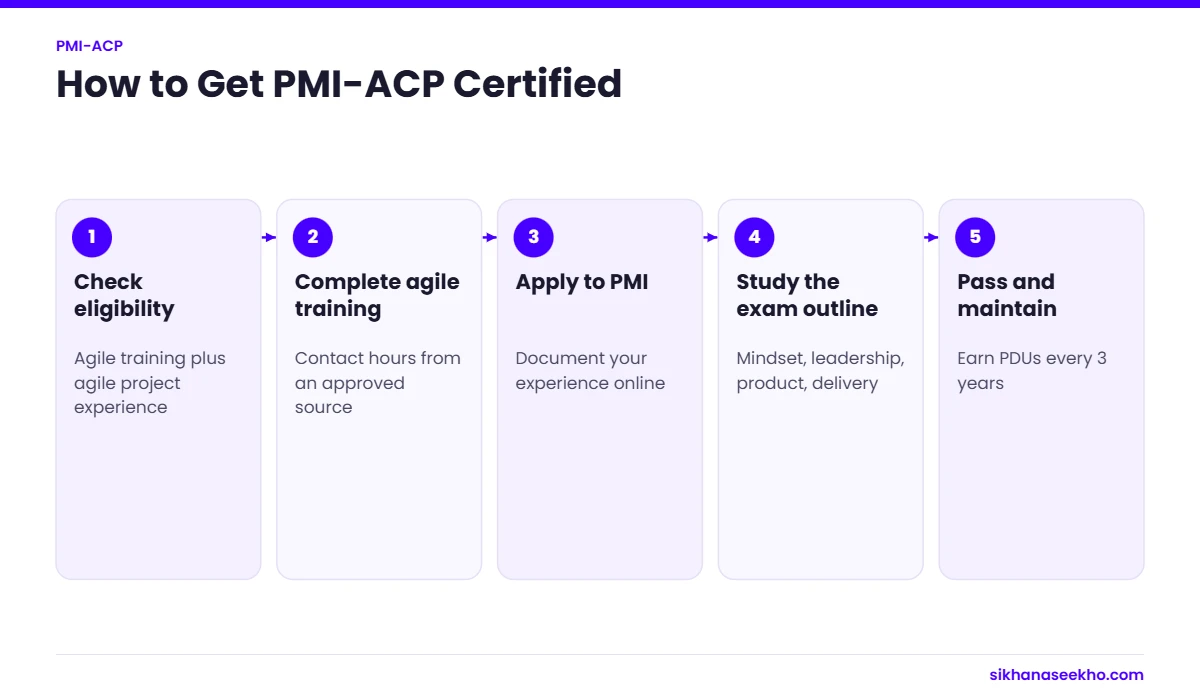
To apply for the PMI-ACP exam, you must meet all the following criteria:
- Education: Secondary degree (high school diploma or equivalent)
- General Project Experience: 2,000 hours (12 months) on project teams in the last 5 years (if you hold PMP or PgMP, this is waived)
- Agile Project Experience: 1,500 hours (8 months) on agile teams in the last 3 years
- Agile Training: 21 contact hours in agile practices, typically through an agile certification course11109.
PMI-ACP Guide: Application Process
Transitioning to the application is straightforward if you follow these steps:
- Create a PMI Account: Register on the PMI website.
- Submit Your Application: Enter your education, project experience, and training details.
- PMI Review: PMI reviews your application for completeness.
- Audit (Random Selection): Some applications are randomly selected for audit, requiring supporting documentation.
- Payment: Pay the exam fee after approval.
- Schedule the Exam: Choose a PMI-approved testing center or online proctored exam8910.
PMI-ACP Guide: Exam Content Outline
The PMI-ACP exam is a three-hour test with 120 multiple-choice questions. It covers seven domains:
- Agile Principles and Mindset
- Value-Driven Delivery
- Stakeholder Engagement
- Team Performance
- Adaptive Planning
- Problem Detection and Resolution
- Continuous Improvement (Product, Process, People)1011
You’ll need a solid understanding of agile frameworks, principles, and real-world application to succeed.
PMI-ACP vs other agile certifications
| Certification | Awarding body | Scope | Renewal |
|---|---|---|---|
| PMI-ACP | PMI | Several agile methods (Scrum, Kanban, Lean, XP and more) | 30 PDUs every 3 years |
| Certified ScrumMaster (CSM) | Scrum Alliance | Scrum | Every 2 years with education units and a fee |
| Professional Scrum Master (PSM I) | Scrum.org | Scrum | Does not expire |
| SAFe Agilist | Scaled Agile | Scaled agile with SAFe | Annual renewal |
Check pmi.org for the current PMI-ACP eligibility rules and exam fees.
PMI-ACP Guide: Study Resources and Preparation
Tips To ace your agile certification, use a mix of these PMI-ACP guide resources:
- PMI-ACP Exam Content Outline: Download from the PMI website for the latest topics.
- PMI-ACP Prep Books: Popular titles include “PMI-ACP Exam Prep” by Mike Griffiths and “The PMI-ACP Exam: How To Pass On Your First Try” by Andy Crowe.
- Online Courses: Look for PMI-registered education providers offering 21 contact hours, such as RMC, PM PrepCast, or Simplilearn.
- Practice Exams: Take simulated tests to assess your readiness and identify weak areas.
- Study Groups: Join online forums or local agile communities for peer support910.
Transitioning between resources and consistent study is key to passing the PMI-ACP exam on your first attempt.
PMI-ACP Guide: Maintaining Your Certification
After passing the PMI-ACP exam, your certification is valid for three years. To renew, you must earn 30 Professional Development Units (PDUs) in agile topics during each three-year cycle11.
What does the PMI-ACP exam test?
The exam tests whether you can apply agile thinking to realistic scenarios, not whether you can recite definitions. Expect questions about a team that is missing sprint goals, a product owner who keeps changing priorities, or a stakeholder who wants a fixed scope on an agile project.
The foundations are short and worth reading closely. The Agile Manifesto, published in 2001, sets out 4 values and 12 principles. The Scrum Guide, last updated in 2020, is under 20 pages. Together they explain the reasoning behind most correct answers.
Beyond Scrum, make sure you understand Kanban flow and work-in-progress limits, Lean ideas such as eliminating waste, XP practices such as pair programming and test-driven development, and agile estimation with story points and velocity.
How should you prepare for the PMI-ACP?
Most working candidates need 6 to 10 weeks of steady study. A practical plan is to spend the first 2 weeks on the Agile Manifesto, the Scrum Guide and Kanban basics, the next 3 weeks on a full prep book or course, and the final weeks on timed practice questions.
Track your practice scores by topic. If you score under 70% in an area, go back to the source material rather than doing more questions. In the final week, take at least 2 full-length timed practice exams to build stamina.
PMI first launched the ACP in 2011 and has updated it since to reflect how agile is used today, including hybrid delivery. Use study materials updated for the current exam content outline, and check pmi.org for the latest requirements before you apply.
If you already hold the PMP, much of the PMI vocabulary will be familiar, and the PDUs you earn while studying agile can also count towards your PMP renewal.
Is the PMI-ACP worth it?
It depends on your role. The PMI-ACP is most valuable for project managers and team leads who work across several agile methods or in hybrid environments, especially in organisations that already value PMI credentials. It shows you understand agile as a whole, not just one framework.
If your goal is a pure Scrum Master role, a Scrum certification such as CSM or PSM I is often more directly relevant, and job adverts for Scrum Masters mention those more often than the ACP.
If you already hold the PMP, adding the ACP is a strong signal that you can lead in both predictive and agile settings. Many hybrid project roles in 2026 ask for exactly that combination, and the 2 certifications share the same PDU renewal system, so you can maintain both with a single learning plan.
Whatever you decide, check a sample of 10 job adverts in your target market. If the ACP appears in several of them, it is likely to pay back the study time.
What are the most common mistakes PMI-ACP candidates make?
The first is studying only Scrum. The exam covers a wider range of agile approaches, so candidates who skip Kanban, Lean and XP lose easy marks.
The second is answering from their own workplace habits. If your organisation runs a version of agile with long sign-off chains or a project manager who assigns tasks, the exam answer will often differ from what you do at work. Choose the option that best reflects agile values: self-organising teams, frequent delivery and close customer collaboration.
The third is leaving timed practice too late. Build up to full-length practice exams in the last 2 or 3 weeks so the real exam does not feel unfamiliar.
Who should not take the PMI-ACP yet?
If you have never worked on or alongside an agile team, build some experience first. The exam is scenario-based, and real sprint experience makes the right answers far easier to recognise.
Frequently Asked Questions (FAQs)
How long does it take to prepare for the PMI-ACP exam?
Most agile practitioners spend 2–3 months preparing, depending on their experience and study habits8.
Is PMI-ACP certification only relevant for software development?
No, the PMI-ACP guide emphasizes its value across all industries where agile principles are applied11.
Can I take the PMI-ACP exam online?
Yes, PMI offers both in-person and online proctored exam options10.
What is the cost of the PMI-ACP exam?
The exam fee varies: PMI members pay less than non-members. Check the PMI website for current rates9.
What happens if my application is selected for audit?
You’ll need to provide supporting documents for your education, experience, and training. If you pass the audit, you can proceed to schedule your exam89.
By following this PMI-ACP guide, agile practitioners can confidently pursue agile certification and advance their careers in agile project management.
Keep learning
- CAPM Certification Guide 2026: Entry-Level PM Cert
- The Code of Ethics for Project Managers Explained
- PMP Renewal Guide 2026: PDUs, CCR Cycle & Deadlines
- How to Earn 60 PDUs for PMP Renewal: Free & Paid
- 4 Simple Steps to Renew Your PMP Certificate
- PMI’s KICKOFF Program Explained