
PMP exam practice is the use of realistic, scenario-based questions and timed mock exams to prepare for PMI’s Project Management Professional exam. Good practice covers all 3 domains, explains why each answer is right or wrong, and builds the stamina and timing you need for exam day.
Are you gearing up for the Project Management Professional (PMP) exam and seeking a reliable resource to elevate your preparation? Look no further – our “30 PMP Exam Practice Questions” is your key to mastering the exam. This article will explore why effective practice is crucial for PMP success and how our product can be your secret weapon in acing the exam.
Why is practice so important for the PMP exam?
Success in the PMP exam requires more than just theoretical knowledge. It demands practical application of project management concepts, critical thinking, and time management skills. Effective practice assesses your understanding of the material and hones your ability to analyze and solve complex scenarios – skills essential for the PMP journey.
How do practice questions help you pass?
1. Knowledge Reinforcement:
Practice questions reinforce your understanding of key concepts, ensuring they are firmly ingrained in your memory.
2. Exam Simulation:
Simulating the exam environment with practice questions familiarizes you with the format, reducing anxiety on exam day.
3. Identifying Weak Areas:
Regular practice helps identify weak areas, allowing targeted study and improvement in specific domains.
4. Time Management:
The PMP exam is time-bound. Practice questions train you to manage time efficiently, a critical skill for success.
A 6-week PMP practice plan
| Week | Practice focus | Target |
|---|---|---|
| 1 | Untimed questions by topic; read every explanation | 50 to 75 questions |
| 2 | People domain scenarios: teams, conflict, leadership | 75 to 100 questions |
| 3 | Process domain: planning, risk, change, agile and hybrid | 100 questions |
| 4 | Business Environment: benefits, compliance, change | 75 questions plus review of weak areas |
| 5 | First full-length timed mock exam | 1 full mock; review every wrong answer |
| 6 | Second and third timed mocks; final review | Scores consistently comfortably above 70% |
Targets are a guide. Quality of review matters more than the number of questions.
How should you review practice questions?
The value of a practice question is in the review, not the score. For every question you get wrong, and every one you guessed, write a 1-line note: what the question was really testing, why the right answer is right, and why your choice was wrong.
Group your notes by topic. After 100 to 200 questions, patterns appear: perhaps you always escalate too early, or confuse risks with issues. Those patterns tell you what to re-study.
Learn PMI’s mindset. In scenario questions, the best answer usually involves analysing the situation, collaborating with the team or stakeholders, and following the agreed process before escalating or acting alone. In agile scenarios, prefer answers that empower the team and engage the product owner.
Finally, use free and paid sources together. Sikhana Seekho offers 200 free PMP practice questions alongside this paid pack, so you can test yourself across topics before your mock exams.
How many practice questions do you need?
There is no magic number, but many successful candidates complete around 1,000 good-quality questions, including 2 or 3 full-length timed mock exams. Fewer questions with careful review beats thousands answered quickly.
Use realistic questions aligned with the current exam content outline. Since 9 July 2026 the PMP exam is aligned with the PMBOK Guide 8th Edition, so check that your question bank has been updated.
Common practice mistakes to avoid
The first is memorising answers. If you repeat the same question bank until you recognise the questions, your scores rise but your understanding does not. Switch sources regularly and focus on why answers are right.
The second is avoiding timed practice. Answering questions slowly at home feels productive, but the real exam is long and tiring. From around week 5 of your plan, practise in blocks that match the real exam sections, with breaks at the same points.
The third is ignoring weak domains. It is tempting to practise what you already know. Track your scores by domain and spend at least half of your practice time on the lowest one.
The fourth is booking too late or too early. Book when your mock scores are steady and comfortable, not after 1 lucky result, and not months after you peaked.
Finally, review your notes in the last 7 days rather than learning new topics. Calm, steady revision of your own mistakes is the best final preparation, and a good night’s sleep before the exam matters more than 50 extra questions.
Using practice questions alongside other study
Practice works best as part of a balanced plan. A simple split is about 40% of study time on learning content from a prep course or book, 40% on practice questions and review, and 20% on revision of your own notes and weak areas.
Early in your preparation, use short sets of 10 to 20 questions straight after learning each topic. Later, move to longer mixed sets of 50 or more, and finally to full-length timed mocks. This progression builds both understanding and stamina.
Keep a simple tracker of every practice session: date, number of questions, score and the 2 topics you got wrong most. After 3 or 4 weeks, the tracker shows clearly whether you are improving and where to focus next.
Introducing Our Product: 30 PMP Exam Practice Questions
Our product is designed with your success in mind. Tailored to the PMP exam, it offers:
1. Domain-Specific Questions:
Focused on key domains, ensuring comprehensive coverage of the exam syllabus.
2. Detailed Explanations:
Understand the logic behind each answer with in-depth explanations, facilitating deeper learning.
3. Realistic Exam Experience:
Experience the actual exam scenario with carefully crafted questions that mimic the PMP exam’s complexity.
4. Flexible Learning:
Practice independently, fitting study sessions into your busy schedule.
5. Progress Tracking:
Monitor your progress, track improvements, and fine-tune your study plan accordingly.
Unlocking PMP Success with Our Practice Questions
Your PMP journey deserves a reliable companion; our practice questions are crafted to be just that. Elevate your preparation, build confidence, and face the PMP exam with the assurance of thorough readiness. Don’t just study – practice strategically with “30 PMP Exam Practice Questions” and pave the way to PMP success.
How to practise for the PMP exam effectively
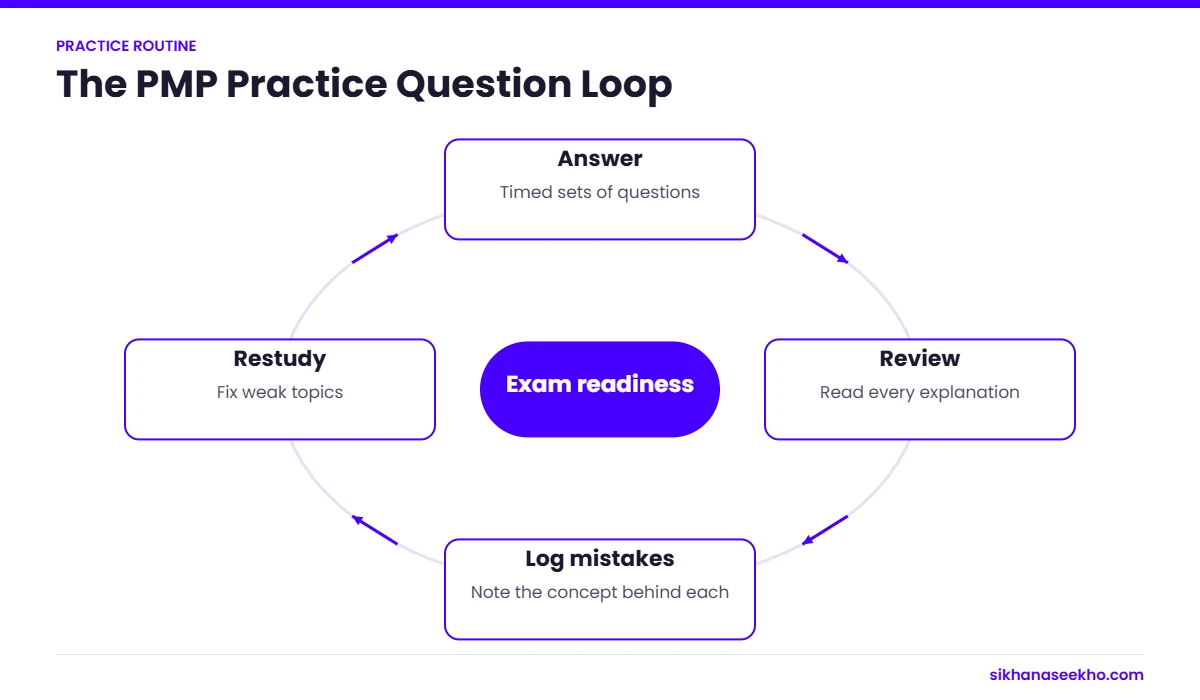
- Start after you have covered each domain once. Practice questions work best once you know the basic concepts.
- Practise in small, focused sets. Twenty questions on one domain, followed by a careful review, beats a hundred rushed questions.
- Review every explanation. Read why the correct answer is right and why each wrong answer is wrong, even for questions you got right.
- Keep an error log. Note the concept behind each mistake and revisit it a few days later.
- Move to full mock exams. In the final weeks, take full-length timed exams to build stamina and pacing.
How many practice questions do you need?
There is no magic number, but most candidates who pass work through well over a thousand quality practice questions and several full mock exams. Quality matters more than quantity: questions should match the scenario-based style of the current exam and come with detailed explanations.
When are you ready to book?
- Your mock exam scores are consistently strong across all three domains.
- You can explain your reasoning for each answer without guessing.
- You finish full mock exams within the time limit with a few minutes to spare.
Free practice resources
Start with our 200 free PMP practice questions, which you can filter by domain and approach, and follow the free PMP study guide for a complete 12-week plan.
PMP exam practice: common questions
What score on practice exams means I am ready?
Many trainers suggest booking when you consistently score comfortably above 70% on reputable full-length mocks. Scores vary between providers, so look for consistency rather than a single high result.
Are free PMP practice questions good enough?
Some are excellent, but quality varies. Use free questions from trusted sources, and check every explanation against official references.
How long is the PMP exam?
Check PMI’s current exam content outline and handbook for the latest number of questions and time allowed, as these can change with exam updates.
Keep learning
- 5 Ways to Stay Motivated While Studying for the PMP Exam
- 38 ChatGPT and Claude Prompts for PMP Exam Preparation in 2026
- PMP Exam Diagrams: A Guide to 30+ Project Management Diagrams
- Risk Tolerance in PMP: Definition, Types and Best Practices (2026)
- 5 Reasons Engineers Should Pursue PMP Certification