
Staying motivated while studying for the PMP exam means turning a long, demanding goal into small, visible wins. The 5 most effective strategies are setting achievable goals, looking after yourself, building a support system, using visualisation, and joining a structured PMP training course with a clear schedule.
5 Strategies to Reignite Your Motivation and Crush the PMP Exam
Why do PMP candidates lose motivation?
Studying for the PMP exam can be long and arduous, and it’s easy to lose motivation. However, if you want to pass the PMP exam and advance your career as a project manager, you need to find ways to stay motivated and energized throughout the studying process. This article will share five proven strategies for reigniting your motivation and crushing the PMP exam.
Set Achievable Goals:
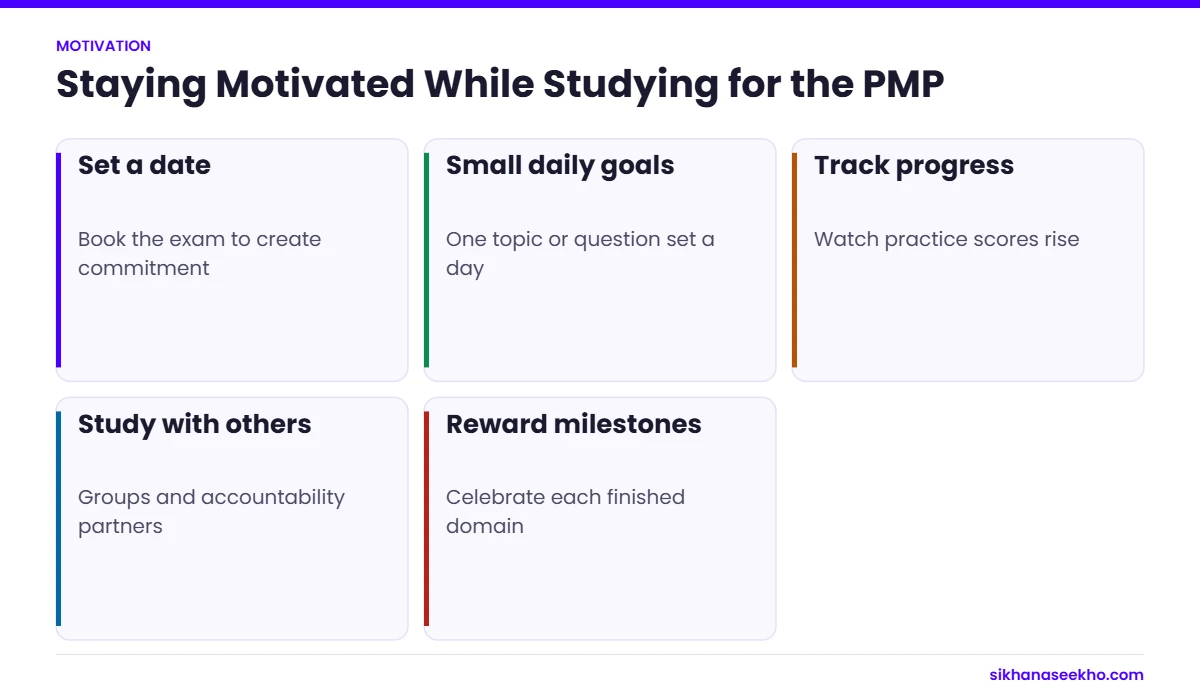
One of the biggest mistakes people make when studying for the PMP exam is setting unrealistic goals for themselves. When you set goals that are too ambitious, you’re setting yourself up for failure. Instead, break your studying goals into achievable chunks that you can work towards each day or week. Celebrate your successes along the way, and adjust your goals as needed.
Take Care of Yourself:
It’s hard to stay motivated when feeling burnt out and exhausted. Make sure to take care of yourself by eating healthy, exercising, and getting enough sleep. Take breaks throughout the day to recharge, and make time for activities that bring you joy and relaxation.
Create a Support System:
Studying for the PMP exam can be lonely, but it doesn’t have to be. Join a study group, work with a mentor or coach, or find a friend who is also studying for the exam. Having people in your corner who understand the process and can offer support and encouragement can make a world of difference.
Use Visualization Techniques:
A visualization is a powerful tool for staying motivated and focused on your goals. Close your eyes and visualize yourself passing the exam with flying colors. Imagine the feeling of accomplishment and pride that comes with achieving your goal. Visualization can help keep you focused and energized on the path to success.
Enroll in a PMP Exam Training Course:
Sometimes, the best way to stay motivated is to have expert guidance and support. A PMP exam training course can provide you with study materials, practice exams, and expert instructors who can answer your questions and provide guidance and motivation
A motivating 10-week PMP plan
| Weeks | Focus | Small win to celebrate |
|---|---|---|
| 1 to 2 | 35 contact hours and exam outline | Contact hours certificate saved |
| 3 to 5 | People and Process topics | First 200 practice questions done |
| 6 to 7 | Agile, hybrid and Business Environment | Scores above 65% on topic quizzes |
| 8 to 9 | Full-length timed mock exams | First mock completed |
| 10 | Review and rest | Exam booked and confirmed |
Adjust the pace to your schedule; many candidates take 2 to 4 months in total.
How do you build a PMP study routine that lasts?
Motivation rises and falls. A routine keeps you moving on the days it is low. Most successful PMP candidates study little and often rather than cramming at weekends.
- Anchor your study to an existing habit. For example, 30 minutes of questions straight after your morning coffee.
- Keep a minimum. On bad days do just ten practice questions. Keeping the streak matters more than the volume.
- Use dead time. Flashcards or audio summaries on your commute add up quickly.
- Plan a weekly review. Every weekend, look back at which topics you got wrong and schedule them for the week ahead.
What should you do when you lose motivation?
- You keep rereading the same chapter. Switch to practice questions on that topic. Active recall is more engaging than rereading.
- Your practice scores have plateaued. Review explanations more slowly, and focus on why the wrong options are wrong.
- You keep postponing your exam date. Book the exam. A fixed date is one of the strongest motivators there is.
- You feel overwhelmed. Narrow your focus to the three most heavily tested areas for the next two weeks.
How do you study when you are tired?
Most PMP candidates study after work, so energy is the real limit, not time. On tired evenings, switch to lighter tasks: 20 flashcards, a short video or 10 practice questions. Keep heavy reading and full mock exams for weekends or mornings when you are fresh.
Use the 25-minute rule. Commit to just 25 minutes of focused study with your phone in another room. Once you start, you will often keep going; if not, 25 minutes still counts.
Protect sleep. Studying late into the night lowers retention and makes the next day harder. A steady 8 to 10 hours of study a week over 10 to 12 weeks beats exhausting bursts.
How do you recover after a bad mock exam score?
A low mock score is information, not failure. Review every wrong answer and group them by topic; you will usually find 2 or 3 areas causing most of the damage.
Spend the next week on those areas only, then take another mock. Most candidates see their scores climb by 5 to 10 percentage points after targeted review.
Talk to someone. A study partner, mentor or online group can put a disappointing score in perspective and share what helped them.
Remember why you started
Write your reason on the first page of your notes: a promotion, a new role, credibility with clients or simply proving to yourself that you can do it. PMP holders often report higher salaries than non-certified peers in PMI’s salary surveys, and the credential is recognised in more than 100 countries. On difficult days, that reason is what gets you to the next study session.
Use accountability
Tell 2 or 3 people your exam date and ask them to check in every 2 weeks. Join an online study group or a PMI chapter study session; studying alongside others makes it much harder to quietly give up.
Track your study hours on a simple chart. Seeing 40, 60, then 80 hours build up is motivating in itself, and it shows whether you are on track for your exam date.
Reward progress, not just the finish. Finishing the 35 contact hours, completing your first 500 practice questions and scoring above 70% on a mock all deserve a small celebration, such as a meal out or a free evening.
Finally, look after the basics: sleep, exercise and breaks. Candidates who keep a sustainable pace for 10 to 12 weeks usually perform better than those who burn out after 4.
What to do in the final week
In the final week, stop learning new topics. Review your own notes on mistakes, take 1 last timed mock exam no later than 3 days before the exam, and then rest. Confirm your exam time, ID and testing setup the day before. Walking into the exam rested and calm is worth more than a last-minute cram, and it keeps the motivation you have built over the past weeks working for you on the day.
After the exam, whatever the result, take a day off. You have earned it, and if you need a second attempt your notes will show exactly where to focus.
Thousands of working professionals pass the PMP every year while balancing jobs and families. With a steady plan, so can you.
Key takeaway
Motivation follows action. Set a date, break the work into weekly targets, make progress visible, study with others and protect your energy. When motivation dips, as it does for almost everyone, lower the bar for that day rather than stopping: 10 questions today keeps the habit alive for tomorrow.
Keep the end goal visible
Write down why the PMP matters to you, whether that is a promotion, a new role, a salary increase or credibility with clients, and keep it where you study. When motivation dips, reread it.
For a structured plan, follow our free PMP study guide, and track your progress with 200 free practice questions.
PMP motivation: common questions
How long does it take to study for the PMP?
Most working candidates need 2 to 4 months at about 8 to 10 hours a week, after completing 35 contact hours of training.
Is it normal to lose motivation halfway?
Yes. Most candidates hit a slump around weeks 4 to 6. Switching to practice questions and setting a booking date usually restores momentum.
Should I book the exam early?
Booking a date once your eligibility is approved can boost motivation, as long as it gives you enough time to prepare.
Keep learning
- 38 ChatGPT and Claude Prompts for PMP Exam Preparation in 2026
- PMP Exam Diagrams: A Guide to 30+ Project Management Diagrams
- Risk Tolerance in PMP: Definition, Types and Best Practices (2026)
- 5 Reasons Engineers Should Pursue PMP Certification
- What are the Importance and Benefits of PMP for Freelancers?