
Quick answer
The PMP (Project Management Professional) is PMI’s globally recognised certification for experienced project managers. For engineers it adds the planning, cost, risk and stakeholder skills that technical training leaves out, and it often opens the move from specialist roles into leading projects.
Everybody wants to be right-on top-level posts like managers etc. Becoming a project manager is a dream for many people. This project management professional is not only for those with a degree in project management. But it is also good for other fields like Information Technology, Construction Industry, and Engineering. Today we will share the reasons why you should pursue a project management professional if you are an Engineer. If it sounds good to you, then this article is for you. A project management professional certification is an add-on to your engineering degree that can help you advance in your career.
Reasons Why You Should Pursue Project Management Professional
Many project management institutes prepare you for many of the tasks involved in starting and managing a project through to completion. Many organizations preferred pmp certified persons. After completing PMP certification, you will be recognized as a certified project manager.
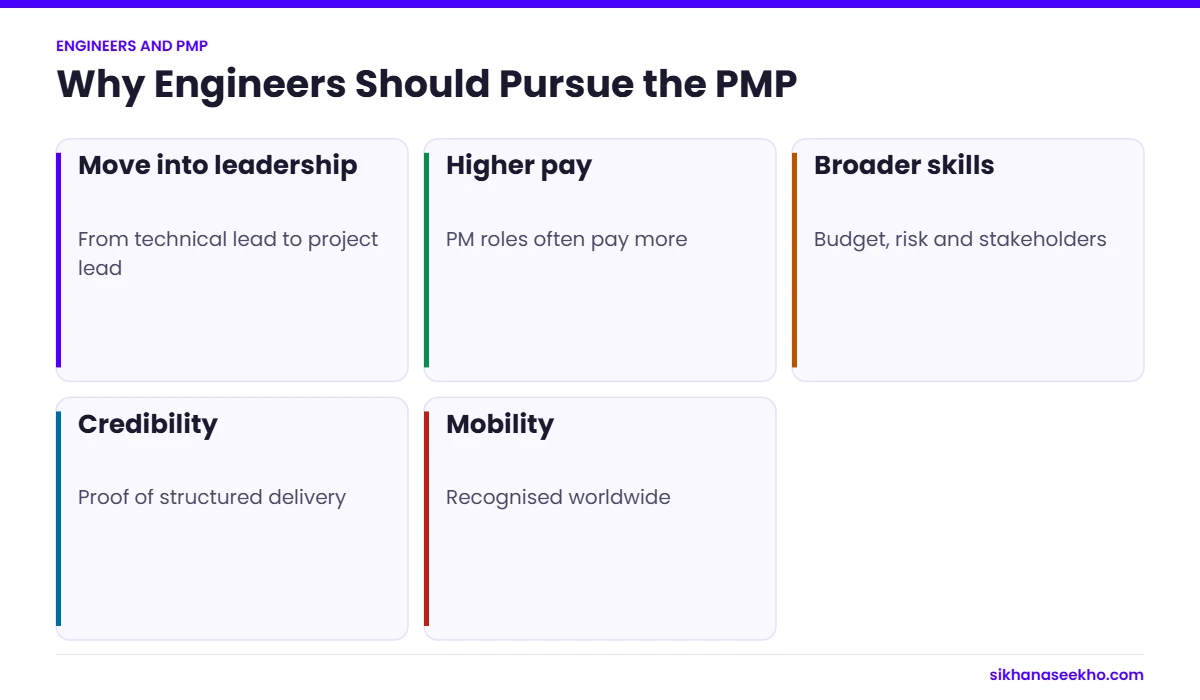
This article will explore five of the most important reasons you should pursue PMP if you want to be a project manager.
What is the Project Management Professional PMP?
The PMP(Project Management Professional), also known as Project Management Certification, is a highly respected and in-demand certification for engineers. There is a bright chance of a higher salary if you pursue your career as a PMP. Here are a few top reasons to pursue PMP if you are an engineer.
· Earning PMP certification will show potential employers that you are serious about your career and help them manage complex projects with your skills.
· You will be able to earn a higher salary. A survey conducted by salary.com shows that an engineer with PMP certification earns $10000 higher than one without certification.
· PMP will help you to advance in your career. Earning PMP certification will create more job opportunities for you with a high salary.
· Another best thing about PMP is it will provide a structured approach to project management. PMP methodology can help you to complete projects on time and within budget.
Why should engineers get Project Management Professional Certificates (PMP)?
There are many reasons why an engineer should have a Project Management Certification. It is a widely recognized certification and a valuable addition to your resume.
Project Management Professional PMP certification shows that an engineer has the knowledge and skills to manage projects effectively. It also demonstrates that an engineer is committed to professional development and is willing to invest the time and effort required to obtain the certification.
PMP certification can also lead to career advancement. Many employers prefer to hire candidates with Project Management Professional certification because it shows they have the necessary skills to manage projects successfully.
In addition, Project Management professionals can help engineers earn higher salaries. PMI’s Earning Power Salary Survey found that PMP-certified professionals earn a median of about 33% more than those without the certification.
Overall, there are many reasons why engineers should get a Project Management Professional PMP certification. Project Management Professional PMP is the world’s most widely recognized project management certification and can lead to career advancement and higher salaries.
How to get a PMP certificate?
- You must have a four-year degree.
- You must have at least three years of project management experience.
- You must take and pass an exam.
- You must have 35 contact hours of project management education.
The PMP certification is a globally recognized credential that can help you advance your career in project management. Pursuing PMP can be a great way to demonstrate your commitment to your career and project management profession. Here are three reasons why you should pursue the PMP if you are an engineer:
- A PMP certification can help you get a job in project management. Many employers prefer to hire candidates who have a PMP certification. A PMP certification can also help you get promoted or earn a higher salary.
- Pursuing the PMP will give you a deeper understanding of project management concepts and principles. The knowledge you gain can help you be more effective in your current role and prepare you for future roles.
- The PMP credential is globally recognized. If you want to work in project management, having the PMP credential can give you an advantage when applying for jobs outside your home country.
What are the pros of getting a PMP certificate?
There are many reasons why you should pursue a PMP certification if you are an engineer:
- PMP Certification is globally recognized and shows that an individual has the potential to tackle any project and manage it well.
- PMP-certified engineers are always in high demand because they have the skills to manage large-scale projects.
- They can plan, execute and monitor projects from start to end.
- PMP-certified engineers have a better understanding of risk management and project quality.
- A person with this certification can set up a project tracker to track the project.
- Pursuing this certification will give you an edge over other individuals without certification.
- Project Management Professional PMP-certified professionals earn, on average, about 33% more than those without the certification. That is because employers are willing to pay more for employees with the skills and knowledge to manage projects effectively.
- A Project Management Professional PMP certification can help you earn a higher salary and improve your career prospects.
Overall, there are many reasons why you should pursue a PMP certification if you are an engineer. The PMP certification is globally recognized and can help you advance your career and earn more money.
What are the cons of getting a PMP certificate?
A few potential downsides to getting a Project Management Professional PMP certificate as an engineer.
- First, it can be expensive and time-consuming to obtain the certification.
- The exam cost and associated study materials can be a barrier for some engineers.
- In addition, the exam is notoriously difficult, and it may take multiple attempts to pass.
- Finally, once you have the certification, you will need to keep up with continuing education requirements to maintain it.
Recommendations on how to pursue PMP as an Engineer and What Resources to Use
If you are an engineer pursuing a project management career, consider getting your PMP certification. A Project Management Professional PMP certification will show potential employers that you have the knowledge and skills necessary to be a successful project manager.
There are a few things that you need to keep in mind if you are an engineer and you want to pursue a PMP certification.
- First, you must ensure that you have at least four years of experience leading and managing projects.
- You also need to complete 35 hours of project management training. Luckily, many online resources can help you meet these requirements.
- Once you have met the requirements, you must pass the PMP exam.
- The exam is composed of 180 multiple-choice questions. You will have four hours to complete the exam.
- Pursuing a PMP certification is a great way to advance your engineering career. Keep the requirements in mind and use online resources to help you prepare for the exam.
PMP eligibility for engineers at a glance
| Requirement | With a 4-year degree | With a secondary diploma |
|---|---|---|
| Project leadership experience | 36 months in the last 8 years | 60 months in the last 8 years |
| Project management education | 35 contact hours | 35 contact hours |
| Exam fee (2026) | $405 PMI members / $655 non-members | $405 PMI members / $655 non-members |
| Renewal | 60 PDUs every 3 years | 60 PDUs every 3 years |
Source: PMI PMP Handbook. Check pmi.org for current fees.
PMP for engineers: common questions
Is PMP worth it for engineers?
For engineers who want to lead projects, yes. It shows employers you understand scope, cost, schedule and risk as well as the technical work.
Can an engineer get PMP without a project manager title?
Yes. PMI counts time spent leading and directing project tasks, not your job title. Many engineers qualify through work as a lead or package engineer.
How long does PMP preparation take?
Most working engineers need 2 to 4 months of steady study after completing the 35 contact hours.
Conclusion
If you are an engineer, you may wonder if pursuing a Project Management Professional PMP certification is worth your time and effort. Here are the top four reasons why you should consider pursuing a PMP:
- A PMP certification will give your career a boost.
- Pursuing a PMP will show potential employers that you are serious about your career and have the skills to lead complex projects.
- A PMP certification will help you stand out from other candidates when applying for jobs.
- Pursuing a PMP will allow you to network with other professionals in the field.
Pursuing a PMP certification is a great way to advance your engineering career. The benefits of becoming a PMP-certified engineer are numerous. If you are looking for a way to improve your career prospects, then earn your PMP today!
A few best project management software is available to help your career. A few free project management software programs are also available, and they work fine.
We have tried our best to tell you why you should pursue a project management professional if you are an Engineer. If there is still any unanswered query, then write us back.
Keep learning
- What are the Importance and Benefits of PMP for Freelancers?
- Does PMP Certification Help You Get a Job? (2026)
- PMP Login: How to Log In to PMI and Use Your PMP Dashboard
- PMP® Exam Prep 2026 by Mujeeb Rehman
- PMP Certification Guide 2026: Everything You Need to Pass
- Free PMP Study Guide 2026: Full PMBOK 8 Prep Plan