
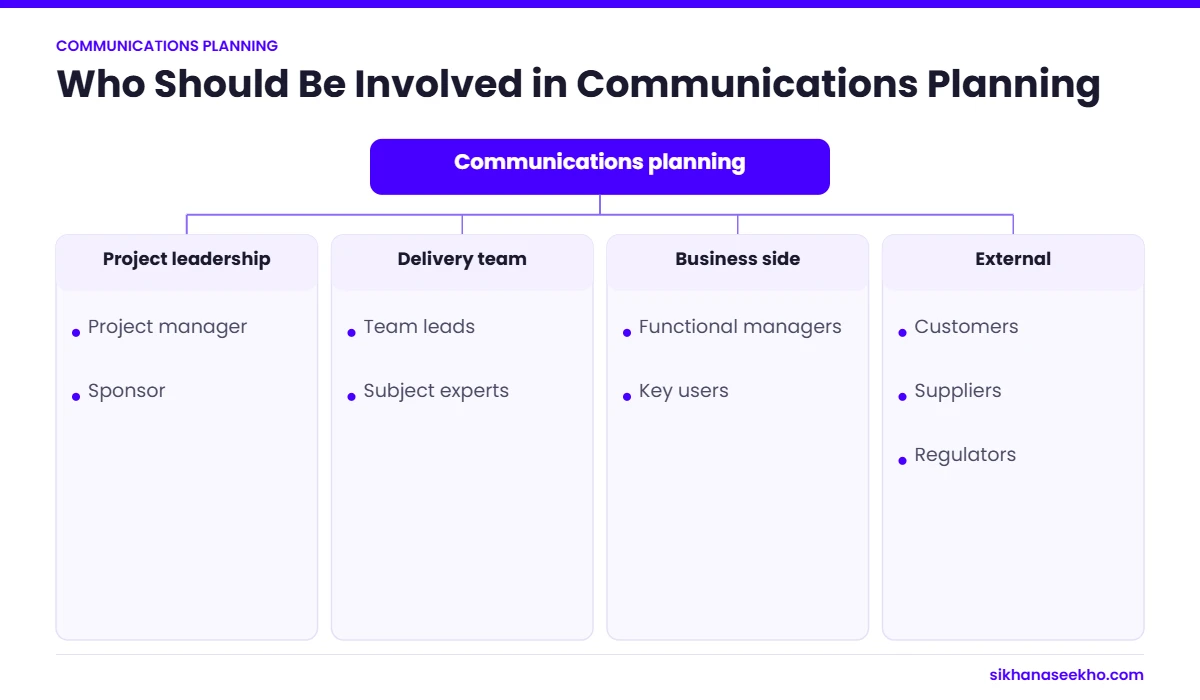
Communications planning is the process of deciding who needs which project information, when, in what format and through which channel. It should involve the project manager, sponsor and key departments such as marketing, public relations, HR, IT, sales, legal and senior management, so every audience gets consistent, timely messages.
Effective communication planning involves identifying stakeholders, creating messaging, and determining the appropriate channels for delivering those messages. To ensure that communication is effective, it is important to involve the right organizations in the planning process. All departments including marketing, public relations, human resources, IT, sales, legal, and senior management should involve themselves in communications planning. Each department brings unique expertise that can help ensure that messaging is consistent, relevant, compliant, and aligned with the organization’s goals and strategy.
Which departments should be involved in communications planning?
Effective communication planning is crucial for the success of any organization. It involves identifying stakeholders, creating messaging, and determining the appropriate channels for delivering those messages. To ensure effective communication, involving the right organizations in the planning process is important. This article will discuss the involvement of organizations in communications planning.
1. Marketing Department
The marketing department promotes the organization and its products or services. They have a wealth of experience creating effective messaging and using the right channels to deliver those messages. They can help identify the target audience and develop communication strategies that resonate with them. To ensure messaging consistency and maintain the organization’s brand, the marketing department should involve itself in communications planning.

2. Public Relations Department
The public relations department is responsible for maintaining the organization’s reputation and managing relationships with the media, customers, and other stakeholders. They are experts in crisis communication and can help develop messaging in an emergency or crisis. They can also help identify potential issues and develop proactive strategies to address them. The public relations department should involve itself in communications planning to align messaging with the organization’s goals and address potential issues proactively.

3. Human Resources Department
The human resources department is responsible for employee communications and engagement. They can help ensure that messaging is appropriate and effective for internal audiences, such as employees and volunteers. They can also help identify potential employee concerns and develop messaging to address them. The public relations department should involve itself in communications planning to align messaging with the organization’s goals and address potential issues proactively.
4. IT Department
Which Organizations Should Be Involved In Communications Planning? The IT department manages the organization’s technology infrastructure and can provide valuable insights into the best message delivery channels. Secure and reliable channels for messaging delivery, and optimized websites and social media platforms for communication can be ensured with their help. Involvement of the IT department in communications planning can optimize technology infrastructure for communication and ensure effective messaging delivery.
5. Sales Department
Which Organizations Should Be Involved In Communications Planning? The sales department is responsible for generating revenue for the organization and can provide valuable insights into the target audience and customer needs. They can identify potential opportunities for communication and develop messaging that resonates with customers. The sales department’s involvement in communications planning can generate relevant messaging for customers and revenue for the organization.
6. Legal Department
The legal department ensures that messaging complies with relevant laws and regulations. They can provide valuable insights into legal requirements and help ensure that messaging does not violate any laws or regulations. To comply with legal requirements and protect the organization from legal risks, the legal department should involve itself in communications planning.
7. Senior Management
Senior management is responsible for setting the organization’s goals and direction. They can provide valuable insights into the organization’s goals and objectives and align messaging. They can also help ensure that messaging is consistent with the organization’s overall strategy. Senior management’s involvement in communications planning can ensure messaging alignment with the organization’s goals and support overall strategy.
Who contributes what to the communications plan
| Department | Contribution | Typical message they own |
|---|---|---|
| Senior management | Sets priorities and approves key messages | Why the project matters to the organisation |
| Marketing | Audience insight and channel expertise | Customer-facing announcements |
| Public relations | Media and reputation management | Press releases and crisis statements |
| Human resources | Employee communication and change support | Changes to roles, training and policies |
| IT | Technical channels and system notices | Outages, releases and access changes |
| Sales | Customer relationships | Updates for key accounts |
| Legal | Compliance and approval of sensitive content | Regulatory and contractual messages |
What goes into a communications plan?
A communications plan is usually a simple table. For each audience it records: what information they need, why they need it, who sends it, the format, the channel, the frequency and how feedback is collected. A sponsor might receive a 1-page status report every 2 weeks by email; a project team might use a daily 15-minute stand-up and a shared board; customers might receive a newsletter once a month.
Include escalation routes and approval rules. Decide who can approve external messages, how quickly urgent issues must be reported, and what happens when a crisis needs a public statement.
Plan for 3 communication methods. Interactive communication, such as meetings and calls, is best for complex or sensitive topics. Push communication, such as emails and reports, sends information to specific people. Pull communication, such as an intranet page or shared dashboard, lets large audiences find information when they need it.
Why does the number of stakeholders matter?
Communication channels grow quickly. The formula is n(n ? 1) ÷ 2. A project with 8 stakeholders has 28 channels; with 15 it has 105; with 30 it has 435. That is why larger projects need a written plan and clear owners for each message, rather than relying on informal updates.
The formula also appears on the PMP exam. A typical question adds 3 people to a team of 10 and asks how many extra channels are created: 13 people give 78 channels, compared with 45 for 10, so 33 extra channels.
Common communications planning mistakes
The first is planning only for the sponsor and forgetting end users, who often decide whether the project succeeds. The second is sending the same detailed report to everyone. The third is never checking whether messages land. Review the plan at each phase gate, ask 2 or 3 stakeholders whether the updates help them, and adjust. In 2026, with hybrid teams spread across time zones, that review matters more than ever.
A simple communications plan template
You can build a workable plan in a spreadsheet with 7 columns: audience, information needed, purpose, owner, format, channel and frequency. Start with the 5 to 10 audiences that matter most, fill in each row with the people involved, and review it with the sponsor before the project starts.
Add a final column for feedback: how you will know whether the message worked. For a sponsor, it might be faster decisions; for end users, fewer support calls after go-live; for a team, fewer missed actions.
Keep it alive. Update the plan whenever stakeholders change, and archive old versions so you can see how communication evolved. A plan written once and never updated is one of the most common reasons projects suffer from the classic complaint: nobody told me.
How do you communicate bad news?
Share it early, with the people who need to act first, and bring options. A short structure works well: what happened, the impact on scope, time or cost, what you recommend and what decision you need. Agree with PR and legal in advance how serious issues will be communicated externally, so you are not drafting a statement under pressure. Honest, early communication protects trust far better than a perfect message sent too late.
After the issue is resolved, review how the message landed and update the communications plan with what you learned.
Wind-Up Which Organizations Should Be Involved In Communications Planning?
In conclusion, effective communication planning is crucial for the success of any organization. To ensure effective communication, involving the right organizations in the planning process is important. To ensure messaging consistency, relevancy, compliance, and alignment with the organization’s goals and strategy, all departments including marketing, public relations, human resources, IT, sales, legal, and senior management should involve themselves in communications planning.
Communications planning: common questions
Who owns the communications plan?
The project manager owns it, with input from the sponsor and the departments that send key messages.
When should the plan be created?
During planning, before work begins, and updated whenever stakeholders or priorities change.
What is the communication channels formula?
n(n ? 1) ÷ 2, where n is the number of people involved.
Keep learning
- Project Management Artifacts in PMBOK 7: Full Artifact List for 2026
- Engagement Model in Project Management
- PMBOK Guide 6th Edition Explained
- PMBOK Guide 7th Edition Explained
- The Triple Constraint in Project Management: Scope, Time, Cost and Beyond
- Beginner’s Guide to Earned Value Management (EVM)